
Quick to Listen, Slow to Speak

I’m not sure how many times I’d repeated in my head (or deserved to have someone say to me), “quick to listen, slow to speak.” This of course is part of James 1:19 and is a simple directive, b it sure is hard. We all want to be heard. We’re tempted to think ourselves much smarter than we truly are and we want to give our two cents. But we don’t stop there, adding additional cents and finding ourselves in debt in the conversation. Having given so much speech, we owe the other person some time of listening.

Tell me if these situations are familiar to you–either as the victim or perpetrator:

  • One person in a conversation does not seem to be really listening, probably because he uses the time when the other person is talking only to think about what he’ll say next.
  • A person uses the story of another merely as a platform to tell another story that she thinks is much greater than the first.
  • Someone cuts you off to either agree, disagree, or correct the opinion that he actually did not hear since he interrupted you in the first place.
  • You have a friend who loves to tell you all about what is going on in her life, but has no time to listen to you.
  • You put your foot in your mouth because you jumped to conclusions without waiting for all the facts or because you didn’t wait for someone to finish.

It is so easy for us to fall into these traps. Embarrassingly, it is easy to complain when someone else does it, but then go off and do those very same things. But we need to evaluate ourselves, be humble in our relationships and conversations, and follow this command. The text goes on to say we should be “slow to anger” and being a person with patience who is slow to speak is key. I find it hard to imagine a hothead–someone quick to anger–as also someone who is a great listener and very humble.

On the flip side, don’t you find yourself drawn to people who listen to you? Who are patient as you speak and ask you questions? This can be a great witness for Christians to their neighbors, especially in a frantic world that is hurried and where we’re having more online relationships or transactional relationships. If you are one who listens, you’ll be taking a step to show the love and care God has for us to someone who may really need it.

This is also a lesson we need to make sure to apply to those God has placed close to us, those about whom we care most. That group is often one that sadly gets our worst, along with our best, since we see them so much. We can be so sure we already know them well enough, so we jump to conclusions, cut them off, or tune out. But we need to slow down.

If you need to be quick, be quick to listen. Give yourself time to really hear people. Take time to think. Then be slow to respond.
Double Dipping a Bonhoeffer Quote for James 3

James 3 is the chapter known for its passage on taming the tongue. We often associate this phrase with restraining the tongue, keeping it from doing harm. I like to think of it in the positive, as well. We should harness our speech to do with it the great goods that God equips us for. Certainly we need to keep from hurtful language, but speech has so much power for good. We get a sense in the passage that complete control over the tongue is impossible, but that should not prevent us from faithfully working on this area of our life.

I already used this quote once before, but I like it so much and it applies so well to this idea of taming the tongue for good. So forgive my repetition.

But God has put his Word into the mouth of men in order that it may be communicated to other men. When one person is struck by the Word, he speaks it to others. God has willed that we should seek and find His living Word in the witness of a brother, in the mouth of a man. Therefore, the Christian needs another Christian who speaks God’s Word to him. He needs him again and again when he becomes uncertain and discouraged, for by himself he cannot help himself without belying the truth. He needs his brother man as a bearer and proclaimer of the divine word of salvation. He needs his brother solely because of Jesus Christ. The Christ in his own heart is weaker than the Christ in the word of his brother; his own heart is uncertain, his brother’s is sure.
Bonhoeffer, Life Together

James 3 is also the text for our focus passage this week, so I hope you take a look. I think we tend to underestimate the power and influence of our own speech and maybe this week you can go through some of the questions and reflect on the role that speech has in your own life–for good or for bad.

A Delight of Reading the Whole Bible in a Year

I have not had as much chance to post this past week as I have been way at a conference. Several of the speakers delivered fantastic sermons, which is always a benefit of these events. But I had a special delight this year as I heard from books like Daniel, Ezra, Ephesians, and Timothy. As the preachers delivered the messages I was so much more familiar with the scriptures that they were using.

But that isn’t to say that I now know enough. In reading though the Bible this past year I am instead primed to learn more and learn better. I loved knowing the context of the stories, remembering conversations had or posts written about those passages, and being challenged in new ways on what I thought I knew.

When they stepped back to give context, I was right there with them. The texts were still fresh in my mind, much closer to the surface, and much more accessible for the Spirit to use in my hearing and responding to the Word. It wasn’t like I was having to watch the same movie over again. It wasn’t at all tired or boring. The Bible is a living Word and I could see that as I had the chance to sit and receive it.

I pray you find that same delight as you grow more familiar with it and continue to read and re-read and read again God’s Word.

A Mix of Boldness and Gentleness

Remind them to be submissive to rulers and authorities, to be obedient, to be ready for every good work, to speak evil of no one, to avoid quarreling, to be gentle, and to show perfect courtesy toward all people. For we ourselves were once foolish, disobedient, led astray, slaves to various passions and pleasures, passing our days in malice and envy, hated by others and hating one another. But when the goodness and loving kindness of God our Savior appeared, he saved us, not because of works done by us in righteousness, butaccording to his own mercy, by the washing of regeneration and renewal of the Holy Spirit,whom he poured out on us richly through Jesus Christ our Savior, so that being justified by his grace we might become heirs according to the hope of eternal life.

Titus 3:1-7

Paul urges gentleness for the believers in these churches. He does not want the Christians to be quarrelsome but rather courteous to others. By the early churches example of such humble love and service, many were impressed with the new movement of Christians.

It didn’t mean they were pushovers. Just before this section Paul exhorts them to be bold in the truth, not letting anyone disregard them. They are to teach and rebuke with authority.

In today’s church, especially as it acts more publicly, do we find such a balance? Is it courteous and nice to the extent that we disregard ourselves and our own teachings, not wanting to offend anyone? Or are we so bold about the truth that we lose all humility and kindness?

Paul wants them to be both, and the humility I think is key. He reminds Titus, “For we ourselves were once foolish, disobedient, led astray, slaves to various passions and pleasures, passing our days in malice and envy, hated by others and hating one another.” How can we treat those who do not know Jesus Christ and his gospel when we are no better ourselves, save for the mercy of God? We should treat others well in hopes of impressing the love of Christ upon them, rather than condemn them as though we were in a position to be the judge ourselves. We all need the mercy of God, and that should be central to the message we carry to others, and to each other in the church.

A look back at Psalm 119

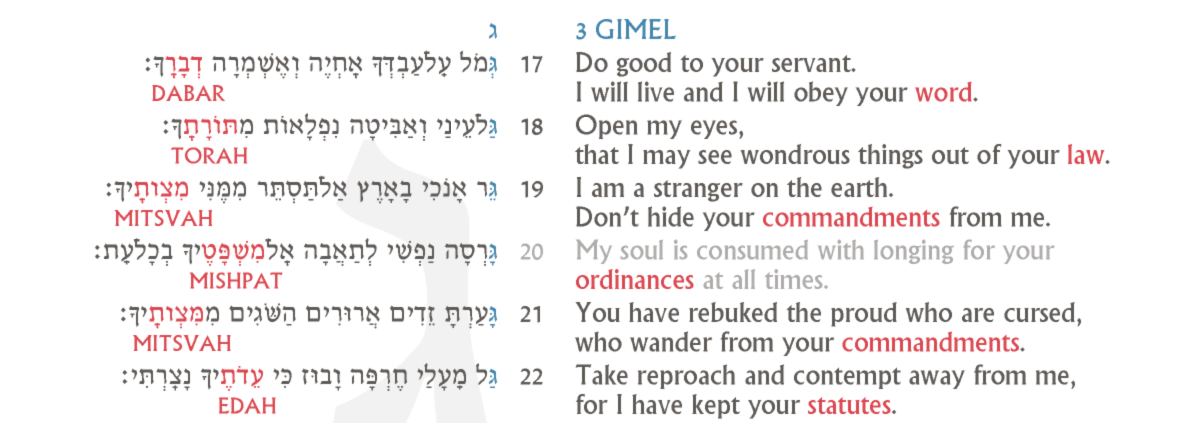
Psalm 119 Screenshot

Better late than never, right? This would’ve made for more sense a couple of weeks ago when we looked at the very long psalm, Psalm 119. If you were at our church, you would’ve heard a sermon that said a great deal about this unique psalm, but I did not include anything on it here on the site. And maybe you’re more of a visual person.

I found this some months back and it emphasizes the acrostic nature of the poem (how each line of the stanza begins with the same letter, with the proceeding stanzas moving along through the Hebrew alphabet). It also points out the place that God’s Word holds throughout the psalm. The way this site puts it is this:

Psalm 119 is telling us that to know the Creator God you must know His law, ordinances, word, commandments, statutes, precepts, decrees, testimonies, ways, and faithfulness.

I’d really encourage you to go take a look at this, and maybe skim down to the end first, as it has a word of explanation that helps make sense of the rest.

Basics of the Bible – Psalm 119 (It is pretty big, so it may take a moment to load).

A supposedly more friendly mobile version is here.

God’s Work, Not Our Work

Therefore do not be ashamed of the testimony about our Lord, nor of me his prisoner, but share in suffering for the gospel by the power of God, who saved us and called us to a holy calling, not because of our works but because of his own purpose and grace, which he gave us in Christ Jesus before the ages began.
2 Timothy 1 :8-9

As much as this is a letter to Timothy and about his ministry, it isn’t really about him. Paul wants to keep the focus on Jesus Christ and what he has done. It is not on the basis of our work that we are called, but because of God’s purpose and grace.

That doesn’t mean we aren’t called to do a work. We are. God has a plan for us and wants us to follow it. But just as it isn’t all about Timothy, it isn’t all about you or me. We are to make our work point to Jesus.

We do have a role to play, but Jesus deserves all the glory. We would have nothing if not for the grace given in him.

It reminds me a bit of this quote from Stacey King, a teammate of Michael Jordan.

I’ll always remember this as the night that Michael Jordan and I combined for 70 points.
(Said after Michael Jordan scored a career high 69 points and Stacey King scored 1 point against the Cavaliers. )*

*But when it comes to the work of our salvation, we don’t even contribute that one point.

Remember Jesus Christ: a lesson from The Silver Chair

Remember Jesus Christ, risen from the dead, the offspring of David, as preached in my gospel, for which I am suffering, bound with chains as a criminal. But the word of God is not bound! Therefore I endure everything for the sake of the elect, that they also may obtain the salvation that is in Christ Jesus with eternal glory.
2 Timothy 2:8-10

To remember Jesus Christ was important for Paul, since it was for Jesus’ that Paul suffered. And he charges Timothy to remember, and not only for himself and for his work, but for others. Timothy is to guard the truth, care for it, and pass it on, reminding the brothers and sisters of this gospel.

Likewise, our common calling is not just to speak about God, but to remind each other of this gospel: That God came to earth in Christ, he put to death death itself, has forgiven our sins and will give us life with him forevermore. Do you remember that? Something has happened on the cross and who we are is a consequence of Jesus Christ. We should never grow weary of thinking back to these things.

To understand better what Paul is saying here we need to stop and look at what it means to remember. I want to make sure the active tone of this word is coming across. It is not just reminiscing or simple, dull memorization so that if someone quizzes you about Jesus you can ring in with the answer.

It’s not quite, “Don’t forget.” It’s more.

My family does a far bit of road tripping up and down the East Coast. One thing we do to pass the time is listen to audiobooks. One year we went through a great recording of The Chronicles of Narnia. In my favorite, The Silver Chair, I think we learn well what it means to remember, and why we should. The Christ figure, Aslan, a lion, tells a girl Jill four signs to lead her on her journey. And before he sets Jill on her way, he gives her a speech in which he says:

“But first, remember, remember, remember the signs, say them to yourself when you wake in the morning and when you lie down at night, and when you wake in the middle of the night. And whatever strange things may happen to you, let nothing turn your mind from following the signs. … The signs which you have learned here will not look at all as you expect them to look, when you met them there. That is why it is so important to know them by heart, and pay no attention to appearances. Remember the signs and believe the signs.”
(Chronicles of Narnia, CS Lewis, 560)

Jill leaves Aslan and discovers her quest is to find a lost Prince. Tragically, all along the way the signs are forgotten or misunderstood. The result is her group had to begin their journey without official support, they end up on the menu of a group of giants, and almost fail entirely when they come face to face with the prince himself—since they hardly were able to recognize him.

The Silver Chair Cover

The problem was she had learned the signs, but was not remembering them.

She knew one sign was to find an ancient city, but failed to recognize it in the rubble she saw because she was distracted and her attention was on the bitter cold and dreams of a warm fire. She knew the Prince would be the one who spoke the name Aslan, but when that person who spoke was an imprisoned, enchanted mad-man, she was paralyzed with fear. Fortunately – against all her “better judgment”, she decided to let this dangerous man loose, freeing the prince, for she says, “What was the point of learning the signs if we weren’t going to follow them when they came up?!”

If only she could keep the signs straight. If only she could remember.

The Silver Chair Illustration

We try so hard to do the same in our lives and in the life of the Church, and how far off the path do we find ourselves. Once we are entrenched in the world the commands of Jesus, the truths of the Bible, even simple ones like “love you neighbor,” do not seem so clear to us. We get distracted, we are afraid or anxious about life, or maybe we focus on our own comfort.

We veer from our course, and all too often also try to justify it. If only we could see more clearly. To follow Christ can be simple enough, but it is difficult. It is easy to lose sight of him. That is why we need to have the discipline to remember Jesus Christ… each night, every morning, and even when we wake in the middle of the night. Only when we keep him fixed in our sight are we able to live the life and follow the path that God has laid out for us.

*This was originally a sermon I preached years ago, but have chosen a selection of it and edited it down as it fits with readings for Year in the Bible this week.

Paul’s Encouragement and Guidance to Timothy in a Nutshell

Paul describes the pitfalls that surround Timothy and that will also come in the last days, putting these alongside of commands to follow in his teachings and lead others in the same way. He gives Timothy what seems like a simple charge, but by no means an easy one. Timothy doesn’t need to reinvent the wheel, rather Paul wants Timothy to continue with what he has heard. To keep true to the message of the gospel and not be ashamed to proclaim it (1:8).

I am reminded of your sincere faith, a faith that dwelt first in your grandmother Lois and your mother Eunice and now, I am sure, dwells in you as well.
2 Timothy 1:5

Follow the pattern of the sound words that you have heard from me, in the faith and love that are in Christ Jesus.
2 Timothy 1:13

But as for you, continue in what you have learned and have firmly believed, knowing from whom you learned it and how from childhood you have been acquainted with the sacred writings, which are able to make you wise for salvation through faith in Christ Jesus.
2 Timothy 3:14-15

To face the demands of his ministry, Timothy must not veer from the message he has received from Paul and from family, and importantly from God’s Word. It is simple enough, but it is a difficult task for Timothy as he will come up against false teachings and false teachers. Paul anticipates the push back Timothy will receive, since he knows of it firsthand. People do not like to be corrected or challenged, so he encourages Timothy.

For this reason I remind you to fan into flame the gift of God, which is in you through the laying on of my hands, for God gave us a spirit not of fear but of power and love and self-control.
2 Timothy 1:6-7

And the Lord’s servant must not be quarrelsome but kind to everyone, able to teach, patiently enduring evil, correcting his opponents with gentleness. God may perhaps grant them repentance leading to a knowledge of the truth, and they may come to their senses and escape from the snare of the devil, after being captured by him to do his will.
2 Timothy 2:24-26

This isn’t then a work of Timothy’s based in his own opinions. Just as he was blessed with teachings from the sacred writings, he needs to continue in that way and base his teaching upon that same authority.

All Scripture is breathed out by God and profitable for teaching, for reproof, for correction, and for training in righteousness, that the man of God may be complete, equipped for every good work.
2 Timothy 3:16-17

To complicate matters Timothy is a young man and Paul, in 1 Timothy, touches on this as well, again anticipating some of the problems.

Let no one despise you for your youth, but set the believers an example in speech, in conduct, in love, in faith, in purity. Until I come, devote yourself to the public reading of Scripture, to exhortation, to teaching. Do not neglect the gift you have, which was given you by prophecy when the council of elders laid their hands on you. Practice these things, immerse yourself in them, so that all may see your progress. Keep a close watch on yourself and on the teaching. Persist in this, for by so doing you will save both yourself and your hearers.
1 Timothy 4:12-16

In and around the church there will be those who flee the truth and turn toward themselves. Just read the beginning of 2 Timothy 3 and you will find a dire description of the last days that is sadly not unlike any time in history. God’s way is ignored and the demanding call of Christ that leads to hardship and persecution (2 Tim 2:3, 3:12, 4:5) is rejected. To meet this culture head on does not require some silver bullet. Timothy doesn’t need something brand new to share Christ. Timothy doesn’t need to be someone different (him being young is fine). What does he need? What does Paul instruct Timothy to do in watching over the church? Remember Jesus Christ. Guard the faith by the help of the Holy Spirit. Flee evil, pursue righteousness. It is simple and Paul charges Timothy in this way:

I charge you in the presence of God and of Christ Jesus, who is to judge the living and the dead, and by his appearing and his kingdom: preach the word; be ready in season and out of season; reprove, rebuke, and exhort, with complete patience and teaching. For the time is coming when people will not endure sound teaching, but having itching ears they will accumulate for themselves teachers to suit their own passions, and will turn away from listening to the truth and wander off into myths. As for you, always be sober-minded, endure suffering, do the work of an evangelist, fulfill your ministry.
2 Timothy 4:1-5