The people’s failure to listen to Jeremiah

Zedekiah brought before the one who conquered Jerusalem, Nebuchadnezzar

You’d think after foreign powers have taken over Jerusalem, taking with them a great number of your own, you might then start to listen to Jeremiah. Jeremiah had been telling about the coming destruction and how it is the judgment of God. But no one listened. But Jeremiah was right.

I figured in reading through this that having shown his prophetic merit, the people would listen when in chapter 42 Jeremiah warns the remnant to remain in the land and not flee to Egypt. He says:

If you will remain in this land, then I will build you up and not pull you down; I will plant you, and not pluck you up; for I relent of the disaster that I did to you.

But after all they’ve experienced, do they listen? No. Time and time again the people do not listen to God through his prophet, and ignoring God’s word is never a wise decision.

More on Colossians 1

I put up the picture inspired by Colossians 1 on Monday, but I did so without explanation. So I thought today I’d talk more about what I see going on in the opening of the chapter. Paul writes beginning in verse three:

3 We always thank God, the Father of our Lord Jesus Christ, when we pray for you, 4 since we heard of your faith in Christ Jesus and of the love that you have for all the saints, 5 because of the hope laid up for you in heaven. Of this you have heard before in the word of the truth, the gospel, 6 which has come to you, as indeed in the whole world it is bearing fruit and increasing—as it also does among you, since the day you heard it and understood the grace of God in truth, 7 just as you learned it from Epaphras our beloved fellow servant. He is a faithful minister of Christ on your behalf 8 and has made known to us your love in the Spirit.

You may have noticed by now that Paul likes to use long sentences. This is one good reason to slow down and make sure you’re understanding what he writes. The picture from Monday centers in on ‘hope’ and I did this because although it comes later in the passage, we hear that it is a cause for the faith and love about which Paul has heard. Their hope–their goal, their promise–spurs them on to have greater faith in Christ and to spread his love to others. Christians who journey toward the goal, who are bound to the hope we have in Christ, should exhibit in that journey the characteristics that arise from that hope: love and faith.

Later in verse five Paul tells of where this hope is found, that is in the word of truth, the gospel. These words have power as they have not only taken hold in these Colossian believers, but in the whole world. Where the gospel is sown it bears fruit and this fruit is faith, hope, and love.

The Colossians know what their end will be, they have their hope, and they are exhibiting the marks of followers of Christ, faith and love. But Paul then goes on to pray for them so that they may know best how to live. They are already trusting Christ and loving the saints, but he wants them to excel in it. Paul wants them to know what faith and love will continue to look like, so he writes:

9 And so, from the day we heard, we have not ceased to pray for you, asking that you may be filled with the knowledge of his will in all spiritual wisdom and understanding, 10 so as to walk in a manner worthy of the Lord, fully pleasing to him, bearing fruit in every good work and increasing in the knowledge of God. 11 May you be strengthened with all power, according to his glorious might, for all endurance and patience with joy, 12 giving thanks to the Father, who has qualified you to share in the inheritance of the saints in light.

Christians surely know we should have faith, hope, and love. What can be difficult is having the wisdom to know not only the what but the how. This is Paul’s prayer. He wants them to know God’s will for them and to have the wisdom to discern how to follow his will. This is not an endeavor to begin alone so we need the strength of God’s power to endure this life, and to do so with patience and joy.

Even though Paul gives thanks to God when he thinks of his fellow Christians, for their love and faith, he reminds his reader that this is not something we’ve achieved on our own, rather it is the Father who has qualified us to receive all we have.

Keep reading Colossians and you’ll see a beautiful picture of Christ and what he has done for us, and how what he has done is sufficient for all we’ll ever need.


Increasing faith and increasing influence

In chapter 10 Paul writes “our hope is that as your faith increases, our area of influence among you may be greatly enlarged…” Here I believe he is talking about the spread and increase of the gospel in the area surrounding Corinth, hoping that the church there can help push the gospel further. But these words got my minding going off on a tangent, something that is not uncommon for me.

Perhaps it happened because of what I was reading previously in the chapter. Given that our struggles are not against the flesh, Paul writes that we should take captive every thought so that our mind will be obedient to Christ. We must not let our minds succumb to temptation, instead we need to place our minds, and by extension, our whole selves under Christ’s control.

So with this on the mind when I came to the passage about influence increasing with faith, I jumped to the fact that as our faith increases so does our understanding of the implications of the gospel in our life. The stronger the faith the more we give over to the Lordship of Jesus Christ. If in faith we take captive our thoughts to give over to obedience to Christ, surely his influence will spread throughout us.

What maybe began as a small understanding of Jesus grows and creeps into every single area of life as Christ grows in our eyes. We cannot keep relationships from his authority, we cannot go about with a belief that our job is a separate area apart from his watch, and we must understand that even our bodies are not our own. The influence of the gospel of Jesus Christ grows as our faith grows. Not that Christ is made to be Lord, but our eyes open wider to see the truth that is there, that he is already Lord, and we make our life correspond to the reality that is in him.

So while the passage may not directly be addressing Christ’s control in a person of faith, certainly if the church of Corinth is increasing in faith, so too will Paul’s ability to influence that geographic area grow, as well, for they will be giving themselves over in obedience to the rule of Jesus Christ.

Being a cheerful giver because of the gospel

Part of 2 Corinthians is a defense that Paul makes about his ministry and actions, including a discussion on the church giving financial aid to those in need.

Paul wants them to be cheerful givers and does not want to use his authority to coerce them. Instead he tells them about what Christ has done for us.

2 Corinthians 8:9 
For you know the grace of our Lord Jesus Christ, that though he was rich, yet for your sake he became poor, so that you by his poverty might become rich.

Rather than command the church in Corinth, he tells the gospel again in the language of money. If they understand the gospel and accept it, Paul believes they will act according to it. He writes in chapter nine about a “submission that comes from your confession of the gospel of Christ.”

Tim Keller in Counterfeit Gods describes 2 Corinthians 8:9 like this:

Jesus, the God-Man, had infinite wealth, but if he had held on to it, we would have died in our spiritual poverty. That was the choice–if he stayed rich, we would die poor. If he died poor, we could become rich. Our sins would be forgiven, and we would be admitted into the family of God. Paul was not giving this church a mere ethical precept, exhorting them to stop loving money so much and become more generous. Rather, he recapitulated the gospel. (Keller, Counterfeit Gods, 67)

A man fully consecrated to God

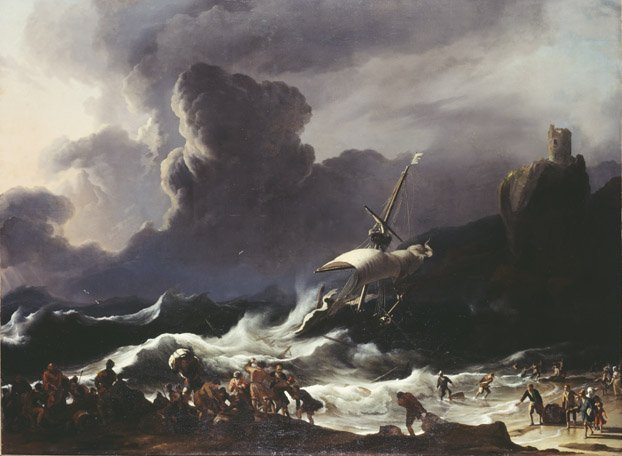
Ludolph Backhuysen – Paul’s Shipwreck

In 2 Corinthians we see a long list of Paul’s sufferings that have come his way during his time as a minister of the gospel. Starting in 2 Corinthians 11:24, Paul writes:

Five times I received at the hands of the Jews the forty lashes less one. Three times I was beaten with rods. Once I was stoned. Three times I was shipwrecked; a night and a day I was adrift at sea; on frequent journeys, in danger from rivers, danger from robbers, danger from my own people, danger from Gentiles, danger in the city, danger in the wilderness, danger at sea, danger from false brothers; in toil and hardship, through many a sleepless night, in hunger and thirst, often without food, in cold and exposure. And, apart from other things, there is the daily pressure on me of my anxiety for all the churches.

Paul was so committed to the call God had placed upon him that he continued the work even as he faced such pains. Knowing the cost did not deter him. Christ was more precious to him than anything else.

This passage about Paul reminds me of the quote that Henry Varley spoke to D.L. Moody, “the world has yet to see what God will do with a man fully consecrated to him.” That certainly was Paul’s desire–to live his life for someone else, no matter the cost. As he pursued this goal, being used by God, Paul helped to change the world. And that is just what will happen when one gives themselves fully to God.

Knowing Our Own Faith

I’m reading a book in preparation for a book club at my church and it is a more narrative take on comparative religion. One thing that has struck me so far are the comments from the three lay people who represent different religions in regards to what they know and do not know about their own faith.

One has been through a religious school, another went to worship services frequently, and they have members of their family who could pass doctrine, practice, and tradition along. Yet these adults have a pretty basic understanding.

I’m not that far along in the book, so there is plenty of time for growth in these characters, but I just wonder what accounts for the limited understanding of one’s own faith, even when there have been years of being among the faith communities?

What we are undertaking with Year in the Bible is by no means a certain way to achieve perfect knowledge of Christianity, but it will certainly continue to be used by God to show us more about him. If we devote ourselves to God’s word, we won’t remain in the dark, rather he’ll shine his light upon us. When we prayerfully approach Scripture, we’re opening ourselves up to the teaching of the Holy Spirit and (I pray) we are learning much. We ought to be able to articulate what we believe and what we believe is there in the text, so let’s continue on in our reading. God wants us to know him, to know Jesus Christ, to understand what we are called to be and do, and to receive maturity in our faith.

Hands of the Potter

Our first chapter of Jeremiah includes Jeremiah’s visit to the house of a potter where he learns a lesson about God.

Jeremiah 18:6b
Behold, like the clay in the potter’s hand, so are you in my hand, O house of Israel.

I am reminded of this great song by Caedmon’s Call called Hand’s of the Potter, to take a listen and enjoy: