Aids for Knowing the Story of the Gospel

As I mentioned last week in talking about 1 Peter, we ought to be able to give a reason for the hope that we have in Christ. If what we believe is important, we should be able to tell others about it. We should know the gospel.

We talked about this in a class recently and at one point I put together a review of most of the weeks. It served as a reminder to jog our memories, but it will also work as a good cheat sheet in learning some short, clear descriptions of what Jesus has done for us.

Here’s a quick summary of what is included on the attached PDF. We talked about how Christ is our sacrificial lamb (1) and our passover (2). He brings life to us, undoing the death brought about by Adam (3). While evil was done to him, like Joseph, he worked in the situation to bring life to us (4). Then lastly, in reference to Moses lifting up a bronze snake that brought healing for all who looked on it, Jesus gives eternal life for all who look upon him (5).

Each of these has a picture to help us remember. Some are more straightforward, like a sheep in the bushes reminding us of Abraham and Isaac. Others are more of the “you had to be there” variety. But again, let me summarize quickly.

We have a picture of the door with the blood placed on it as passover, then next to it the cross laid over it, showing the blood of Christ that now saves us.

The third picture is to represent how in Adam, his sin at the tree brought death to all. Then in Christ, the “Second Adam”, which you read through from left to right, but this time include the two items inserted with a carrot, went to the tree (the cross) and died for us, bring life to us.

The fourth picture represent how Joseph and Jesus both left their father’s house, suffered injustice, were thrown into a pit (the grave in Jesus case), but then through those events saved others (life preserver).

Lastly we have the snake that brought death, then the bronze snake that when looked upon brought life, just as our sin (missing the mark) brings death, but looking to Christ brings us eternal life.

Hope this helps. If you still are left scratching your head about these, let me know and maybe I can help.


Five stories of Jesus we should be able to tell. (Click for full-size PDF)


Looking back to Hosea and the motivation of prophets

This fits with last week’s readings, but I thought it’d be worth writing about.

Hosea is a startling story. It is unique in what the prophet is called to do, not just say. He is to marry a whore, and his relationship of faithfulness to an adulterous spouse parallels that of God’s love for his adulterous people. And that still applies to us now, to his church. It reminds me of a song by Derek Webb called “Wedding Dress.” He writes about the church’s tendency to look for something more than Christ, to find satisfaction outside of him. But this is a propesterous idea given that Christ has given us all we need. He even gave his very life.

Listen to the song below:

If you want to hear his explanation for the song, you can find it here. I’d mention this as some context–he doesn’t write and sing about the church and its sin as some third party observer. He acknowledges that he is a part of it and he is sinful, too. He doesn’t speak in condemnation of the church, but in rebuke that comes from love. We must still love the things that God loves, including the church, but that then leads us not to accept such faults, but to work for its restoration.

That is what the prophets do, as well. They love God’s people and because of such love they desire greatly for their repentence.*

*Jonah is a bit odd here since he is a prophet to a people he doesn’t love, but that’s a problem that we’ll talk about next week.

Famous Amos

Famous Amos

Amos is a prophet against the people of Israel and he begins his prophecy with oracles of judgment. He describes the horrible sins of Israel’s foreign neighbors and slowly brings the target closer to home. He begins far off, moves to nearby neighbors, then to Judah, and finally he pulls all the punches and ends with the eighth oracle: judgment on Israel itself.

Israel has oppressed the poor, given themselves to pagan practices, exploited others financially, and not respected those who have taken special vows for God. Their sins are made worse for unlike the other foreign nations, they should know better since they know God.

As I mentioned earlier there is a last word of hope. Israel has failed but it is not the end for them for in the last days God will restore all things. Amos concludes with this powerful promise:

“I will plant them on their land, and they shall never again be uprooted out of the land that I have given them,” says the LORD your God.
Amos 9:15

Tough to Be a Prophet

I’m sad Google ranked Joel Osteen higher than the prophet Joel.

Like other Minor Prophets, Joel is a book calling for repentance. Just because he is writing to God’s chosen people does not mean that they will necessariliy be spared from judgment. They have sinned against God and have been unfaithful to him. Joel preaches that their restoration will come once they turn from sin, and turn to God.

It’s not always a great job to be a prophet. Joel (and others) have to deliver messages against their people. They are messengers of bad news. They announce the sin of their peers. This is a quick way to make enemies, then and now.

But their message is not a despairing one. Look for the words of hope that are held out for God’s people. In the end, despite their lack of faith, God will renew them and will make his residence among us once more (Joel 3:17).

Year in the Bible, Q2 Week 10 – More Minor Prophets

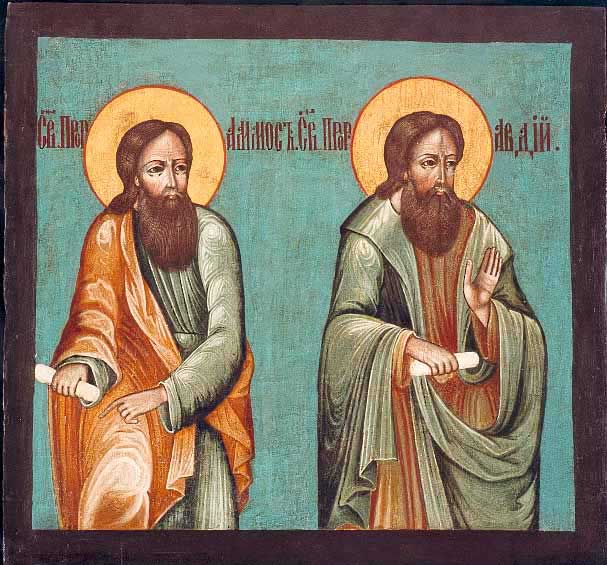
The Prophets Amos and Obadiah

We’re getting far along in this summer quarter of Year in the Bible. It may be a tough time for many of you to stick with it. We’re not so close to the beginning that its novelty spurs you on, nor are we close enough to the end of our year that the light at the end of the tunnel serves as motivation. On top of that we’re coming to the end of summer when many schedules shift and kick into high gear.

You’re not alone in such difficulties. Find someone else who is reading and be encouragers. We see encouragement as a great caling for Paul in his letters. He writes to teach, to challenge, to inform, and also to encourage. I think we underestimate the value of having others to help us along in the journey, or we underestimate how much our own words can lift someone else up.

But I hope you can keep with it as this is something I believe is of great value. Know that I’m praying for you all.

This week we go through several smaller books, so make sure to keep them straight. It’d be a great idea to pause once you finish each book and write a few sentences about what each book was about.

We continue in the minor prophets with Joel, Amos, and Obadiah. Don’t blink when you read that last once as it is only one chapter long. We then go to 2 Peter in the New Testament, and of course we have some Psalms to read as well. Enjoy!

God’s Unending Love

How can I give you up, O Ephraim?
How can I hand you over, O Israel?
How can I make you like Admah?
How can I treat you like Zeboiim?
My heart recoils within me;
my compassion grows warm and tender.

I will not execute my burning anger;
I will not again destroy Ephraim;
for I am God and not a man,
the Holy One in your midst,
and I will not come in wrath.

Hosea 11:8-9

God speaks of his judgment at the faithlessness of his people, but shows his great mercy and compassion in these words. God is unlike us. We hold grudges and find it near impossible to forgive. We seek revenge and pour out hostility on those who reject us. God is not like us for he will never give up on his people.

We should have great comfort and security in God’s stubborn love for us.

Always Have a Reason

“…but in your hearts honor Christ the Lord as holy, always being prepared to make a defense to anyone who asks you for a reason for the hope that is in you; yet do it with gentleness and respect…”
1 Peter 3:15

This is an utterly simple command of Peter, and one I think we take for granted. In many areas of life we assume we know what is needed. We assume we’ve got something under control or that we know “how to take it from here.” But when we finally are out in the position to reveal what we know, to put our learning into practice and take off the training wheels, only then do we realize our deficiencies.

I almost know the lyrics to countless songs. Pop songs and hymns, bubble gum oldies and classic rock, contemporary Christian and country. I know them when I sing along. I do not know the lyrics well enough to sing on my own, which is embarrassingly revealed as I stumble through half-remembered lines when I’m singing around the house. I overestimate my knowledge and it an example of the behavior that leads us to think we know, really know, more than we do.

Getting back to Peter’s call to us, we all can pick answers about our faith if it were a multiple choice quiz. But if we are asked about the hope that we have, can we give a response? Can we clearly communicate the gospel of Jesus Christ? Can we do so on the spot, without help (except by the Spirit)?

I hope reading though God’s Word helps you prepare yourself. Peter tells us in plain language to be prepared, so what is stopping us? This story of Jesus Christ is the good news for the world and our only hope. If we don’t share his story, who will? It is not only beneficial for the hearer, but when we know more about the hope we have, it will only strengthen our own belief, too.

If you’re interested in working on your ability to communicate the gospel, let me know. I’ll always make time for that. I even have some resources from a recent class that has some visuals to help us learn, remember, and communicate Jesus that I’m happy to pass along. I’ll try to remember once I get back in town to post some to our site.

Connecting Hosea to 1 Peter

Our focus passage for the week takes a look at the connection between Hosea and the book of 1 Peter, but if you are not following along with those, here’s a short summary. Peter quotes lines from the prophet when he is addressing the believers–both Jew and Gentile. He makes the bold assertion that they are now part of the people of God, brought in by his mercy to the family of faith, not based on blood, but on their being chosen in Christ. When he writes that those who were once not God’s people and who did not receive mercy are now God’s people and have received mercy, Peter is grafting believer’s into the history of Israel, assigning to them the words that had been first used to speak of God’s people in Hosea.

Especially for those Gentiles who had been kept at a distance before Christ came, this would have been an overwhelming affirmation of their place within the Kingdom of God. They are made to be God’s people and have been chosen to be a royal priesthood so that they may all declare the praises of God, who has saved us from the darkness (v9). To be brought in from the darkness into the light, to be made a people who were once not a people, to be called priests who were once pagans, is a great reversal and a humbling work of God for which he is to receive all praise.