
New Reading Plan begins Sunday – Join in and invite a friend

Our new reading plan begins Sunday, May 25th. In only 10 weeks you get an overview of the whole Bible.

While you don’t read from every book, this plan tries to give you a birds-eye view of what God has been up to with his people. You’ll see the promises God makes to Abraham, his faithfulness to Israel and their tumultuous relationship, and the way the promises are fulfilled in Jesus Christ. Since this plan seeks to be an overview, I’m hoping it will also work well as an introduction to the Bible for people who are wanting to know more about God in his word. Maybe this is perfect for someone who has never really read before.

The readings for each week aren’t too extensive, so take your time and reflect on the readings. We have a Bible study at our church on Wednesdays at 6pm, or you can find a reading partner or small group to discuss what you’re reading. Every Sunday there will be a short devotional to guide your study. Posts will also go up to help throughout the weeks.

I’d love to hear that you’re reading along and how it is going, so feel free to email me, leave a comment, or otherwise contact me as we go along. I’d love to hear questions about the passages, comments, or suggestions!

Reading Plan

Ways to Learn, Relearn, and Review 1 Corinthians

Review of 1 Corinthians Image

Since we finished reading 1 Corinthians just last week, what do we do now? The reading plan was pretty clear that we finished, but so you know, you are allowed to return to 1 Corinthians. You can reread it to your heart’s content.

If you want some methods of review, here are a few.

  • You could read it. Slowly. Again. Not a complicated method. Maybe you could try a different version this time around.
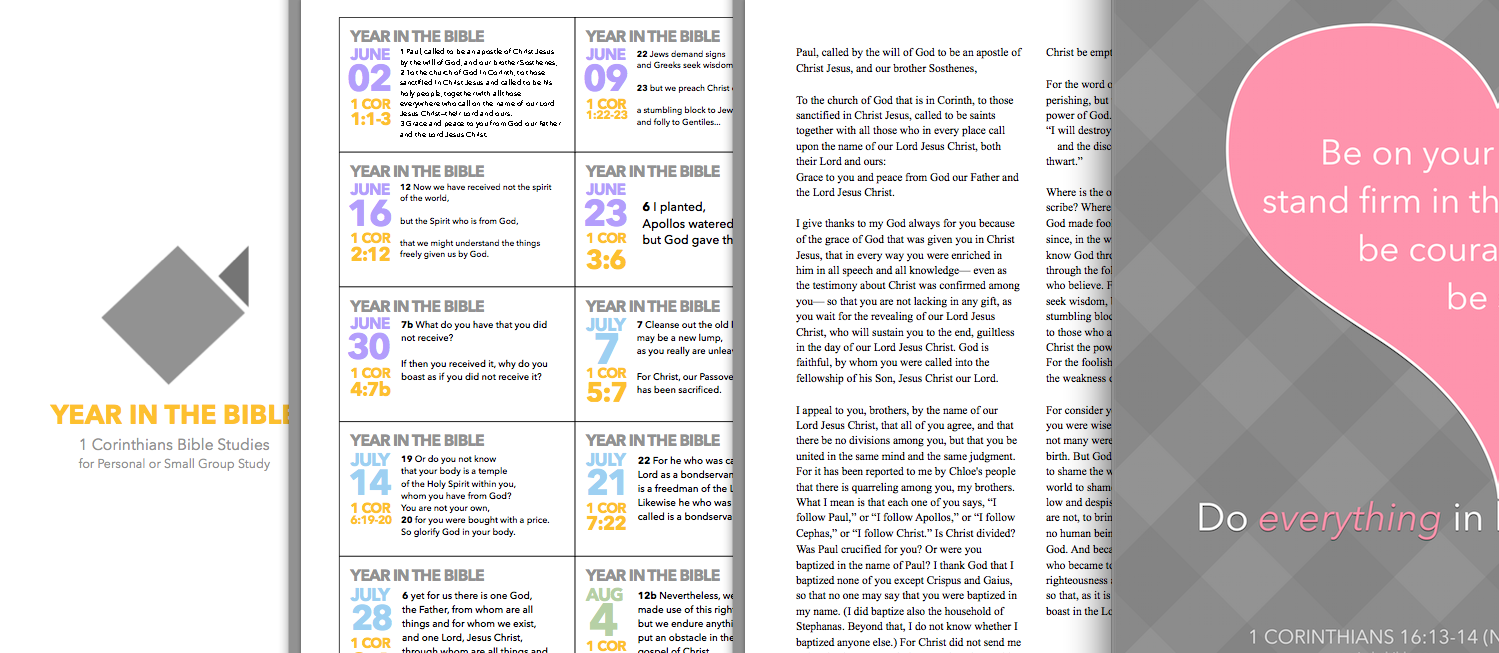
  • You could use the Bible studies to go in-depth. Besides that link to the website, you can also download them all as one PDF here.
  • Using the Bible visualizations you can review the memory verses. We did this in our final meetings of the Bible study and tried to remember what the context of those verses were. It’s great to know these verses, but it is even better to remember why Paul was talking about Christ as our Passover lamb or why he talks about eating to the glory of God. Again, if you want to download them, here is a big (20 mb) PDF you can use.
  • Something else we did to review at our study was like a puzzle. I stripped 1 Corinthians of all its verses and chapter headings and then mixed up all the chapters. The goal was to be able to put the letter back in order. You can use this to try it out for yourself. I’d recommend stapling the few chapters that are two pages together so that you have sixteen units to put in order.
  • If visuals aren’t your style for memorization or you want something more portable, print out these memory verse cards, cut them out, and flip through them.

Have another idea? I’d love to hear it.

Do Everything in Love

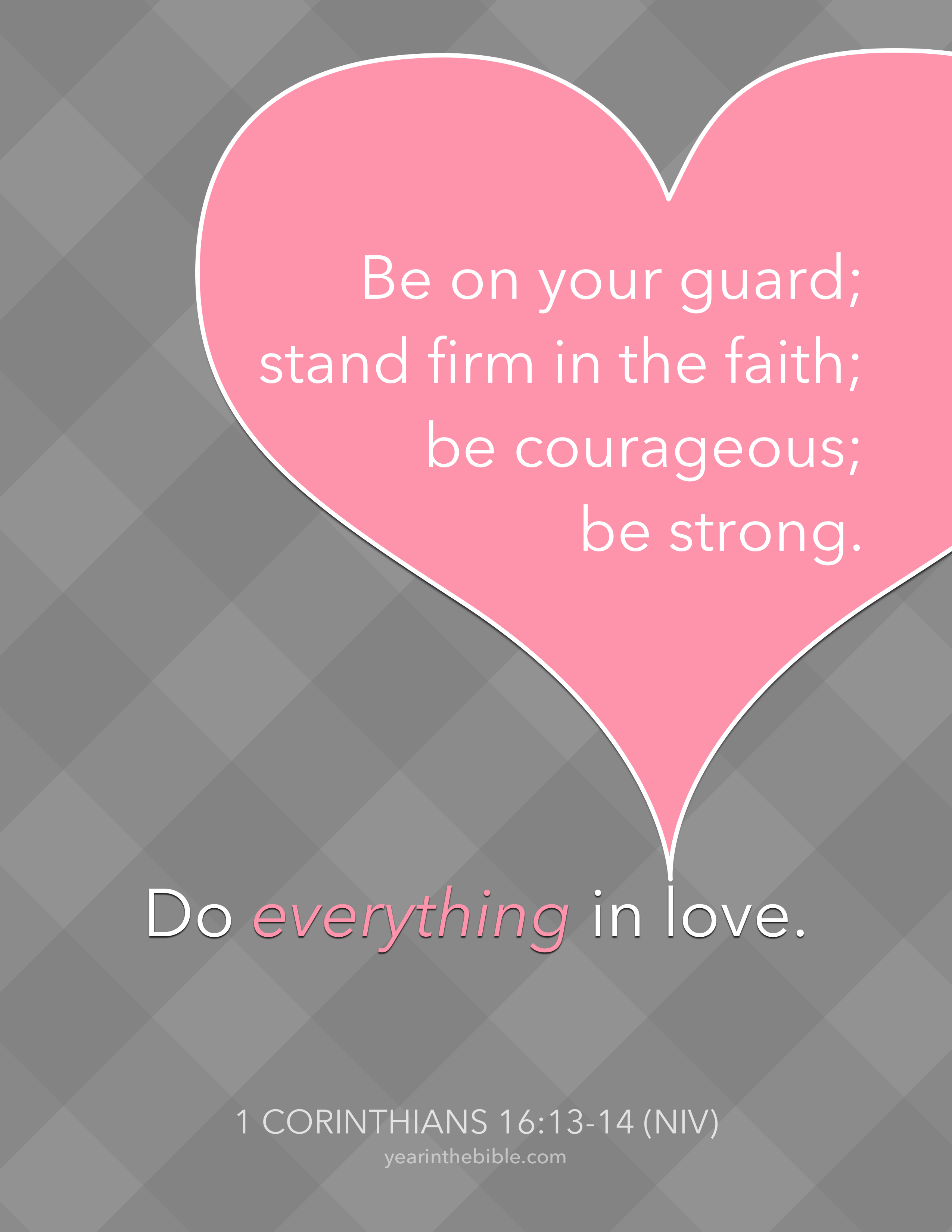
Throughout these months we have had memory verses each week. Whether you have tried to memorize these verses or not, I hope you’ve benefited from the visuals I’ve made. The goal is to better understand the meaning of the verse with these graphical representations, or to at least make them easier to remember. Now at the end of 1 Corinthians we have our final Bible visualization.

A theme of 1 Corinthians has been love. Love is what will right the wrongs of the church and love should be the theme of the Christian life. So it no wonder that in his closing words to Corinth that Paul would encourage them to live in love. He says, “Be on guard; stand firm in the faith; be courageous; be strong.” Then follows that by saying do everything–and I would take that as including the above list–in love. For the Christian, there is no way of being strong that is not a loving strength. There is no courage apart from love. All we do should be done in the love we receive from God and should have love as its goal.

To help you memorize that, here is the final visual. Enjoy.

Memory Verse for 1 Cor 16.13-14

To review the past Bible Visualizations from 1 Corinthians go here.

Don’t Overlook the Final Greetings of Paul

When you read through Paul’s letters, do you get to the end and skim through his final greetings? For example, do you treat 1 Corinthians 15 as the real last chapter of the letter, and think the rest is fluff, maybe even stopping before chapter 16? In a way, chapter 15 did have something like a climax to the letter. Paul triumphantly declares the victory we have in our Lord, Jesus Christ. But don’t let that slow you down and distract you from finishing the book. Remember, it’s all important for it says in 2 Timothy 3:

All Scripture is breathed out by God and profitable for teaching, for reproof, for correction, and for training in righteousness, that the man of God may be complete, equipped for every good work.

We read in Paul’s final words his concern for the other churches and ministers. He has a few more instructions for them. And if nothing else, we’re reminded that this is a letter. If a pastor were to write to a church and include no personal remarks, I’m not sure how that would go over. Paul doesn’t just care about the truth of Jesus Christ, he cares about the church. And to care about the church is to care about the individual members that constitute it. The issues presented in this letter are deeply personal to him because these people are a personal concern.

So as you read this or other letters of Paul, don’t forget they are letters. They were not printed out with verse numbers and chapters, all with their own subheadings. They were written by hand and sent from believer to believer as a personal letter to build up, teach, and encourage the church.

Our Future Hope Gives Us Reason to Work Today

Take note of the last lines of 1 Corinthians 15. In this chapter, Paul has gone on and on about the resurrection of Jesus and how our faith hangs upon that fact. Because Jesus lives we are assured a blessed future. Our weak and corruptible bodies will be transformed in a flash. Because Jesus lives, so will we. But that future tense doesn’t mean the Christian life is gazing off on the horizon. We do look ahead and can sing a triumphant song, as Paul does, because in Christ we have the victory. But in Christ we still live our lives in the present. Paul writes:

Therefore, my beloved brothers, be steadfast, immovable, always abounding in the work of the Lord, knowing that in the Lord your labor is not in vain.

He says “therefore” showing that this line is building upon the truth of the resurrection and our future hope. Because we will be made new in Christ, we now work for the Lord in all we do. The Christian hope does not remove our responsibilities for this life. Rather it should give us all the more reason to work for Christ’s kingdom today, knowing that such labor will never be in vain.

As you near the end of 1 Corinthians, go back and read it again

This reading plan through 1 Corinthians has been intentionally slow and many weeks have been quite short. The aim wasn’t to allow for the study and reflection to be quick and easy, rather to give time to review and reread, and gain great depth from this wonderful letter of Paul.

As we near the end of Paul’s letter I’d highly encourage you to start over. Go back to chapter one and begin again. Read it a couple times even. This coming Sunday starts the final week of readings and the more we can see the whole of 1 Corinthians and then combine that with the close focus we’ve put on each week’s assignment, the better understanding we’ll walk away with when we reach Paul’s final words. Going back through it you may find that the text is much easier to understand. You may see recurring themes that hadn’t stood out on your first read through. I’m not saying you’ll necessarily be an expert by now, but the more you study and pray through this book, the more God is going to use it.

Five months can seem like a flash, but what we read back in June may seem far off. Refamiliarize yourself with the whole and be reminded that while there are sixteen chapters, 1 Corinthians is still just one letter.

Questioning the Resurrection of the Dead

Continuing the topic of resurrection in chapter 15, Paul voices some of the questions or objections that he has heard to this fantastic notion of the dead being raised. Some have asked how this happens? If in fact it does happen, what sort of body will they have?

Paul uses several mini-parables to answer this, looking at seeds, animals, and celestial bodies. Even with his concise illustrations this can still be a difficult passage. Or maybe I should say, of course it is a difficult passage. Resurrection is not an easy thing to believe in. In a very literal sense, it’s not natural for us. Nature allows for birth and death, but no more. The resurrection is supernatural.

For such an amazing concept, maybe watching a short video will help. Here’s NT Wright on resurrection and its understanding in the first century. It’s not very long (6 min), but it is part of a much longer video, if you’re feeling adventurous.