To Eat or Not to Eat? The Question of 1 Corinthians 10

Dinner Plate

In reading 1 Corinthians 10:23-30, I found Ken Bailey’s commentary, Paul Through Mediterranean Eyes, very helpful. He again brings to focus the cultural writing style of Paul that differs from our own. We often put the point of greatest emphasis at the end, while Paul repeatedly in his letter puts it right in the center of his argument. Because of that, it can be a bit confusing. Here is Bailey on this passage, with the numbers in parentheses corresponding to the points Paul makes in the order they are found in Scripture:

This order confuses the modern reader. We are accustomed to:

On the one hand:

(1) Think of others and try to be helpful. (7) Don’t offend people. (2) Eat (or don’t eat) the meat you buy in the market for it is the Lord’s. (6) Do so to the glory of God. (3) At a meal in a pagan’s home eat whatever they serve you. (5) You are a free person, give thanks and eat.

But on the other hand:

(4) If someone whispers to you “This is idol meat, I am sure you would want to know,” then do not eat (out of respect for his or her conscience, no your conscience).[1]

Knowing the style in which Paul writes helps us to understand this section much better. It is easy to read it as though he is going back and forth, saying two things at once. But much of that is because we assume his argument builds linearly and concludes at the end. But his central emphasis, as it has been in past chapters, is seeking to love others and seek their good, rather than express our own rights or freedoms.


  1. Ken Bailey, Paul Through Mediterranean Eyes, 285. ↩

Paul Concludes his Section On Freedom and Responsibility

1 Cor 10.31

This week we get into Paul’s final section on the issue of freedom and responsibility for the Christian. Much of the discussion has used the issue of food and food offered to idols as the backdrop and we return there in the latter half of chapter ten.

As you read these verses, try to make sense of them in light of the preceding couple chapters. What is Paul trying to get across?

If you are looking for some takeaway, our memory verse for this week is not a bad place to start.

Memory Verse for 1 Corinthians 10:31 for iPhone

Cloud, Sea, Food, and Drink in 1 Corinthians 10

"Pillar of Cloud, Pillar of Fire" by Isaac Brynjegard-Bialik. Check out more of his papercut art by clicking the image above.
“Pillar of Cloud, Pillar of Fire” by Isaac Brynjegard-Bialik. Check out more of his papercut art by clicking the image above or go to his blog: http://isaacb2.blogspot.com

Paul begins 1 Corinthians 10 drawing out four parts of the Exodus story: the cloud, the sea, spiritual food, and spiritual drink. God’s presence was made known to his people by the cloud. The sea is what was the means of deliverance when the Egyptian army came charging after the Hebrews. The food was the manna and the drink was the miraculous water that sprang forth from the rock. These are signs of God’s provision in freeing his people from bondage and leading them to the promised land. But we are then reminded, that nevertheless God was not pleased with them.

These four parts parallel the presence we have in God’s Holy Spirit and the sacraments of the church in the New Testament, baptism and communion. In drawing these parallels Paul is framing the church as a new people of the Exodus. But his warning is also clear. Just because you are God’s people and recipients of his presence and partakers of the sacraments, don’t presume that all you do pleases God. Corinth was a church that we know of its faults from previous chapters. They are defrauding their fellow believers, using their freedom in Christ to return to sin (like returning to slavery in Egypt), and exercising their rights in a way that causes others to stumble. Paul wants them to know, and to learn this lesson from history, that like the people of the Exodus, the blessings of God did not give a blanket approval of all that was going on. If you come to church, take communion, and are baptized, that does not mean God is satisfied. God wants us to press on and, like we read in 1 Corinthians 9, we discipline ourselves pursuing a goal. Paul wants his church to learn from their forebears and not repeat the mistakes that lead to them missing out on further blessings.

God Will Not Let Us Be Tempted Beyond What We Can Handle

Memory Verse 1 Cor 10.13

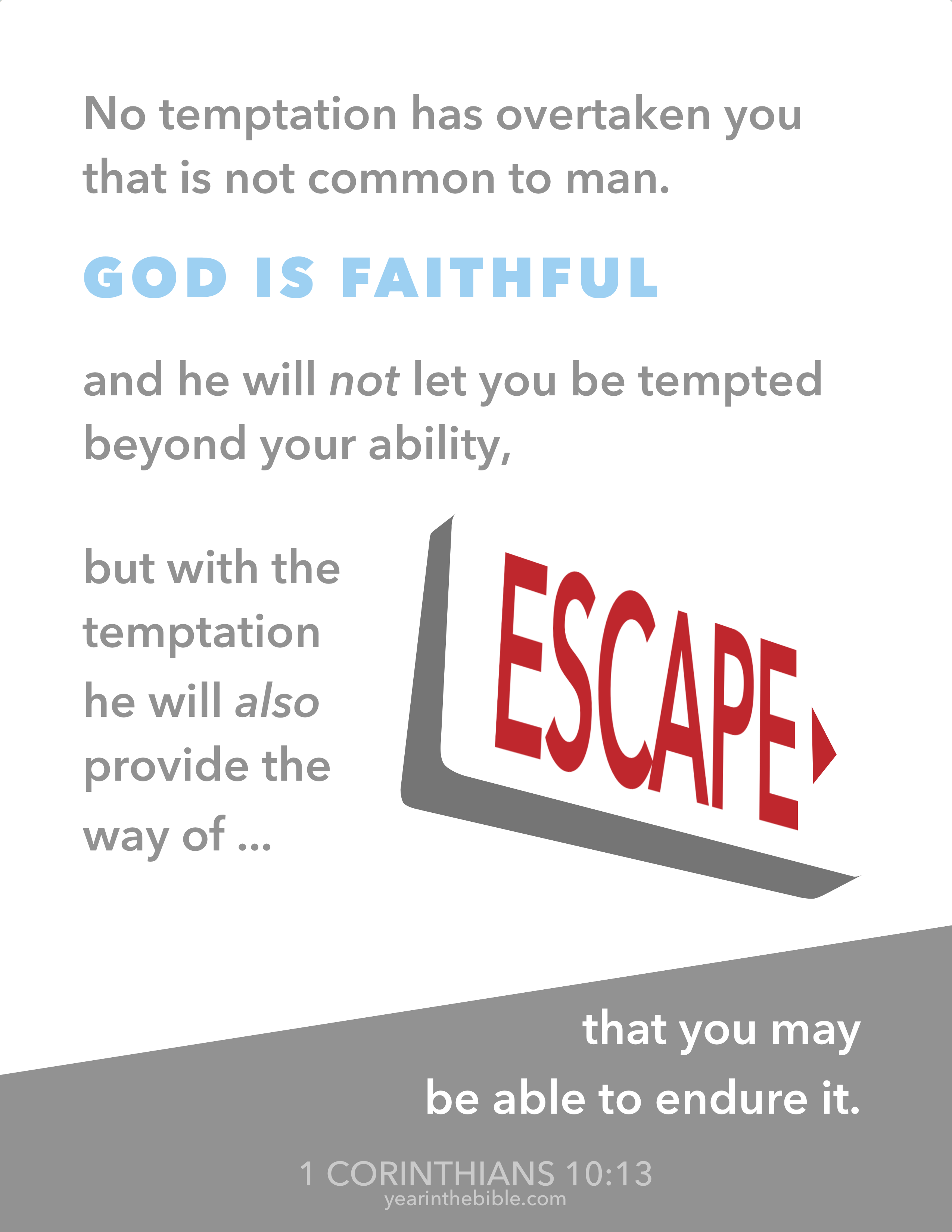
This week’s memory verse from 1 Corinthians 10 was a verse I remember memorizing when I was a kid. It is from 1 Corinthians 10:13 and it says:

No temptation has overtaken you that is not common to man. God is faithful, and he will not let you be tempted beyond your ability, but with the temptation he will also provide the way of escape, that you may be able to endure it.

This are hopeful words. We all face temptation and I think we are reminded here that even Jesus Christ, who became man, faced them, too. In the midst of temptation we should know that our God is faithful. He is with us and desires that we remain faithful to him, so he provides ways for us to resist temptation. It is not something we can do alone, but because he provides we do not have to be slaves to sin. We can endure because we can have patience to see it through that comes from our faith in Christ.

This is just a great verse to know by heart for God will encourage us with these words as we face the trials that surely will come in this life.

Memory Verse for 1 Corinthians 10:13 for iPhone

Is Ignorance Bliss? What would Paul say?

As a lover of history and learning in general, I’ve never really resonated with the phrase, “ignorance is bliss.” I love to learn and think ignorance is pretty far from a blissful condition. If we don’t know our history, as the saying goes, we are destined to repeat it. Certainly there is so much to learn from those who have gone before us. We can learn from their triumphs and learn from their mistakes, as well. This applies to us personally, seeing other individuals and learning from them. But it also applies to groups and churches and even nations. For example, what can we learn from Egypt and its upheaval? What could Egypt have learned from its own history and history at large that may have been able to guide them in these last couple years? Whatever that answer may be, ignorance would have been no help.

Thankfully, God have given us a fantastic book full of our own history. It is the history of God’s people and the story of God’s work among us. In this context, is ignorance bliss? Is it better to overlook the testimony of the Bible? Are we better off not knowing Adam or the judges? Should we care about Moses or the kings? The Old Testament is too often set aside, but we are worse off if we choose to be ignorant. And I think it is a choice. Perhaps if you do not know Christ and have never been to church, you haven’t necessarily chosen to be ignorant of the Scriptures. But if you are a Christian and do not know the Bible we’ve been gifted, you have made a choice to be ignorant. It is an avoidable circumstance. Every day is a new day to pick up God’s word and read. Every day we can pray for the Spirit to enlighten our minds to understand God’s truth.

Or every day we can choose ignorance. We can choose to miss out on the lessons we can learn from those who have gone before us. We can choose to turn our backs on what God says about himself in the Bible. We can be ignorant of the fact that the God of the entire cosmos came to us in Jesus Christ and revealed all we need to know. Jesus reveals God to us in the flesh and shows us the way, shows us what life really is, and shows us truth.

The letter we are reading currently, 1 Corinthians, is a letter to a specific church in Corinth as well as to the wider church community of that day. It was written almost two thousand years ago. Life was different then. I think we can underestimate that. But that doesn’t mean this letter, and other letters like it, have no bearing on us today. I would not want you to be ignorant of their struggles and of Paul’s message. The Bible is living and active and by the Spirit it speaks to us today. We ignore it at our own peril.

How much better to heed Paul’s warning in 1 Corinthians 10, and accept an invitation to know God in his word. It is our very own history that we read. We are the seed of Abraham, heirs of the promise, and as we read from Genesis through Revelation, it is our story. At times it is frustrating as we see how far humanity can fall, but it is encouraging that our God remains faithful throughout. And to know of God’s faithfulness through the ages is a much more blissful condition than to remain in the dark about it. So let’s seek to be in the light, God’s light, learning from him and learning from the wisdom he shares with us.


Paul wants us to remember our history, which is the history of Israel

Moses strikes water from the stone, by Francesco Bacchiacca

Our Bible reading this week is from 1 Corinthians 10:1-22. Paul begins it by encouraging the reader not to be unaware of what has gone on before us. That is a double negative that could be understood as, “I want you to know…” Paul wants his readers to know their history, so he calls to mind a few events. Maybe some did know about these events, but they weren’t on their minds. He wants them to remember and be thinking of these things as he moves along in this chapter.

But perhaps we are not as familiar with Paul’s references. If so, let’s begin this week by going back and reading through those chapters that will help us to know (to not be unaware).

To do this, read Exodus 13-17.

As you do, try to connect Paul’s references to the events found here. You could just read the few verses you may find in your cross references, but it’ll be much better to read within its context and be reminded of the larger story.

Running for the Goal Means Keeping Our Eyes on the Prize

It is so tempting to go through life comparing ourselves to everyone around us. Am I keeping up with the Jones?

Instead of fixing our eyes on our neighbors, we need to set our sights on the goal that is before us. We need to set our mind on things above, where Christ is, not the things of earth (Col 3); we should look to Jesus, the author and perfecter of our faith (Heb 12). As we run we need to keep our true goal in mind.

We could look around and think that we’re doing enough because we’re not as bad as someone else. But other people are not like some sort of pace car that we measure ourselves against. We look to Jesus alone and seek him as our goal.

The Importance of Having a Goal in Our Christian Walk

There is a good reason there are so many 5k races these days. What aspiring runners have realized is that without a goal, the training is much more difficult. If you just want to run because it’s good for you, that may never happen. But if you first sign up for a race and then start training, that goal drives you on to prepare with more intensity, commitment, and endurance.

Runners

In his comparison to running Paul writes, “I do not run aimlessly” and then in reference to boxing, “I do not box as one beating the air.” He has a goal. The call of God drives him onward and rather than pointlessly beating the air, he disciplines himself. He knows what he needs to do in order to best meet the task before him.

I fear that for many Christians, their faith is pointless. Not that it doesn’t mean anything, rather it is pointless in that it lacks direction. There is no goal that drives them. Some think believing in Jesus is the finish line. But believing in Jesus enters us into his kingdom and into a new way of being. It’s a new creation and a new beginning. As Paul has mentioned earlier in 1 Corinthians we are no longer like the natural person for we have been gifted with the Holy Spirit. We are given God’s wisdom and all of us should have a calling and purpose.

But if we think we have no driving purpose it takes away from what we’re called as Christians to do. For what good is discipleship with no purpose? Why read the Bible? Memorize scripture? Pray? The goal of these things isn’t to make ourselves good. The goal is to do the good to which God calls us. The goal is to discipline ourselves like an athlete so that as we run the race and seek the goal of sharing the gospel, we will be ready. Discipleship should be seen as training–not training for no reason, but training in preparation for whatever God intends for us.

We can view the spiritual disciplines of our faith as aimless jogging, just to make us fit. Or we can view discipleship as training for a race, and a race that we intend to run hard. If you see it as the latter and you know that God wants to use you, doesn’t that then encourage you to be in the best shape possible?

So what goals do you have? What purpose do you see in your life? What do you think God wants you to do for the kingdom? That’s the first step. See the race God wants you to enter and sign up. Then “discipline your body and keep it under control,” as Paul writes. Looking toward the goal, commit yourself to whatever God needs you to do in order reach that end.