Why Does Paul Instruct the Church in Corinth to Expel the Sinner in Chapter 5?

When Paul says to cast the man out of the church who is sleeping with his father’s wife, it is important to remember everything that he says, lest we miss his point. He begins in verse four with:

Let him who has done this be removed from among you.

But that is not all. A couple verses later he adds:

When you are assembled in the name of the Lord Jesus and my spirit is present, with the power of our Lord Jesus, you are to deliver this man to Satan for the destruction of the flesh, so that his spirit may be saved in the day of the Lord.

This is not punishment for no purpose. Paul instructs the church in a way to enact discipline on this man for two reasons. What we see in the verse quoted above is “so that his spirit may be saved.” It is the difference between a strictly punitive action and a restorative one. Paul wants the church to, by their expulsion of him, restore his soul. If he wants to be part of the body again, he’ll have to turn from this sin. He can’t just go to the more open-minded church around the block in Corinth. This is his fellowship to which he would seek to restored.

Dough

The other purpose in casting out this man, a man who has sinned in such a way that even the extremely permissive Roman society would condemn him, is to guard the body of believers. His sin is not harmless. It is like a leaven that makes it way into the whole dough. Paul wants to protect this people who he cares greatly about. He’s already compared himself to a mother and a father in his relationship to them. He knows that if this influence remains it will affect the whole church.

So rather than recommend what may have been a Jewish judgment of incest, stoning, or delivering this man before Roman courts for the Roman law he has broken, Paul instructs the body to do something that may save the man’s spirit on the day of the Lord and will protect the life and witness of the church in Corinth.

How is Christ Our Passover Lamb?

Lamb

When Paul refers to Christ as our Passover Lamb, there is a wealth of Scripture that a Jewish audience would have flooding to mind. But the church, as it is now, is a place of great variety, and those who were familiar would have been expected to bring others along in their understanding. Here are two great passages to help make you more familiar with the Passover and further your understanding of how how Christ is our lamb.

Exodus 12

Here is where we learn of God’s instituting of the Passover. God’s people are in slavery in Egypt and God is in the process of bringing plagues upon the land as his means of deliverance. God then gives instructions for how to survive his final judgment on Egypt. It is a way for the Hebrews to be saved as death passes them over and this plague will be the catalyst for their deliverance from bondage.

1 The Lord said to Moses and Aaron in the land of Egypt, 2 “This month shall be for you the beginning of months. It shall be the first month of the year for you. 3 Tell all the congregation of Israel that on the tenth day of this month every man shall take a lamb according to their fathers’ houses, a lamb for a household. 4 And if the household is too small for a lamb, then he and his nearest neighbor shall take according to the number of persons; according to what each can eat you shall make your count for the lamb. 5 Your lamb shall be without blemish, a male a year old. You may take it from the sheep or from the goats, 6 and you shall keep it until the fourteenth day of this month, when the whole assembly of the congregation of Israel shall kill their lambs at twilight.

7 “Then they shall take some of the blood and put it on the two doorposts and the lintel of the houses in which they eat it. 8 They shall eat the flesh that night, roasted on the fire; with unleavened bread and bitter herbs they shall eat it. 9 Do not eat any of it raw or boiled in water, but roasted, its head with its legs and its inner parts. 10 And you shall let none of it remain until the morning; anything that remains until the morning you shall burn. 11 In this manner you shall eat it: with your belt fastened, your sandals on your feet, and your staff in your hand. And you shall eat it in haste. It is the Lord’s Passover. 12 For I will pass through the land of Egypt that night, and I will strike all the firstborn in the land of Egypt, both man and beast; and on all the gods of Egypt I will execute judgments: I am the Lord. 13 The blood shall be a sign for you, on the houses where you are. And when I see the blood, I will pass over you, and no plague will befall you to destroy you, when I strike the land of Egypt.

John 1

Here in the New Testament in John, John the Baptist is identifying Jesus with the Passover Lamb, proclaiming that Jesus has come to take away our sins.

29 The next day he saw Jesus coming toward him, and said, “Behold, the Lamb of God, who takes away the sin of the world! 30 This is he of whom I said, ‘After me comes a man who ranks before me, because he was before me.’ 31 I myself did not know him, but for this purpose I came baptizing with water, that he might be revealed to Israel.” 32 And John bore witness: “I saw the Spirit descend from heaven like a dove, and it remained on him. 33 I myself did not know him, but he who sent me to baptize with water said to me, ‘He on whom you see the Spirit descend and remain, this is he who baptizes with the Holy Spirit.’ 34 And I have seen and have borne witness that this is the Son of God.”

35 The next day again John was standing with two of his disciples, 36 and he looked at Jesus as he walked by and said, “Behold, the Lamb of God!” 37 The two disciples heard him say this, and they followed Jesus.

Take note that here in the very beginning of John’s gospel, Jesus’ ministry is already directed to the cross, where he will make the ultimate sacrifice.

Christ, Our Passover Lamb, Makes Us New

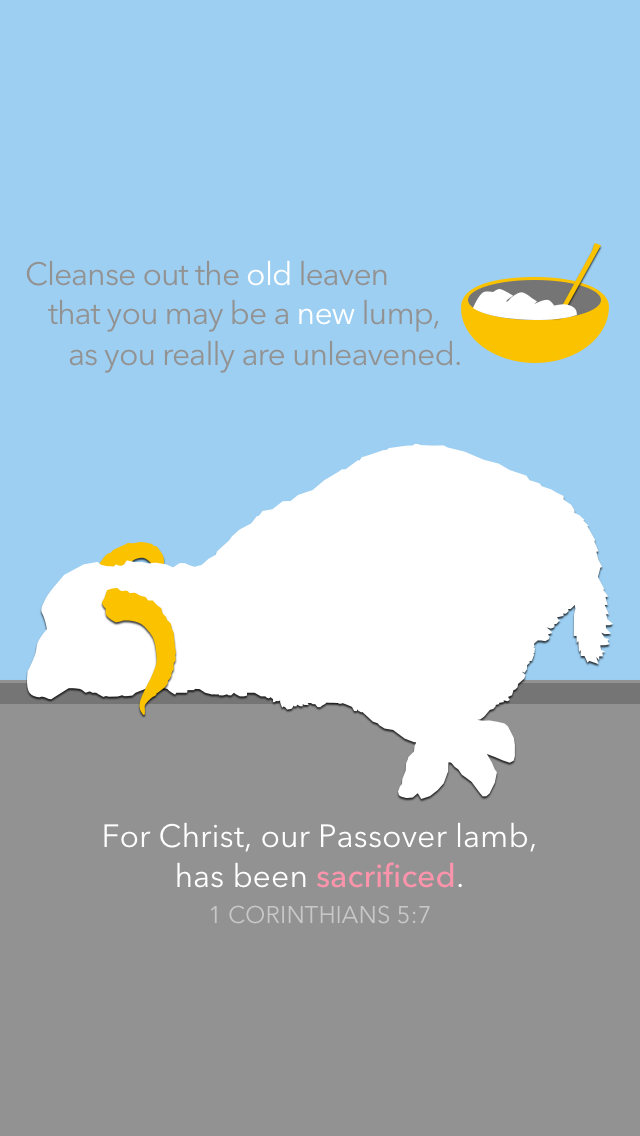
Memory Verse 1 Cor 5.7

If we want to have a new start, we can’t just do it on our own. We don’t flip a switch and wipe the slate clean. No, it is done for us. The leaven is cleaned out, the old is gone, and this has happened because of Christ Jesus. He has taken our sin away by sacrificing himself for us. We can be the new creation because Christ is our Passover Lamb.

Memory Verse for iPhone

Steward of the Mystery of God

Whenever I think of the word steward I think of the Lord of the Rings. In Lord of the Rings there is a character whose position is the Steward of Gondor. His job is to be the caretaker of his city, Gondor, in the absence of the true king. What I love about the concept of steward is that it is both, at the same time, a position of great authority and great humility. Paul speaks about his role as a steward of God’s mysteries and as such he has authority among the churches. But his authority is completely foreign to him–it is not his own. He is not there to teach of his own wisdom. He preaches the cross. Paul doesn’t go to the churches as he sees fit, rather he goes where God has called him. So as a steward he has power, yet it is humble through and through, for it is the power of God that he is entrusted with.

This is why Paul goes on in this chapter to say that he isn’t accountable to the church. A steward must be found faithful, but it is a faithfulness to the one who has given the power. Paul is a steward of the mysteries of God, and he is then accountable to God. God is the one who judges faithfulness. The churches do not judge him, Paul himself won’t even judge.

He wanted what wasn't his to have -- the big throne.
He wanted what wasn’t his to have — the big throne.

Going back to Lord of the Rings for a moment, the character ends up getting into trouble because he is not respecting the position he has and seeks to claim more power than is due to him. He wants to go beyond the authority he has as steward and rule on his own. He wants to occupy the throne of the king. In doing this he is not found faithful.

This is just what Paul is seeking to avoid. In verse six as he writes, “I have applied all these things to myself and Apollos for your benefit, brothers, that you may learn by us not to go beyond what is written, that none of you may be puffed up in favor of one against another.” A steward that goes beyond what is written is going beyond the role of steward. It is dangerous territory of pride and ego. That is the downfall of the steward in the Lord of the Rings.

Paul’s intent should be ours, as well. We’ve been blessed with God’s word and what he has given us in it is sufficient. We veer toward sin when we step beyond Scripture and begin to speculate, innovate, or even delete. This quote from John Calvin from his commentary on the book of Romans says it well,

Let this then be our sacred rule, to seek to know nothing concerning it, except what Scripture teaches us: when the Lord closes his holy mouth, let us also stop the way, that we may not go farther.

God has entrusted us with much. He has given us his word but has also given each of us the life we live. To be found faithful we must seek to be good stewards, humbling acknowledging that all we have is truly God’s. We must also as stewards humbly accept what God has shown us and how he directs us, and make it our aim to trust his will, not looking to go beyond his perfect wisdom. After all, as we’ve learned in 1 Corinthians, our wisdom cannot compare to his own. God’s wisdom in the cross of Christ may seem foolish, but it is the power of God; it is our righteousness, sanctification, and redemption.

All We Have is Given by God

Bible Visualization for 1 Corinthians 4:7b

Before we get into more of the reflection of this great chapter in 1 Corinthians, I wanted to give you all the memory verse visualization. It’s already Wednesday so you may be getting a late start trying to study this one small part of the chapter. For future reference, if you are reading this on the website rather than getting these posts via email, the site has a handy sidebar that says: read, study, memorize. Under the study part you can click and get the Bible study and under the memorize heading is this visualization.

This week is a simple statement that fits well with what Paul has been arguing throughout. He stands firmly against boasting in ourselves, and makes his point in yet another way here in 1 Corinthians 4:7b.

Memory Verse for 1 Corinthians 4:7b for iPhone

Merely Human Or?

Paul uses this great phrase in 1 Corinthians 3, saying at the end of verse 4, “are you not being merely human?” We’ve been shown a variety of comparisons in this letter as Paul is always urging us to be more as we follow the ways of God. Do we settle for milk or move on to solid food? Do we settle for being merely human, or do we look for even more? The choice should be obvious, but it is not always easy. But we do not act alone, for we have God with us, helping us to choose the greater–to choose himself.

Here is how he frames the choices in this life:

  • Merely human with the wisdom of the world?
    or recipients of the wisdom of God in the cross, by his Spirit?

  • Merely human trying to do things in our own strength?
    or empowered by the Spirit, serving God in the work to which he has called us?

  • Merely human built upon what will burn up and be lost?
    or God’s building, the temple of his Spirit, built to late upon Christ?

  • Merely human tied to the fleeting things of this life?
    or Christ’s cherished possession, recipient of all things, for all things are his?

If we are being built by God, what’s God’s building plan?

Paul writes how God is the one who truly gives the growth and we just take a part in being used by God, whether to “plant” or “water.” But what are we growing into? What is the building plan? It’s a humbling beginning to this chapter as we recognize our place before God. We can claim no credit for God’s work. We take a part, but God is the true actor. But as humbling as that is, we are then shown an extraordinarily privileged and high calling that God has for each of us. God is growing us and building upon us because, as it says in verse 16, we are God’s temple, the dwelling place of the Spirit of God. Paul writes, “For God’s temple is holy, and you are that temple.”

plant and water

This is an amazing truth for God’s people. The temple had been the dwelling place for God. It had been a place among the people, but distinct from them. Only a select few could enter and even fewer still could enter the Holy of Holies. In all of creation this was the place of his presence. Now Paul writes that we are his temple. We are that holy place of his presence. The Spirit of the Most Holy God resides in us, in we who are in the foundation of Christ.

This past Sunday I preached on this text as well as a text from Daniel 7. Along with the strange visions of that chapter, we get a parallel picture of God’s craftsmanship, compared to what will ultimately be burned up, fade away, and be destroyed. We learn in both texts that what God builds, and builds upon Jesus Christ, is the only thing that will last. I wrote for the sermon:

“In Daniel, these great beasts look so powerful, but they will come to an end.
Only the kingdom of God will last.
The Son of Man will have all dominion, glory, and a kingdom that will last forever.

Likewise, the powers in our time will fall. They will not last. A life built upon them will not last.
But a life built by God, upon Jesus Christ will last.
Therefore your life will last, your life will be eternal.

Only that which is of God is forever, and your life can be in God’s hands. Your life can be forever, if it is built upon the one foundation: Jesus Christ. We are God’s building, his temple, and his craftsmanship is flawless. We live forever when we live a life in Christ.”

Paul, Apollos, and a long line of servants of Christ have served his Church. There have surely been many who have blessed you by similar service. But we know that through it all, by the Spirit, God has been working upon you and in to give you the growth. We are being built into his temple, a place of God’s very presence, and if that were not already amazing enough, we have a sure hope that God’s building, his people, are built to last forever.

What then is Apollos? What is Paul? – The role we play in ministering to others on God’s behalf

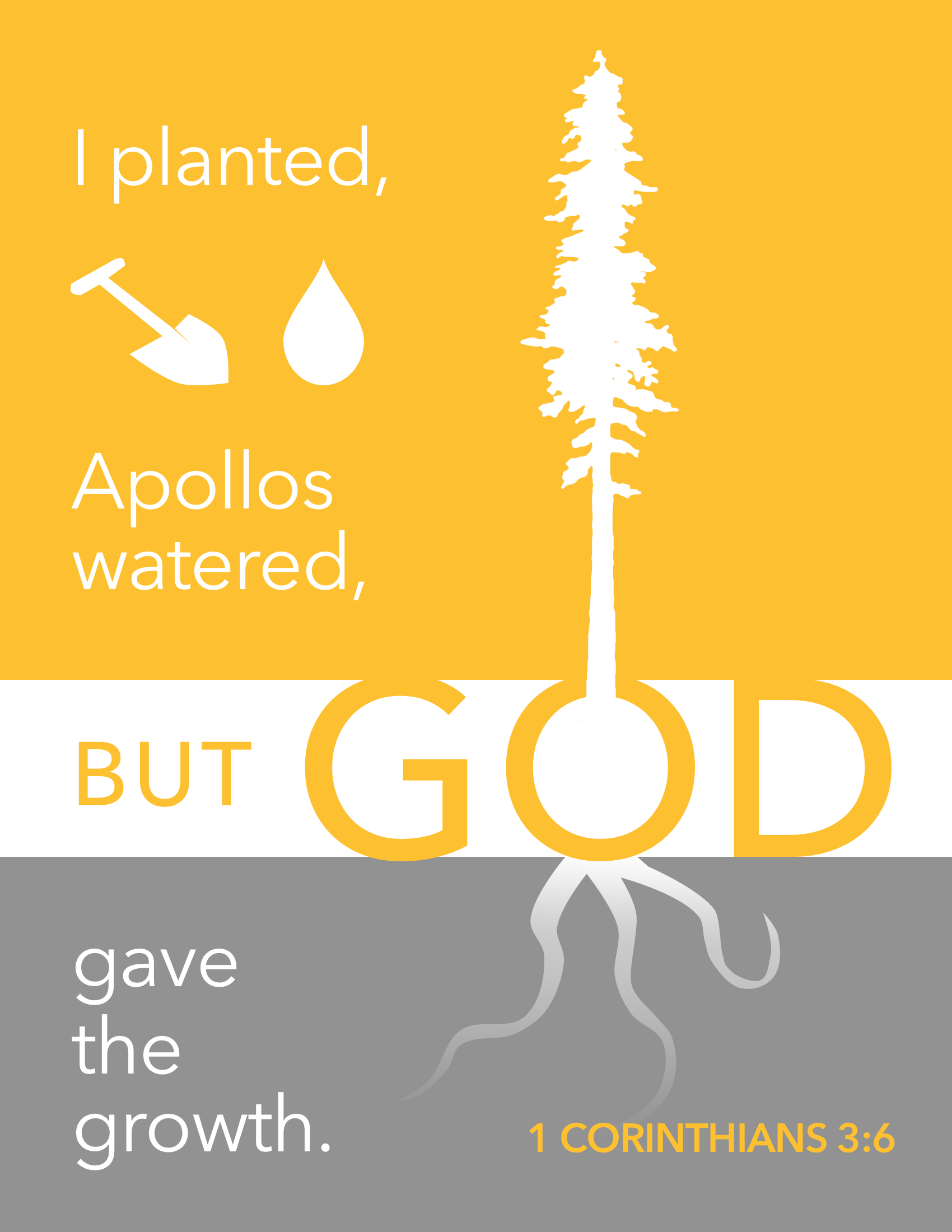
Memory Verse 1 Cor 3.6

Yesterday we focused on what was hindering the Corinthians’ understanding (their jealousy and strife) and what it led to was not only the divisions in their church, but a misunderstanding of who people like Paul and Apollos were. Paul describes their problem and then turns attention to himself, and Apollos, briefly.

What then is Apollos? What is Paul? Servants through whom you believed, as the Lord assigned to each. I planted, Apollos watered, but God gave the growth. So neither he who plants nor he who waters is anything, but only God who gives the growth. He who plants and he who waters are one, and each will receive his wages according to his labor. For we are God’s fellow workers. You are God’s field, God’s building.

1 Corinthians 3:5-9

What do we learn about these two in this passage? Who are they? What is their job? How should the church view them?

First, we see that they are servants. Being a servant, obviously, means that they are not masters. The Corinthians had elevated them and thought Paul and Apollos were to be played off each other as though they were rivals, but they are both servants who in fact are co-laborers, working together.

Are you a gardener? I’m sure you then know that there aren’t good ways to compete over one plant. If one plants and one waters, you can’t do so with different aims. You have the same goal. Paul is not at odds with Apollos. They both want to see growth. They are both called by God to their task. They both serve for God’s glory.

We also learn that as much as Paul or anyone labors, they do not claim credit for the work that God accomplishes. He may have planted, but just as importantly, Apollos watered, but neither compare to the growth that God achieves.

If not for God, what would happen to the seed? If not for God, would the water do any good? It is as it says in Psalm 127:

Unless the Lord builds the house,
those who build it labor in vain.

Paul is not anything but a servant of God. He is a tool God has used. All glory should pass right through him and be directed at the only one worthy. He has had the privilege of being called to this people to minister to them, as has Apollos. But Paul is telling them that God was at work then, God is at work now, and God is the one who will continuously give the growth.

Memory Verse for 1 Corinthians 3:6 for iPhone