
Finding a Rhythm in Your Bible Readings

Paul Penning His Letter

Our reading plan takes us into the second half of chapter 1, but it is important to realize that this is a continuation. That seems completely obvious, but we can easily forget the obvious and act as though this letter is a collection of separate sections. Paul in verse 17 has just begun his argument, drawing attention to the manner in which he preached. He didn’t try to gain attention for himself or to make disciples of Paul. He came preaching Christ. This week he continues what he started, a lesson on the cross of Jesus Christ.

We often study the Bible (or hear sermons) in which we hop around the Bible, never reading more than a handful of verses at a time. In reading straight through 1 Corinthians we will have a chance to really understand what the entire letter has to say. We’ll gain an understanding that is only possible with continuous reading of the whole. The connections of one half of chapter one to the other will be more clear and we won’t just understand a section, but we’ll understand how sections are related to each other. We’ll have perspective on the whole of 1 Corinthians.

This is our goal and to best accomplish that, I’d encourage you to read this week’s reading, 1 Corinthians 1:18-31, and then read the whole chapter again. It won’t take too long to do this a couple of times, especially if you are intentional about having some time in your day, every day, to read God’s Word.

You can find your own rhythm as we go along, but it could look something like this:

  • Sunday: read the new text for the week
  • Monday:read from the beginning through to the end of the assigned reading
  • Tuesday: read the new text, again
  • Wednesday: study the text, using the available Bible study
  • Thursday: read the next text, again and work on memorizing the Scripture
  • Friday: read from beginning through to the end of the assigned reading, plus memorization
  • Saturday: read the new text, again, plus memorization[1]

This is just one idea. It may not work as well once we’re further along into the book, since you may not have the time to go back and start at chapter one and read through chapter eight a couple of times in a week. But when we get there, find a new rhythm. Break 1 Corinthians down into chunks and reread those.

The more we read and pray through this book, the more we’ll know it. And please take note: the goal isn’t to merely know these words. We want to understand what God is telling us. Our goal is that in committing to study this book, this book will in turn shape us. We know the phrase, “you are what you eat.” In a way that applies to what we read. The more we read God’s Word, the more we put ourselves before him to become what he wants us to be.

Maybe your rhythm will be to read the section slowly, bit by bit, each day. Maybe you’ll read it Sunday then have a card in your pocket with a memory verse that you learn, internalize, then recite over and over again throughout the week. These are all great ways to do it. However you do it, I know that if you are in God’s Word, in some way, always returning to it throughout the week, God will do great things.


  1. For some personalities, listing out what you do every day looks awful. This then is not your rhythm. It’s just a suggestion, so find your own! For others, having a list is freeing. If that’s you, I hope this helps. ↩

Who is Sosthenes from 1 Corinthians 1?

Paul writes his letter and begins it by noting that it is sent from he and his brother Sosthenes. But who is this Sosthenes?

While we cannot be sure who this refers to, there is a Sosthenes mentioned in chapter 18 of the book of Acts.

12 But when Gallio was proconsul of Achaia, the Jews made a united attack on Paul and brought him before the tribunal, 13 saying, "This man is persuading people to worship God contrary to the law." 14 But when Paul was about to open his mouth, Gallio said to the Jews, "If it were a matter of wrongdoing or vicious crime, O Jews, I would have reason to accept your complaint. 15 But since it is a matter of questions about words and names and your own law, see to it yourselves. I refuse to be a judge of these things." 16 And he drove them from the tribunal. 17 And they all seized Sosthenes, the ruler of the synagogue, and beat him in front of the tribunal. But Gallio paid no attention to any of this.

This Sosthenes was a Jewish leader who, when his plans to attack Paul ended in an embarrassing rejection by the Roman ruler Gallio, was beaten and rejected by his own people. It is not far fetched to think that this man that was beaten and isolated may have been one that Paul himself would have approached, showing compassion. In so doing maybe this onetime enemy of Paul became a friend of the church and a brother. Paul probably would have had a special sympathy for Jewish leaders persecuting the church, for that was Paul’s own history back when he was Saul.

No Leader is Good Enough to Replace Christ

An issue that arises in this first chapter is the way in which factions have developed within the church, each seeking to ally themselves with a different teacher. Some follow Paul, others, Apollos, Cephas, or Christ.

This may have reflected ethnic divisions in Corinth, with the Roman contingent in the city preferring the Roman citizen, Paul. The Greeks identified with the Greek, Apollos. Jews with Peter, here identified with his Jewish name, Cephas. Ken Bailey writes:

Breaking into ethnic enclaves is unacceptable. Furthermore, loyalties to individuals is not an excuse for breaking the unity of the church. Their leaders are not adequate centers for primary loyalty. (Emphasis mine.)

We still fall into this trap of lifting individuals up into a role that is only properly filled by Jesus Christ. That is a clear emphasis of Paul in chapter 1: Jesus Christ is who matters more. Did Paul die for you? Were you baptized into Paul? No. Jesus Christ, and he alone, has died for you and could do so. Being indentified with Christ is what is greatest importance and he is whose name we call upon and whose name is placed upon us. After all, we’re called Christians.

Again, Bailey sums up the issue well and very succintly, “The question is not ‘Who is my leader?’ but rather, ‘Who died for us?’” These divisions are problematic, but the solution lies in turning to the cross, which dominates the next section of 1 Corinthians.[1]


Today I saw this article on the front page of Christianity Today that I thought (was going to) fit perfectly on this topic. It’s titled ‘Our Unhealthy Obsession with Pastors,’ by Luma Simms. The article does do a good job of hitting on this point that we can focus too much on a local church leader, and Simms writes, “Many of us have come to believe, consciously or unconsciously, that the man standing up front every Sunday is the only one doing real ministry.”

Of course that is not true. Pastors are just one group among the whole royal priesthood of God’s people. While we need to be cautious that we are not idolizing the man or woman that stands behind the pulpit, we need to at the same time lift up the varied work of the whole church.

I said that I thought this article was going to be a perfect fit, but it went from being a critique on the celebrity culture that seems to trace itself from 1 Corinthians 1 to today and became more an article about making sure that people don’t idolize the pulpit so that women don’t covet that sort of leadership. It is as though the greatest concern here isn’t a pastor taking attention from Christ, but that a certain group of people thought to be disallowed from the pastorate are sinfully drawn to it.

There is a better reason to not idolize the pulpit, and it is so that Jesus Christ remains as our focus. And we have no reason to fear a woman leading, as this letter of 1 Corinthians itself will give us examples of both men and women who exhibit leadership as they prophesy in the church.


  1. Kenneth E. Bailey, Paul Through Mediterranean Eyes, 71. ↩

God’s Calling in 1 Corinthians 1

Calling on Jesus

Exciting discussion occurred around my breakfast table this morning–which is a relative term since I’m not that excitable early in the day. But my wife and I were talking about the different ways to translate the opening lines, and in particular, the way in which the word “call” or “called” is used.

In this week’s reading I counted four instances of the word and three of them fall in the first two verses. From the ESV here are verses with the words bolded:

Paul, called by the will of God to be an apostle of Christ Jesus, and our brother Sosthenes.
To the church of God that is in Corinth, to those sanctified in Christ Jesus, called to be saints together with all those who in every place call upon the name of our Lord Jesus Christ, both their Lord and ours…

Ken Bailey translates this differently, keeping the calling as something God does throughout, which changes the last phrase to:

…Together with all those who are called by the name of our Lord Jesus Christ.

This use of “called” is not quite the way someone is “called” Harry in the UK (ie. the way we use “named” in the US). But according to Bailey, it’s not so far off. Being called by the name of Jesus is an action that claims us as belonging not to ourselves, but to our Lord Jesus Christ, for “God’s name is called upon the things that belong to God, be they objects like temples, or people.”1

Either way, the calling is a meaningful action. It is God’s calling to himself a people, calling them to be his own in Jesus Christ. This is God’s action, graciously taking a divided, sinful people and making them into his church. This is God finding a villain to the early disciples, Saul, and calling him to now be an apostle of Jesus Christ, Paul. It is God calling us to take part in the story of Jesus Christ.

Whether one translation is better than the other does not keep us from seeing that in these verses we find that our identity is founded in Jesus Christ and thanks be to God for such a call. Paul wants our attention turned to Jesus and his opening is all about Jesus–just take note of how often his name is repeated in this chapter. And now we are to be about him and our calling on him is all it takes to bind the church in Corinth with saints in every place. This introduction reminds us that it is less about us and more about the one who has called us, sanctifies us, and blesses us in Christ Jesus, our Lord.


  1. Kenneth E. Bailey, Paul Through Middle Eastern Eyes, 60. ↩

To Whom Was Paul Writing?

The opening of 1 Corinthians sets the stage for what will follow in Paul’s letter. [1] This is not unique to this letter, but is often how Paul works. So it is good to spend this week making sure we’re on the same page before we digest any more.

One key question, which may sound obvious, is, “To whom is this letter addressed?” Is it simply to the “church of God in Corinth”? If so, is this letter very limited in its application to just the pastoral setting of that one church in that one city long ago?

Or is this letter to this church, and in response to its needs, as well as to “all those who call upon the name of our Lord Jesus Christ”? Is Paul addressing the Church (big C) as he addresses this Corinthian church (little C)? Because if he is, then his intent is larger and his teaching more dynamic as it applies even to us today, living centuries later.

Some scholars take the first view and see 1 Corinthians as an “occasional” letter very much written in response to the particulars of Corinth and its people. One commentary I’m using in studying this book is Paul Through Mediterranean Eyes by Ken Bailey and he offers an alternative. He doesn’t think Paul was quickly jumping from thought to thought as he addressed the particulars of Corinth–the issues he heard either by letter or word of mouth. Rather he sees a well-organized structure to 1 Corinthians and that the questions of Corinth are fit into Paul’s outline, and not that his outline is based first on their questions.[2]

Understanding a broader audience for Paul, we are now able to continue into the letter keeping our eyes open to what he wants this church, and all churches to understand and believe about our Lord Jesus Christ.


  1. This is why I’ve made the opening lines our memory verse. While others may pack more punch, the opening lines will benefit us throughout our reading. I posted this a week or so back, but this visualization may help you to memorize: 1 Corinthians 1:1-3 ↩

  2. Kenneth E. Bailey, Paul Through Mediterranean Eyes: Cultural Studies in 1 Corinthians., 23-26. ↩

1 Corinthians in Focus

After taking some time to investigate what is next for Year in the Bible, I decided I wanted to slow things down a bit. Reading through the Bible with many of you last year was a fantastic experience, and I know that I learned a great deal. But how often did we wish we had more time to sit and pray over certain passages? We gained much by reading everything–we now have a great breadth of knowledge. But now we’ll change our approach. Our next reading plan will focus on depth.

Rather than read 20 plus chapters a week, we’ll be reading around 20 verses. From June through October you are invited to read 1 Corinthians.

We will slowly go through Paul’s letter to Corinth and its sixteen chapters that deal with the cross of Jesus Christ, the Lord’s Supper, spiritual gifts, sex, love, resurrection, and more. Given the slower pace and the ability to read such short passages quickly, we will try new ways to keep the Bible in front of us for these months. The website – YearInTheBible.com – will again provide tools, tips, and insights, and I hope to have memorization play a role this time. Also, given its short length, this reading plan can easily be added on to whatever current plan you may have.

In this last year I heard how helpful it is to have some plan to guide our reading, and I think this will be another enriching time to join others in the church and learn from God in his Word.

Teaser poster

No More Tears in God’s New Heaven and New Earth

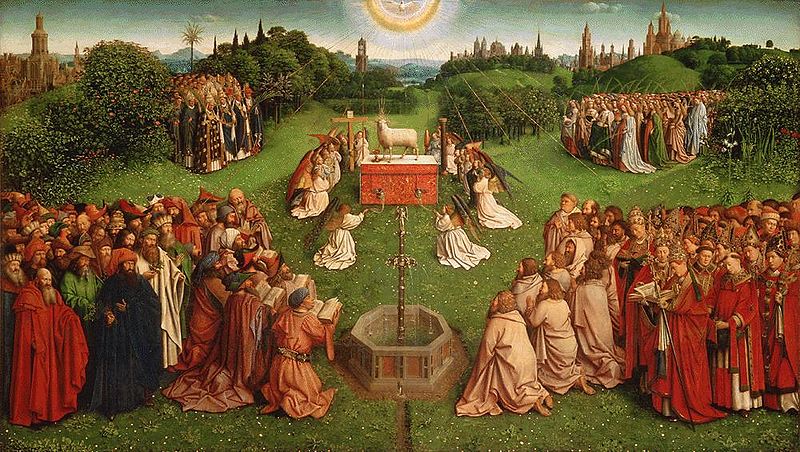
Adoration of the Mystic Lamb, Jan van Eyck, c. 1390-1441

From NT Wright’s commentary, Revelation for Everyone, he says this about Revelation 21:1-5:

When has there been a moment in your life when you have said to yourself, ‘This is new’? I don’t just mean a car with a few new gadgets, or a meal with a different combination of sauces and seasonings – though these, too, may point in the right direction. I’m thinking more of major life-experiences in which we think to ourselves, ‘Everything is going to be different now. This is quite new. This is a whole new world opening up.’

Such experiences might well include some major life-events: birth, marriage, full recovery from a long and dangerous illness, the experience of someone new coming to live with you. All these, interestingly, feature in the list of images which John uses as he builds up this breathtaking picture of the new heaven and new earth. ‘I will be his God and he shall be my son’ (verse 7): a final new birth. The holy city is like ‘a bride dressed up for her husband’: a wedding. There will be ‘no more death, or mourning or weeping or pain any more’: the great recovery. And, central to this whole picture, and indeed explaining what it all means, is the great promise: ‘God has come to dwell with humans.’ The new, permanent guest.

There may be mystery about God’s new creation, but what we do know is surely good news. What a hope we have in Jesus Christ.

Psalm 145, with bonus video

Psalm 145:3-8

Great is the Lord and most worthy of praise;
his greatness no one can fathom.
One generation commends your works to another;
they tell of your mighty acts.
They speak of the glorious splendor of your majesty–
and I will meditate on your wonderful works.
They tell of the power of your awesome works–
and I will proclaim your great deeds.
They celebrate your abundant goodness
and joyfully sing of your righteousness.
The Lord is gracious and compassionate,
slow to anger and rich in love.

In reading through the Bible we can’t help but see the greatness of God that is still so hard to fathom even though it is throughout the scriptures. But even though he is so good, we at times fail to take that next step of sharing his goodness with others. We do not witness to his mighty acts, passing on such good news from generation to generation.

In taking this year, I pray that it has been time to “meditate on [God’s] wonderful works” and may that spur us on to tell of his power, proclaim his great deeds, and celebrate. Our God is so gracious and compassionate that we ought to rejoice and sing praise to him.

As a bonus, enjoy this video by Shane and Shane based off this Psalm.