The HESED of God in Psalm 136

  • NIV – his love endures forever
  • KJV – his mercy endureth for ever
  • ESV – his steadfast love endures forever
  • MESSAGE – his love never quits
  • NLT – his faithful love endures forever
  • NASB – his lovingkindness is everlasting
  • HCSB – his love is eternal

All these are translations of the phrase, kiy l’olam hesedo, which creates the refrain of Psalm 136.

It is hard to take a robust word like hesed and condense its meanings to one word in the English language. There are parts of the word with which these different translations do well. Hesed involves kindness, and surely when it is described of God, his kindness to us, a sinful creature, must involve mercy and we know its motivation is his love for us. There are examples of its use in the Bible that relate to its enduring quality, which is fitting here given that it is coupled with the word olam, which means everlasting or without end.

It is kindness, but it is more than that. It is love, but more. There is more than just the action and orientation, it brings in a commitment, such as the covenant God has made with us. When speaking of God it conveys the steady faithfulness he has to his undeserving people, and is descriptive of one who has done so much to save and shepherd his own. We could never remain faithful as he has, nor could we maintain the covenant. But God, with his great hesed, goes beyond what we deserve to forgive us and lavish his love upon us.


Revelation: A Vision of Tomorrow that Matters Today

Francisco de Zurbarán, Agnus Dei, c. 1635

I had the privilege to preach this last Sunday on chapter five from the book of Revelation. In it Jesus Christ, the lamb of God, steps up as the only one worthy to open the scroll of God. I thought I’d share the cliff notes version of the sermon, as I didn’t write too much on the book for last week.

One concern of mine in regards to this book is that we see it as just an extended forecast–something that shows us the future, but has no real bearing for how we live today. Revelation does show us what is to come, but I believe it also reveals a vision that breaks into our life in the here and now. Here is a summary of three takeaways for how we should live today.

  • Worship and Praise

    Revelation pulls back the curtain to give us a glimpse of one so worthy, so glorious that he deserves our praise now and through eternity.

  • Perseverance and Hope

    Revelation pulls back the curtain and shows us the truth that although this world appears to be in chaos, God has a plan, a plan that Christ accomplishes, and it is a plan for his victory, so let us persevere with hope.

  • Royal Priesthood

    Revelation pulls back the curtain and reminds us that the God who reigns has called us into that family business. We reign with Christ and live as a part of his kingdom, serving right now, as a royal priesthood in this world.

Hope Fulfilled Around the Throne of God

We see a powerful image of what life with God will be like, and in these verses are wonderful promises of Jesus truly fulfilled. Jesus, the bread of life, told us that if we come to him we won’t hunger and if we believe, we’ll never thirst. He said that he is our good shepherd. He offers us living water. Our lives are hidden within him, finding shelter there. Such hope is wrapped up in the scene around the throne in chapter seven:

They are before the throne of God
and serve him day and night in his temple;

and he who sits on the throne
will shelter them with his presence.
‘Never again will they hunger;
never again will they thirst.
The sun will not beat down on them,’
nor any scorching heat.
For the Lamb at the center of the throne
will be their shepherd;
‘he will lead them to springs of living water.’
‘And God will wipe away every tear from their eyes.

Vanity of Vanities! All is vanity!

Oddly, Ecclesiastes packs a punch even though it is talking about the listlessness of life. Life is vanity, we are a vapor, there is no point. If this were entirely true, then it is surprising that the author intends for you to keep reading more than one chapter.

There is meaning in life, and it comes through in Ecclesiastes, but much of the book is devoted to talk about what has no real worth.

I think this resonates with many in today’s world who have had the realization that they live a life with no purpose. Some leave jobs and lives behind to forge a new path searching for meaning. Others reject the values of wealth and power that society seeks to lift up hoping to live life according to a better principle or philosophy.

This creates a great opportunity to shine a light on what Christ offers. To those without, he gives direction. In Christ we all have a calling. We have a purpose as we seek to be his disciples, loving God and loving others. Participating in his kingdom work is of great worth and eternal value. The world offers goals like get a bigger house, have more cable channels on your bigger TV, and gain fame. But these are vanity and are nothing in comparison to the revolutionary purpose of living for Jesus.

Proverbs; Short and Sweet

We often equate the length of writing with its quality. If someone writes a thirty page paper it must be more scholarly than a fifteen page paper. Right?

Well, not always. Length shouldn’t account for everything. Especially when we consider that some authors have been paid by the word.

Even if we know that is true, we can still be influenced by the notion that longer is better. This really gets in the way of appreciating a book like Proverbs. It is too easy to breeze through the quick sayings of Proverbs, missing the depth of the words.

Take this from Proverbs 3 as an example:

Trust in the Lord with all your heart,
and do not lean on your own understanding.
In all your ways acknowledge him,
and he will make straight your paths.
Be not wise in your own eyes;
fear the Lord, and turn away from evil.
It will be healing to your flesh
and refreshment to your bones.

How long does it take to read that? How long ought it to take to take this in and reflect upon it?

So instead of missing out because we move too fast, take the time to reflect on these sayings. Sometimes lengthy writing just masks an inability to communicate clearly. Let’s then be thankful for the concise and powerful words of Proverbs.

Trying to Empathize with Lamentations

Jeremiah lamenting the destruction of Jerusalem, Rembrandt, 1630

In reading Lamentations I wondered how much we could empathize with the weeping over a destroyed Jerusalem. We are so less rooted to our geography in this culture and see it as a point of pride to be well-traveled. For some the goal of growing up is to get out of the small town you grew up in. Even the US taken as a whole isn’t all that old of a country and our history is hardly anything compared to the longstanding nations elsewhere in the world.

So if we were to imagine a hometown or an iconic city like Washington, D.C. or New York City destroyed, how would we react? Could our sorrow even begin to match that of what is read in Lamentations? Jerusalem was not only a civic center or place of worship, it was both those things and more. It was where that generation’s ancestors had worshiped the living God who made his dwelling place there, among all the places on earth.

Surely that destruction would cause questions and doubts. Where is God if his habitation is destroyed? Where is he if he would allow his people to be exiled? Who are we if we do not have our home or a place to gather and worship?

As we read Lamentations, take the time to imagine the devastation the author must have felt. Only once you have tried that then move toward the jubilation you can imagine when God’s people are returned home and this city is rebuilt. You can’t grasp the hope that comes in places like the end of Isaiah, dealing with Israel’s restoration, without first understanding the depth of despair that met the people as Jerusalem burned.

A Prayer for Lent from 2 Thessalonians

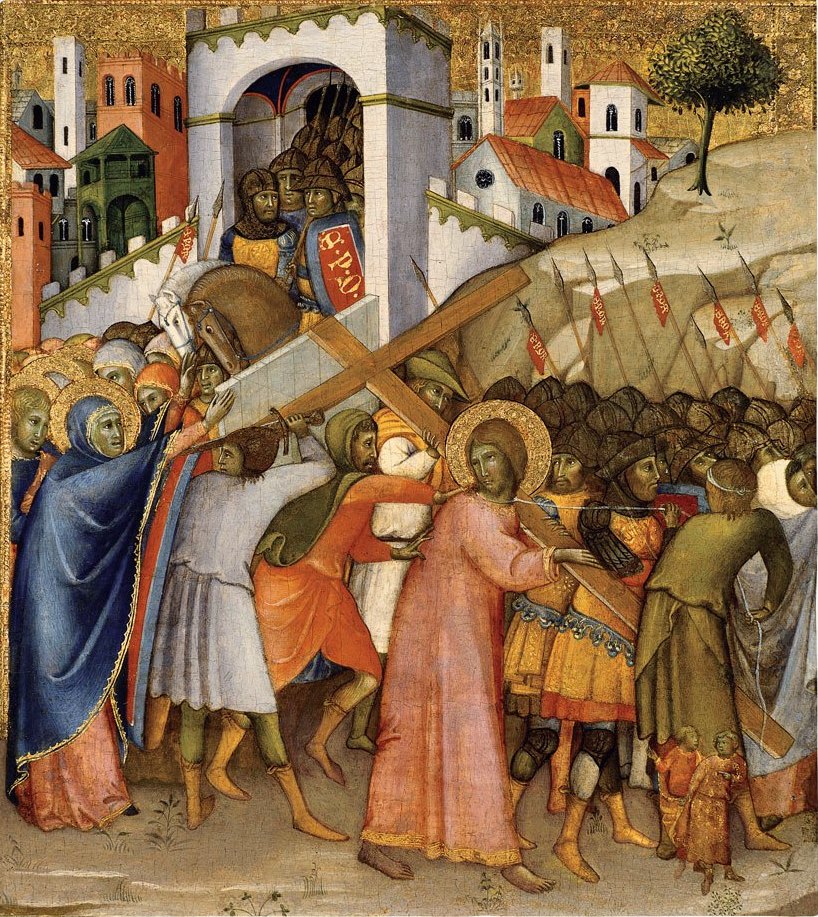
Andrea di Bartolo. Way to Calvary. c. 1400

We are in the season of Lent when our minds should turn to what God did for us in Jesus Christ. We slowly proceed through these weeks and approach the cross where our Lord went to die for sinners like you and me. We ought to reflect on what it means for the Son of God to even to enter our world and take on flesh. What does it mean that our God would sacrifice so much to endure a life like our own? Even more amazing is that he didn’t come to be served, but to serve, doing things you’d never expect like wash disciples’ feet–including one who was to betray him. Jesus then willingly walks the road of suffering to Golgotha in order to be a sacrifice for us, show himself in glory, and reveal his great love for us.

Lent being such a season, I can’t think of a more timely prayer for God’s people than the words of Paul from 2 Thessalonians 3:5:

May the Lord direct your hearts to the love of God and to the steadfastness of Christ.

God’s love is most clearly seen in Jesus Christ, who was steadfast in his obedience. May that be what holds our attention and captivates our heart in this time of preparation.

Why We Work

There are several remarks about work and against idleness in 1 & 2 Thessalonians. But we mustn’t get the wrong idea as to what this focus on work is for. Paul’s concern with work is work that is an outpouring of our faith, and these works express a faith that is in Christ. Our good works aren’t about making ourselves good, rather they are to point to Jesus, fulfill our purpose, and glorify God. Paul’s says in 2 Thessalonians:

To this end we always pray for you, that our God may make you worthy of his calling and may fulfill every resolve for good and every work of faith by his power, so that the name of our Lord Jesus may be glorified in you, and you in him, according to the grace of our God and the Lord Jesus Christ.
2 Thessalonians 1:11-12