Absurdity of Idolatry

There is a great little section in chapter 44 of Isaiah that in describing the making of an idol in such a mundane way, shows the whole endeavor to be a bit absurd.

Isaiah describes the whole process, start to finish. You plant a tree and let it grow. Then you cut it down for its parts. You use some for a fire. The fire warms you, and then while you’re at it, you throw on some dough and make some bread. You’ve got some wood leftover? Let’s make a god. And then we may as well worship this piece of wood that we just grew, cut down, burnt, and used to carve into some likeness.

How can we think something that we just used for the simple needs of warmth and for cooking can then also give birth to a statue worthy of worship? Verse 17 says, "the rest he makes into a god, his idol, and falls down to it and worships it. He prays to it and says, "Deliver me, for you are my god!""

Sounds crazy, right? Do we condemn such an action, or just pity the person?

It’d be easier to judge if we weren’t susceptible to idolatry in our own ways. But regardless of the idol–a wooden totem or the idol of power of money–not one of them can answer when we cry out "deliver me!" God alone is savior and only he hears our cries.

Prophecy Fulfilled Against Assyria in Isaiah 37

There were a number of prophecies against Assyria and their fall and in Isaiah 37 we see those prophecies fulfilled. In chapter 31 we read:

And the Assyrian shall fall by a sword, not of man;
and a sword, not of man, shall devour him…

In chapter 37, after Sennacherib, the leader of the Assyrians, mocks the God of Israel in his dealings with Hezekiah he leaves to attend to an uprising in the south by the king of Egypt.

Sennacherib from palace in Nineveh

Sennacherib has been very successful in his rule, as he notes to Hezekiah. Assyria has been used by God to bring his judgment on the land and Sennacherib says, “Behold, you have heard what the kings of Assyria have done to all lands, devoting them to destruction. And shall you be delivered? Have the gods of the nations delivered them, the nations that my fathers destroyed…?”

Hezekiah must be in great fear, for himself, his people, and Jerusalem. But he knows that those other gods were no gods at all. He goes to the temple and prays for God’s deliverance, and does so with the purpose that the kingdoms of earth may know that Israel’s God is truly God.

As I said, the prophecy is fulfilled and Hezekiah’s prayers are answered. In going to fight off the Egyptians, Sennacherib is dealt a grew blow, loses thousands of men, and retreats back to the capital of Ninevah.

There is an interesting comparison between these two leaders. Hezekiah goes to the temple and is heard by God and is spared. Later, after backing down following the loss of so many of his men at the hand of God’s angels, Sennacherib goes to his temple. There he is not delivered, rather he finds his end as his own sons kill him in order to seize power for themselves.

Also-in reading about this passage I found two accounts of how the 185,000 of Sennacherib’s camp were put to death. One is an account of some pesky mice that came out in the night to gnaw away at the bows and the straps of Assyrian shields, leaving that army weakened. The other is not as exciting, and records disease as the tool used to bring about their destruction.

“The Waiting is the Hardest Part”

When we think of the word “wait”, what does that look like? If someone is waiting for someone or something, what are they actually doing? It is easy to think of waiting as doing nothing. Waiting can seem like inaction, waiting for a later time when you will act. But read the first chapter of 1 Thessalonians. Read it all but the last verse.

Paul writes of their “work of faith and labor of love and steadfastness of hope in our Lord Jesus Christ,” they are imitators of Paul–who was no slouch, and they did this in affliction. The church has been an example all around Achaia and Macedonia, and beyond that, the word of the Lord has sounded forth from them everywhere. They welcomed Paul and his colleagues and they turned from idols to worship the living and true God. Does that sound like they’re doing nothing? This is how they wait, waiting for the the Son from heaven.

Waiting for Jesus’ return is not sitting on our hands. Later in his letter Paul explicitly tells them to admonish the idle. To wait upon Jesus is a vigilant life. It is active, for he did not leave us here to do nothing. We have a purpose and he has given us his Spirit! Why would we be blessed with the Holy Spirit if all we’re expected to do is nothing? Let’s wait, but do so in a way outline here in 1 Thessalonians.

Doodlings on James

If we were to imagine what it would look like to be quick to listen and slow to speak, what would it be?

Is this the makeover that we need?

Quick to Listen, slow to speak = Big ears, small mouth.

Quick to Listen, Slow to Speak

I’m not sure how many times I’d repeated in my head (or deserved to have someone say to me), “quick to listen, slow to speak.” This of course is part of James 1:19 and is a simple directive, b it sure is hard. We all want to be heard. We’re tempted to think ourselves much smarter than we truly are and we want to give our two cents. But we don’t stop there, adding additional cents and finding ourselves in debt in the conversation. Having given so much speech, we owe the other person some time of listening.

Tell me if these situations are familiar to you–either as the victim or perpetrator:

  • One person in a conversation does not seem to be really listening, probably because he uses the time when the other person is talking only to think about what he’ll say next.
  • A person uses the story of another merely as a platform to tell another story that she thinks is much greater than the first.
  • Someone cuts you off to either agree, disagree, or correct the opinion that he actually did not hear since he interrupted you in the first place.
  • You have a friend who loves to tell you all about what is going on in her life, but has no time to listen to you.
  • You put your foot in your mouth because you jumped to conclusions without waiting for all the facts or because you didn’t wait for someone to finish.

It is so easy for us to fall into these traps. Embarrassingly, it is easy to complain when someone else does it, but then go off and do those very same things. But we need to evaluate ourselves, be humble in our relationships and conversations, and follow this command. The text goes on to say we should be “slow to anger” and being a person with patience who is slow to speak is key. I find it hard to imagine a hothead–someone quick to anger–as also someone who is a great listener and very humble.

On the flip side, don’t you find yourself drawn to people who listen to you? Who are patient as you speak and ask you questions? This can be a great witness for Christians to their neighbors, especially in a frantic world that is hurried and where we’re having more online relationships or transactional relationships. If you are one who listens, you’ll be taking a step to show the love and care God has for us to someone who may really need it.

This is also a lesson we need to make sure to apply to those God has placed close to us, those about whom we care most. That group is often one that sadly gets our worst, along with our best, since we see them so much. We can be so sure we already know them well enough, so we jump to conclusions, cut them off, or tune out. But we need to slow down.

If you need to be quick, be quick to listen. Give yourself time to really hear people. Take time to think. Then be slow to respond.

A Mix of Boldness and Gentleness

Remind them to be submissive to rulers and authorities, to be obedient, to be ready for every good work, to speak evil of no one, to avoid quarreling, to be gentle, and to show perfect courtesy toward all people. For we ourselves were once foolish, disobedient, led astray, slaves to various passions and pleasures, passing our days in malice and envy, hated by others and hating one another. But when the goodness and loving kindness of God our Savior appeared, he saved us, not because of works done by us in righteousness, butaccording to his own mercy, by the washing of regeneration and renewal of the Holy Spirit,whom he poured out on us richly through Jesus Christ our Savior, so that being justified by his grace we might become heirs according to the hope of eternal life.

Titus 3:1-7

Paul urges gentleness for the believers in these churches. He does not want the Christians to be quarrelsome but rather courteous to others. By the early churches example of such humble love and service, many were impressed with the new movement of Christians.

It didn’t mean they were pushovers. Just before this section Paul exhorts them to be bold in the truth, not letting anyone disregard them. They are to teach and rebuke with authority.

In today’s church, especially as it acts more publicly, do we find such a balance? Is it courteous and nice to the extent that we disregard ourselves and our own teachings, not wanting to offend anyone? Or are we so bold about the truth that we lose all humility and kindness?

Paul wants them to be both, and the humility I think is key. He reminds Titus, “For we ourselves were once foolish, disobedient, led astray, slaves to various passions and pleasures, passing our days in malice and envy, hated by others and hating one another.” How can we treat those who do not know Jesus Christ and his gospel when we are no better ourselves, save for the mercy of God? We should treat others well in hopes of impressing the love of Christ upon them, rather than condemn them as though we were in a position to be the judge ourselves. We all need the mercy of God, and that should be central to the message we carry to others, and to each other in the church.

God’s Work, Not Our Work

Therefore do not be ashamed of the testimony about our Lord, nor of me his prisoner, but share in suffering for the gospel by the power of God, who saved us and called us to a holy calling, not because of our works but because of his own purpose and grace, which he gave us in Christ Jesus before the ages began.
2 Timothy 1 :8-9

As much as this is a letter to Timothy and about his ministry, it isn’t really about him. Paul wants to keep the focus on Jesus Christ and what he has done. It is not on the basis of our work that we are called, but because of God’s purpose and grace.

That doesn’t mean we aren’t called to do a work. We are. God has a plan for us and wants us to follow it. But just as it isn’t all about Timothy, it isn’t all about you or me. We are to make our work point to Jesus.

We do have a role to play, but Jesus deserves all the glory. We would have nothing if not for the grace given in him.

It reminds me a bit of this quote from Stacey King, a teammate of Michael Jordan.

I’ll always remember this as the night that Michael Jordan and I combined for 70 points.
(Said after Michael Jordan scored a career high 69 points and Stacey King scored 1 point against the Cavaliers. )*

*But when it comes to the work of our salvation, we don’t even contribute that one point.

Remember Jesus Christ: a lesson from The Silver Chair

Remember Jesus Christ, risen from the dead, the offspring of David, as preached in my gospel, for which I am suffering, bound with chains as a criminal. But the word of God is not bound! Therefore I endure everything for the sake of the elect, that they also may obtain the salvation that is in Christ Jesus with eternal glory.
2 Timothy 2:8-10

To remember Jesus Christ was important for Paul, since it was for Jesus’ that Paul suffered. And he charges Timothy to remember, and not only for himself and for his work, but for others. Timothy is to guard the truth, care for it, and pass it on, reminding the brothers and sisters of this gospel.

Likewise, our common calling is not just to speak about God, but to remind each other of this gospel: That God came to earth in Christ, he put to death death itself, has forgiven our sins and will give us life with him forevermore. Do you remember that? Something has happened on the cross and who we are is a consequence of Jesus Christ. We should never grow weary of thinking back to these things.

To understand better what Paul is saying here we need to stop and look at what it means to remember. I want to make sure the active tone of this word is coming across. It is not just reminiscing or simple, dull memorization so that if someone quizzes you about Jesus you can ring in with the answer.

It’s not quite, “Don’t forget.” It’s more.

My family does a far bit of road tripping up and down the East Coast. One thing we do to pass the time is listen to audiobooks. One year we went through a great recording of The Chronicles of Narnia. In my favorite, The Silver Chair, I think we learn well what it means to remember, and why we should. The Christ figure, Aslan, a lion, tells a girl Jill four signs to lead her on her journey. And before he sets Jill on her way, he gives her a speech in which he says:

“But first, remember, remember, remember the signs, say them to yourself when you wake in the morning and when you lie down at night, and when you wake in the middle of the night. And whatever strange things may happen to you, let nothing turn your mind from following the signs. … The signs which you have learned here will not look at all as you expect them to look, when you met them there. That is why it is so important to know them by heart, and pay no attention to appearances. Remember the signs and believe the signs.”
(Chronicles of Narnia, CS Lewis, 560)

Jill leaves Aslan and discovers her quest is to find a lost Prince. Tragically, all along the way the signs are forgotten or misunderstood. The result is her group had to begin their journey without official support, they end up on the menu of a group of giants, and almost fail entirely when they come face to face with the prince himself—since they hardly were able to recognize him.

The Silver Chair Cover

The problem was she had learned the signs, but was not remembering them.

She knew one sign was to find an ancient city, but failed to recognize it in the rubble she saw because she was distracted and her attention was on the bitter cold and dreams of a warm fire. She knew the Prince would be the one who spoke the name Aslan, but when that person who spoke was an imprisoned, enchanted mad-man, she was paralyzed with fear. Fortunately – against all her “better judgment”, she decided to let this dangerous man loose, freeing the prince, for she says, “What was the point of learning the signs if we weren’t going to follow them when they came up?!”

If only she could keep the signs straight. If only she could remember.
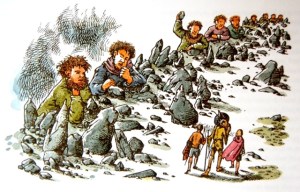
The Silver Chair Illustration

We try so hard to do the same in our lives and in the life of the Church, and how far off the path do we find ourselves. Once we are entrenched in the world the commands of Jesus, the truths of the Bible, even simple ones like “love you neighbor,” do not seem so clear to us. We get distracted, we are afraid or anxious about life, or maybe we focus on our own comfort.

We veer from our course, and all too often also try to justify it. If only we could see more clearly. To follow Christ can be simple enough, but it is difficult. It is easy to lose sight of him. That is why we need to have the discipline to remember Jesus Christ… each night, every morning, and even when we wake in the middle of the night. Only when we keep him fixed in our sight are we able to live the life and follow the path that God has laid out for us.

*This was originally a sermon I preached years ago, but have chosen a selection of it and edited it down as it fits with readings for Year in the Bible this week.