Like many protestants, growing up I placed more value on prayers that were off the cuff. To borrow more contemporary phrases, you want to be “authentic” or “organic.” Just reading someone else’s words was too “ritualistic.”
While I do think there is value in praying without a script, I’ve grown to appreciate learning from and using other’s prayers, too. Like in any relationship, you need to be both spontaneous as well as deliberate and thought out. Written prayers can help with that deliberate side, as you search and meditate on the words.
The psalms are such a rich place to do that sort of prayer. It is full of words that can not only be our prayer, but teach us to pray. That doesn’t mean we need to come away speaking King-James-style (the Bible translation, not Lebron) every time we pray. But we can learn from the content, the patterns, and the heart behind these psalms.
This week we read Psalm 19, and it ends with such a simple and beautiful prayer. I can’t tell you the number of times I’ve used it, and I hope it can be a blessing as you use it to pray, as well as a model to help you learn to find our own words.
Let the words of my mouth and the meditations of my heart be acceptable in your sight, O LORD, my rock and my redeemer.
Do you like difficult grammar and long sentences? Do you prefer that your readings are slow and demand a second (or third) pass? Then Peter is your guy here in the midst of his letter. It can get a little tricky.
What is clear, though, is that he’s talking to a group of churches that are facing growing persecution. “Suffering” is a constant theme so far. Peter is working out how suffering relates to what we believe about Jesus. If you have heard of the victory that Christ has secured for his people and how he has now ascended and is seated on the throne, what do you make of the suffering that hasn’t lessened, but rather is increasing? Is that to be expected?
Peter is trying to deal with this throughout. What God has done in Jesus is big—and goes back before the world was made. God has had a plan and still has one, so do not lose hope when things are hard. Suffering does not negate God’s plan. In fact, it is present in his plan, not the least in Jesus himself. Jesus suffered, was rejected, and even put to death. So do not assume suffering has no part in the Christian life. But take comfort knowing you are like Jesus in that regard. In those trying times put you hope in Jesus who is able to work for good through suffering. God works through it for others, who we are to bless when they curse, not return evil with evil.
Then this theme of suffering extends beyond this life, and clarity gets a little murky in 1 Peter 3 and 4.
For Christ also suffered once for sins, the righteous for the unrighteous, that he might bring us to God, being put to death in the flesh but made alive in the spirit, in which he went and proclaimed to the spirits in prison, because they formerly did not obey, when God’s patience waited in the days of Noah, while the ark was being prepared, in which a few, that is, eight persons, were brought safely through water. Baptism, which corresponds to this, now saves you, not as a removal of dirt from the body but as an appeal to God for a good conscience, through the resurrection of Jesus Christ, who has gone into heaven and is at the right hand of God, with angels, authorities, and powers having been subjected to him. (1 Peter 3:18-22 ESV)
And:
For this is why the gospel was preached even to those who are dead, that though judged in the flesh the way people are, they might live in the spirit the way God does. (1 Peter 4:6 ESV)
Christ, or the Spirit, preaching to spirits? Preaching to them in prison, or before they were imprisoned? In the time of Noah, or now after their disobedience? Just another super easy passage. Then in chapter four, there’s a preaching to the dead after they are judged? That doesn’t sound like what we read elsewhere or confess as the church? What’s going on?
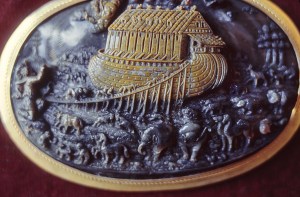
Allessandro Masnago – Cameo with Noah’s Ark, c. 1600
To do our best at understanding difficult passages, we must hold closely what is already clear in 1 Peter. He’s addressing suffering in the church. Does suffering have victory when it comes to death? No, Christ suffered and was even put to death. But the result is bringing us to God and making us alive in the spirit. Suffering is not the end for Christ has the victory. It seems here Peter is illustrating this point with the example of suffering in the time of Noah, when evil spirits were a cause. Jesus, who was put to death in the flesh, but was raised in the spirit, goes to proclaim this victory to those evil spirits. Then Noah is the example for us. Hold fast to God, even with opposition and suffering around you. Noah committed himself to God and that was evident by his entering the ark, remaining safely in the waters of the flood. He persevered. We are likewise to commit, persevere in the face of suffering, and baptism by water is a sign for us.
In chapter four again a concern is suffering and death and Peter assures the church that Christ still has the victory. The gospel was preached to those who are now dead, and even though they suffered in this life of flesh and were judged by the world, we know there is more. Death does not end God’s victory or hold back his reach. The world may wield its power and threaten death, but in Jesus there is victory. There is life in the Spirit that no suffering can touch. Hope in Jesus is not only for this life, but for all eternity.
If you want some heated disagreement about Bible interpretation, jump into the passages in the New Testament about marriage. What does Peter or Paul have to say about the roles that men and women have?
Much attention is given in chapter three where Peter says, “wives, be subject to your own husbands.” But this is just part of a verse, which is itself part of a much larger section of this letter. In chapter three Peter is continuing the topic he began back in 2:13. He’s talking about how to react when under authority. So the word “likewise” in 3:1 should send us back to make sure we are seeing how this one part functions in the larger section. What we understand here about women and men should be informed by what Peter said about living under an emperor or governor and how slaves are to live under masters.
If we lose context we can miss the meaning. People are quick to read chapter three (on its own) as Peter recommending not just behavior within an institution, ie. how women should live within a first century marriage, but as approval and recommendation of the institution itself, ie. a marriage where the husband has greater authority over the wife. There is much debate on what exactly a Christian marriage is, but we can’t brush aside the context of these passages. Peter says “likewise” to continue a stream of thought and place this discussion alongside emperors and slave masters. We do not argue for or recommend absolute authority in an emperor as the best form of government nor do we approve of slavery. We see those sections as guidance for how to live within those existing institutions, regardless of whether they are good or divinely ordained. So does marriage likewise continue with those previous two examples, or does it stand alone?
What God clearly wants in these sections is for us to see opportunities to serve God, no matter our circumstance. If we are a slave serving a master, Peter gives the Christian a way to see this service as being done for God and for His purposes. We don’t need the worldly forms of power and authority to have influence for God. Peter writes in 2:15, “For this is the will of God, that by doing good you should put to silence the ignorance of foolish people.” Even in subjection and suffering, we can do a good work to witness to Jesus, the one who subjected himself to the powers of this world and suffered for our sin.
These passages will likely continue to lead to passionate disagreement. Let’s then be slow when we ask the question that started this post, “What does Peter or Paul have to say about the roles that men and women have?” Let’s not rush to change that question into what roles men and women should have. The former describes the existing conditions and then how to live within them, while the latter prescribes how marriage should be. We’ve got to read more than the one verse, and see the larger context. And even beyond that, we need to read Scripture in light of all Scripture and see the call that God has on his sons and daughters.
In many ways, Genesis is a book that is easy to read because it’s a narrative. It tells about people and places, and though those names and locations may be a bit foreign to us, we have heard many of the stories throughout at various times in our lives. There’s a certain familiarity about it. However, Genesis is also a tough read because we may not know what exactly we are supposed to get out of it. Reading through Genesis can make us uncomfortable as we come across sections like chapter 6, where the “Nephilim” are introduced and there’s something about the “sons of God” and the “daughters of man.” These terms are confusing, and perhaps we’ve not encountered this part of the narrative very often in a sermon or Sunday school lesson.
A question came in this week about what we make of this section of chapter 6 (v. 1-4). Who are the “sons of God”? Are they angels? Are they people? Who are the “daughters of men”? Why weren’t these two groups supposed to intermarry?
First, let it be said that these questions have baffled readers and scholars (both Jewish and Christian) for centuries. So, if you’ve asked these questions, you’re in excellent company! It helps to know that these are tough questions that many others have sought to answer, but don’t let the fact that it’s difficult stop us from seeking to at least understand it better (even if we can’t understand completely).
Scholars, as you may imagine, are not all in agreement as to the meaning of the term “sons of God.” The fact is, those who wrote it and were the original readers almost certainly understood what it meant, but the full meaning has been lost to us. So, the most honest answer is that we don’t know.
What I’ll do is offer a few suggestions offered by people who know much more than I do!
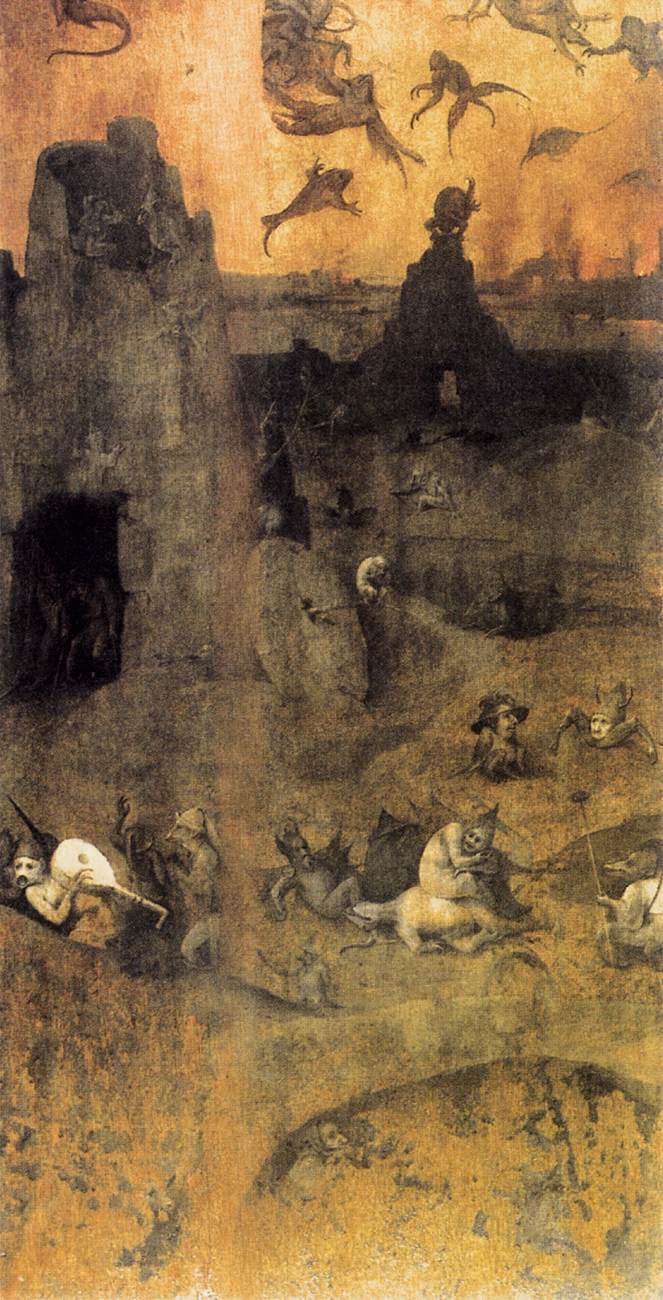
One view is that “sons of God” refers to angels that were having relationships with human women. While the term “son of God” is used in other books (Job, for example) to refer to an angelic being, it’s not the only way to understand the term. Furthermore, the Genesis narrative at this point is focused on the continuing rebellion of humans and their advancement in sin. This being the case, it is much more likely that “sons of God” refer to some human creatures, and this is an example of humanity’s continuing spiral downward in sin.
Hieronymus Bosch – The Fall of the Rebel Angels, c. 1510
So, what are some other possibilities? John Walton, an Old Testament professor at Wheaton College, suggests that the term (“sons of God”) refers to the kings of the Ancient Near East. These rulers, often regarded as sons of God by the people they rule, may have been not just intermarrying, but involved in some sort of sexual perversion with the “daughters of men.” In this interpretation, the daughters of men would have been God’s people. Interestingly, these Ancient Near East rulers were very concerned with immortality and long life, so the limiting of their days to 120 years would be an appropriate consequence.
A third possibility is that the lines of Seth and Cain are represented by “sons of God” and “daughters of men.” Remember, Cain was the firstborn son of Adam and Eve- the one who murdered his brother, Abel. Later on, Eve has another son whom she called Seth. Because of what he had done, Cain was driven away from the Lord’s presence. Seth was considered the “child of promise,” and it was his family line that “began to call upon the name of the Lord” (Genesis 4:26). So, in this interpretation, the sons of God are the line of Seth (the line of promise) and the daughters of men are the descendants of Cain. The children of the promise were intermixing with those who had been cursed. Those who worshipped God were not to live like the rest of humankind, marrying whomever they wanted; rather they were to live as a distinct people.
Given that this section of Genesis is fixed on the theme of humanity’s plunge into disorder, it seems much more likely that the term “sons of God” refers to a group of human beings. Saint Augustine and John Calvin are two examples from history who believed the “sons of God” to be human creatures.
Both the second and third possibilities have their interesting points of support, and of course there are other variations out there. Even without knowing with certainty the identity of the groups of people in this text, we can understand the point of the text is to show us that human beings were choosing their own way. What had begun in the garden, when Adam and Eve ate of the Tree of the Knowledge of Good and Evil is continuing to have its impact. Human beings want to be the determiners of good and evil, and are trying to usurp God from his rightful place. And it’s not going well.
Hope this helps, and please bring us more of your questions, because it’s very likely that others are asking the same ones!
Also: Here’s a short video on the identity of the “nephilim” and how much weight we should give any particular interpretation of that term.
I’m no expert on the book of Psalms. Poetry is not generally what I’m grabbing off the bookshelf, but there is great beauty when I find the patience to sit and read slowly.
Today I was reading through Psalm 8 and I appreciated the thought that I am by no means the first person to read this. Rather I fall in a very long line of God’s people who have sat and read, or heard, this Psalm.
O LORD, our Lord, how majestic is your name in all the earth!
I confess this is not a very deep insight. What really struck me though is how much the coming of Jesus casts a new light on the whole world, including this book and this psalm. There were people who unrolled the Psalms and reread these words about God’s creation.
When I look at your heavens, the work of your fingers, the moon and the stars, which you have set in place, what is man that you are mindful of him, and the son of man that you care for him?
As David continues on, it calls to mind the account in Genesis where God creates this wondrous place and places humans as the crowning piece of his creation. He made man and woman in his image and set them apart to have dominion and to rule. But now, in rereading, it calls to mind Jesus.
Yet you have made him a little lower than the heavenly beings and crowned him with glory and honor. You have given him dominion over the works of your hands; you have put all things under his feet,
What was true in one way for the humans that God placed in this creation is even more true for Jesus. This perfect human who can rightfully take the place over creation, who deserves to wear the crown and receive all glory and honor! I can just imagine the author of Hebrews, who quotes this in chapter 2, sitting there with Psalm 8 and having such joy in rereading it; in seeing it almost brand new in light of Jesus.
Like I said, it isn’t a unique insight to remember that other people have read Scripture. But that doesn’t mean it isn’t helpful. I’m encouraged when I picture the saints that have gone before me, being blessed by the Psalms, just like we are today. And I’m encouraged to know that the history goes back even further, even before history, to when God already had a plan for his son to come and fulfill this and so many other passages.
I was not always the best student when I was in school. There are plenty of times where I was assigned a reading, such as in English classes, and instead I just “learned about” the book. I read a bit, but more so found summaries and essays that were helpful and were ultimately shortcuts to the reading.
I could get through school easily enough like this with minor consequences, such as I was 36 when I finally read the Great Gatsby, rather than a teenager. But that sort of reading creates a bad pattern. A pattern that I think many of us can follow when it comes to the Bible. We may learn about it, while not really reading it. And we miss things.
Take for example this week’s reading from Genesis. We are doing the first five chapters, and even if you tried to read the Bible before and only got a few chapters in, you’d already have read the creation account.
But are we really reading? You’ve likely learned about it and it is even a point of controversy in and outside the church. There are arguments about creation theories and many wonder if the Bible conflicts with science. So we are familiar with the Biblical account of creation, but are we reading it? For instance, have you noticed the way that there are two creation accounts? That chapter 1 (and a bit of 2) speaks of creation one way, then chapter 2 goes over it some of it again, with a different style? Why is that? What is the purpose of these two chapters? Those are great questions to dig in as you read! What does God want us to learn from these opening chapters? Are we seeing God’s omnipotence? The goodness and beauty of creation? His purpose? Our purpose?
I don’t point this out to scold anyone for not noticing something in Scripture! Rather it is an exciting invitation to read. God’s Word is full and it is rich. It can be unexpected and comforting and challenging. Even in the familiar opening chapters of Genesis there can be a new word that God will bring to us by his Spirit.
Not to end with a contradiction to what I began with, but here are some resources to help us learn. A video introduction to Genesis and an article that tries to tease out the differences in those chapters of Genesis, just to get you thinking. I offer them not as a replacement to read, nor as something that is on par with the Bible, but as a help and invitation to read the Bible more deeply.
We’ve now begun our new reading plan that will take us through July. We’ll cover both Old and New Testaments, with plenty of variety along the way. But one thing will be constant–the Psalms. Each week we’ll have Psalms to read and reflect on.
But does that sounds difficult? Or maybe you already love the Psalms and want to go even deeper? Either way, this short video from the wonderful Bible Project will help you get going.
Just one of many great videos from The Bible Project.
After quite a long hiatus, we’re starting something new. Not quite the whole Bible in a year that we started with. Not quite a deep dive into one book like with 1 Corinthians. And a little more than The Bible in 10 Weeks. It’s a whole season (or two) of reading broadly through Scripture, starting this month and taking us through July. What better time to recommit and reconnect by reading God’s Word?
Watch for more info or check out the Reading Plan section.


 Year in the Bible