
Humility and the Wedding Feast

Luke 14 includes a parable about a wedding feast where Jesus teaches us to not seek out a place of honor for ourself, instead seek a humble position. The judgment on the proud is that they will be brought down, and the humble will be raised up. Jesus says, “For everyone who exalts himself will be humbled, and he who humbles himself will be exalted.”

Christians are called to be humble, just like Christ who humbled himself. We hear that lesson often, but how do we do it? Have you faced a time at work when you felt like you had to exalt yourself to gain the attention of superiors? Do you worry that if you don’t seek credit and put yourself out there to be noticed someone else will? How do we manage that cultural influence along with Jesus’ words?

Do we have the radical trust in God that he will lift us up and that his exaltation is far more important than any promotion? Is our goal in life to climb the ladder or to be a witness for Jesus and to serve others humbly at the station we are at currently?

Humility is not self-deprecation, but it is certainly not boasting. But it does have to do with moving the self out of the center and making that a place for Christ, and boasting in him. When we do so humility doesn’t become timidity, rather it gives great confidence because we find ourselves firmly fixed on Christ, caring more for his name receiving glory than our own.

Story So Far, Week 6

I’ve read Luke 9:62 many times before. There Jesus says, “No one who puts his hand to the plow and looks back is fit for the kingdom of God.” I had often thought of Lot’s wife who turns back to her home and is turned into a pillar of salt. She was being delivered from judgment and all she could do was look back to her home.

But as we’ve finished the book of Exodus this week, I couldn’t help but read this verse in Luke and think of the Israelites as a whole. They were delivered from slavery and almost immediately they turn their hearts back to Egypt and to other gods. God is angered by these actions. We read this week in Exodus 34 that our God is a jealous God. He wants us for himself alone. God wants us to only worship him. Yet we look back again and again. We look back to false gods and idols. We look back imagining that an old life was better than it truly was. We rewrite history like the Israelites who wished they could return to Egypt where they felt life was better.

In Luke, Jesus pushes his disciples to not turn back from following him. There is a radical break in the way the disciples and Jesus relate to possessions and treasure–don’t look back to those. Do not return to seeing the world the way the culture does and they way you used to. To follow Jesus in many ways is to leave behind the things of the world.

As always, Jesus never pushes us and challenges us to do what he will not do himself. Earlier in chapter nine it says of Jesus, “When the days drew near for him to be taken up, he set his face to go to Jerusalem.” Jesus knew what waited for him there. Jesus set his face to the city where he would be crucified, and he didn’t look back. Repeatedly Jesus says to his disciples that he came for that very purpose. Jesus did not look back even though his purpose was to die for those who hated him.

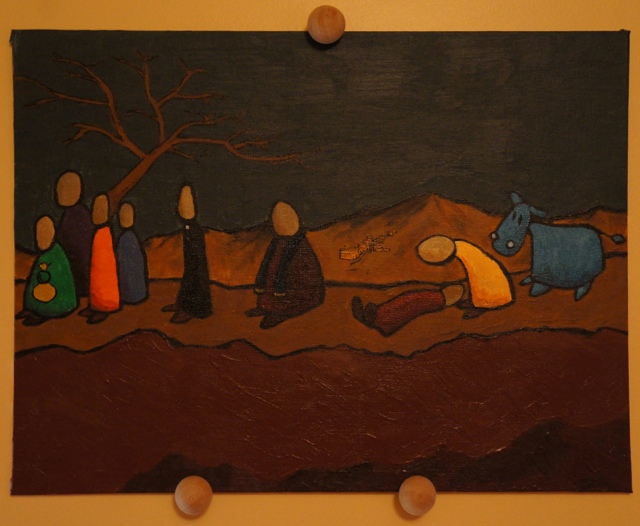
This Jesus is the one who tells us, “If anyone would come after me, let him deny himself and take up his cross daily and follow me. For whoever would save his life will lose it, but whoever loses his life for my sake will save it.” He calls us to come and follow him. We are to firmly fix our eyes on Jesus, and let the things of earth fade away, never looking back.

This is a hard task, greater than our efforts could accomplish, but thanks be to God that he gives us the strength and works in us, both to will and to work for his good pleasure (Phil 2:13).

Abundant Life is Not Abundant Possessions

The section we read this week from Luke dealt with possessions in a few different ways. Jesus asks his twelve to go out to proclaim the kingdom of God and tells them to leave behind your possessions–no staff, no bag, no money. When later in chapter ten Jesus sends out seventy-two, his instructions are very similar. He sends them out carrying no stuff.

The Rich Fool thinks swimming in solid gold is a pleasurable experience.

Chapter twelve has the parable of the rich fool, who puts so much stock in what he has today, but forgets that he has no guarantee of his future. The fool puts his present day in order neglecting the eternal and is called out as God says, “Fool! This night your soul is required of you, and the things you have prepared, whose will they be?”

This goes along with the sentiment, “you can’t take it with you.” Why invest so much in what cannot last? Why worry yourselves about things that will perish, while all the while neglecting what will last forever?

The warning is against those who lay up treasure for themselves and are not rich toward God. Being rich toward God matters far more than any other so-called riches, for as it says earlier in the chapter, “one’s life does not consist in the abundance of his possessions.” Instead we have life and abundance in Jesus Christ. He says in John 10, “I came that they may have life and have it abundantly.”

If abundant life is what we seek, we are better to look beyond our stuff. We should look to Christ and set our minds on things that are above, where Christ is, and not to things on earth (Col 3:1-2). Only in that relationship will we be satisfied. That relationship is what lasts and is of eternal value.

Unlikely Sermon Title: Please, Stop Giving an Offering

Throughout the latter half of Exodus, God is describing for Moses and the people what is required for the tabernacle. There needs to be fine cloth, gold and silver, jewels, and other materials for the craftsmen to assemble this dwelling place of God among the Israelites.

In chapter 35 Moses says to all the congregations of the people of Israel, “This is the thing that the Lord has commanded. Take from among you a contribution to the Lord. Whoever is of a generous heart, let him bring the Lord’s contribution: gold, silver, and bonze; blue and purple and scarlet yarns…”

Moses goes on listing valuable items that were surely precious to the people. The people hear this message and Scripture says they came back to Moses, “everyone whose heart stirred him, and everyone whose spirit moved him,” and they brought a contribution for God’s tabernacle and for its service. These items came in the form of brooches and armlets, and other personal possessions. It was not as though the people went out to the bank and withdrew some spare gold bullion. They took what was being used in one way for themselves and sacrificed it to God, to be used for his purposes. They also gave of their time, such as the women who spun fine yarns and linens. The people brought their treasure, and in doing so revealed what truly should be our treasure–God.

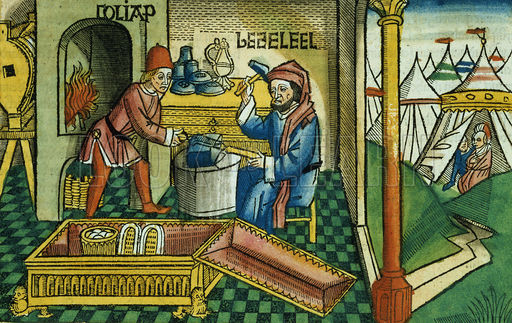
What really amazed me in reading is in chapter 36. Bezalel and Oholiab, along with the other craftsmen God had gifted skill and artistry to, all had to stop their work and come to Moses with a message. The people had continued to bring contributions for God, a free will offering, every morning to such an extent that the workers had far too much. So they tell Moses, “Let no man or woman do anything more for the contribution of the sanctuary.” People gave their treasures over to God to such an extent that it says they had to be restrained from bringing more. They gave what was sufficient and then some.

What a wonderful problem for the craftsmen to have, and what a wonderful testimony to God of how the Israelites were here being joyful givers, gladly treasuring God and his will above whatever earthly treasures they had previously cherished.

Keep Building on a Solid Foundation

I’m sure that you’ve already learned a great deal from God’s word in these last few weeks, and that may be encouragement enough to make you want to continue along in reading all of the Bible. But even so, it is great to have passages that make it explicitly clear that what we are doing is of great importance. If we read these words, take them to heart, let God speak to us through them to challenge, comfort, and shape us, then we are building our lives on a solid ground.

In Luke 6 Jesus shares an illustration about not only listening, but being doers of God’s word. He compares two builders. One digs deep and lays a foundation on rock. The other builds a house on the ground with no foundation. When a stream breaks against these two houses, the one with a foundation is not shaken, but the other falls and is left in ruin.

The one who listen to the words of Jesus and does them is building upon a foundation of rock. It is a strong, well built life, firmly fixed upon Christ’s every word. Those who hear and disregard, those who learn yet fail to heed the call of Christ, they are left in ruin when a storm hits.

It is a striking comparison especially since it is not the comparison of a strong foundation to a lesser one. Building on Christ’s words is the foundation, and neglect of him is no foundation at all. These are words of warning, but also of great encouragement.

Continue in God’s word. They are the words of life, they are trustworthy, they reveal God to us and point us to Jesus Christ. But do not stop there. Hear this word as a word for you, a word of instruction and of call. These pages we read every day speak to us now, just in the place where we are, and we are to build our lives upon them. If we fail to do so, Jesus tells us plainly what to expect.

Grace Precedes Law

We finally come to the Ten Commandments in Exodus 20, a codified law for God’s people. To many, the law characterizes the Old Testament and the old covenant, and given its prominence not only here, but throughout the many books of the Old Testament, it isn’t hard to understand that view. But do not forget the preceding chapters and stories in Exodus and Genesis.

God graciously created this world and placed us in it. God has provided for a people that he chose for himself, not based on their superiority as a people, but because of his grace. God called Abraham out to be the father of many nations, made a covenant with him, and while Abraham struggles in his faith, God remains ever faithful. He protects his people, provides for them, and in Exodus we see how God set them free from the oppression in Egypt.

God did not come to Moses and deliver two tablets of stone and say, “Moses, deliver these to the people. Gather all the elders and proclaim this law to them, and let it be known that whoever keeps it perfectly will be rewarded. In five years, I’ll be back, and if you were good, I’ll have a chat with Pharaoh about letting you go.”

Instead God hears the cries of his people and frees them from Egypt. He sets them free, parts waters, gives manna from Heaven, and also as an act of grace, he then gives them this law. Grace precedes the law. The Israelites were never a people who earned or deserved God’s favor. They did not merit it. God chose them for himself, and in his grace saves them. The law follows as a way to live as God’s people, and a way to live well.

Be careful when simplistically dividing the Old and New Testaments as though one were law and the other grace, as though grace were absent in the beginning. The Bible is a book that reveals to us who our God is, and we see he is and always has been a God of grace.

Picture It: The Tabernacle

Soon after the flight from Egypt, the book of Exodus describes in great detail the size, shape, material, color, and number of the parts of God’s sanctuary among the people. It can be easy to skim through these chapters and miss their significance. I found that having a visual can help piece it all together.

This is an illustration that was made by Tim Challies, who has done a number of visuals for passages of Scripture or doctrines of theology. Click on the image to see it full-sized and I’d encourage you to click here to see more from him on his site (you’ll see other links to other posts near the bottom).