
Questioning the Resurrection of the Dead

Continuing the topic of resurrection in chapter 15, Paul voices some of the questions or objections that he has heard to this fantastic notion of the dead being raised. Some have asked how this happens? If in fact it does happen, what sort of body will they have?

Paul uses several mini-parables to answer this, looking at seeds, animals, and celestial bodies. Even with his concise illustrations this can still be a difficult passage. Or maybe I should say, of course it is a difficult passage. Resurrection is not an easy thing to believe in. In a very literal sense, it’s not natural for us. Nature allows for birth and death, but no more. The resurrection is supernatural.

For such an amazing concept, maybe watching a short video will help. Here’s NT Wright on resurrection and its understanding in the first century. It’s not very long (6 min), but it is part of a much longer video, if you’re feeling adventurous.
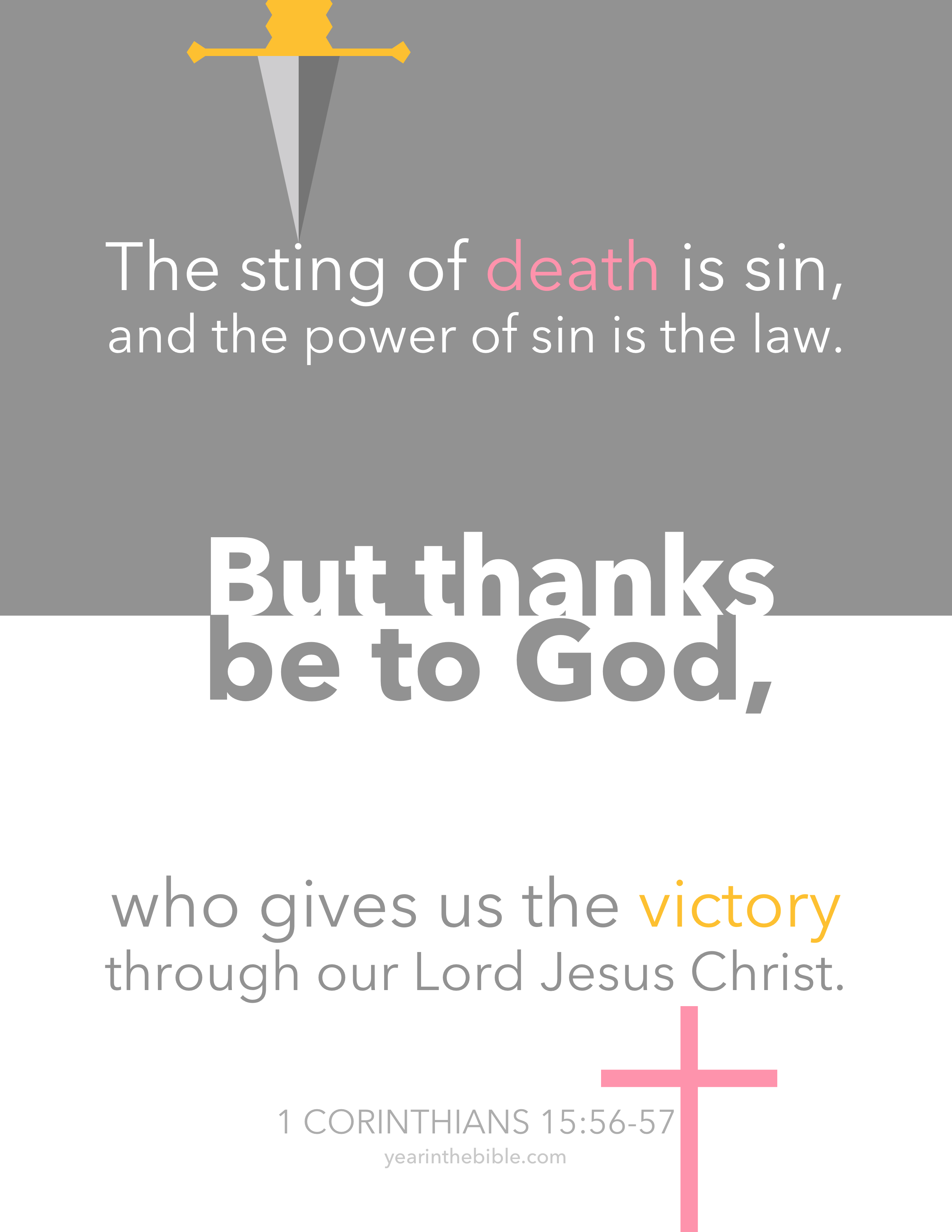
But thanks be to God for the victory we have in Jesus Christ

We’re back to having a Bible visualization this week. (I’m still trying to catch up on last week.) 1 Corinthians 15 is a powerful chapter on the resurrection of Jesus Christ and what that means for us as well. Paul puts it succinctly near the end as he lays out a great contrast. We all face death and are under the power of sin. The law could do nothing to save us from such a fate. Then Paul uses that wonderful, good news-filled, gracious phrase: but God. Or at least in this section, “but thanks be to God.” Death is not the end nor does sin have the power. God, through Jesus Christ, gives us the victory over such things in his death and resurrection.

 Memory Verse for 1 Cor 15.56-57

Call for questions on 1 Corinthians 14:26-15:34

I have been gone quite a bit over the last two weeks and have not managed to do much more than put up the Bible study handouts for the readings. In the meantime we’ve had some great bits in 1 Corinthians and rather than brush over them and move right along to what we’ll start tomorrow, I wanted to put out a call for any questions. Was there some standout part of these last two weeks of readings that you have a question about? Was there something that you weren’t quite sure about? Maybe you just want to see if there is more to know about a section that you’ve always liked.

I can’t do it all this week, but I’d love to have a few suggestions that can be addressed. So if you have one–go back and see if you had something underlined or had written in a little question mark in the margins–let me know. Either email me, leave it in the comments, or some other third way of reaching me. I look forward to the feedback!

What is of first importance in 1 Corinthians 15

Paul structures the section we read this week in two parts, and the second flows from the first. First we look to Jesus Christ and his resurrection. Paul mentions what here is of "first importance." These are core events to the Christian faith, and without them–without Christ then the we would have nothing else. But since we do have such a hope that has been passed on to Paul, to the Corinthians, and through generations to us, then we see in what follows that Christ’s resurrection provides a way for our resurrection.

Christ’s resurrection is like the bottom Jenga piece that if you remove, everything else falls apart. If Christ is not raised from the dead, as Paul writes, "we are of all people most to be pitied."

A Brief Answer to “Should Women Be Silent in Church?”

Paul writes what have been pretty controversial words in 1 Corinthians 14:34:

The women should keep silent in the churches. For they are not permitted to speak, but should be in submission, as the Law also says.

So what does that mean? Is it plainly that women shouldn’t be allowed to talk in a church service?

Here is the brief answer I supplied for this week’s Bible study:

In chapter 14 Paul has been writing about speaking in church and not speaking in church, trying to maintain order in the church’s worship service. He has told both those speaking in tongues and speaking prophecy to be silent. He tells them to be silent to protect worship and encourage peace and the building up of the body. He doesn’t tell them to be silent because they have no place in worship–Paul actually lifts up their value in these last few chapters. In that context, it is not unlikely that he is telling women now to be silent because of disruptions in worship that may have occurred as women, in that time usually less educated and separated from the men in worship, were talking with each other or speaking to their husbands asking questions in order to better understand what was being said. Paul would rather that take place elsewhere and he values peace over confusion and commotion when the church gathers.

A good Presbyterian memory verse

Memory Verse for 1 Cor 14.40

If you’re a Presbyterian, particularly one who has served one a committee or session, then you’ve almost certainly heard the phrase, “decent and in order.” Now, if you haven’t already, you can memorize that phrase and add to it a knowledge of where it comes from. Paul writes those words in his essay on worship, for he believes our worship should be an environment where we can learn, where our God of peace is best represented, and chaos and commotion are kept at bay.

Should I speak in tongues? If I can’t is there something wrong with me?

Personally, I believe there is much I could learn about speaking in tongues. I’m not part of a tradition nor am I from a part of the world that embraces it as much as others. That said, I think I can still understand some of what Paul wants us to learn in 1 Corinthians 14 in regards to the practice.

I think it’s clear from Paul’s writing in this chapter and in the ones preceding that speaking in tongues does has a place and a function in the body of Christ. But that place is not primarily in public worship and its function isn’t for boasting and it’s not to be a litmus test as to whether or not you have the Spirit. After all, it is just one of many gifts of the Spirit, and each is gifted according to God’s will.

Unfortunately this is how tongues is presented in some churches. To those churches whether or not your speak in tongues is the sign of if you have the Spirit of God. It is treated as the sign and the gift above others. That is not building up the body and instead it’s dividing it between the haves and have-nots. That is not the reason we’ve been given these gifts by God.

That reason, the building up, is so important and it is why Paul placed prophecy above speaking in tongues in this section. Speaking in tongues is a more personal, private gift, but prophecy is one that builds up the body, believer and even unbeliever. He doesn’t want to demean speaking in tongues, and he mentions that he does it himself. But he does want to focus more on the goal behind these gifts, that is, of building up the body.

Build a cathedral, not a new vacation home

In my commentary on 1 Corinthians by NT Wright, he uses a great illustration for the purpose behind these spiritual gifts. Paul desires that they be used for the body, for love, and to build up. Wright then describes two different building projects in his writings on this section.

And the key question, which he highlights in the first verse, is: are you behaving according to the principle of chapter 13? Are you exercising the gifts God gives you in the spirit of love? The underlying contrast here is the same as we saw in chapter 8, verses 1–2: there are some things which can ‘puff you up’, making you proud and self-important, but what builds people up is love. And this chapter is all about making sure that public worship ‘builds everybody up’ rather than simply everybody developing their own spiritual giftedness and displaying it like so many strutting peacocks. When people come together to worship the God revealed in Jesus, they are not building their own private houses. They are building a great cathedral for all to share and enjoy.