God’s Work, Not Our Work

Therefore do not be ashamed of the testimony about our Lord, nor of me his prisoner, but share in suffering for the gospel by the power of God, who saved us and called us to a holy calling, not because of our works but because of his own purpose and grace, which he gave us in Christ Jesus before the ages began.
2 Timothy 1 :8-9

As much as this is a letter to Timothy and about his ministry, it isn’t really about him. Paul wants to keep the focus on Jesus Christ and what he has done. It is not on the basis of our work that we are called, but because of God’s purpose and grace.

That doesn’t mean we aren’t called to do a work. We are. God has a plan for us and wants us to follow it. But just as it isn’t all about Timothy, it isn’t all about you or me. We are to make our work point to Jesus.

We do have a role to play, but Jesus deserves all the glory. We would have nothing if not for the grace given in him.

It reminds me a bit of this quote from Stacey King, a teammate of Michael Jordan.

I’ll always remember this as the night that Michael Jordan and I combined for 70 points.
(Said after Michael Jordan scored a career high 69 points and Stacey King scored 1 point against the Cavaliers. )*

*But when it comes to the work of our salvation, we don’t even contribute that one point.

Salvation is Only a Work that God Can Do

"The Vision of The Valley of The Dry Bones", Gustave Doré, 1866
“The Vision of The Valley of The Dry Bones”, Gustave Doré, 1866

Our focus passage from this last week was the familiar passage (at least familiar relative to other parts of Ezekiel) of the valley of dry bones. God brings Ezekiel to a place full of death. There are bones that are long dead and have dried up. They appear to be hopeless, for who holds out hope that life can return to a corpse, let alone the bones that remain after years of decay? But God commands Ezekiel to speak this prophecy to the bones:

O dry bones, hear the word of the Lord. Thus says the Lord God to these bones: Behold, I will cause breath to enter you, and you shall live. And I will lay sinews upon you, and will cause flesh to come upon you, and cover you with skin, and put breath in you, and you shall live, and you shall know that I am the Lord.

Ezekiel 37:4b-6

As God had described it so it happened. Ezekiel witnesses dry bones covered with sinews and then flesh. But just to have appearance of the living is not enough. God then breathes life, Spirit, into the bodies. Then they stood as a great army.

These bones represent the whole house of Israel that believed itself beyond hope, but God still had a plan for them. He would revive them and put his Spirit within them. Just as it was with the vision of the bones, the work God would do in Israel would be miraculous and therefore would cause the people to know whose hand was behind this. Then the people would know God is the Lord for only God could save them from death and gift them with life.

This chapter describes the work of God for a nation in exile and suffering from their sins, but the miracle of turning death to life is described as well in the New Testament. I find that Ephesians 2 parallels this in some ways.

And you were dead in the trespasses and sins in which you once walked, following the course of this world, following the prince of the power of the air, the spirit that is now at work in the sons of disobedience— among whom we all once lived in the passions of our flesh, carrying out the desires of the body and the mind, and were by nature children of wrath, like the rest of mankind. But God, being rich in mercy, because of the great love with which he loved us, even when we were dead in our trespasses, made us alive together with Christ—by grace you have been saved— and raised us up with him and seated us with him in the heavenly places in Christ Jesus, so that in the coming ages he might show the immeasurable riches of his grace in kindness toward us in Christ Jesus. For by grace you have been saved through faith. And this is not your own doing; it is the gift of God, not a result of works, so that no one may boast. For we are his workmanship, created in Christ Jesus for good works, which God prepared beforehand, that we should walk in them.

Ephesians 2:1-10

Like the dry bones, we were dead. What could the bones do to restore flesh and life? Nothing. As a people dead in our sins, how could we save ourselves? We lived according to the sinful ways of the world, like the people of God in Ezekiel. They acted just like the nations surrounding them and suffered discipline for their disobedience. Likewise we are described here as children of wrath, just like the rest of mankind. But God rescues us in both situations and it is not because we deserved it. I see two reasons, first that God is merciful and loving to his people.

But God, being rich in mercy, because of the great love with which he loved us, even when we were dead in our trespasses, made us alive together with Christ…

Imagine reading that passage and ending before this verse. It is a dire situation. That is a pretty big “but” that comes to our aid. The situation was dire as well for the people in exile. In both, all hope is lost if not for the intervention of a gracious God. It is and has always been “by grace you have been saved.”

The other reason that God would do such a thing is that it fits in with his perfect plan. In Ephesians we see lines like, “so that in the coming age he might show immeasurable riches of his grace in kindness toward us in Christ Jesus” and “created in Christ Jesus for good works.” Ezekiel is full of the line, “that you may know that I am the Lord your God.” God’s work for the whole house of Israel is a testimony to his character and his grace and he wants the people to know, and he wants the world to know. We are chosen not to merely enjoy a blessing, but to also carry a great responsibility in God’s plan for this world.

God saves us from our sin and he raises us up with Christ. He does so because he has a plan for us. That plan is one of blessing, surely. But it blessing to be shared. His saving us is not a result of good works, but it is part of a plan that God prepared beforehand that leads to good works for his sake.

It is only because of God’s grace could we receive such mercy and love. Like dry bones, we could not bring back life. Even if we could somehow restore flesh and sinews, we still would lack life–the breath of God within us. Fortunately his plan did not call for us to remain dead. His plan was for us to have a life where we walk in his ways. This plan bought us back from death, restored us, and raised us to life with and because of our Lord Jesus Christ.

More on hypocrisy, aided by Blue Like Jazz

As I wrote on Matthew 23, I was reminded of a favorite section of the book Blue Like Jazz by Donald Miller. It doesn’t entirely fit the hypocrisy of the scribes and Pharisees of Matthew 23, so it didn’t fit in with that post, but I wanted to share it.

His struggle with hypocrisy wasn’t a self-righteous boasting, but did have the flavor of not practicing what he preached, as seen in Matthew 23:3. He writes this as he was confronted with something like a crisis of faith:

“I don’t have any doubts about God or anything; it’s just me. I feel like I am constantly saying things I don’t mean. I tell people they should share their faith, but I don’t feel like sharing my faith. I tell people they should be in the Word, but I am only in the Word because I have to teach the Word. I said to a guy the other day, ‘God bless you.’ What does that mean? Then I started thinking about all the crap I say. All the clichés, all the parroted slogans. I have become an informercial for God, and I don’t even use the product.

As much as we can keep ourselves busy, busyness can hide time from honest, personal reflection. This is true within the church as well as it can provide plenty to occupy your time. These things can all be very good. But make sure that you slow down and make sure you are seeking out God himself, and not just the good things of God. Ritual and habit are not bad in and of themselves, but take time to think through our actions and the meaning behind them. As you approach the Bible, seek God in his Word for the joy of knowing him, not only to finish this reading plan.

I will say that there is a place for obedience, even when we “don’t feel like it.” God can use us regardless of our initial willingness (see Moses and all sorts of other characters from the Bible). That may be a critique of this book. Christianity is not always going to be some authentic expression of our deepest desires. Our deep desires are often sinful, and a life following Christ is hard as he warned us that we’ll have to pick up our cross to follow him.

But there is wisdom in this quote. We shouldn’t mistake learning about God with knowing God or giving instruction for others with personal discipleship.* For example, taking children to church is not the same thing as bringing them up in the faith. Writing a check for some ministry is not the same as serving people face-to-face. Researching the Bible for a class is not all that reading the Bible is about. These are not bad things, but we must make sure we do not let them become everything. We are invited not only to live a certain way or to know certain things, but to know God in Jesus Christ–to have a relationship.

Informercials can be really informative, but God wants disciples who follow him, and they can be transformative in this world.

*A problem it seemed the scribes and Pharisees had. Matthew 23

Woe to Hypocrisy

Jesus comes down hard on the scribes and Pharisees in Matthew 23. They are guilty of hypocrisy as “they preach, but do not practice.” They lay heavy burdens upon the people, yet they will hardly lift a finger. These leaders love to soak up all the attention that their positions bring, presenting themselves outwardly as righteous. But in their hearts they are sinful. As leaders they are blind guides who close the doors of the kingdom on people, and under their leadership people fall further from the truth.

One illustration Jesus uses works perfectly as an object lesson, one that I remember as a kid helping my mom get ready for a youth group session. Jesus says, “you clean the outside of the cup and plate, but inside they are full of reed and self-indulgence.” To recreate this, I went out in my backyard and was tasked to play in the dirt. A great task for a young boy. One cup was to be dirtied on the outside, but clean inside. The other was to look spotless externally, but filthy on the inside.

The trouble with the pharisees is that they work hard on the external appearances and do nothing in regards to their hearts. But Jesus has already taught that it is what comes from within that makes us clean (Matt 15:11). What is within them is unclean. If attention was paid to cleaning the inside, then the outside could truly be clean, as well. An even more severe description is then applied to these leaders. Jesus says that on the outside they appear freshly painted with new coats of clean, white paint. But this paint is only a thin facade that hides the fact that within is a tomb, full of bones and uncleanness. They are full of death, yet are tasked with helping the people live!

Their hypocrisy is the double standards that they apply and the two-faced life they live. They look one way, but act another. They instruct people to live in ways completely different from how they live themselves. They are hypocrites as they boast in themselves, yet they truly have nothing worthy of such boasting.

Certainly it is possible for Christians to be guilty of hypocrisy in just the same way. But Christians should not make claims about having attained righteousness on our own, nor having made ourselves completely void of sin. In a way we ought to know better than others just how sinful we really are. We then can’t boast in the ways the scribes and Pharisees do. We can only boast in Christ. Only he can make us clean. Only he can bring us to life, as though he were opening those tombs and giving life to dead bones. That’s what we boast in. Therefore it makes no sense to seek celebrity and fame for ourselves, looking for places of greater honor.

These woes are still warnings for us today. We should be on guard against such sinful tendencies we all have. We ought to preach and practice, humbly doing so with a gospel that is firmly rooted in the redeeming work of Jesus Christ, not our own. And as God does accomplish his transforming work within us, we can’t allow ourselves to be puffed up with pride. From start to finish it is God. Pride only interferes with that. Humility opens a person up to his work.

Humility also confronts hypocrisy as it is not afraid to let others see our weaknesses, since humility is not concerned with receiving praise. Rather in our weakness, humility knows that it is only God who is seen as strong.

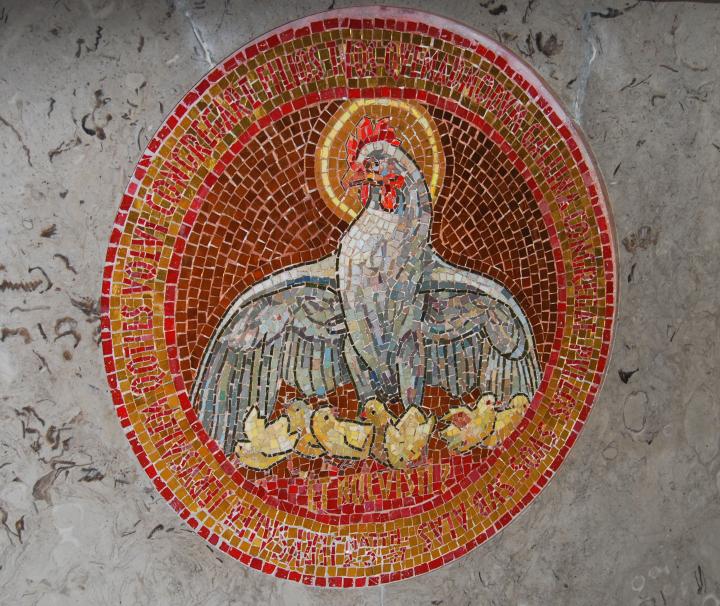
As a Hen Gathers Her Brood

When I was on vacation after Christmas I went to church and heard a sermon that was on Matthew 23, with great focus on the image that comes at the end. Jesus laments for Jerusalem saying:

How often would I have gathered your children together as a hen gathers her brood under her wings, and you were not willing!

The preacher referenced a mosaic that depicts this, so I wanted to track it down to share it with you. It is found at a church called Dominus Flevit, which means ‘the Lord has wept.’ It is located on the Mount of Olives, where Jesus wept over Jerusalem, and its architecture designed to resemble a tear drop.

It is humbling to think of the care Jesus has for us and how it extends even to those who reject him. He is brokenhearted over Jerusalem and only desires to protect and love its people.

Dominus Flevit Mosaic

God is still guiding history, and he won’t take a day off tomorrow

mayan calendarDon’t forget to set your clocks tonight–the end of the world is tomorrow.

Or so some interpreters of Mayan calendars would have us believe. But there are some real easy reasons to ignore this and the many other claims like it that come up every so often. We aren’t looking forward to the end of the world. We aren’t looking forward to the end of our time on the world, as if we were to be snatched away. We are looking ahead when Jesus Christ will come back. That is what we believe the future holds.

Not this week, but later in Matthew we are told we don’t know the day nor the hour this will happen. (So if someone is real specific, that’s reason number one they are wrong.) We are to live always with vigilance in anticipation of his return and live in light of his rule. We need not be fearful about the end, nor do we need to worry or panic about its coming. We have read this week that God came into this creation. He did not create the world, wind it up and then let go. We aren’t chugging along on our own. God has created this world, but he has remained intimately involved with it. No end of times would spring upon us as though it snuck up on God, too. We need not panic for this world is not out of his sovereign hands.

Christmas shows us that God still cares and has not forsaken his people nor his creation. The opposite is true–he still has a perfect plan for us and nothing can stop him. Not even the Mayans.

Bonus: Enjoy REM singing happily about the end…

Into Darkness Christ Came: Matthew 2 and Reflections on Newtown, CT

We know about the recent events of Newtown, CT and the depths of darkness we see in such a tragedy. It make me ache to think of those whose lives were snatched away. It seems difficult to celebrate with joy the coming of Jesus when the world looks so dark.

Sadly, that is just the sort of world to which Christ came. It is why he came. This place is not as it should be nor is it as it was created to be.

When Christ came, did waves of goodwill roll out from Bethlehem enveloping the whole world? Sadly no. Immediately the dark powers of this world were in full force. Jerusalem was distrubed, but the king–the man with power and power to lose–escalates the situation. Hate takes hold, fear drives him on. And so soon after Immanuel, Jesus Christ is born, children are slaughtered by Herod to protect his place as King.

16 When Herod realized that he had been outwitted by the Magi, he was furious, and he gave orders to kill all the boys in Bethlehem and its vicinity who were two years old and under, in accordance with the time he had learned from the Magi. 17 Then what was said through the prophet Jeremiah was fulfilled:

18 “A voice is heard in Ramah, weeping and great mourning, Rachel weeping for her children and refusing to be comforted, because they are no more.”

Matthew 2

How can we even claim to be a people–a world–worth saving? From his first to his final breath, we see how the world reacts to its savior. Jesus comes to bring peace on earth, to make peace between humanity and God. Yet Herod seeks his life at his birth, and the crowds are calling to crucify him before his death.

It is terrible. And this world can still be terrible. It can terrify us. But that is why he came. And that is why we need his peace. Only Jesus has the power and authority to say in John 14, Peace I leave with you; my peace I give you. I do not give to you as the world gives. Do not let your hearts be troubled and do not be afraid.”

But it is hard to live with his peace, especially in trying times. I am reminded of the Christmas carol, “I Heard the Bells on Christmas Day” and this stanza:

And in despair I bowed my head
“There is no peace on earth,” I said,
“For hate is strong and mocks the song
Of peace on earth, good will to men.”

Hate is strong. There is evil is this world. We can’t ignore that. We can’t deny it. The events of the world do not make sense if there is no sin. It is a powerful force pulling and pushing us. But there is more. Hate is strong, sin and death are powerful, but they do not have the victory.

It may appear that they do, but we are to live according to what is unseen. We are to step out in faith and believe that Christmas does mean peace on earth and Jesus has come to save. It does not always look like this has happened. But by faith we say we will not live according to the darkness. We won’t live according to the ways of the world nor the values or this world. We, by faith, seek to be children of light and live in light of God’s rule. We live as followers of a new way.

He did not design his people for hate and fear. He called us to love and service. We are called to live in a way that is a great ‘yes’ to God and his ways, and is a resolute ‘no’ to the evil we know tries to overwhelm the world.

Christ came into a world not unlike what we see now. Full of fights for power, with greed, fear, and hate. A world with sin. The fight looked to have been lost to all who knew him for those powers had won. The powers had put him on the cross. It looked like the day was lost–that love had lost. But we were wrong. Christ defeated such powers and did so through sacrifice, humility, love, and obedience. The cross looked to become a sign of the victory of all that is wrong in the world, but appearances can deceive. Hate was strong, Christ was mocked, there seemed to be no peace. Despair seemed the only option for his disciples.

But the truth of God can go unseen for a time. Sin and death were no match. We were wrong. When it looked like Christ had failed and God had died, he had won the victory. The Christmas carol concludes:

Then pealed the bells more loud and deep:
“God is not dead, nor doth he sleep;
The wrong shall fail, the right prevail,
With peace on earth, good will to men.

By faith we hear those words and sing that song. There still is hideous evil in this world and we mourn. But we Christians are called to live out our hope. We live unlike those who believe hate gives strength and power prevails. We follow a savior who had power in humility and submission. Our savior died at the hands of evil, but he died for us, and he now lives. At this time of year we celebrate his birth, but every Sunday we celebrate his resurrection, and the resurrection is victory over the powers of sin and death.

Jesus Christ came to a world created good, a world that fell–but did not fall from grace. God’s grace endures. Christ came to this world bringing grace, making peace, and doing so because it is a place in the greatest of need.

Today the world needs Jesus Christ. We need him. Only he is our peace, and when we place our faith in him, look to him for our hope, and live in his love, then we make a stand. We draw a line and say ‘no.’ We will not let sin masquerade as sovereign on earth. We will not forsake this world to evil. God is not dead, nor does he sleep. Christ rose and we will carry his name into a world in desperate need and live according to his rule, anticipating the day when he will come again.


Nehemiah’s Mourning

In the opening of Nehemiah hears the sad news of what state Jerusalem is in and in response he weeps and mourns for days. I think if we saw this godly sort of grief happening we might think something was wrong–not with the situation of Jerusalem being in ruin–but rather with Nehemiah. Days of mourning? We might try to tell him to think about something else. Do something to get if of your mind. Don’t be so glum.

But this is not a mourning that bears no fruit. He is deeply affected by the news he has heard and it leads him to action. His sorrow leads him to put everything on the line, going to the king and asking leave to return to Jerusalem. Once there it leads him to repent with his countrymen. It leads him to give generously from his wealth to sustain the building projects. And this is not just a simple construction site. It is full of danger. Nehemiah is moved at this news and does not just write a check and send it off, while staying in safety. He goes to the city and together with the people stands guard against his enemies who intend to attack. To rebuild the walls is not an easy endeavor and it is a dangerous one for all who are involved. God used Nehemiah’s mourning to him to action and sacrifice in order to accomplish God’s will.