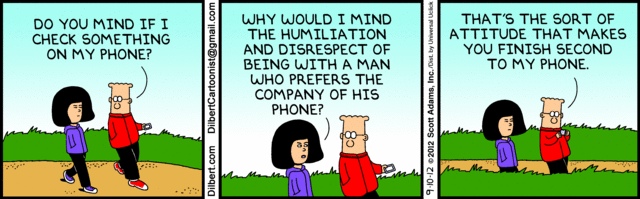
I wonder if God ever says something like this as he watches us. Do we prefer phones to people, to real presence, to God?
(There is even a movie coming out in 2013 in which a man falls in love with his phone.)


Guided reading plans to help you read and understand the Bible.
I wonder if God ever says something like this as he watches us. Do we prefer phones to people, to real presence, to God?
(There is even a movie coming out in 2013 in which a man falls in love with his phone.)
Philippians is a book that shows the great depths of Christ’s humility. Christ is the one who has the most reason to be proud, but instead he humbled himself more than any other. He came down to us from heaven, emptying himself and taking the form of a servant. Not only did he come to serve, but he came to die for the people he came to save.
Paul writes to the church urging us to follow Christ in this regard. He says, “Do nothing from selfish ambition or conceit, but in humility count others more significant than yourselves. Let each of you look not only to his own interests, but also to the interests of others. Have this mind among yourselves, which is yours in Christ Jesus…” Then what follows it he powerful description of Christ’s humility.
But Christ does not end in a lowly position. His end is not the cross. He has been raised up and at the name of Jesus, every knee should bow and every tongue confess that Jesus Christ is Lord. This is quoted from the book of Isaiah, here in reference to Jesus and in Isaiah as a reference to God. Paul is making the case that it is right to worship Christ, to lift up his name. He is the Son of God.
In sight of this, how can we not be humble? God came to us, died for us, saved us, loves us. This is not something God had to do, but something he chose to do in his great mercy. We cannot live in light of this with conceit or pride. We ought to live like Christ, being like servants. If we are to make a name for anyone, it should be the name of Christ. Like John the Baptist our pursuit is to decrease so that Christ may increase (John 3).
We should put great effort and energy into spreading the name of Christ, all for the glory of God. Our work should be to shift focus away from ourselves and onto the one who has saved us.

I read this quote a while back and I think it is fitting. It is about orchestras and the way in which the best musicians come together not to bring attention to themselves, but to come together and make something greater than themselves. It’s from an article The Believer, which I’ve slightly edited, referring to the New York Philharmonic:
They were the top in their school and then the top at Juilliard and now they’re playing second cello. And the humility is as high as the musicianship. Let’s say you’re playing a Beethoven piece in a room where the same piece was played one hundred years ago. They’re sitting in the same chairs, wearing the same shoes and suits, playing instruments that are one hundred years old, playing the same sounds with the best conductor of their time, who is standing under photos of twenty of the greatest conductors. And when the music started playing, I had this idea that the music was coming through this little channel—for lack of a better word—for years and years. Musicians come and go and they’re stewards of the music for a brief period of time. But once the music plays—it’s really between Beethoven and the listener at that point. The musicians are there to get their … hands off of it. All that training! Thousands of hours! Sight-reading every day! All so they can get … out of the way because nobody gives a crap about them at all. The less you notice them, the better it sounds. I mean, it was the highest level of art in music that I’d ever seen, and it was performed by people who had spent countless hours of work just to be invisible.
We may know the name of an orchestra or even the name of the conductor. But can we name all the musicians whose work comes together to make something beautiful? That is how it should be in the church. We hope the church has made itself known for its great work and witness in this world, and certainly we hope the conductor, Christ, is known the world over. But our aim, as a second cello, should not be to draw attention to ourselves.
We are stewards of the gospel, stewards to the King of Kings and Lord of Lords. He has entrusted us a great work to do for his kingdom. We ought to devote such countless hours to make Christ visible and ourselves invisible–at least compared to Christ. That is humility. May he be seen by what we do. May Christ’s name receive all glory for our labors. May Jesus Christ receive all praise.
I had two people this week send me something in regards to the Bible. One of them was this fabulous illustrated kids map for areas in the Old Testament, but it is under copyright, so sadly I do not think it would be the most responsible thing to post here.
 The other was a reflection on Joel 2:25a:
I will restore to you the years that the swarming locust has eaten…
Her reflection (if I understood correctly) was on what seemed like the years she had lost by not studying Scripture earlier in life. But she was comforted by another who shared this verse with her. God can do great things to restore in us what has been lost. Whether it has come due to his discipline or judgment in our lives or some missed opportunity due to our poor choices, God can use even the damaged experiences of this world and work through them to bring about something glorifying to his name.
This fits with last week’s readings, but I thought it’d be worth writing about.
Hosea is a startling story. It is unique in what the prophet is called to do, not just say. He is to marry a whore, and his relationship of faithfulness to an adulterous spouse parallels that of God’s love for his adulterous people. And that still applies to us now, to his church. It reminds me of a song by Derek Webb called “Wedding Dress.” He writes about the church’s tendency to look for something more than Christ, to find satisfaction outside of him. But this is a propesterous idea given that Christ has given us all we need. He even gave his very life.
Listen to the song below:
If you want to hear his explanation for the song, you can find it here. I’d mention this as some context–he doesn’t write and sing about the church and its sin as some third party observer. He acknowledges that he is a part of it and he is sinful, too. He doesn’t speak in condemnation of the church, but in rebuke that comes from love. We must still love the things that God loves, including the church, but that then leads us not to accept such faults, but to work for its restoration.
That is what the prophets do, as well. They love God’s people and because of such love they desire greatly for their repentence.*
*Jonah is a bit odd here since he is a prophet to a people he doesn’t love, but that’s a problem that we’ll talk about next week.
We’re getting far along in this summer quarter of Year in the Bible. It may be a tough time for many of you to stick with it. We’re not so close to the beginning that its novelty spurs you on, nor are we close enough to the end of our year that the light at the end of the tunnel serves as motivation. On top of that we’re coming to the end of summer when many schedules shift and kick into high gear.
You’re not alone in such difficulties. Find someone else who is reading and be encouragers. We see encouragement as a great caling for Paul in his letters. He writes to teach, to challenge, to inform, and also to encourage. I think we underestimate the value of having others to help us along in the journey, or we underestimate how much our own words can lift someone else up.
But I hope you can keep with it as this is something I believe is of great value. Know that I’m praying for you all.
This week we go through several smaller books, so make sure to keep them straight. It’d be a great idea to pause once you finish each book and write a few sentences about what each book was about.
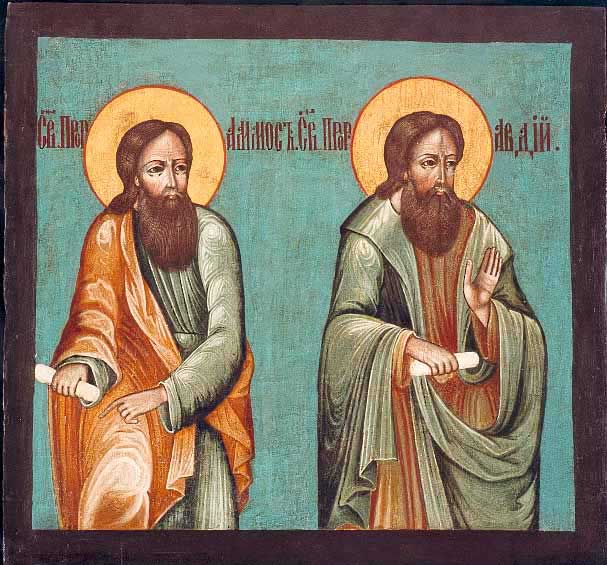
We continue in the minor prophets with Joel, Amos, and Obadiah. Don’t blink when you read that last once as it is only one chapter long. We then go to 2 Peter in the New Testament, and of course we have some Psalms to read as well. Enjoy!
How can I give you up, O Ephraim?
How can I hand you over, O Israel?
How can I make you like Admah?
How can I treat you like Zeboiim?
My heart recoils within me;
my compassion grows warm and tender.
I will not execute my burning anger;
I will not again destroy Ephraim;
for I am God and not a man,
the Holy One in your midst,
and I will not come in wrath.
Hosea 11:8-9
God speaks of his judgment at the faithlessness of his people, but shows his great mercy and compassion in these words. God is unlike us. We hold grudges and find it near impossible to forgive. We seek revenge and pour out hostility on those who reject us. God is not like us for he will never give up on his people.
We should have great comfort and security in God’s stubborn love for us.
I have read two interesting reports recently, one about the extremely high number of words that we read in a day, and the other about how we’re trying to squeeze more tv into more parts of our day.
The first article is article from the BBC which looks at a study from UC San Diego. It states, “An average US citizen on an average day, it says, consumes 100,500 words, whether that be email, messages on social networks, searching websites or anywhere else digitally.” I’m not sure if you’re aware–but that’s a lot of words. You’re reading a book a day at that clip.
But to where is all that reading being directed? Do we read short 140 character tweets and short one-sentence facebook posts? Is it countless articles from news sites? Do we devote a good portion of our those 100,000 words to God’s Word? It isn’t to say that we shouldn’t read anything else, but where are our priorities?
It seems like this word count is pretty impressive with how busy we seem to be, but even given our tight schedules, this other article was surprising, and you see why just in its title, How We’re Finding More Time to Watch TV. The author, Dorothy Pomerantz, takes a look at how new forms of media, like online videos, aren’t necessarily replacing more traditional television watching, rather they are coming in addition to TV. The author writes, “online video isn’t cannibalizing broadcast TV, it’s cannibalizing our non-screen time.” Traditional TV isn’t as much under attack as dinner time is. Again, it prompts us to ask about our priorities? All this technology at our finger tips along with some of the greatest minds of our day come together to work so that we can watch TV on the bus? Is that what we really hunger for? Maybe we need to go on an information diet.
This week we move along into week 9 of Year in the Bible, and I humbly offer you some words to read as part of your 100,000 per day.* We’ll read all of Hosea and 1 Peter, as well as some Psalms. Those first two fit very nicely together, and I hope that their pairing helps in your appreciation of these texts.
*Sorry, I just took almost 400 of them right now!

This week I read our Old Testament passages first before moving into the New, so by the time I read Romans, parts of 2 Samuel kept coming to mind. One part especially struck me from Romans 12 in the way we are to relate to our enemies.
David was by no means a perfect man, but he did display character unlike those around him. Starting back in 1 Samuel David has had many enemies, such as Saul, Abner, and Absalom. To these so-called enemies, David showed great respect and grace. In chapter 19 he is criticized for showing too much grief at the death of Absalom, who was his son, and his military commander complains and says David loves those who hate him.
But Romans 12 teaches us to bless those who persecute us and not to repay evil with evil. We are to love those who hate us. This certainly must be one of the most difficult commands placed upon us. We wish it could just stop at not repaying evil with evil. Couldn’t we just turn the other cheek and move along? Can’t I just walk away? To most such actions are commendable. But we’re called to do more.
It is too easy to support and encourage a perspective that views others as enemies (and not in a way to help target who we should love). We want a foil, a villain, an antagonist–someone or something to compare ourselves to and come out looking good. We’d rather demonize the enemy than sacrifice for their sake and show them love. This is not the way of the Christian.
Christ shows us a greater way, “Love your enemies and pray for those who persecute you.” When we were enemies, God showed his love for us in sending Jesus Christ.
We won’t be able to match his demonstration of love, but one simple way we could start is to hold our tongues when it comes to labeling others as ‘enemy.’
 Year in the Bible