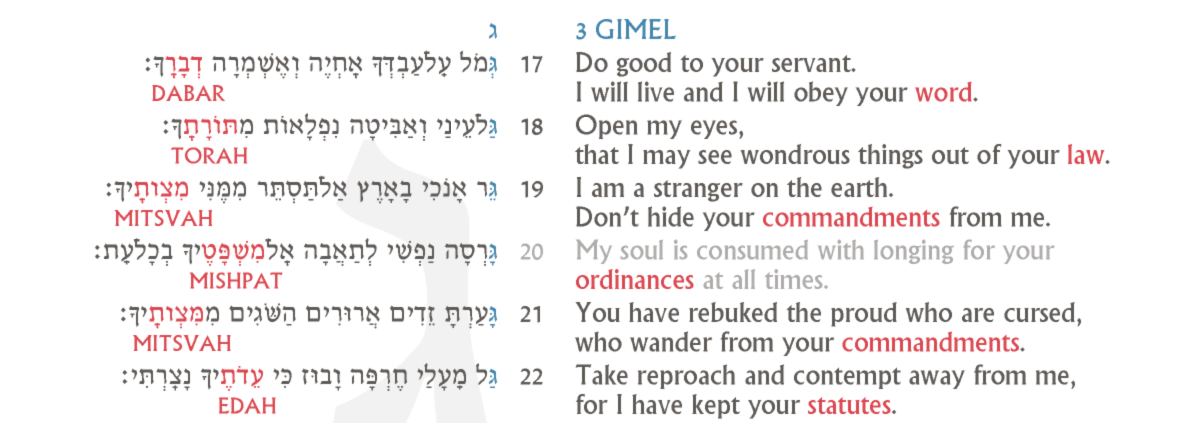
A look back at Psalm 119

Psalm 119 Screenshot

Better late than never, right? This would’ve made for more sense a couple of weeks ago when we looked at the very long psalm, Psalm 119. If you were at our church, you would’ve heard a sermon that said a great deal about this unique psalm, but I did not include anything on it here on the site. And maybe you’re more of a visual person.

I found this some months back and it emphasizes the acrostic nature of the poem (how each line of the stanza begins with the same letter, with the proceeding stanzas moving along through the Hebrew alphabet). It also points out the place that God’s Word holds throughout the psalm. The way this site puts it is this:

Psalm 119 is telling us that to know the Creator God you must know His law, ordinances, word, commandments, statutes, precepts, decrees, testimonies, ways, and faithfulness.

I’d really encourage you to go take a look at this, and maybe skim down to the end first, as it has a word of explanation that helps make sense of the rest.

Basics of the Bible – Psalm 119 (It is pretty big, so it may take a moment to load).

A supposedly more friendly mobile version is here.

Can There Be Perfect Matches Between Imperfect People?

In reading Song of Songs I thought this would be an appropriate time to share an article that is just an except from a larger book, but still one of the better and more insightful pieces on marriage I’ve read recently. It may be odd to read this along with Song of Songs, in which two people gush about one another. But it is good to remember that even the ones we love the most are imperfect, just like us.

Here is the opening paragraph:

In generations past, there was far less talk about “compatibility” and finding the ideal soul-mate. Today we are looking for someone who accepts us as we are and fulfills our desires, and this creates an unrealistic set of expectations that frustrates both the searchers and the searched for.

You Never Marry the Right Person, Tim Keller – Relevant Magazine

Questions of Women in Ministry, 1 Timothy 2

There is a passage in 1 Timothy that draws a fair bit of attention and controversy. As Paul gives instructions to Timothy in how to safeguard the church, he also includes descriptions as to how men and women ought to conduct themselves.

Let a woman learn quietly with all submissiveness. I do not permit a woman to teach or to exercise authority over a man; rather, she is to remain quiet. For Adam was formed first, then Eve; and Adam was not deceived, but the woman was deceived and became a transgressor. Yet she will be saved through childbearing—if they continue in faith and love and holiness, with self-control.

1 Timothy 2:11-15 ESV

Much of the controversy hinges on whether these specific instructions are specific to this church and its contexts, or whether they are universal in scope. Should the women (or woman) in Ephesus set their sights on learning humbly and restrain themselves from inappropriately teaching and seizing authority because they have been deceived, and were especially prone to deception given that women in that culture were not often allowed the same access to education? Or should women not teach nor speak by mere fact that they are women?

I’ve been reading more on this text in the last few days, looking for resources on this issue to help present the arguments eloquently. I’ll include a link to a short essay found on Biblegateway that I think does a good job of presenting the different views, and does so without a quarrelsome, arrogant, or dismissive tone. Many articles on this issue can be aggressive, and especially given the way in which the whole of 1 Timothy speaks to that problem in the church, I wanted to find something respectful.

Personally, as I’ve said before, we need to read Scripture in light of Scripture. There are examples throughout the Bible of women of influence and authority. In the Gospels women play a very prominent role, even more so when taken in light of the prevailing customs of that culture. We see in books like Romans and Acts that women already had prominent positions in the early church. Given that fact, and other theological assertions of Paul himself in letters like Galatians, I believe when we come upon Paul’s writing here, we are warranted to spend more time on the passage that may seem to more easily lean one way, and read it in light of other passages and understand it to mean something else. Again, if we note the culture to which he writes, the mere assertion that the women ought to learn (v11) already pushes the boundaries of the roles of women.

That being said, I’d encourage you to read this article. It is from the IVP New Testament Commentaries, provided “generously by InterVarsity Press.” Isn’t great what you can access for free on the internet?

Men and Women in Worship, 1 Timothy 2

A Reminder as to Why We Read the Bible

It’s been a while since I shared linked to an article here, but I thought I’d offer this short piece for your reading. It’s great to be reminded of the reasons behind what we do, and as much I try to encourage Bible readings, it is probably good to hear it coming from somewhere else.

So take a look at this article, Why We Read the Bible, from Desiring God.

Here’s a quick quote to sum up much of what it is about if you really don’t think you have five minutes to read today.

“Bible reading is meant to deepen our personal relationship with Christ.”

Solomon’s Temple

Solomon’s Temple is given great attention in our readings this week. As I write that it looks a bit wrong to call it Solomon’s Temple. It’s not his. He had it built, but we don’t always name a building after its architect or patron. It was for God.
Anyway–that’s what it is known as and I thought y’all might like to see some artist’s renditions to get a sense of what it may have looked like.

Enjoy. (My favorite is the second one. Be sure to click on it and read all the extra info!)

Interestingly, an Isaac Newton sketch of the temple
Click to see enlarged version (ESV Study Bible Illustration – another good example of why study Bible’s are great!)

And here is a video that is another interpretation (and the only one I found with such a tall front to the building–not sure how they did that math… but still interesting 3D look into things).

Job in 25 minutes

We’re finishing Job having now spent three weeks going through its 42 chapters. There is a lot to digest from it, and not only because of its length. It is a weighty book dealing with questions of God’s role in the world and suffering.

We were blessed at church to have had a sermon two Sundays ago that took on the minor task of preaching on the entirety of the book. Often as we preach from the texts we’re reading we preach on some of the texts. But as this tries to sum up the whole, I thought I’d link to it here and offer it up as a good word on this deep book.

The Patience of Job, Lauren Taylor, October 21, 2012