This reading plan through 1 Corinthians has been intentionally slow and many weeks have been quite short. The aim wasn’t to allow for the study and reflection to be quick and easy, rather to give time to review and reread, and gain great depth from this wonderful letter of Paul.
As we near the end of Paul’s letter I’d highly encourage you to start over. Go back to chapter one and begin again. Read it a couple times even. This coming Sunday starts the final week of readings and the more we can see the whole of 1 Corinthians and then combine that with the close focus we’ve put on each week’s assignment, the better understanding we’ll walk away with when we reach Paul’s final words. Going back through it you may find that the text is much easier to understand. You may see recurring themes that hadn’t stood out on your first read through. I’m not saying you’ll necessarily be an expert by now, but the more you study and pray through this book, the more God is going to use it.
Five months can seem like a flash, but what we read back in June may seem far off. Refamiliarize yourself with the whole and be reminded that while there are sixteen chapters, 1 Corinthians is still just one letter.
If you’ve already read through 1 Corinthians 13, well done. If you haven’t, that’s fine and maybe you’d want to do a little exercise. This is a chapter on love. It’s a very famous chapter on love. Paul helps us to better understand what it is. But there are many other people in the world today that would want to do that job for us. Things like music, movies, and even greeting cards compete with one another to tell us what love is.
With all those definitions floating around it’d be good to know what you think. So, before you read and study this week’s passage, try sitting down and reflecting on how you’d define love. What is it? What’s love look like?
Then after you do that, see how well your understanding lines up with what we see in 1 Corinthians.
Having now finished eight chapters of 1 Corinthians we are right in the middle of Paul’s letter and it is a great time to look back at the first half.
I was going to give a bit of a review in this post, but it’ll have to wait for tomorrow. But perhaps that’s serendipitous. It’ll give you time to see what you can remember on your own. See if you can remember something from the beginning, the next couple chapters, and then the most recent ones. Do certain themes stand out? Can you especially remember a certain passage? Did God bless you by your reading and study in some way?
In terms of the memory verses, do you have any of those stored away? As you review the verses from each week, which you could do visually here, does that help you recall more from the chapters that the verses are in?
As you take the time to do this, I’d absolutely love to hear how it goes. What has helped the most, what has stuck with you, what more can we do or what can we do differently? Let me know in the comments or via email or if you’re in the neighborhood, stop on by the office.
I hope that in reviewing, you get excited at what God has been teaching you and you can get a dose of excitement as we look ahead to the last eight chapters. (Maybe, if you’re so excited, you’d want to share this with a friend and invite them to read with you.)
When I was putting together some graphics to go along with this second iteration of Year in the Bible, I came up with a simple image of a book with a bookmark pulled down through the middle. Year in the Bible is a guided reading plan, so I thought a book with a bookmark fit that pretty well. The logo for Year in the Bible looks like a square and a triangle and is supposed to evoke the shape of an open book, too. I also have made bookmarks for this 1 Corinthians plan to tuck in your Bible. This all makes sense because books and reading go and in hand.
Except that is now changing.
When we kicked this off in June, I remember another pastor here mentioning the bookmarks and how you might need to take it and tape it to the back of your phone, if that’s where you read. What was meant as a joke had a lot of truth in it. For more and more people, reading the Bible doesn’t mean opening a book, but instead pulling out a phone.
What does it mean if reading the Bible now looks more like this?
So, I’ve been mulling that over for a while. Are there any implications for the way we engage with God’s word when we do so via a screen instead of a page? Do we lose something? Do we gain something? I certainly don’t have any conclusive remarks on this, especially since we’re just in the middle of what seems to be this great change in the way we read.
One worry for me is that I lose a bit of the uniqueness of the Bible when it is just another item for me to read on my phone. It doesn’t stand apart. I don’t have to make the deliberate choice I once did to carry a Bible with me. There is no sacrifice of space in my bag or the added weight to my shoulders. Also, if I went away to rid myself of distractions and to-do lists and emails and sat with my Bible, nothing else competed for my attention. With a phone or tablet, it is very easy to stop reading to quickly do something else. The temptation to multitask is great. For these reasons, and a few more, I’m not ready yet to part with my dead-tree Bibles.
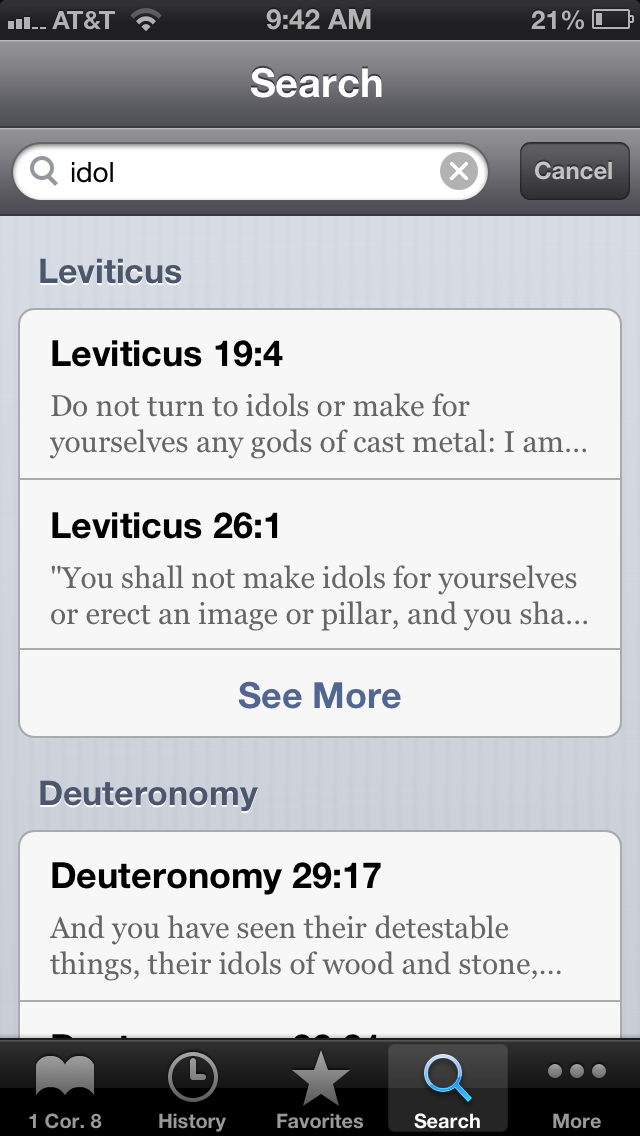
Searching the Bible has never been easier. (Pictured is the ESV Bible App)
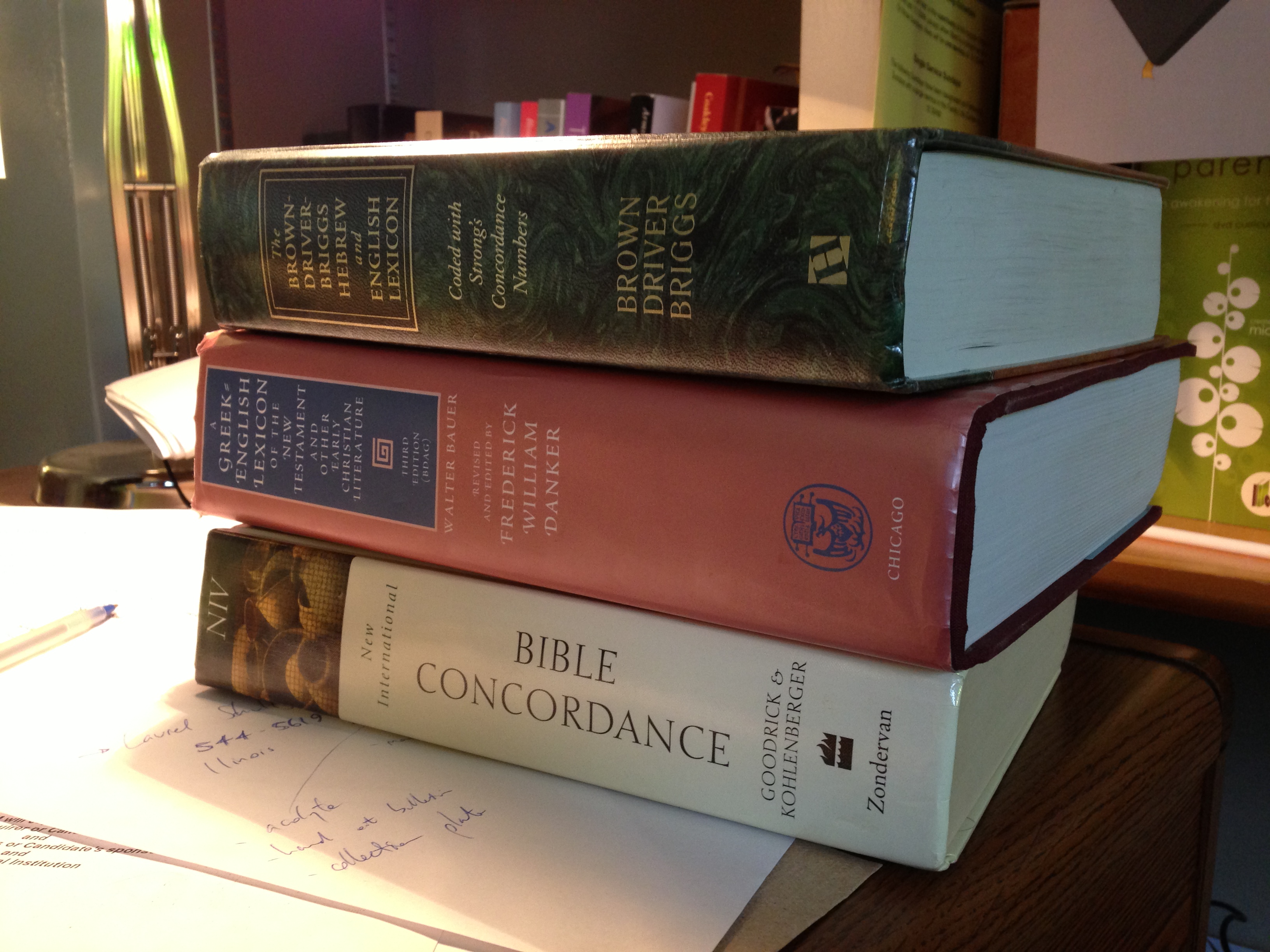
But on the other hand, I now always have the Bible with me. And not only one translation, but many. My paper Bibles have nice concordances, but with the technology we have now, I can search through the entire Bible in a moment. I can follow cross-references all around Scripture, and do so with ease. Reading like this on a phone or a website has really encouraged not only the reading, but study. I am no expert scholar in Biblical languages, but I’ve got tools that help me with Greek and Hebrew that fit in my pocket. With that sort of ability it is not an usual feeling for me to think that I am living in the future.
Imagine carrying these books in your bag, let alone your pocket.
There are sites and apps that can bring a communal aspect into your personal readings. You can tap on a verse and find out what comments others had contributed in regards to it. Have questions about what Paul meant in a certain passage? Maybe someone had the same question, too, and maybe someone else has a pretty good answer. There’s another program that provides fantastic illustrations and interactive graphics to help you feel like you’re in ancient Jerusalem, so as you read through the gospels you can see what it was like. As I’ve mentioned before, we can listen to the audio of the Bible and there can be real value in hearing and listening, as well as reading. Who knows what else may be offered in five or ten years?
Community notes in the Youversion Bible app
About five hundred years ago the Bible was a book that resided in the hands of a select few. It wasn’t for the masses. But things change. Perhaps some of the reverence was lost when the Bible slowly became common. Would you feel the same way about the Bible if you only saw it richly ornamented and embellished in a church instead of in every hotel room drawer? Probably not. Yet the gain outweighed what was lost. God’s word is for the people of God, and when the printing press started a revolution and the texts were being translated into the vernacular, it had a great impact.
Illuminated manuscript of the Bible
I don’t know all the implications of the technology many are now using to read the Bible, but we can at least rejoice as more people are given access to God’s word around the world. The tools are being spread and men and women are engaging with the Bible in new ways and the more we can draw attention–not to the technology–but to the content, the better it will be, for our focus can then be drawn to the Word of God, Jesus Christ.
Moving into chapter eight we are going from a chapter with 40 verses to one with only thirteen. So again, this reading plan takes a bit of self-direction. How do I best use my time throughout this week to not just check off reading 1 Corinthians, but how do I read it well? How do I study it? How do I pray through it? How do I open myself up to hear what God has to say to me? It’s short so you get creative.
I had the opportunity, due to a bit of a road trip today, to listen to 1 Corinthians in the car. I listened starting in the beginning and then went through chapter eight. Then I listened to chapter eight again. (Either to gain more emphasis for our current chapter, or maybe because it is easy to let my mind drift as I try to pay attention to driving.) This is a great way to spend some extra time this week. As I listened I could better detect the themes coming up again and again–words like puffed up and calling jumped out more than they have before. Also, as I went through the chapters I paid close attention to the memory verses, verses that now I can (almost) recite along with the reader of the audio Bible. It was great to be reminded of the context in which these verses fall.
If you need help in doing something like this, ie. listening to the Bible, let me know. There are websites for it such as biblegateway as well as phone apps like the youversion Bible.
So, with the shorter chapter, try rereading old chapters, or even listening to them. Also work on memory verses, either as a refresher or for the first time. It’s never too late to start.
And if those ideas aren’t enough, you could try writing me (or posting in the comments) some really hard questions about this chapter. I always like a challenge. Maybe your question will work its way into Sunday’s sermon!
While it’s always good advice to take notes and write down summaries of what you’ve read, this passage is especially suited for that method of Bible study.
First off, chapter seven is a long chapter. With anything that we read, our minds can easily wander even while our eyes continue moving from word to word. If we stop to make notes in the margins or in a journal, we are keeping ourselves accountable to reading in order to understand, not reading to get it done (and out of the way).
This chapter also covers lots of different topics and within those topics Paul will go back and forth between his views. Try to break it down in parts, step back and ask yourself what is he trying to say and how does this fit in the broader themes of 1 Corinthians? If nothing else, this practice will at least reveal the questions you may have and that is the first step to finding some answers.
This last week I had multiple conversations about how the language we use tends to reflect the language and words we around–both the speech we hear and text we read. This is all the more reason to devote ourselves to God’s word. We should let it sink deep within us and allow it to then flavor our own speech.
Memorization is a wonderful means to accomplish this goal.
That being said here is this week’s memory verse for chapter seven.
When Paul refers to Christ as our Passover Lamb, there is a wealth of Scripture that a Jewish audience would have flooding to mind. But the church, as it is now, is a place of great variety, and those who were familiar would have been expected to bring others along in their understanding. Here are two great passages to help make you more familiar with the Passover and further your understanding of how how Christ is our lamb.
Exodus 12
Here is where we learn of God’s instituting of the Passover. God’s people are in slavery in Egypt and God is in the process of bringing plagues upon the land as his means of deliverance. God then gives instructions for how to survive his final judgment on Egypt. It is a way for the Hebrews to be saved as death passes them over and this plague will be the catalyst for their deliverance from bondage.
1 The Lord said to Moses and Aaron in the land of Egypt, 2 “This month shall be for you the beginning of months. It shall be the first month of the year for you. 3 Tell all the congregation of Israel that on the tenth day of this month every man shall take a lamb according to their fathers’ houses, a lamb for a household. 4 And if the household is too small for a lamb, then he and his nearest neighbor shall take according to the number of persons; according to what each can eat you shall make your count for the lamb. 5 Your lamb shall be without blemish, a male a year old. You may take it from the sheep or from the goats, 6 and you shall keep it until the fourteenth day of this month, when the whole assembly of the congregation of Israel shall kill their lambs at twilight.
7 “Then they shall take some of the blood and put it on the two doorposts and the lintel of the houses in which they eat it. 8 They shall eat the flesh that night, roasted on the fire; with unleavened bread and bitter herbs they shall eat it. 9 Do not eat any of it raw or boiled in water, but roasted, its head with its legs and its inner parts. 10 And you shall let none of it remain until the morning; anything that remains until the morning you shall burn. 11 In this manner you shall eat it: with your belt fastened, your sandals on your feet, and your staff in your hand. And you shall eat it in haste. It is the Lord’s Passover. 12 For I will pass through the land of Egypt that night, and I will strike all the firstborn in the land of Egypt, both man and beast; and on all the gods of Egypt I will execute judgments: I am the Lord. 13 The blood shall be a sign for you, on the houses where you are. And when I see the blood, I will pass over you, and no plague will befall you to destroy you, when I strike the land of Egypt.
John 1
Here in the New Testament in John, John the Baptist is identifying Jesus with the Passover Lamb, proclaiming that Jesus has come to take away our sins.
29 The next day he saw Jesus coming toward him, and said, “Behold, the Lamb of God, who takes away the sin of the world! 30 This is he of whom I said, ‘After me comes a man who ranks before me, because he was before me.’ 31 I myself did not know him, but for this purpose I came baptizing with water, that he might be revealed to Israel.” 32 And John bore witness: “I saw the Spirit descend from heaven like a dove, and it remained on him. 33 I myself did not know him, but he who sent me to baptize with water said to me, ‘He on whom you see the Spirit descend and remain, this is he who baptizes with the Holy Spirit.’ 34 And I have seen and have borne witness that this is the Son of God.”
35 The next day again John was standing with two of his disciples, 36 and he looked at Jesus as he walked by and said, “Behold, the Lamb of God!” 37 The two disciples heard him say this, and they followed Jesus.
Take note that here in the very beginning of John’s gospel, Jesus’ ministry is already directed to the cross, where he will make the ultimate sacrifice.






 Year in the Bible
