Do We Read to Understand?

After reading a paragraph, a chapter, or a whole book, are you able to turn around and summarize what you’ve just read? It’s a great practice to jot down notes in the margins as you read, just as a simple exercise to make sure you’re actually processing the words that pass before your eyes. Then on the larger scale, we should ask ourselves the obvious questions after the completion of a book, “What did I just read?” Here is a short attempt at answering the question in a more roundabout way from the site Near Emmaus. He is attempting in just a couple paragraphs to describe the reason that Paul wrote Romans, and in so doing gives broad strokes of description about the whole book.

Here is just one line, but go to the site for more:

This epistle addresses the Adamic problem including Jews and Gentiles. Paul uses this problem to show the glory of the salvation found in those who have followed Abraham’s model of faith which is now encapsulated in those who call Christ “Lord”.

Give it a shot yourself after a chapter or section. See if you can very briefly boil down some of Paul’s arguments as you read. It’ll help you to better understand and retain these words of Scripture.
Year in the Bible, Quarter 2 Week 6

I’m back from vacation now and here we are in week six of Year in the Bible. We’ll play a little bit of catch up in covering the two weeks of reading on the site, so now is the time to share any questions you may have.

We’re continuing in both 1 Samuel and Romans, with the latter especially packed full of information. This is all the more reason to try coming out to one of the two reading groups to share insights and try to get the most out of these books.

I’ve been hearing some good stories from people who are keeping up with all the readings and even heard today of someone who was able to catch up on three weeks of backlog. What was great is that this catching up wasn’t rushed through just to get it done. We don’t want to read to have just read the Bible. We don’t want to check it off like some chore. We read to learn more of God and to hear his voice speak to us.

So if you are catching up, take your time. You don’t want to rush through and miss what God would have you see.

Off to the Midwest

Here is a short note on my vacation.

I just want to give a heads up to everyone that I’ll vacationing from posting this week. But that is not a vacation from reading.

We all have many things on our plates and when something new comes along, temporary or permanent, we have to make choices. Can we fit it all on? Does something need to be displaced? These decisions are made, whether we are aware or not. Let’s be assertive in such a process. If we take account of our priorities and step in to make these decisions, then we can protect what we deem important. Reading God’s Word is important.

I’ll keep that up, and post if I get a chance.

Year in the Bible, Q2 Week 4

We now begin another wonderful week of reading God’s Word. I hope you enjoyed the way, in just one week, we finished the letter to the Galatians. Certainly there is plenty to study in a book like that, but it packs a punch when you read straight though. We almost finished Judges, which we’ll do this week as it only has a few more chapters. Then on top of finishing Judges, we’ll begin and end both Ruth and Ephesians.

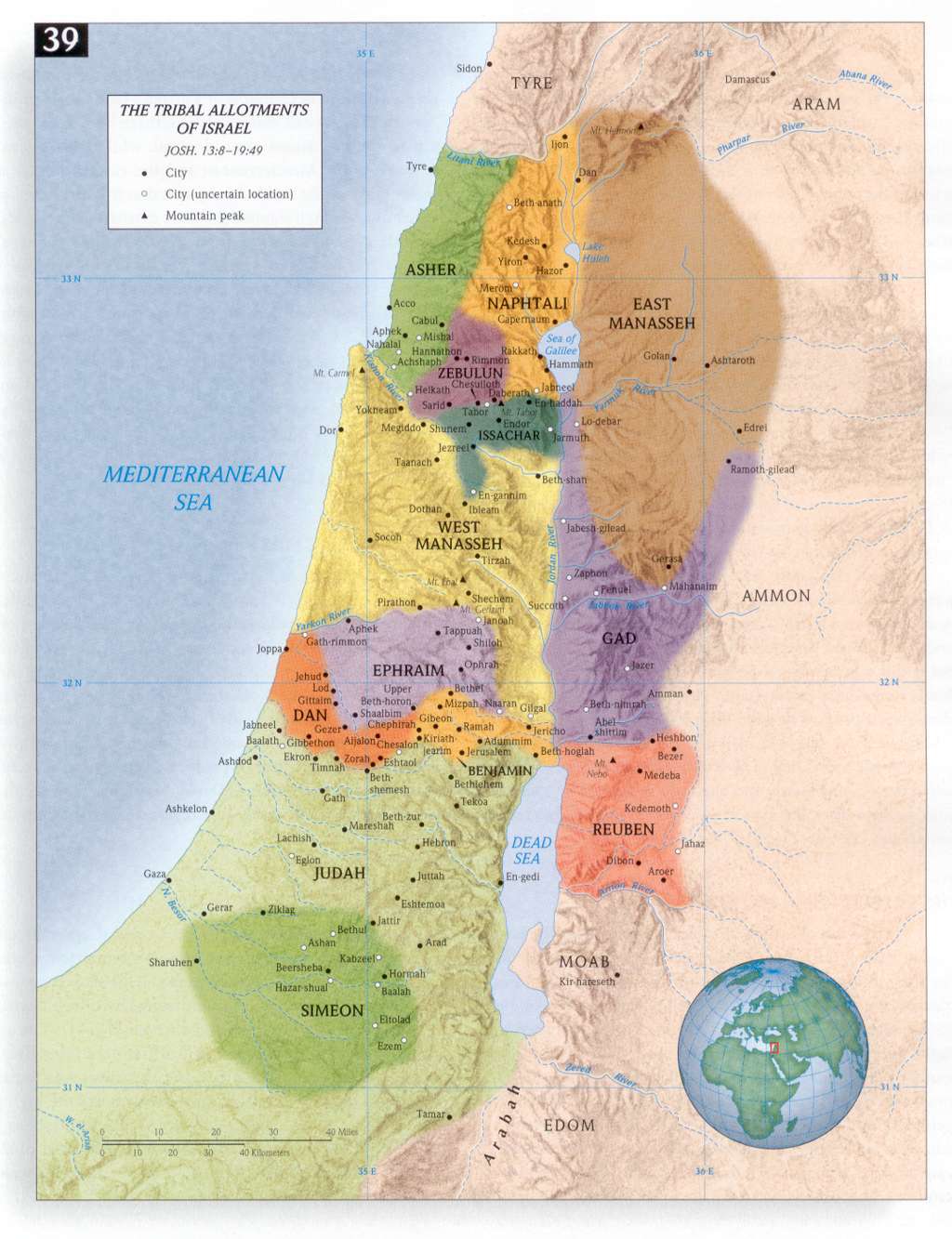
Map of the 12 Tribes to help give you the context for Judges. Click for full size.

But do not be overwhelmed. We have may four books this week (Judges, Ruth, Ephesians, Psalms), but no one book has that many chapters. Figure out a good way to read them, and might I suggest not trying to each a little bit every day. That may be confusing.

The great thing about having four this week is that we can really build momentum. When we can start to build a longer list of books we’ve read, it makes me excited to see all we’ve done. God has given us each of these books and all of the Scriptures are useful for us today, so what a blessing to have journeyed through as many as we have.

So I hope you share such excitement and enter this week with an anticipation that God will continue to speak to you as you make your way to the end of three more books of the Bible.

If as you are reading you have thoughts to share, pass them along. And let me know if you’d be OK if I then share them here.

A Word on Focus Passages

It has been a few months now since we began reading the Bible in a year, so I thought I’d go back and touch on one of the aspects that people newer to Year in the Bible may not be familiar with. Each week we read quite a bit of text. We average around 23 chapters per week, with a lighter load mixed in for periodic breaks (or times to catch up!). Reading at this pace is difficult at times, and if you share my experience, it is a very different style of reading.

I grew up doing a lot of Bible study in which you take little chunks at a time. This is a great way to do it since you don’t rush and you have the flexibility to wrestle with passages, meditating on them to try to plumb the depths of God’s Word. That’s typically how sermons go, as well, with a preacher spending focused time on one or two passages. This is how I’ve taught Bible studies. For example, before beginning Year in the Bible, we spent just about all of 2011 studying the book of John.

Now that we’ve sped things up considerably you may lose some of that narrowly focused, in-depth time in the Bible. I think we’ve gained something by shifting into this style for a year, and I wrote about it here. Simply put, it is good to step back to see the larger arc of the story of God’s love for us.

We’re doing Year in the Bible in order to gain this larger perspective and to make sure we read and appreciate all of God’s Word. But we don’t want to miss out entirely on what is gained by slow, meditative study. That’s why each week there is a corresponding Bible study. That’s all that the Focus Passages are. I take a short selection from the readings, and prepare some questions and supporting passages. We use them for Bible studies and small groups, but they’re also great for personal study.

If you haven’t already, take a look at them in the This Week section, and to make it even easier, here is the current week’s below:

Q2 W3 Focus Passage Galatians 2

Some Context for Galatians

Or: An exercise in imagination to help see the importance of Paul’s letter

Saint Paul Writing His Epistles, Valentin de Boulogne

Imagine if you will:

Paul has come your way through the region of Galatia, and you think you understood what he has taught. But he wasn’t the only one who has come talking about Jesus, and what Jesus’ life, death, and resurrection mean for us.

Some of what Paul said sounded radical, such as complete dependence on God’s grace, not on what we do. But others came along to you adding to his teaching.

Yes, God is gracious, but don’t we still need to earn grace? God has given you the law, right? Shouldn’t we then follow it? Why would he give it to you if you couldn’t follow it? And if you can uphold the law, then you must.

Should we be concerned? Did Paul just emphasize some parts of the gospel and other teachers emphasized other parts? Are they teaching the same thing? They all sound pretty smart, how can I make heads or tails of this? Are they all right in some way? How should we react?

If only Paul would write to us to help clear things up…

Quarter Two, Week Three

Is it just me or have the last couple weeks flown by? We’ve already finished up both Joshua and Mark and now we begin Judges and Galatians.

I’ll just make one tip as we get into these readings. Galatians is a letter, and how many letters do you read spread out over a week? Answer: none. We don’t typically read letters in parts, so I’d encourage you to take your time with Judges, but when it comes to Galatians, try to read it in one sitting. It’s not that long, so don’t worry. If you do I think you’ll get a good sense of Paul’s intent and purpose in writing this to the churches in Galatia.

If you have questions throughout this week, send them my way!

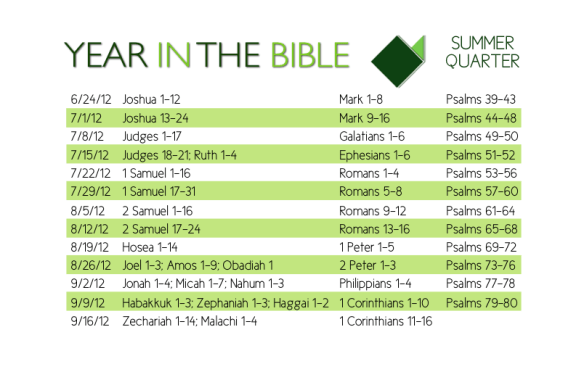
Reading Guide for Summer Quarter

I had forgotten to do this earlier, as I did for our first quarter, but here is something to print out or use in some way as a guide for your readings. I made it about a half page, so you can tuck it right inside most Bibles.

When you’ve got 5 minutes to read, you don’t want to waste 2 of them trying to figure out what we’re supposed to be reading that week. So keep this, or something else like it, handy. I hope it helps.