Should I speak in tongues? If I can’t is there something wrong with me?

Personally, I believe there is much I could learn about speaking in tongues. I’m not part of a tradition nor am I from a part of the world that embraces it as much as others. That said, I think I can still understand some of what Paul wants us to learn in 1 Corinthians 14 in regards to the practice.

I think it’s clear from Paul’s writing in this chapter and in the ones preceding that speaking in tongues does has a place and a function in the body of Christ. But that place is not primarily in public worship and its function isn’t for boasting and it’s not to be a litmus test as to whether or not you have the Spirit. After all, it is just one of many gifts of the Spirit, and each is gifted according to God’s will.

Unfortunately this is how tongues is presented in some churches. To those churches whether or not your speak in tongues is the sign of if you have the Spirit of God. It is treated as the sign and the gift above others. That is not building up the body and instead it’s dividing it between the haves and have-nots. That is not the reason we’ve been given these gifts by God.

That reason, the building up, is so important and it is why Paul placed prophecy above speaking in tongues in this section. Speaking in tongues is a more personal, private gift, but prophecy is one that builds up the body, believer and even unbeliever. He doesn’t want to demean speaking in tongues, and he mentions that he does it himself. But he does want to focus more on the goal behind these gifts, that is, of building up the body.

Does being ignorant lead us to learn or despair?

In case you were ever wondering, I write these devotionals and posts to help. Simple enough, right? My hope is that people pick up their Bibles and don’t just learn from them, but learn how to learn. I want to help people develop their own tools to study Scripture. But this can be hard because it is easy for someone like me who grew up in the church, always enjoyed Bible study from a very young age, and went to seminary to take for granted how the Bible can be a difficult read. It is impossible for me to approach Scripture the way someone who has never read it would.

Since I have read it before I can at least pass along some of what I’ve gain and with Year in the Bible I try to bring others along into a deeper appreciation for what God has blessed us with. But it is difficult because I don’t always know the questions people may have or the experiences they bring with them. I’m not always sure how something may be received, such as the use of commentaries.

I like to read a commentary as I go through and often will share insights gained from such reading. I intend for these short quotes or references to shed light on the text. There is an immense amount of study and research that goes into their writing and I think it helps illuminate Paul’s letter which was written almost two thousand years ago. But even as I write that last sentence, I fear that commentaries may intimidate and make people feel inadequate. If to “really” understand the Bible you need several degrees and endless hours to study all the scholarly writings, then how can I read the Bible? Perhaps revealing the great depth of the Bible reminds us that we’re not swimming in the kiddie pool, and then we immediately feel out of our element.

But again, I’m doing this to help and I pray that God works upon you to dispel that spirit of fear. Yes, there is great depth, but God speaks to us in his Word, he blesses us with his Spirit to aid in our comprehension. We could think about all that we don’t know and toss our hands up and walk away. Or we could see the great wisdom that God wants to show us and see its vastness as an adventure. Knowing God is not simplistic thing, but isn’t that more exciting?

If it is an adventure, let us see it as Everest and with great excitement journey together. To take that analogy further, we can recognize that there are Sherpas who guide us along, like those we’ve relied upon for 1 Corinthians like Ken Bailey or NT Wright. But we all go together. In these last few weeks we’ve read of spiritual gifts and have heard that if we do not have the same gifts as they do, that is all right. Some can be guides–teachers with knowledge and understanding. But it is a gift to be shared with the body, to equip others to seek God in his Word, as well.

So, as I write hoping to help, I pray these devotionals equip you to read, not discourages you with the notion that God’s Word is beyond your abilities. May whatever you gain inspire a sense of wonder that leads you to desire still more nourishment from God in Scripture. We’ve one month to go in reading 1 Corinthians and may the Spirit already be stirring in you a hunger to seek out what is next, and perhaps then you can be one to inspire someone else to meet God in his Word.


Build a cathedral, not a new vacation home

In my commentary on 1 Corinthians by NT Wright, he uses a great illustration for the purpose behind these spiritual gifts. Paul desires that they be used for the body, for love, and to build up. Wright then describes two different building projects in his writings on this section.

And the key question, which he highlights in the first verse, is: are you behaving according to the principle of chapter 13? Are you exercising the gifts God gives you in the spirit of love? The underlying contrast here is the same as we saw in chapter 8, verses 1–2: there are some things which can ‘puff you up’, making you proud and self-important, but what builds people up is love. And this chapter is all about making sure that public worship ‘builds everybody up’ rather than simply everybody developing their own spiritual giftedness and displaying it like so many strutting peacocks. When people come together to worship the God revealed in Jesus, they are not building their own private houses. They are building a great cathedral for all to share and enjoy.

Strive to Build Up the Church

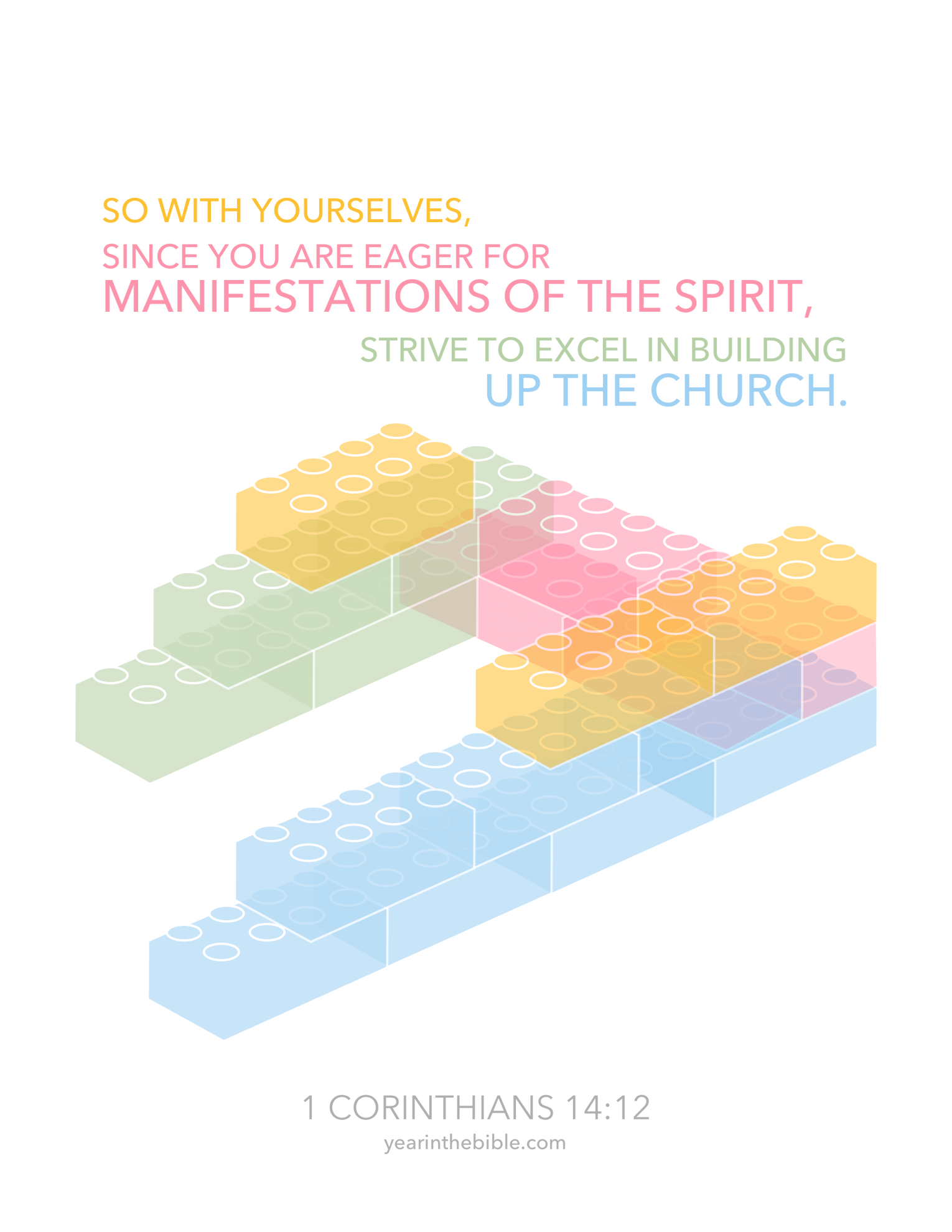
1 Corinthians 14:12

In thinking of how to illustrate this week’s memory verse, I must surely have been influenced by my three year old son. He loves legos and building all sorts of things with them. So when it came to this passage about building up the church what better than legos?

Paul’s instruction to strive after building up fits well with these chapters, as his concern is not for pointless manifestations of the Spirit. Instead the Spirit gifts us for a reason. We ought to desire the gifts not to boast and brag. These gifts aren’t about drawing attention to ourselves. We strive after them so that the church may be built up.

Love Never Ends

Lover Never Ends

Love never ends.

1 Corinthians 13:8a

These three words have great force especially when we remember that this is love that has its roots in God. It is God’s love that never fails. Reading these words this week brought this song to mind: One Thing Remains.

Enjoy.

Love Bears All Things–Even the Cross

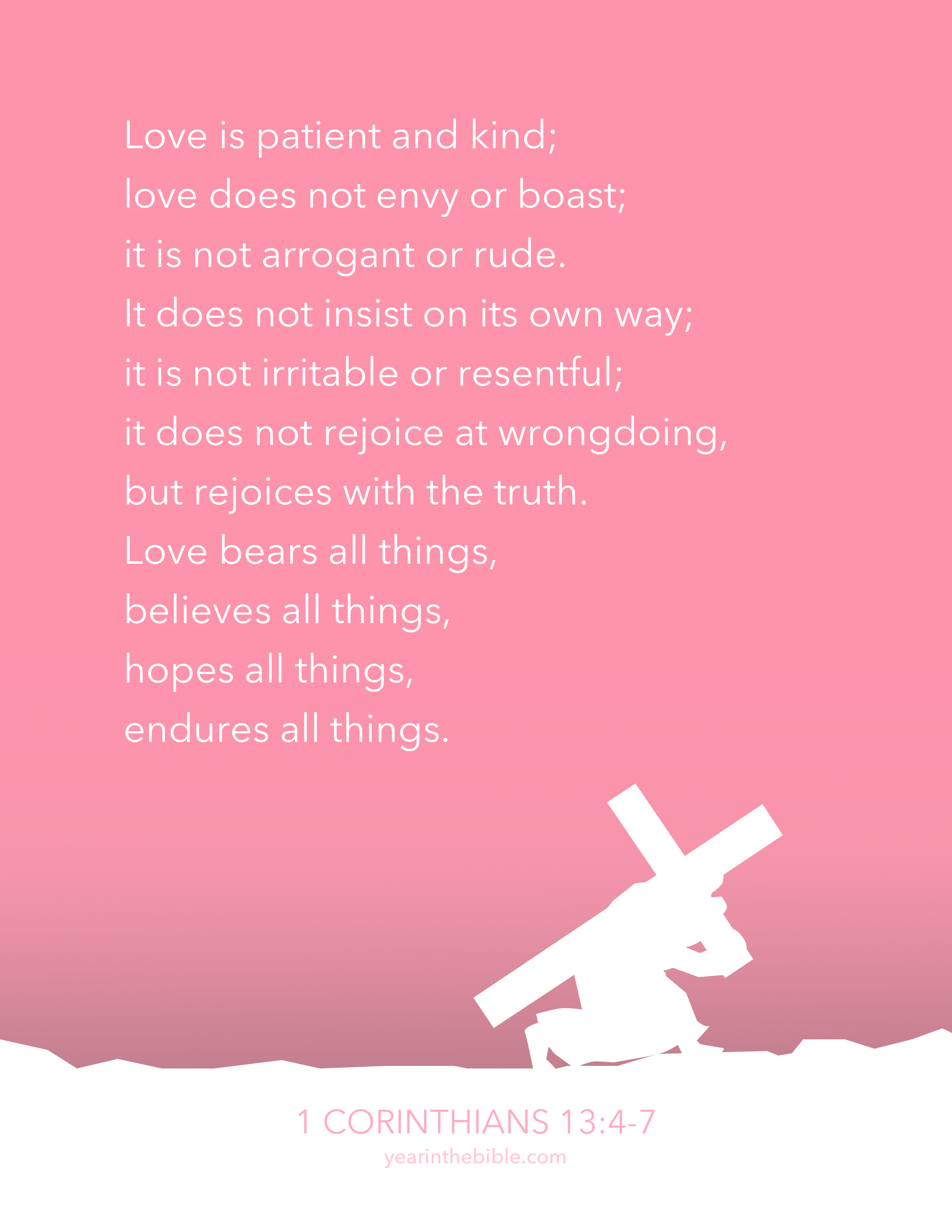
Love is patient and kind; love does not envy or boast; it is not arrogant or rude. It does not insist on its own way; it is not irritable or resentful; it does not rejoice at wrongdoing, but rejoices with the truth. Love bears all things, believes all things, hopes all things, endures all things.

1 Corinthians 13:4-7

It wasn’t that hard to choose a memory verse for this week. It’s not an unfamiliar one but it is a powerful one. Paul wants the church to turn from all that has divided them and caused them turmoil and turn to love. In this short chapter, 1 Corinthians 13, he lays out what that means.

In putting together a visual, I wanted to keep it simple and remind us that we wouldn’t really know love if not for the love that we see in Jesus Christ.

Memory Verse for 1 Cor 13.4-7

How would you define love?

If you’ve already read through 1 Corinthians 13, well done. If you haven’t, that’s fine and maybe you’d want to do a little exercise. This is a chapter on love. It’s a very famous chapter on love. Paul helps us to better understand what it is. But there are many other people in the world today that would want to do that job for us. Things like music, movies, and even greeting cards compete with one another to tell us what love is.

With all those definitions floating around it’d be good to know what you think. So, before you read and study this week’s passage, try sitting down and reflecting on how you’d define love. What is it? What’s love look like?

Then after you do that, see how well your understanding lines up with what we see in 1 Corinthians.