Why is the foot jealous of the hand?

You’ve most likely read or heard about Paul’s illustration of how the church is the body of Christ. We are the body which, while made up of many parts, is one. While it is one, it has many members. The problem that Paul sees in the church is that some parts are thinking of themselves as lesser than others (or being made to feel as though they are less). Paul writes in 1 Corinthians 12:

For the body does not consist of one member but of many. If the foot should say, “Because I am not a hand, I do not belong to the body,” that would not make it any less a part of the body. And if the ear should say, “Because I am not an eye, I do not belong to the body,” that would not make it any less a part of the body. If the whole body were an eye, where would be the sense of hearing? If the whole body were an ear, where would be the sense of smell? But as it is, God arranged the members in the body, each one of them, as he chose. If all were a single member, where would the body be? As it is, there are many parts, yet one body.

His illustration makes sense to us without any further cultural insights, but his point is even stronger when we learn how certain body parts were viewed. His example of a foot is not chosen randomly. The foot, being the very bottom of the body, was (and still is in some cultures in the Middle East) seen as dishonorable. It would be offensive to show the sole of your foot to someone if you were to travel to certain countries. So what Paul is doing here is picking the part of the body that would most likely be seen as a lesser part and using it as the example of that which should be kept in high esteem.

But God has so composed the body, giving greater honor to the part that lacked it, that there may be no division in the body, but that the members may have the same care for one another.

Using the foot Paul makes his point that even those that may be seen as the lowest should be valued in the church body. There is no exception. The body is one and should live with unity, not stratification or divisions.
The Unity of the Body and Diversity of Gifts

This chapter is on the diversity of the gifts the church is given by the Spirit, but while it highlights diversity, it does so in the context of the oneness of the body of Christ. Whatever differences there are, we aren’t to esteem some higher than others. We are brought together into one body that is to work together, weep together, and mourn together. These varied gifted all share the same source, the Holy Spirit, and are all to work for the common good. The one Spirit unites us, and this is a gracious work that only God can do.

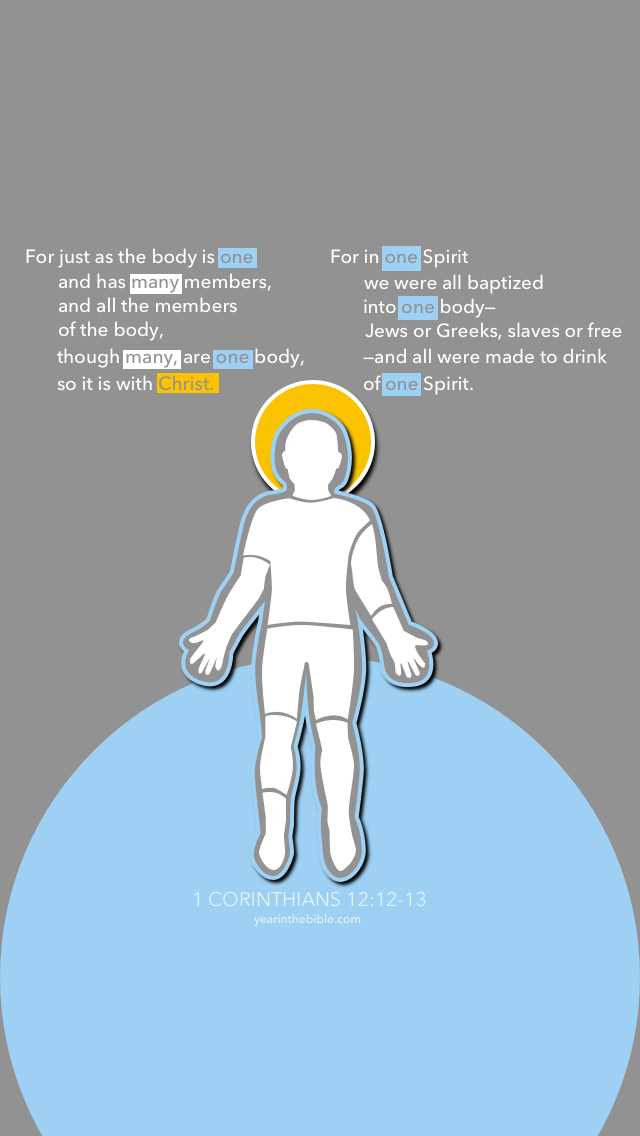
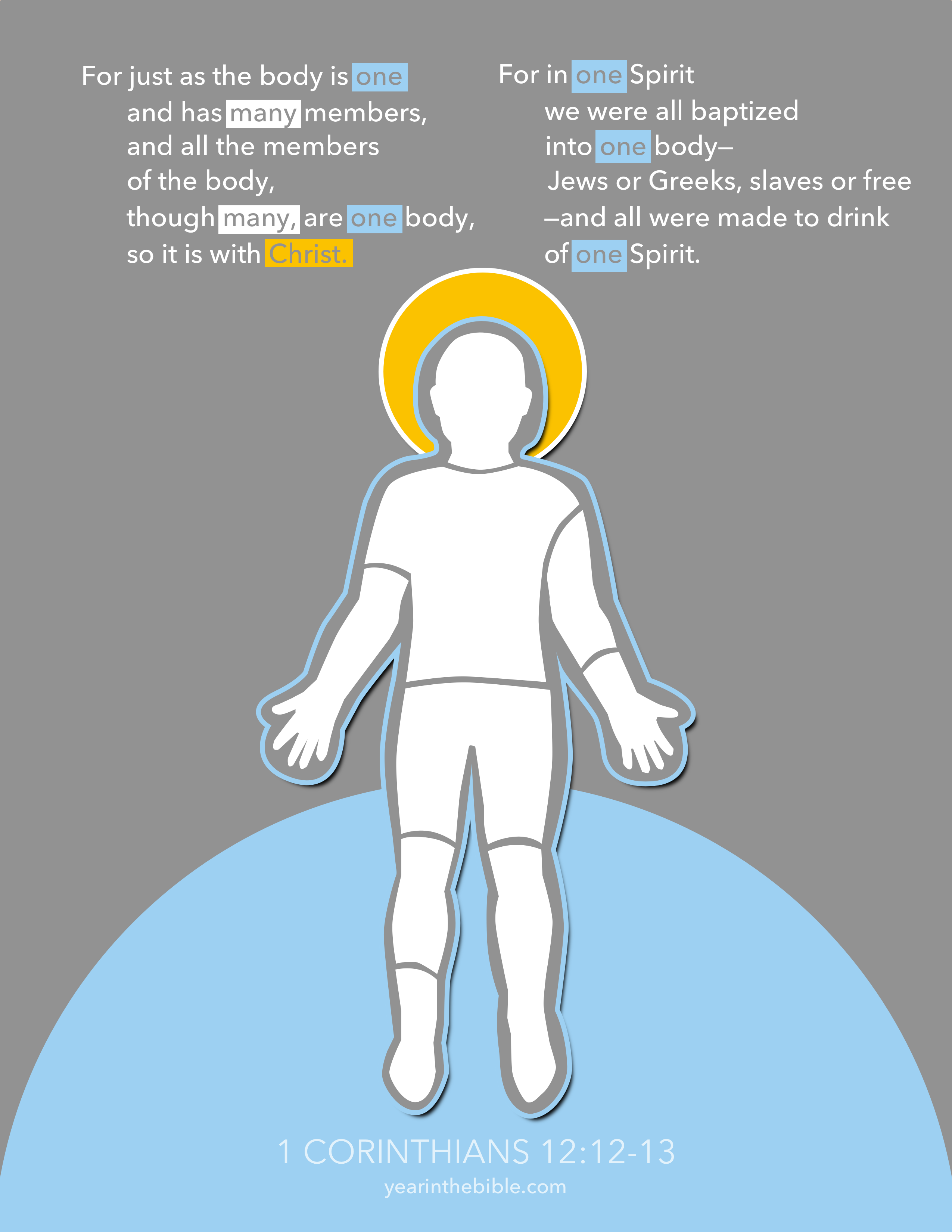
Memory Verse for 1 Cor 12.12-13

Our memory verse for this week seeks to lift up and remind us of this unity that we have as a people all baptized into the same Spirit and who daily must drink of the one Spirit.

Memory Verse for 1 Corinthians 12:12-13 for iPhone

Jacques Cousteau and Spiritual Gifts

“When one man, for whatever reason, has the opportunity to lead an extraordinary life, he has no right to keep it to himself.”

-Jacques Cousteau

Or tweaked for our purposes, in light of a passage like 1 Corinthians 12:

When the members of the body of Christ, because they are dearly loved by God, are given gifts of the Spirit, they have no right to keep those gifts to themselves.

We Have a Spirit Who Speaks

Paul takes chapter twelve to discuss the gifts that the Spirit of God gives to the church. But he begins by contrasting it with the idols of the Corinthians’ old faith. Paul writes:

You know that when you were pagans you were led astray to mute idols…

The way that Paul contrasts the old and the new, dark and light, death and life is powerful. Here is contrasts that which speaks and that which is mute.

I think we are reminded all the more about the way the Spirit that dwells in us speaks when we think back to past ways. The church in Corinth, in following after false religion, worshipped idols. Already Paul has discussed how these idols and so-called gods have no real existence. So when we think to the way the Spirit manifests himself in us, it is not like anything from the pagan practices. Those idols were mute. There is no way those idols were going to speak through the people. But that is not what we have now. The living God has sent us his Spirit and by the Spirit we speak. God has not sent us his Spirit to remain idle and mute in the church. The Holy Spirit in us is the only way that we can make our confession of faith, only by the Spirit can we say, “Jesus is Lord.”

Proclaiming Community in Communion

Two Sundays ago I was on vacation with my family and had the chance to worship at another church. It is always good to be able to step away and see how other churches do things and be reminded that the Church of God is much bigger than what I experience.

It happened to be a Sunday that the church was celebrating communion and one of the pastors was describing the sacrament and what we were about to do. What he said next was not wrong, but it gave me pause. As I said, it wasn’t wrong, but it was problematic because he didn’t follow it up with more. He said that what we were going to do was an intensely personal act between us and God. But he spoke nothing about how communion involves community.

When we take of the Lord’s Supper it is not merely a individualized, personal encounter with God. It is an act of the body and it is an act that emphasizes the body and how we are made one. God has taken away all that divided by the work of Jesus Christ on the cross. What divided us from God is taken away, but also what divided people.

When we take communion, as it says in 1 Corinthians 11, “we proclaim the Lord’s death until he comes.” By our actions we proclaim what that death did and what it represented. That’s why Paul criticizes the church in Corinth because their practice was not uniting the community, it was dividing it. If communion should proclaim the truth of the gospel, it can’t privilege the rich over the poor as they were doing. Nor should it focus entirely on the individual. There is that component, and we all should examine ourselves before taking of the sacrament, but there is more. Christ died to make us–collectively–his church. He is our head and we are his body. If we are not remembering that good news in communion, how then can our actions proclaim it?

The next time you celebrate the Lord’s Supper, be intentional to look around you at the other sisters and brothers to whom Jesus Christ has united us. You can certainly bow your head in private reflection, but know that this meal is thankfully more than about you and God, but it is a celebration that in Jesus the church is brought together and united. As we focus on the “foolish” act of our Lord on the cross, giving his body and blood for us, we proclaim his death–a death that brings us into fellowship with God and other believers.

What Does it Mean to Take Communion in an “Unworthy Manner”?

Lord's Supper

We read some strong words of warning in 1 Corinthians 11 about the way in which we approach the Lord’s Table and take communion. We are told:

Whoever, therefore, eats the bread or drinks the cup of the Lord in an unworthy manner will be guilty concerning the body and blood of the Lord. Let a person examine himself, then, and so eat of the bread and drink of the cup. For anyone who eats and drinks without discerning the body eats and drinks judgment on himself.

But what does it mean to eat the bread or drink the cup in an unworthy manner?

Paul writes in a style that often circles back around to a previous point. A great example is 1 Corinthians 1:17-2:2, in which he begins with his preaching of the cross–not his own wisdom, and returns to that same exact point. In this chapter he writes that the Corinthian community is splitting into factions when they have come to eat the Lord’s Supper. Some are going hungry, others are getting drunk, and because of that they really aren’t celebrating the sacrament (11:17-22). He then reminds them of the tradition that he has received and has passed on to them, giving us a picture of what happened “on the night when [Jesus] was betrayed…” (11:23-26). Then Paul returns to the point that preceded the words of institution (11:27-34). Paul critiques, puts forth communion as it should be, then goes back to critique. We might prefer to order this passage with the two critiques together, and then conclude with verses 23-26. In fact, reading it that way would make perfect sense. And in so doing it helps us to make sense of this “unworthy manner.” It is the same issue present in the earlier critique. Ken Bailey writes:

The key lies in the comparisons between sections A (11:17-22) and C (11:27-34). In section A the Corinthians had broken up into quarreling groups. Rich people came early, ate all the food and got drunk. The poor (who had to work) came later, found nothing to eat, remained hungry and were humiliated by being left out. The “church of God” (the entire Christian community) was “despised” in the process. This outrageous activity was clearly the “unworthy manner” that Paul was talking about. When this happened, the Corinthians were “guilty of profaning the body and blood of the Lord.” This was more than “disrespect for the elements,” although that was no doubt a part of what Paul was saying. Rather, such outrageous behavior was criminal activity against “the body” of Christ, this is, against the community what was his body.1


  1. Ken Bailey, Paul Through Mediterranean Eyes. 322. ↩

The Downside to Memorization and Its Defense

I read an article today that peaked my interest since I have been thinking about memorization a lot more recently. As I have emphasized much of the good associated with memorization (of which I think there is plenty), there can also be a downside. At times the focus is placed too heavily on recitation without any concern for understanding.

At The Atlantic, Ben Orlin writes an article titled When Memorization Gets in the Way of Learning that comes down pretty heavy-handed against memorization. But he does then seek to build it back up to be more useful. Some of what he says I might disagree with, partly because of the limited definition he places upon memorization, “learning an isolated fact through deliberate effort.” But I’d share his biggest concern, which is that memorization detaches what is memorized from a web of meaning and connections and context. Orlin writes:

Some things are worth memorizing–addresses, PINs, your parents’ birthdays. The sine of π/2 is not among them. It’s a fact that matters only insofar as it connects to other ideas. To learn it in isolation is like learning the sentence “Hamlet kills Claudius” without the faintest idea of who either gentleman is–or, for what matter, of what “kill” means. Memorization is a frontage road: It runs parallel to the best parts of learning, never intersecting. It’s a detour around all the action, a way of knowing without learning, of answering without understanding.

This relates directly to this week’s memory verse. The words we may know by heart that precede our taking of communion may already be memorized. But if we know the words without knowing the meaning and significance, what have we gained? It is the same concern with memorizing the creeds or a catechism. Or why would we memorize the Lord’s Prayer if you only do so that you can recite it with your brain turned off?

This isn’t to say memorization is bad. We just need to remember its place. I want memorization of Scripture to be a result of long meditation and thoughtful reflection. It should be a desire of ours to know these great passages of God’s Word so well that we can recall them even if our Bible isn’t around. The end goal really isn’t memorization. Memorization can be and should be a tool to help us learn and retain. As we do so we’ll only then gain a greater sense of awe and wonder at the goodness of our God.

The (too?) Familiar Words of 1 Corinthians 11

How often have we heard the words spoken before the Lord’s Supper? And like with anything that becomes familiar, how often are they overlooked?

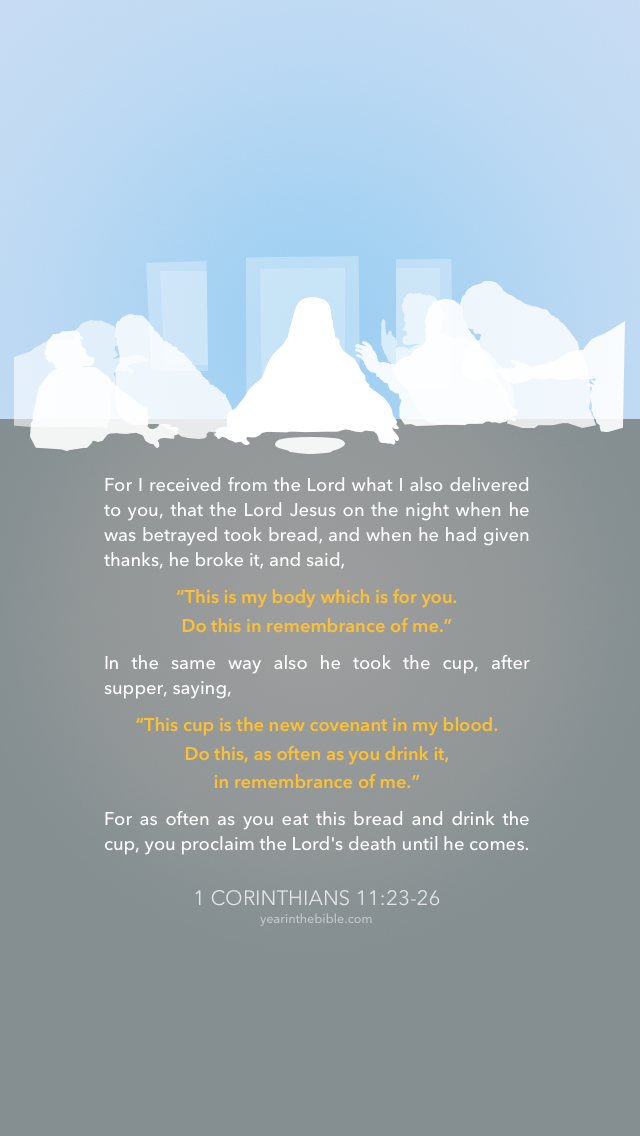
This week we come upon the words of institution for the sacrament of communion. These are words passed on to Paul that he has then given to the church. In choosing what the memory verses would be, I thought this would give us a good opportunity to memorize and study anew these words. Maybe memorizing them will be easy for some, since they are familiar. But even though we know the words, memorizing them is another story.

It’s the difference between hearing a song on the radio and being able to sing along and having no music playing and being able to sit down and write the lyrics. To be able to produce on our own these great words will help us to appreciate what can so easily be neglected.

Memory Verse for 1 Corinthians 11:23-26 for iPhone