God’s Calling in 1 Corinthians 1

Calling on Jesus

Exciting discussion occurred around my breakfast table this morning–which is a relative term since I’m not that excitable early in the day. But my wife and I were talking about the different ways to translate the opening lines, and in particular, the way in which the word “call” or “called” is used.

In this week’s reading I counted four instances of the word and three of them fall in the first two verses. From the ESV here are verses with the words bolded:

Paul, called by the will of God to be an apostle of Christ Jesus, and our brother Sosthenes.
To the church of God that is in Corinth, to those sanctified in Christ Jesus, called to be saints together with all those who in every place call upon the name of our Lord Jesus Christ, both their Lord and ours…

Ken Bailey translates this differently, keeping the calling as something God does throughout, which changes the last phrase to:

…Together with all those who are called by the name of our Lord Jesus Christ.

This use of “called” is not quite the way someone is “called” Harry in the UK (ie. the way we use “named” in the US). But according to Bailey, it’s not so far off. Being called by the name of Jesus is an action that claims us as belonging not to ourselves, but to our Lord Jesus Christ, for “God’s name is called upon the things that belong to God, be they objects like temples, or people.”1

Either way, the calling is a meaningful action. It is God’s calling to himself a people, calling them to be his own in Jesus Christ. This is God’s action, graciously taking a divided, sinful people and making them into his church. This is God finding a villain to the early disciples, Saul, and calling him to now be an apostle of Jesus Christ, Paul. It is God calling us to take part in the story of Jesus Christ.

Whether one translation is better than the other does not keep us from seeing that in these verses we find that our identity is founded in Jesus Christ and thanks be to God for such a call. Paul wants our attention turned to Jesus and his opening is all about Jesus–just take note of how often his name is repeated in this chapter. And now we are to be about him and our calling on him is all it takes to bind the church in Corinth with saints in every place. This introduction reminds us that it is less about us and more about the one who has called us, sanctifies us, and blesses us in Christ Jesus, our Lord.


  1. Kenneth E. Bailey, Paul Through Middle Eastern Eyes, 60. ↩
To Whom Was Paul Writing?

The opening of 1 Corinthians sets the stage for what will follow in Paul’s letter. [1] This is not unique to this letter, but is often how Paul works. So it is good to spend this week making sure we’re on the same page before we digest any more.

One key question, which may sound obvious, is, “To whom is this letter addressed?” Is it simply to the “church of God in Corinth”? If so, is this letter very limited in its application to just the pastoral setting of that one church in that one city long ago?

Or is this letter to this church, and in response to its needs, as well as to “all those who call upon the name of our Lord Jesus Christ”? Is Paul addressing the Church (big C) as he addresses this Corinthian church (little C)? Because if he is, then his intent is larger and his teaching more dynamic as it applies even to us today, living centuries later.

Some scholars take the first view and see 1 Corinthians as an “occasional” letter very much written in response to the particulars of Corinth and its people. One commentary I’m using in studying this book is Paul Through Mediterranean Eyes by Ken Bailey and he offers an alternative. He doesn’t think Paul was quickly jumping from thought to thought as he addressed the particulars of Corinth–the issues he heard either by letter or word of mouth. Rather he sees a well-organized structure to 1 Corinthians and that the questions of Corinth are fit into Paul’s outline, and not that his outline is based first on their questions.[2]

Understanding a broader audience for Paul, we are now able to continue into the letter keeping our eyes open to what he wants this church, and all churches to understand and believe about our Lord Jesus Christ.


  1. This is why I’ve made the opening lines our memory verse. While others may pack more punch, the opening lines will benefit us throughout our reading. I posted this a week or so back, but this visualization may help you to memorize: 1 Corinthians 1:1-3 ↩

  2. Kenneth E. Bailey, Paul Through Mediterranean Eyes: Cultural Studies in 1 Corinthians., 23-26. ↩

Year in the Bible Begins Today (and I’m already finished?)

Welcome to day one of the new Year in the Bible!

I hope you are even half as excited as I am to begin a new reading plan together and to uncover what God has in store for us as we read and study 1 Corinthians. I’ve tried to answer the questions you may have as we prepared for today, but I’ve got one more that may come now that you’ve had time to read.

I can imagine a few people picking up their Bible, looking up what the reading assignment is for this week, sitting down and then in a few minutes asking, “What now?” What do you do for the rest of your week when you finish the text so quickly?

Here are some simple suggestions:

  • Read it again. That’s a simple one, right?
  • Write down your reflections and/or questions.
  • Find someone to share those reflections with.
  • Rewrite the text in your own words or summarize the text.
  • If you have some sort of study Bible, take a look in the margins for cross references and do some Biblical exploration for other passages that may expand on ideas from this text.
  • Memorization – this week I’m encouraging you to memorize 1 Corinthians 1:1-3, Paul’s intro. (They won’t all be this long.)

It is far too easy to read something and let it quickly pass through you. What we want to do is read in such a way that God’s word permeates our minds and rests in our hearts. That’s why we’re going slow. So when you finish early, know that it is an intentional choice to give you more time to devote yourself to learning 1 Corinthians.

Week 1 Memory Verse 1 Cor 1.1-3

About the Bible Studies

Even though we are already slowing down as compared to our last reading plan, it is no reason to get rid of the Bible studies we had in what were called “focus passages.” When we read 25 chapters I didn’t want us to miss out on the slow, meditative sort of reading that allows us to prayerfully go through Scripture. When we do so we allow God to confront us with challenges and questions, we can better see and gain comfort in his Word, and we can take the time to ask our own questions. Even better we can do so with others.

On Wednesdays we’ll have a Bible study at 6pm at our church. Anyone is welcome. We’ll take time to talk about anything of interest that came up and we’ll also use the Bible study handouts to guide our discussion. Small groups also have used these handouts to study the Bible. Whether at the Wednesday group or a small group, I believe studying with others is the best way. I’d encourage you to at least find a friend (or make a new friend!) to read with you. Ask your spouse, invite your neighbor, get a co-worker to meet with you at lunch. Find a way to let the Spirit speak through others. I know for me, I never leave a time spent gathered around the Bible with another without having benefited.

Anyone can read through 1 Corinthians in five months. Most could find time to do it today. But we don’t want to read it just to do it. We want to read it to understand what God wants us to know and to be shaped by the Spirit as we study his Word. Bible study is key to this.

Here is the first week’s study to take a look at. Again, we’ll study this together this Wednesday at 6pm. But I am just as happy if you find a friend or get a small group together to study Scripture.

Week 1 – 1 Corinthians 1:1-17

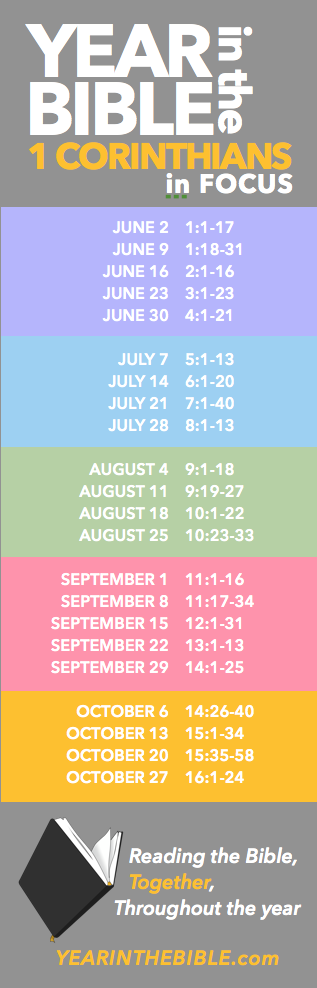
Our 1 Corinthians Bible Reading Plan in a convenient bookmark

Even though we won’t be flipping all over the Bible, it is still nice to keep a bookmark so you won’t lose your place in 1 Corinthians. But I also don’t want you to lose your place in the ongoing reading plan, so I’ve made a bookmark for you to slide in your Bible and keep track of what we’re doing each week.

I’ve included a letter-sized .pdf to print out if you’d like–that way you get the sizing right. Although if you’re coming to church this Sunday you will find one slipped into the bulletin. I hope this helps you spend more time reading and in prayer, and less time flipping through papers or checking the website to find that week’s assignment.

Bookmark Letter Sized for Printing

1 Corinthians Reading Plan Bookmark for Web

Visual Aids for Memorizing Scripture

I mentioned a week ago that memorization would be playing a greater role in this Year in the Bible. That may have already scared off some people. You may think that you’re awful at memorizing anything, let alone a verse of the Bible. I’m not going to argue with you. You may be awful. I don’t know.

What I do know is that this is a valuable thing to do and I want to help you as much as I can. Imagine going through 1 Corinthians for these five months and at the end looking back and having 22 Bible passages memorized, stored in your heart, that give you a good sense of what the book was about. After learning from God’s Word, if we have those verses in us, how much easier will it be to go back and find other passages? How much better will we understand the structure of Paul’s letter? How much more will God be able to call us to remember those passages?

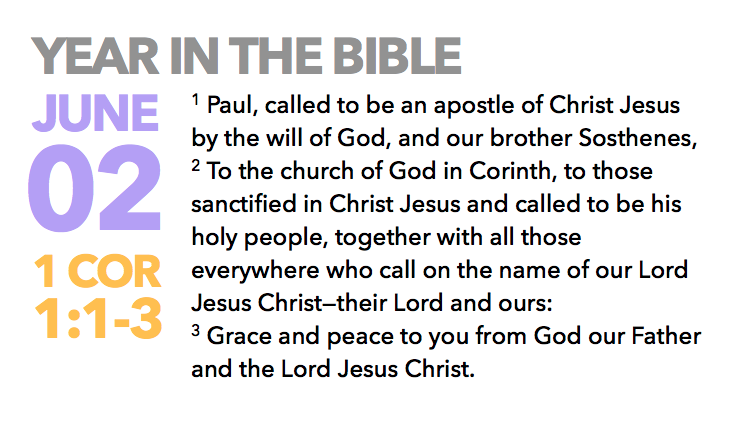
I think we can do it. But I think it’ll be tough at times. So again, I want to make it easier. If you’ve got tricks you already know about memorizing, send them my way. I’m open for suggestions. I wanted to give you a teaser now of one thing we can do. Visualizing can really help out, so I put together this mini-poster. You can print it out (it’s letter sized, 8.5×11”) and use it to see the way the opening verses of 1 Corinthians are laid out.

Here’s the basic structure:

  • Verse 1 – Who the letter is from and on whose authority it is written (in white)
  • Verse 2 – Who the letter is to–and take note it is to more than just the Corinthians (in grey)
  • Verse 3 – His opening greeting (in white)

With a bit of coloring, arrows, and even some simple pictures, I hope I’ve put together something that helps you to internalize these lines of scripture. Not all weeks will have three verses, but I thought knowing the “from” and “to” of 1 Corinthians is a good place to start.

Memory Verse 1 Cor 1.1-3

The Value of Memorization

Have you ever quoted your mother in giving advice? Has a famous line of some presidential speech made its way into your conversation? How did you do it? Do you carry around a quote book, organized by topic, to pull out and read from at just the right time?

Of course not. These nuggets are stored deep down in your brain. They live alongside movie lines you could recite in your sleep, sports statistics such as a starting lineup of a decades old baseball team, and your childhood street address. We commit all sorts of things to memory. Some clearly of more value than others. But value is what gets it there.

What we value we focus on, we repeat, we talk about, and eventually we memorize–often without even knowing it.

As Year in the Bible slows down to focus on 1 Corinthians, I want memorization to take a central role. God’s Word has tremendous value, therefore we should take the time and energy to store it in our hearts. Since we are reading fewer verses each week we have more time to dig deep, we’ll have the time to meditate on these verses, reading them over and over. As we do so, God’s Spirit will strengthen the roots that Scripture has within us.

Each week we’ll have a couple of verses to memorize. Think of it almost like a parallel to last year’s focus passages. I’m working on ways to encourage and make it easier, but it will still take dedication. We’ll have verses printed on paper the size of business cards to tuck away in your pocket. I’m often thinking of visual aids, and have already worked on one for our first memory verses: 1 Corinthians 1:1-3 (Paul’s Opening Lines).

My hope is that by the end of these several months, we’ll have a great storehouse of Scripture in our minds, ready to be used by God in us, for us, and through us.

1 Corinthians in Focus

After taking some time to investigate what is next for Year in the Bible, I decided I wanted to slow things down a bit. Reading through the Bible with many of you last year was a fantastic experience, and I know that I learned a great deal. But how often did we wish we had more time to sit and pray over certain passages? We gained much by reading everything–we now have a great breadth of knowledge. But now we’ll change our approach. Our next reading plan will focus on depth.

Rather than read 20 plus chapters a week, we’ll be reading around 20 verses. From June through October you are invited to read 1 Corinthians.

We will slowly go through Paul’s letter to Corinth and its sixteen chapters that deal with the cross of Jesus Christ, the Lord’s Supper, spiritual gifts, sex, love, resurrection, and more. Given the slower pace and the ability to read such short passages quickly, we will try new ways to keep the Bible in front of us for these months. The website – YearInTheBible.com – will again provide tools, tips, and insights, and I hope to have memorization play a role this time. Also, given its short length, this reading plan can easily be added on to whatever current plan you may have.

In this last year I heard how helpful it is to have some plan to guide our reading, and I think this will be another enriching time to join others in the church and learn from God in his Word.

Teaser poster