
More on hypocrisy, aided by Blue Like Jazz

As I wrote on Matthew 23, I was reminded of a favorite section of the book Blue Like Jazz by Donald Miller. It doesn’t entirely fit the hypocrisy of the scribes and Pharisees of Matthew 23, so it didn’t fit in with that post, but I wanted to share it.

His struggle with hypocrisy wasn’t a self-righteous boasting, but did have the flavor of not practicing what he preached, as seen in Matthew 23:3. He writes this as he was confronted with something like a crisis of faith:

“I don’t have any doubts about God or anything; it’s just me. I feel like I am constantly saying things I don’t mean. I tell people they should share their faith, but I don’t feel like sharing my faith. I tell people they should be in the Word, but I am only in the Word because I have to teach the Word. I said to a guy the other day, ‘God bless you.’ What does that mean? Then I started thinking about all the crap I say. All the clichés, all the parroted slogans. I have become an informercial for God, and I don’t even use the product.

As much as we can keep ourselves busy, busyness can hide time from honest, personal reflection. This is true within the church as well as it can provide plenty to occupy your time. These things can all be very good. But make sure that you slow down and make sure you are seeking out God himself, and not just the good things of God. Ritual and habit are not bad in and of themselves, but take time to think through our actions and the meaning behind them. As you approach the Bible, seek God in his Word for the joy of knowing him, not only to finish this reading plan.

I will say that there is a place for obedience, even when we “don’t feel like it.” God can use us regardless of our initial willingness (see Moses and all sorts of other characters from the Bible). That may be a critique of this book. Christianity is not always going to be some authentic expression of our deepest desires. Our deep desires are often sinful, and a life following Christ is hard as he warned us that we’ll have to pick up our cross to follow him.

But there is wisdom in this quote. We shouldn’t mistake learning about God with knowing God or giving instruction for others with personal discipleship.* For example, taking children to church is not the same thing as bringing them up in the faith. Writing a check for some ministry is not the same as serving people face-to-face. Researching the Bible for a class is not all that reading the Bible is about. These are not bad things, but we must make sure we do not let them become everything. We are invited not only to live a certain way or to know certain things, but to know God in Jesus Christ–to have a relationship.

Informercials can be really informative, but God wants disciples who follow him, and they can be transformative in this world.

*A problem it seemed the scribes and Pharisees had. Matthew 23
Woe to Hypocrisy

Jesus comes down hard on the scribes and Pharisees in Matthew 23. They are guilty of hypocrisy as “they preach, but do not practice.” They lay heavy burdens upon the people, yet they will hardly lift a finger. These leaders love to soak up all the attention that their positions bring, presenting themselves outwardly as righteous. But in their hearts they are sinful. As leaders they are blind guides who close the doors of the kingdom on people, and under their leadership people fall further from the truth.

One illustration Jesus uses works perfectly as an object lesson, one that I remember as a kid helping my mom get ready for a youth group session. Jesus says, “you clean the outside of the cup and plate, but inside they are full of reed and self-indulgence.” To recreate this, I went out in my backyard and was tasked to play in the dirt. A great task for a young boy. One cup was to be dirtied on the outside, but clean inside. The other was to look spotless externally, but filthy on the inside.

The trouble with the pharisees is that they work hard on the external appearances and do nothing in regards to their hearts. But Jesus has already taught that it is what comes from within that makes us clean (Matt 15:11). What is within them is unclean. If attention was paid to cleaning the inside, then the outside could truly be clean, as well. An even more severe description is then applied to these leaders. Jesus says that on the outside they appear freshly painted with new coats of clean, white paint. But this paint is only a thin facade that hides the fact that within is a tomb, full of bones and uncleanness. They are full of death, yet are tasked with helping the people live!

Their hypocrisy is the double standards that they apply and the two-faced life they live. They look one way, but act another. They instruct people to live in ways completely different from how they live themselves. They are hypocrites as they boast in themselves, yet they truly have nothing worthy of such boasting.

Certainly it is possible for Christians to be guilty of hypocrisy in just the same way. But Christians should not make claims about having attained righteousness on our own, nor having made ourselves completely void of sin. In a way we ought to know better than others just how sinful we really are. We then can’t boast in the ways the scribes and Pharisees do. We can only boast in Christ. Only he can make us clean. Only he can bring us to life, as though he were opening those tombs and giving life to dead bones. That’s what we boast in. Therefore it makes no sense to seek celebrity and fame for ourselves, looking for places of greater honor.

These woes are still warnings for us today. We should be on guard against such sinful tendencies we all have. We ought to preach and practice, humbly doing so with a gospel that is firmly rooted in the redeeming work of Jesus Christ, not our own. And as God does accomplish his transforming work within us, we can’t allow ourselves to be puffed up with pride. From start to finish it is God. Pride only interferes with that. Humility opens a person up to his work.

Humility also confronts hypocrisy as it is not afraid to let others see our weaknesses, since humility is not concerned with receiving praise. Rather in our weakness, humility knows that it is only God who is seen as strong.

As a Hen Gathers Her Brood

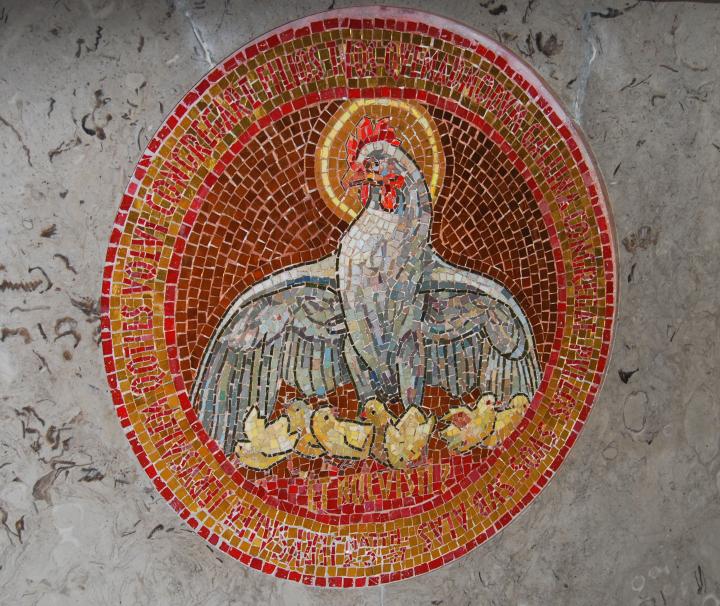
When I was on vacation after Christmas I went to church and heard a sermon that was on Matthew 23, with great focus on the image that comes at the end. Jesus laments for Jerusalem saying:

How often would I have gathered your children together as a hen gathers her brood under her wings, and you were not willing!

The preacher referenced a mosaic that depicts this, so I wanted to track it down to share it with you. It is found at a church called Dominus Flevit, which means ‘the Lord has wept.’ It is located on the Mount of Olives, where Jesus wept over Jerusalem, and its architecture designed to resemble a tear drop.

It is humbling to think of the care Jesus has for us and how it extends even to those who reject him. He is brokenhearted over Jerusalem and only desires to protect and love its people.

Dominus Flevit Mosaic

A Reminder as to Why We Read the Bible

It’s been a while since I shared linked to an article here, but I thought I’d offer this short piece for your reading. It’s great to be reminded of the reasons behind what we do, and as much I try to encourage Bible readings, it is probably good to hear it coming from somewhere else.

So take a look at this article, Why We Read the Bible, from Desiring God.

Here’s a quick quote to sum up much of what it is about if you really don’t think you have five minutes to read today.

“Bible reading is meant to deepen our personal relationship with Christ.”

Let the Little Children Come to Me

There is a short section in Matthew 19 that deals with children who were being brought to Jesus. The disciple rebuke the people then Jesus says, “Let the little children come to me and do not hinder them, for to such belongs the kingdom of heaven.”

How many of you find this to be a surprising text? Surprising not for the way in which Jesus reacts, but for the way the disciples seek to prevent the children from coming?

I was thinking about my own reaction to the story, and I think it is a great credit to the church today that so many are shocked at the disciples. We read it and say to ourselves, “Where do they get off trying to stop children, of all people, from coming to Jesus?” But we only say that because so many in the church have worked in the intervening centuries to do as Jesus did and welcome children. Children are to have a place in the church and we celebrate them. So many places in our society leave no place for kids. They are a nuisance or inconvenient. But in a church that seeks to follow Jesus here, the very opposite is true.

If churches were not a place that embraces children as a legitimate part of the community, but rather saw them as not-yet-important part of it, we’d read this passage and be more surprised that Jesus welcomes them. What the disciples did was probably not unexpected to their audience, but thankfully when I read it I’m taken aback and say, “What were they thinking?”

Good thing Jesus set us straight.

Visualizing Our Progress through the Bible

If you need a bit of motivation, I’ve shown this visual to a few folks in recent weeks. We’ve completed three of four quarters of our reading plan. You might think that means we’ve ready 75% of the Bible, but wait–because the fall quarter was longer, you’ve actually read more than three quarters of Scripture.

So what does that look like? My Bible is just about 1600 pages, so I took a quick picture of our progress. It isn’t exact, but it gives a good estimate and sure is exciting for me to know how far along we’ve come!

Three quarters bible

In need of a resolution?

times square ballDo you have a friend who is in need of a last minute resolution? Well, they can start with not putting things off to the last minute. But if they want another idea, invite them along to finish out Year in the Bible with you. Let them know what it is about, introduce them to the reading plan and website, and you can even meet with from time to time to talk about the readings. I know it can be odd to join in so late in the game, but we’re not reading start to finish like a novel, so it isn’t so bad. They can augment the readings, too, if they’d like.

Or maybe your resolution is to catch up with the readings? Regardless of our readings, the aim of going through God’s Word in a year is to know him better. Resolve to seek God out in the Bible. Resolve to prayerfully approach it. Resolve to give God enough time in devotional reading. Resolve to be humble enough to learn from it and change your life accordingly.

It is good to remember that we are not reading the entirety of the Bible to impress friends or check something off a list. We do it because the Bible is such a gift, one not to be taken for granted. And God has shown us himself in it. Let’s meet him there.

Week Two is Already Here

If you haven’t noticed, there have been fewer posts this past week. I’ve been on vacation and busy with extra people around. But that may be the case for you, too. So maybe you’ve had less time to read. So if you are pressed for time, I’d rather you read your Bible readings rather than read this website.

This new week we start into Ezekiel and continue through Matthew. As we have been celebrating Christmas I hope you’ve enjoyed seeing how the story continues through the Gospel of Matthew. Jesus didn’t just come to be born, but to live and die for us. It’s good to see what he came to do.