
Unlikely Sermon Title: Please, Stop Giving an Offering

Throughout the latter half of Exodus, God is describing for Moses and the people what is required for the tabernacle. There needs to be fine cloth, gold and silver, jewels, and other materials for the craftsmen to assemble this dwelling place of God among the Israelites.

In chapter 35 Moses says to all the congregations of the people of Israel, “This is the thing that the Lord has commanded. Take from among you a contribution to the Lord. Whoever is of a generous heart, let him bring the Lord’s contribution: gold, silver, and bonze; blue and purple and scarlet yarns…”

Moses goes on listing valuable items that were surely precious to the people. The people hear this message and Scripture says they came back to Moses, “everyone whose heart stirred him, and everyone whose spirit moved him,” and they brought a contribution for God’s tabernacle and for its service. These items came in the form of brooches and armlets, and other personal possessions. It was not as though the people went out to the bank and withdrew some spare gold bullion. They took what was being used in one way for themselves and sacrificed it to God, to be used for his purposes. They also gave of their time, such as the women who spun fine yarns and linens. The people brought their treasure, and in doing so revealed what truly should be our treasure–God.
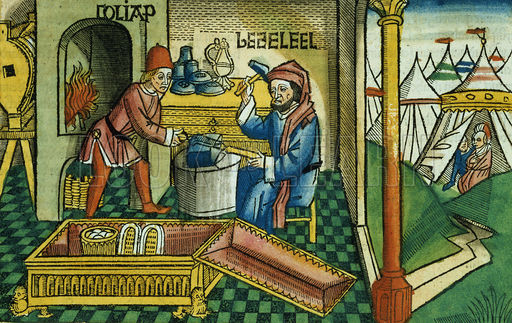
What really amazed me in reading is in chapter 36. Bezalel and Oholiab, along with the other craftsmen God had gifted skill and artistry to, all had to stop their work and come to Moses with a message. The people had continued to bring contributions for God, a free will offering, every morning to such an extent that the workers had far too much. So they tell Moses, “Let no man or woman do anything more for the contribution of the sanctuary.” People gave their treasures over to God to such an extent that it says they had to be restrained from bringing more. They gave what was sufficient and then some.

What a wonderful problem for the craftsmen to have, and what a wonderful testimony to God of how the Israelites were here being joyful givers, gladly treasuring God and his will above whatever earthly treasures they had previously cherished.

Year in the Bible Giveaway

We won’t get to the Prodigal Son in Luke 15 until next week, but in anticipation of it I thought I’d put forth a little contest for you all to enjoy.

What I want is for y’all to put together some sort of “artistic representation” of the prodigal son parable. Now don’t let that scare you off–there’s a reason I put it in quotes. I only want you to do something creative that captures the story, or a scene, or some aspect of this powerful parable.

Send in your entries, as many as you’d like, to me and I’ll select a winner and to that person I’ll give a free copy of The Prodigal God, by Tim Keller. This is a great book on this parable that I highly recommend. It’s simple and profound, and for those worried that I’m just giving you additional reading, it’s also a pretty short book.
Here are some ideas to get your brain in gear:

pencil sketch

lego creation

food sculpture

painting

performance in mime

poem

Take a picture or record whatever you’ve done and I’ll announce a winner at the end of next week. Send it to me at caseyclark@trianglepc.org

*I’ll have to limit the winner to the USA for shipping.

Week 6 is here

This week we finish Exodus, seeing the completion of the numerous pieces of the sanctuary that God instructs his people to build.

Luke has so much it is hard to preview it for the week. How about this–Jesus continues to wow and amaze.

What has been a joy for me in the last weeks is seeing and hearing all the number of ways God has used these readings to influence you. If you have some experience in which the Year in the Bible texts have come up in your life and how the Spirit is using them, let me know. It would make my week to hear from you about it.*

*Unless our baby is born this week. That would then make my week.

Story So Far, Week 5

In Exodus we see the way God has instructed the Israelites in how to be a people of his own, including how they should order their lives with law and how they should order worship. In Luke, Jesus called his disciples, continued teaching, and showed the people his great power, even power over death.

In Luke 7, a pharisee questions Jesus’ interactions with a sinful woman. Jesus responds with a story of forgiven debt, making the point that the one who has been forgiven much, loves much, and the one who has been forgiven little, loves little.

What we must remember is that we have all been forgiven much. We are all sinful and our debt is far more than we could ever repay. Left to our own ability and effort, we would be lost. But God has forgiven this debt–in fact he paid this debt for us himself in the work of Jesus Christ. If we daily remind ourselves of this, of how abundant God’s grace is, it will spur us on to love much. As forgiven sinners we cannot treat with disdain other sinners in this world. We all suffered under the weight of great debts. Therefore we should share love with others as recipients of grace.

Having this constant remember of grace is part of why I think God describes himself to his people in the beginning of the Ten Commandments with the words, “I am the Lord your God, who brought you out of the land of Egypt, out of the house of slavery.” Whenever God describes himself in this way, he is reminding his people that they have been redeemed from slavery, they have been given abundant grace, and they have much to be thankful for.

When we recognize how much God loves us and how abundant is his grace, the more we will be propelled to love and forgive those who God places in our paths.

Keep Building on a Solid Foundation

I’m sure that you’ve already learned a great deal from God’s word in these last few weeks, and that may be encouragement enough to make you want to continue along in reading all of the Bible. But even so, it is great to have passages that make it explicitly clear that what we are doing is of great importance. If we read these words, take them to heart, let God speak to us through them to challenge, comfort, and shape us, then we are building our lives on a solid ground.

In Luke 6 Jesus shares an illustration about not only listening, but being doers of God’s word. He compares two builders. One digs deep and lays a foundation on rock. The other builds a house on the ground with no foundation. When a stream breaks against these two houses, the one with a foundation is not shaken, but the other falls and is left in ruin.

The one who listen to the words of Jesus and does them is building upon a foundation of rock. It is a strong, well built life, firmly fixed upon Christ’s every word. Those who hear and disregard, those who learn yet fail to heed the call of Christ, they are left in ruin when a storm hits.

It is a striking comparison especially since it is not the comparison of a strong foundation to a lesser one. Building on Christ’s words is the foundation, and neglect of him is no foundation at all. These are words of warning, but also of great encouragement.

Continue in God’s word. They are the words of life, they are trustworthy, they reveal God to us and point us to Jesus Christ. But do not stop there. Hear this word as a word for you, a word of instruction and of call. These pages we read every day speak to us now, just in the place where we are, and we are to build our lives upon them. If we fail to do so, Jesus tells us plainly what to expect.

Grace Precedes Law

We finally come to the Ten Commandments in Exodus 20, a codified law for God’s people. To many, the law characterizes the Old Testament and the old covenant, and given its prominence not only here, but throughout the many books of the Old Testament, it isn’t hard to understand that view. But do not forget the preceding chapters and stories in Exodus and Genesis.

God graciously created this world and placed us in it. God has provided for a people that he chose for himself, not based on their superiority as a people, but because of his grace. God called Abraham out to be the father of many nations, made a covenant with him, and while Abraham struggles in his faith, God remains ever faithful. He protects his people, provides for them, and in Exodus we see how God set them free from the oppression in Egypt.

God did not come to Moses and deliver two tablets of stone and say, “Moses, deliver these to the people. Gather all the elders and proclaim this law to them, and let it be known that whoever keeps it perfectly will be rewarded. In five years, I’ll be back, and if you were good, I’ll have a chat with Pharaoh about letting you go.”

Instead God hears the cries of his people and frees them from Egypt. He sets them free, parts waters, gives manna from Heaven, and also as an act of grace, he then gives them this law. Grace precedes the law. The Israelites were never a people who earned or deserved God’s favor. They did not merit it. God chose them for himself, and in his grace saves them. The law follows as a way to live as God’s people, and a way to live well.

Be careful when simplistically dividing the Old and New Testaments as though one were law and the other grace, as though grace were absent in the beginning. The Bible is a book that reveals to us who our God is, and we see he is and always has been a God of grace.

Welcoming the Stranger

20120425-202503.jpg

It was brought to my attention recently that there is an event going on this Friday at 7pm at Church of the Good Shepherd (Durham, NC) entitled “Welcoming the Stranger: a biblical perspective on loving all our immigrant neighbors.”

In Exodus, God puts great emphasis on the treatment of the needy, including the sojourner:

“You shall not wrong a sojourner or oppress him, for you were sojourners in the land of Egypt.

Exodus 22:2

Reading this during this past week along with hearing about the event caught my attention, so I thought I should let others know about it. Here is the synopsis from the website:

In a time when “the immigration problem” is becoming more divisive, Christians must cut through the rhetoric on all sides and listen clearly to what God teaches us through the Bible. How do we, today, listen and respond to God’s declaration of love for the immigrant?

God loves the foreigner, giving him food and clothing. Therefore you are to love the foreigner, since you were foreigners in the land of Egypt (Deut 10:18-19).

Instead of advocating for a particular stance on immigration reform, this event seeks to remind us that immigrants arepeople and not representatives ofa problem. What does it mean to love our immigrant neighbors in the Triangle, including undocumented immigrants?

Love does not eradicate the many worthy questions of immigration policy—what about those who are here illegally?, what about the economic realities?—but it does require us to engage. Loving our immigrant neighbors starts with learning, and that’s the purpose of this event, Welcoming the Stranger. We hope you will join us at this free community event. Please invite everyone you know.

Picture It: The Tabernacle

Soon after the flight from Egypt, the book of Exodus describes in great detail the size, shape, material, color, and number of the parts of God’s sanctuary among the people. It can be easy to skim through these chapters and miss their significance. I found that having a visual can help piece it all together.

This is an illustration that was made by Tim Challies, who has done a number of visuals for passages of Scripture or doctrines of theology. Click on the image to see it full-sized and I’d encourage you to click here to see more from him on his site (you’ll see other links to other posts near the bottom).