
As you near the end of 1 Corinthians, go back and read it again

This reading plan through 1 Corinthians has been intentionally slow and many weeks have been quite short. The aim wasn’t to allow for the study and reflection to be quick and easy, rather to give time to review and reread, and gain great depth from this wonderful letter of Paul.

As we near the end of Paul’s letter I’d highly encourage you to start over. Go back to chapter one and begin again. Read it a couple times even. This coming Sunday starts the final week of readings and the more we can see the whole of 1 Corinthians and then combine that with the close focus we’ve put on each week’s assignment, the better understanding we’ll walk away with when we reach Paul’s final words. Going back through it you may find that the text is much easier to understand. You may see recurring themes that hadn’t stood out on your first read through. I’m not saying you’ll necessarily be an expert by now, but the more you study and pray through this book, the more God is going to use it.

Five months can seem like a flash, but what we read back in June may seem far off. Refamiliarize yourself with the whole and be reminded that while there are sixteen chapters, 1 Corinthians is still just one letter.
Questioning the Resurrection of the Dead

Continuing the topic of resurrection in chapter 15, Paul voices some of the questions or objections that he has heard to this fantastic notion of the dead being raised. Some have asked how this happens? If in fact it does happen, what sort of body will they have?

Paul uses several mini-parables to answer this, looking at seeds, animals, and celestial bodies. Even with his concise illustrations this can still be a difficult passage. Or maybe I should say, of course it is a difficult passage. Resurrection is not an easy thing to believe in. In a very literal sense, it’s not natural for us. Nature allows for birth and death, but no more. The resurrection is supernatural.

For such an amazing concept, maybe watching a short video will help. Here’s NT Wright on resurrection and its understanding in the first century. It’s not very long (6 min), but it is part of a much longer video, if you’re feeling adventurous.

But thanks be to God for the victory we have in Jesus Christ

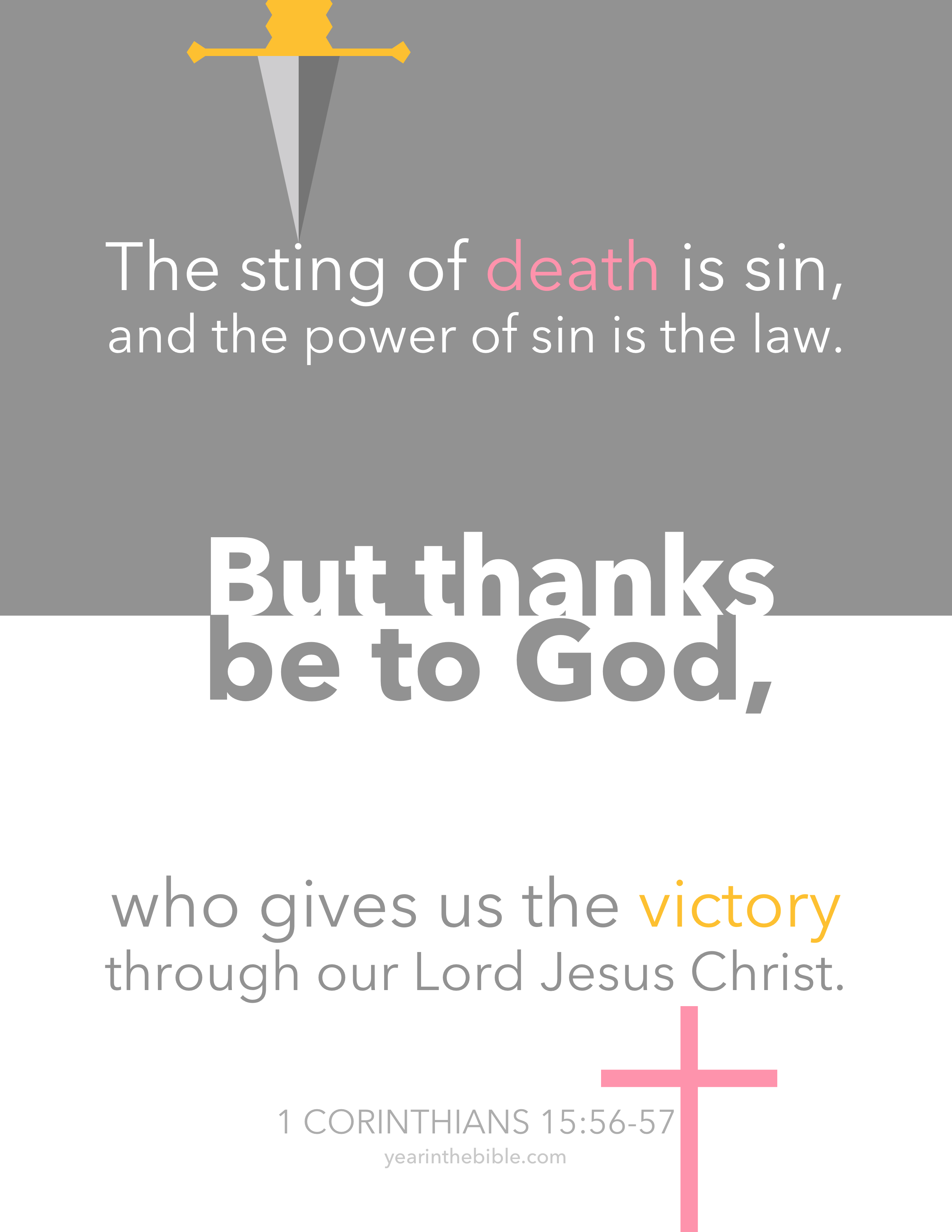
We’re back to having a Bible visualization this week. (I’m still trying to catch up on last week.) 1 Corinthians 15 is a powerful chapter on the resurrection of Jesus Christ and what that means for us as well. Paul puts it succinctly near the end as he lays out a great contrast. We all face death and are under the power of sin. The law could do nothing to save us from such a fate. Then Paul uses that wonderful, good news-filled, gracious phrase: but God. Or at least in this section, “but thanks be to God.” Death is not the end nor does sin have the power. God, through Jesus Christ, gives us the victory over such things in his death and resurrection.

 Memory Verse for 1 Cor 15.56-57

Call for questions on 1 Corinthians 14:26-15:34

I have been gone quite a bit over the last two weeks and have not managed to do much more than put up the Bible study handouts for the readings. In the meantime we’ve had some great bits in 1 Corinthians and rather than brush over them and move right along to what we’ll start tomorrow, I wanted to put out a call for any questions. Was there some standout part of these last two weeks of readings that you have a question about? Was there something that you weren’t quite sure about? Maybe you just want to see if there is more to know about a section that you’ve always liked.

I can’t do it all this week, but I’d love to have a few suggestions that can be addressed. So if you have one–go back and see if you had something underlined or had written in a little question mark in the margins–let me know. Either email me, leave it in the comments, or some other third way of reaching me. I look forward to the feedback!

What is of first importance in 1 Corinthians 15

Paul structures the section we read this week in two parts, and the second flows from the first. First we look to Jesus Christ and his resurrection. Paul mentions what here is of "first importance." These are core events to the Christian faith, and without them–without Christ then the we would have nothing else. But since we do have such a hope that has been passed on to Paul, to the Corinthians, and through generations to us, then we see in what follows that Christ’s resurrection provides a way for our resurrection.

Christ’s resurrection is like the bottom Jenga piece that if you remove, everything else falls apart. If Christ is not raised from the dead, as Paul writes, "we are of all people most to be pitied."

A Brief Answer to “Should Women Be Silent in Church?”

Paul writes what have been pretty controversial words in 1 Corinthians 14:34:

The women should keep silent in the churches. For they are not permitted to speak, but should be in submission, as the Law also says.

So what does that mean? Is it plainly that women shouldn’t be allowed to talk in a church service?

Here is the brief answer I supplied for this week’s Bible study:

In chapter 14 Paul has been writing about speaking in church and not speaking in church, trying to maintain order in the church’s worship service. He has told both those speaking in tongues and speaking prophecy to be silent. He tells them to be silent to protect worship and encourage peace and the building up of the body. He doesn’t tell them to be silent because they have no place in worship–Paul actually lifts up their value in these last few chapters. In that context, it is not unlikely that he is telling women now to be silent because of disruptions in worship that may have occurred as women, in that time usually less educated and separated from the men in worship, were talking with each other or speaking to their husbands asking questions in order to better understand what was being said. Paul would rather that take place elsewhere and he values peace over confusion and commotion when the church gathers.

Imagining the Commotion in Corinth

What then, brothers? When you come together, each one has a hymn, a lesson, a revelation, a tongue, or an interpretation. Let all things be done for building up. If any speak in a tongue, let there be only two or at most three, and each in turn, and let someone interpret. But if there is no one to interpret, let each of them keep silent in church and speak to himself and to God. Let two or three prophets speak, and let the others weigh what is said.

It may be hard for some to imagine a scene in church where more than two or three are talking at once. Truly, it may be hard to imagine more than one person. Many denominations today are in no real need of hearing an instruction about making sure people are silent in worship, if anything it would be the opposite. But that is the scene in Corinth.

Take time as you read this to try to imagine what this would look like. What would worship be like if everyone had something to share, whether it be a lesson, prophecy, tongues, hymns, and there was no order in the way they shared. How would that sound? How would that look? Perhaps you can wonder, if you were one who was interrupted or shouted over, how would it feel?

If there was such a commotion, what would be the point? If you couldn’t understand someone why listen? I for one am not a fan of loud restaurants. I’m not the best at projecting and it is near impossible for me to have a good conversation. Because of that I’m drawn to more low-key environments. Paul likewise wants to turn down the noise to make room for encouraging words and provide peace for the people of God.

A good Presbyterian memory verse

Memory Verse for 1 Cor 14.40

If you’re a Presbyterian, particularly one who has served one a committee or session, then you’ve almost certainly heard the phrase, “decent and in order.” Now, if you haven’t already, you can memorize that phrase and add to it a knowledge of where it comes from. Paul writes those words in his essay on worship, for he believes our worship should be an environment where we can learn, where our God of peace is best represented, and chaos and commotion are kept at bay.