
Looking Back on Chapter 1 and Preparing for Chapter 2 of 1 Corinthians

As we close the first chapter and begin the second, it is important to take account of what we’ve read. A goal of reading the way we are is to really get a sense of the whole of the letter. What is Paul saying start to finish?

You could go back and review any highlights or underlines. As you read you can jot down short summaries in the margins. At least, if your Bible has them, review the section headings–I hope those will remind you of what is in them.

I thought I’d provide a few short questions to review. See if what you are reading is being retained and understood. If so, fantastic! If not, maybe slow down or read it a few more times this week.

Who is it from?
And the answer is more than Paul.

Who is it to?
And the answer is more than the Corinthians.

What was going well in the church?
And who is really responsible for that?

What was going wrong in the church?
And who really deserves the church’s loyalty?

What does Paul preach?
And how might the world react to it?

Now in chapter two, read it with an eye toward retention. Read it knowing that we’re not just checking off a "to-do" list, but we are approaching God in his word to us. By the Spirit we are blessed with understanding. Read it knowing that God has something to say and it is worth remembering.

And if you want to remember just one thing, our memory verse this week is 1 Corinthians 2:12:

Now we have received not the spirit of the world
but the Spirit who is from God,
that we might understand the things freely given by God.

Again, I know memorization is hard and if you are like me, you are out of practice, so here again is a visualization to help you remember it:
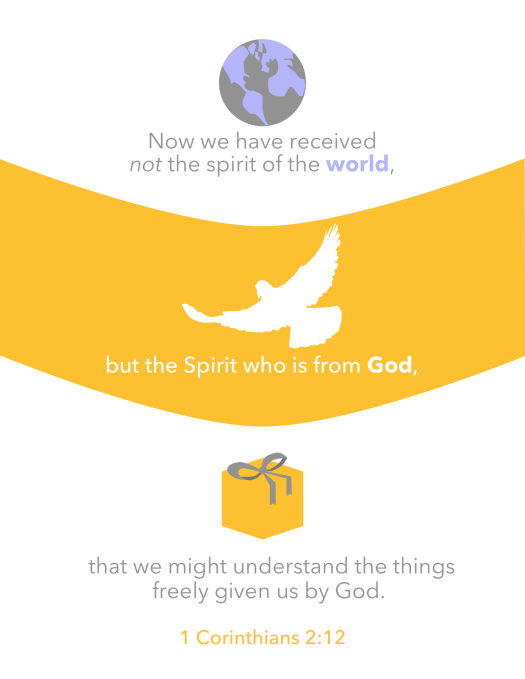
1 Corinthians 2:12

Here is a size for your iPhone, to make it your background.

And don’t forget the Bible study, which we cover on Wednesday night at 6pm at the church, or look at it with a friend or on your own. You can find it here.


Jesus May Be Mocked, But He is Always Worthy of Praise

When Jesus was crucified, as Paul says in 1 Corinthians, it certainly appeared foolish. Here Jesus is seen as a common criminal, a failure, and powerless. In Mark we read these words of how he is mocked at the crucifixion:

And the soldiers led him away inside the palace (that is, the governor’s headquarters), and they called together the whole battalion. And they clothed him in a purple cloak, and twisting together a crown of thorns, they put it on him. And they began to salute him, “Hail, King of the Jews!” And they were striking his head with a reed and spitting on him and kneeling down in homage to him. And when they had mocked him, they stripped him of the purple cloak and put his own clothes on him. And they led him out to crucify him.

Mark 15:16-20

That is our savior. Paul won’t waiver from this painful sight–the Messiah dying on the cross. It seems foolish. But it is our savior. It is love in action.

I thought I’d share a hymn that puts these two concepts together. Each stanza begins with what appears foolish: birth in a manger, a wandering existence with no home, his beating, and finally his crucifixion. But coupled with these scenes is the fact that such humble events do not diminish our Lord. Each stanza asks, “Who is this?” And the answer is always, regardless of circumstance, “our God.” We still praise him. Jesus Christ is the Son of God in these times and judging by the world’s standards, or by the world’s wisdom, does not fully comprehend his real power and glory.

Who Is This, So Weak and Helpless?

Who is this, so weak and helpless,
Child of lowly Hebrew maid,
Rudely in a stable sheltered,
Coldly in a manger laid?
’Tis the Lord of all creation,
Who this wondrous path has trod;
He is Lord from everlasting,
And to everlasting God.

Who is this, a Man of Sorrows,
Walking sadly life’s hard way,
Homeless, weary, sighing, weeping
Over sin and Satan’s sway?
’Tis our God, our glorious Savior,
Who above the starry sky
Is for us a place preparing,
Where no tear can dim the eye.

Who is this? Behold him shedding
Drops of blood upon the ground!
Who is this, despised, rejected,
Mocked, insulted, beaten, bound?
’Tis our God, Who gifts and graces
On His church is pouring down;
Who shall smite in holy vengeance
All His foes beneath His throne.

Who is this that hangs there dying
While the rude world scoffs and scorns,
Numbered with the malefactors,
Torn with nails, and crowned with thorns?
’Tis our God Who lives forever
’Mid the shining ones on high,
In the glorious golden city,
Reigning everlastingly.

You can also listen to the song here, in a rendition from Indelible Grace, sung by Sandra McCracken (although the video was not made by them):

N.T. Wright on the Foolishness of the Cross

What was so foolish about the cross?

“The Christian good news is all about God dying on a rubbish-heap at the wrong end of the Empire. It’s all about God babbling nonsense to a room full of philosophers. It’s all about the true God confronting the world of posturing, power and prestige, and overthrowing it in order to set up his own kingdom, a kingdom in which the weak and the foolish find themselves just as welcome as the strong and the wise, if not more so”.

N. T. Wright, Paul for Everyone: 1 Corinthians.

Committed to Preaching an Offensive Gospel

Paul writes in chapter one about how the gospel of Jesus Christ, and the cross in particular, may be offensive. To some we see it for what it is, the heart of the good news. Others see it as folly, weakness, or a stumbling block to belief.

At times people may desire to overcome the offensiveness of the crucifixion and make the message more appealing to the world. We may even do so with the best of intentions, so that more people may hear the message. But Paul is committed to the message of the cross of Jesus Christ and he will not sugar coat it. He knows that it is a hindrance to Jews and the idea of worshiping an executed criminal is simply absurd to the Greeks. But he can not gloss over the crucifixion.

In our attempts in today’s world to make the message of Jesus Christ more “relevant” or sensitive to our modern culture, we cannot lose sight of what we preach. God is pleased to save those who believe through a foolish message. We ought not water it down for in so doing we will lose its fullness. The cross of Christ may offend. A gospel of grace–as wonderful and freeing as it is for believers–is not always accepted as good news. But we must trust in God’s wisdom and in his message, not concerning ourselves with whether we appear as fools to this world.

Paul, a very educated and eloquent man, did not seek to sidestep that which he knew would cause problems for his readers and listeners with lofty speech and convincing rhetoric. I’m sure he could’ve concocted a message that would be far more appealing. But Paul had no desire to merely entertain. No he decided to know nothing but Jesus Christ and him crucified.

Memorizing the Message of Christ Crucified

Each week with our memory verse we have the chance to really focus in on one small portion of Scripture. That one or two verse segment may contain some core truth found in this letter. It may help us remember helpful background, like the first week’s memory verse during which we memorized the key players in 1 Corinthians (from whom, to whom). These short lines also help us recall the larger points and arguments that Paul makes. For instance, this week the verses are 1 Corinthians 1:22-23:

Jews demand signs and Greek seek wisdom,
But we preach Christ crucified,
a stumbling block to Jews and folly to Gentiles…

These verses lift up the centrality of Jesus Christ and his sacrificial death on the cross. They also reminds us that God coming to die for us was not what people were looking for and it seemed utterly foolish to the world. But these verses also can remind us of the surrounding passage. These lines fall in the center of a larger message Paul is writing that begins with the cross (v. 16), returns to the cross here in verses 22-23 and then ends again with Paul preaching Jesus Christ crucified (2:1-2). If we can memorize the center or crux or Paul’s argument, then we are better able to recall this whole section from 1:17-2:2.

Again here are some visuals to help you out. First a letter sized graphic. Second is something I made for those of who you use your smartphones all day long. Make it your lock screen and every time you glance at your phone, you’re given the chance to repeat the memory verses.

Memory Verse 1 Cor 1.22-23

Small sized for your iPhone

Finding a Rhythm in Your Bible Readings

Paul Penning His Letter

Our reading plan takes us into the second half of chapter 1, but it is important to realize that this is a continuation. That seems completely obvious, but we can easily forget the obvious and act as though this letter is a collection of separate sections. Paul in verse 17 has just begun his argument, drawing attention to the manner in which he preached. He didn’t try to gain attention for himself or to make disciples of Paul. He came preaching Christ. This week he continues what he started, a lesson on the cross of Jesus Christ.

We often study the Bible (or hear sermons) in which we hop around the Bible, never reading more than a handful of verses at a time. In reading straight through 1 Corinthians we will have a chance to really understand what the entire letter has to say. We’ll gain an understanding that is only possible with continuous reading of the whole. The connections of one half of chapter one to the other will be more clear and we won’t just understand a section, but we’ll understand how sections are related to each other. We’ll have perspective on the whole of 1 Corinthians.

This is our goal and to best accomplish that, I’d encourage you to read this week’s reading, 1 Corinthians 1:18-31, and then read the whole chapter again. It won’t take too long to do this a couple of times, especially if you are intentional about having some time in your day, every day, to read God’s Word.

You can find your own rhythm as we go along, but it could look something like this:

  • Sunday: read the new text for the week
  • Monday:read from the beginning through to the end of the assigned reading
  • Tuesday: read the new text, again
  • Wednesday: study the text, using the available Bible study
  • Thursday: read the next text, again and work on memorizing the Scripture
  • Friday: read from beginning through to the end of the assigned reading, plus memorization
  • Saturday: read the new text, again, plus memorization[1]

This is just one idea. It may not work as well once we’re further along into the book, since you may not have the time to go back and start at chapter one and read through chapter eight a couple of times in a week. But when we get there, find a new rhythm. Break 1 Corinthians down into chunks and reread those.

The more we read and pray through this book, the more we’ll know it. And please take note: the goal isn’t to merely know these words. We want to understand what God is telling us. Our goal is that in committing to study this book, this book will in turn shape us. We know the phrase, “you are what you eat.” In a way that applies to what we read. The more we read God’s Word, the more we put ourselves before him to become what he wants us to be.

Maybe your rhythm will be to read the section slowly, bit by bit, each day. Maybe you’ll read it Sunday then have a card in your pocket with a memory verse that you learn, internalize, then recite over and over again throughout the week. These are all great ways to do it. However you do it, I know that if you are in God’s Word, in some way, always returning to it throughout the week, God will do great things.


  1. For some personalities, listing out what you do every day looks awful. This then is not your rhythm. It’s just a suggestion, so find your own! For others, having a list is freeing. If that’s you, I hope this helps. ↩

Who is Sosthenes from 1 Corinthians 1?

Paul writes his letter and begins it by noting that it is sent from he and his brother Sosthenes. But who is this Sosthenes?

While we cannot be sure who this refers to, there is a Sosthenes mentioned in chapter 18 of the book of Acts.

12 But when Gallio was proconsul of Achaia, the Jews made a united attack on Paul and brought him before the tribunal, 13 saying, "This man is persuading people to worship God contrary to the law." 14 But when Paul was about to open his mouth, Gallio said to the Jews, "If it were a matter of wrongdoing or vicious crime, O Jews, I would have reason to accept your complaint. 15 But since it is a matter of questions about words and names and your own law, see to it yourselves. I refuse to be a judge of these things." 16 And he drove them from the tribunal. 17 And they all seized Sosthenes, the ruler of the synagogue, and beat him in front of the tribunal. But Gallio paid no attention to any of this.

This Sosthenes was a Jewish leader who, when his plans to attack Paul ended in an embarrassing rejection by the Roman ruler Gallio, was beaten and rejected by his own people. It is not far fetched to think that this man that was beaten and isolated may have been one that Paul himself would have approached, showing compassion. In so doing maybe this onetime enemy of Paul became a friend of the church and a brother. Paul probably would have had a special sympathy for Jewish leaders persecuting the church, for that was Paul’s own history back when he was Saul.

No Leader is Good Enough to Replace Christ

An issue that arises in this first chapter is the way in which factions have developed within the church, each seeking to ally themselves with a different teacher. Some follow Paul, others, Apollos, Cephas, or Christ.

This may have reflected ethnic divisions in Corinth, with the Roman contingent in the city preferring the Roman citizen, Paul. The Greeks identified with the Greek, Apollos. Jews with Peter, here identified with his Jewish name, Cephas. Ken Bailey writes:

Breaking into ethnic enclaves is unacceptable. Furthermore, loyalties to individuals is not an excuse for breaking the unity of the church. Their leaders are not adequate centers for primary loyalty. (Emphasis mine.)

We still fall into this trap of lifting individuals up into a role that is only properly filled by Jesus Christ. That is a clear emphasis of Paul in chapter 1: Jesus Christ is who matters more. Did Paul die for you? Were you baptized into Paul? No. Jesus Christ, and he alone, has died for you and could do so. Being indentified with Christ is what is greatest importance and he is whose name we call upon and whose name is placed upon us. After all, we’re called Christians.

Again, Bailey sums up the issue well and very succintly, “The question is not ‘Who is my leader?’ but rather, ‘Who died for us?’” These divisions are problematic, but the solution lies in turning to the cross, which dominates the next section of 1 Corinthians.[1]


Today I saw this article on the front page of Christianity Today that I thought (was going to) fit perfectly on this topic. It’s titled ‘Our Unhealthy Obsession with Pastors,’ by Luma Simms. The article does do a good job of hitting on this point that we can focus too much on a local church leader, and Simms writes, “Many of us have come to believe, consciously or unconsciously, that the man standing up front every Sunday is the only one doing real ministry.”

Of course that is not true. Pastors are just one group among the whole royal priesthood of God’s people. While we need to be cautious that we are not idolizing the man or woman that stands behind the pulpit, we need to at the same time lift up the varied work of the whole church.

I said that I thought this article was going to be a perfect fit, but it went from being a critique on the celebrity culture that seems to trace itself from 1 Corinthians 1 to today and became more an article about making sure that people don’t idolize the pulpit so that women don’t covet that sort of leadership. It is as though the greatest concern here isn’t a pastor taking attention from Christ, but that a certain group of people thought to be disallowed from the pastorate are sinfully drawn to it.

There is a better reason to not idolize the pulpit, and it is so that Jesus Christ remains as our focus. And we have no reason to fear a woman leading, as this letter of 1 Corinthians itself will give us examples of both men and women who exhibit leadership as they prophesy in the church.


  1. Kenneth E. Bailey, Paul Through Mediterranean Eyes, 71. ↩