Was Paul married or single?

Many people have wondered what was Paul’s marital status. Given his role within the Jewish community it is likely he would’ve been married. But what we read in his letters indicates he was single. That’s just about as much as my previous studies have shown me. Then I read this in the commentary I’ve been studying during our 1 Corinthians reading plan:

Orr and Walther [two biblical scholars] make a strong case that Paul was a widower. They write, “Jewish leaders holding the position attributed to Paul in the New Testament ordinarily were married.” But Paul is clearly traveling without a wife (9:5). Apparently his wife had died. Greek has a word for “widowers” (kheros), but that word does not appear in the New Testament time period when Koine Greek was in use. Later in this passage when Paul discusses the “unmarried,” (7:25) he uses the traditional Greek word for “virgin” (parthenos). In the present text [1 Corinthians 7:6-9] he discusses “a-gamois and widows.” The natural way to read the text is to see these two words as a pair and understand that Paul is writing about “widowers and widows.” Orr and Walther translate a-gamois literally as “de-married” and explain that in this passage it means “widowers.” Paul uses this word three times in this chapter. All of them can best be understood as mean, “once married, now not married.”

Ken Bailey, Paul Through Mediterranean Eyes. 204.

I thought this was pretty convincing. What do you think?

Bible Study Tips for 1 Corinthians 7

While it’s always good advice to take notes and write down summaries of what you’ve read, this passage is especially suited for that method of Bible study.

First off, chapter seven is a long chapter. With anything that we read, our minds can easily wander even while our eyes continue moving from word to word. If we stop to make notes in the margins or in a journal, we are keeping ourselves accountable to reading in order to understand, not reading to get it done (and out of the way).

This chapter also covers lots of different topics and within those topics Paul will go back and forth between his views. Try to break it down in parts, step back and ask yourself what is he trying to say and how does this fit in the broader themes of 1 Corinthians? If nothing else, this practice will at least reveal the questions you may have and that is the first step to finding some answers.

Bible Memorization Helps Flavor Our Speech

Memory Verse 1 Cor 7:22

This last week I had multiple conversations about how the language we use tends to reflect the language and words we around–both the speech we hear and text we read. This is all the more reason to devote ourselves to God’s word. We should let it sink deep within us and allow it to then flavor our own speech.

Memorization is a wonderful means to accomplish this goal.

That being said here is this week’s memory verse for chapter seven.

Memory Verse 1 Cor 7:22 for iPhone

If our bodies are for the Lord, does it matter if I exercise?

Given what Paul argues in 1 Corinthians 6 about the importance of our bodies and their role as temples of the Holy Spirit, it follows that what we do with and to our bodies matters. In light of that I found this discussion about exercise, sleep, and diet especially interesting. What sort of impact can the way we treat our body have on our sanctification? Is exercise a spiritual discipline?

Watch and let me know what you think.

Our Bodies Are Not Our Own, So What Are Our Bodies For?

Paul begins the final section of chapter six with a illustration that parallels food and the body. He says that food is meant for the stomach and the stomach for food. He doesn’t want us to be deceived in thinking that the body is meant for sexual immorality and sexual immorality for the body. No, Paul shows us the correct purpose for the bodies that God has given us. The body is for the Lord and the Lord for the body.

Paul then makes an argument about the negative affect of treating the body as though it were meant for immorality and makes a positive argument for why it is for the Lord and how the body is the Lord’s.

Many in Corinth saw sex as something to be treated casually and even within the church there were those who thought that freedom in Christ meant the freedom to do anything with their bodies, including incest and prostitution. Paul disagrees with this and tries to show why what we do with our bodies has great importance.

Any sexual interaction creates a new unity. Therefore there is no casual sex. This is a myth of our culture that says sex can be “just sex.” It is something more. So to have sex with a prostitute is to join yourself to the prostitute. It is not a casual encounter with no significance and to make it all the worse, Paul reminds us that we are already joined to Christ. We are members of Christ and to engage in this wrong behavior is to take the members of Christ and make them members with a prostitute. We should rather flee this sexual immorality and flee to Christ.

This stems from a low view of the body and of sex. Sex shouldn’t be seen in the same way as food. Ken Bailey’s commentary says this on the topic:

Paul is objecting to the dehumanizing of sex that takes place when it is turned into a form of entertainment and made parallel to food. Paul is rejecting the view that says “I feel hungry–I eat. I feel sexual desire–I engage in sex.”1

No we are made for something more. Our bodies are for the Lord and in Christ we are bound to him, two are made one in spirit. If we throw ourselves into immoral sexual relationships we are pulling ourselves away from unity to Christ and united our bodies, temples of the Spirit, to a prostitute. We are torn apart from the fellowship we find in Jesus.

It is more than a moral argument about what is acceptable in polite society. Paul wants his readers to realize that our bodies are meant for the Lord and they will be raised up with him. Our bodies are meant for the resurrection and what we do to them matters. Christianity is not a religion that pulls away from the body and focuses only on the otherworldly. We believe God created this world and proclaimed it good. Our God even came to us and took on flesh in Jesus Christ. Jesus had a body and our bodies are of great worth and we can’t toss them aside or think what we do with them has no meaning. No, they are meant for the Lord and destined to be raised with him.

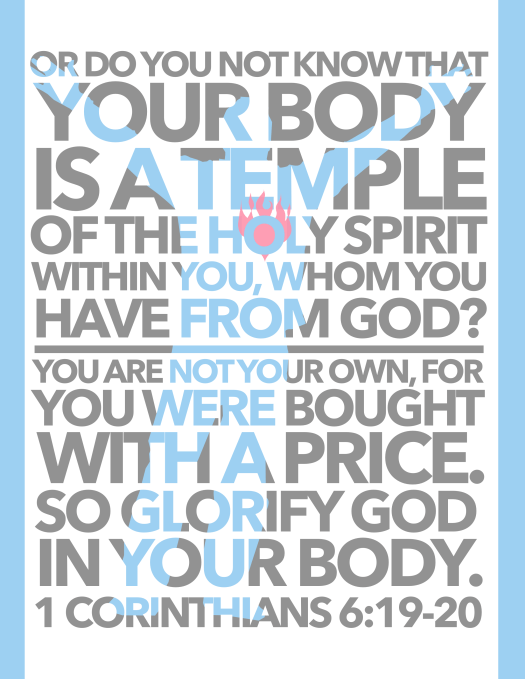
Memory Verse 1 Cor 6.19-20

Our bodies are given a great task in that they are temples of the Holy Spirit. Where once there was one place where all people went to seek the presence of God, now the one who is found in Christ is the very dwelling place of his Spirit. As a temple, our bodies then are to be places of worship, sacrifice, dedication, praise, offering, and thanksgiving. As a temple, we represent God’s presence where ever we walk.

Sexual immorality draws us away from Christ, harming the unity we have with him. It also misunderstands the purpose of our bodies, giving us a vision of a purpose that is far too small for the Christian. God has given us our bodies to be temples of the Holy Spirit, to be for the Lord. And we are the Lord’s. We have been purchased at great cost to be Christ’s. The price for you and for me was his death. But that is how much we are loved and prized by God. We are beloved, a cherished possession. So know that we now do in our bodies matters. His sacrifice for us gives our whole selves–bodies and all–great significance. If you and your body are important to God, they should be important to you as well.

The last line says it all so well. Remember, you are not your own, for you were bought with a price. So glorify God in your body.


  1. Ken Bailey, Paul Through Mediterranean Eyes. 185. ↩

The Sins Paul Warns the Church About in 1 Corinthians 6

Shifting his focus back from our response to sin within the body (and how we should not bring these matters for judgment before the unbelievers), Paul now returns to the matter of sin itself. He lists out certain behaviors that, like treating the courts as though they are the highest authority, are inconsistent with the life to which Christ has called us.

Paul has already met head on the issues of divisions, jealousy, and strife in the church. Also, the issue that everyone has reported to him of a man sleeping with his father’s wife has been addressed. Now in chapter six he presents a longer lists of sins.

It comes after a stern warning, “Do not be deceived.” We all have a great ability–great in its scope, not great in benefit–to deceive ourselves. It is an awful power that we have. We are skilled at rationalizing behaviors and thoughts, causing ourselves to believe what we do is right and appropriate. The world and its values can set the tone for what we come to think is right. There are even those in the church, in Paul’s day and in ours, that come along teaching something very different from what we see in Scripture. Paul often in his books is having to counter false teaching and warn them of its presence. So here he warns them not to be deceived and then reminds them of what is unrighteous behavior.

Do not be deceived: neither the sexually immoral, nor idolaters, nor adulterers, nor men who practice homosexuality, nor thieves, nor the greedy, nor drunkards, nor revilers, nor swindlers will inherit the kingdom of God.
(1 Corinthians 6:9–10)

Make no mistake about the type of town Corinth was. Paul indicates the Corinthians took part in this behavior as he follows this line by saying bluntly, “such were some of you.” These would be just the types of behaviors many were familiar with and had taken part in, and now they were likely to be tempted to fall back into old patterns. But also take note that Pauls says, “such were some of you,” indicating that old patterns were broken and healing was manifest in this community. All this because of what we read in the end of verse 11, “But you were washed, you were sanctified, you were justified in the name of the Lord Jesus Christ and by the Spirit of our God.”

This list is not unlike the sins that Paul lays out in Colossians 3:5,8.[1] In both places the list breaks down into two sections of five.[2] The first five in both places seem to relate to sexual sins, even with idolatry as “idolatrous worship in Corinth involved sacred prostitution with the priestesses of Aphrodite/Venus.”[3] The emphasis on sexual sin, both heterosexual sin and homosexual sin, clearly stems from the problems that are damaging the community of faith in Corinth that have come up in the previous chapter.

In both 1 Corinthians and Colossians the lists continue with another set of five. In 1 Corinthians 6 they are: thieves, greedy, drunkards, revilers, swindlers. This is a list tailored to this church as we have already read of their defrauding each other in the courts–a form of the first and last sins in the list. We haven’t read yet, but will in a later chapter, about their issues surrounding the communion table. In chapter 11 Paul mentions that some are getting drunk at the meal while others go hungry because other greedily take all the food. We can safely assume that a church that is already factious will most likely give way to insults (revilers) when excessive drinking is thrown into the mix. Ken Bailey summarizes how this list is so well-suited for this church:

Behind this list of ten sins lie aspects of three problems in the Corinthian church: stealing and their misuse of the courts, their sexual misconduct, and irregularities at their Eucharistic meals.[4]

Again Paul wants to remind them not of their sins, but of their former sins. He wants them to remember these as their past ways and focus on who has accomplished this work in them. If we are washed, sanctified, and justified, then we can be free from this sin.


  1. Kenneth Bailey, Paul Through Mediterranean Eyes. 176-77. ↩

  2. In many translations of 1 Corinthians 6 the the first five sins listed appear as four since two items in the list are often combined into one: homosexuality. The Greek reads, oute malakoi and oute arsenokoitai, which refers to two partners in a homosexual relationship.  ↩

  3. Bailey, 178. ↩

  4. Ibid, 179. ↩

Judges of the World and of Angels

Paul is upset by what the Corinthians have been doing in bringing their grievances before the secular courts. He mentions that having lawsuits is already a failure, but to then take such cases before unbelievers makes it all the worse.

Why does he say this?

In verses 7-8 he is lifting up the love, sacrifice, and humility that should instead be the character of a Christian community. Paul writes, “Why not rather suffer wrong? Why not rather be defrauded?” He wants the body to endure the suffering, but instead it is getting caught up with the ways of the world, wronging and defrauding fellow believers in the courts. Earlier in chapter four Paul wrote, “When reviled we bless; when persecuted, we endure; when slandered, we entreat. We have become, and are still, like the scum of the world, the refuse of all things.” This is not the attitude of someone always seeking to prove themselves, to seek retribution, to fight it out before the world in the courts.

These battles in the courts are a public witness and they do not witness to the unity of the church or to the pattern of life that should be based on Christ’s crucifixion. It is to their shame, as Paul says.

After spending so much time in the preceding chapters speaking about the wisdom of God in the cross of Jesus Christ and a wisdom that we have received by the Holy Spirit, Paul is confronted with a church that appeals to the wisdom of the world to determine its verdict. God’s wisdom is greater and he has granted it to his people, so isn’t there even just one person wise enough to settle dispute in the church? Paul then reminds them that the judges of the world are no real authority on these matters, instead the saints are ones who will be given great authority. In Christ we will reign with him and we will judge the world.

Paul then makes his arguments as he moves from the greater to the lesser. If you will judge the world, can’t you then judge a smaller issue? (Not to say that this is trivial in the sense that it doesn’t matter, it is just of lesser significance than judging the world.) If you are to judge angels–creatures that are otherworldly, heavenly–can’t you judge matters of this life?

This is a call for the church to remember its calling. And it is a high calling. The Corinthians need to live into it, to see themselves for what they are and what they are going to be. If they are judges of the world, what does it say if they bring matters of the church before mere human (1 Cor 3:4) courts? If the church has been entrusted with the mysteries and wisdom of God, matters that the rulers did not understand (2:8, 4:1), what is the witness to the world if such wisdom is inadequate to discern issues within the Christian body? Who then is the real authority in the life of the church? If God’s wisdom is to rule in their church, they must change course and stop acting as though the law of the unrighteous is their judge.

Our Body is for The Lord and is a Temple of the Holy Spirit

Memory Verse 1 Corinthians 6:19-20

In chapter seven Paul is continuing his discussion of sin in the church body, and specifically sexual sin. He isn’t making a simply moralistic argument about what is proper for a Christian community rather it is a theological argument.

Paul doesn’t base the conduct of the church on any passing norms in the culture. For the sake of argument he even acknowledges the church in Corinth’s thought that all things are now lawful for us in Christ. But Paul says that just because something is permissible, that does not mean it is good for the body. Our bodies have a purpose and it is not to satisfy sexual desire. We are not our own, rather we are Christ’s. And we serve his purposes.

Memorizing 1 Corinthians 6:19–20 will serve us well in remembering what we are called to do with the bodies God has blessed us with.

Memory Verse 1 Corinthians 6:19–20 for iPhone