Or: An exercise in imagination to help see the importance of Paul’s letter
Saint Paul Writing His Epistles, Valentin de Boulogne
Imagine if you will:
Paul has come your way through the region of Galatia, and you think you understood what he has taught. But he wasn’t the only one who has come talking about Jesus, and what Jesus’ life, death, and resurrection mean for us.
Some of what Paul said sounded radical, such as complete dependence on God’s grace, not on what we do. But others came along to you adding to his teaching.
Yes, God is gracious, but don’t we still need to earn grace? God has given you the law, right? Shouldn’t we then follow it? Why would he give it to you if you couldn’t follow it? And if you can uphold the law, then you must.
Should we be concerned? Did Paul just emphasize some parts of the gospel and other teachers emphasized other parts? Are they teaching the same thing? They all sound pretty smart, how can I make heads or tails of this? Are they all right in some way? How should we react?
If only Paul would write to us to help clear things up…
In Mark 6 Jesus returns to his hometown, Nazareth, teaching in the synagogue, but while some people were astonished, others were more reluctant to accept not only Jesus’ teachings but the man himself. They wonder where he got this teaching, since they didn’t see this in Nazareth. They wonder how this Jesus could perform such mighty works and say, “Is not this the carpenter, the son of Mary and brother of James and Joses and Judas and Simon?”
They know Jesus, but they know him before he had began his ministry and revealed himself as the Christ. The people of Nazareth know Jesus the carpenter, not the Messiah. And because they think they already know him they’ve made their conclusions. Jesus can’t change their assumptions about who he is.
How often do our preconceived notions or past experiences limit our ability to accept something or someone new? If we knew someone years ago and they were a bit of a terror, when they appear reformed do we believe they have changed? Or can we not get beyond our previous conclusions and think it must be a facade? In a similar way, if we know someone as an upstanding citizen and all around “good person,” do we refuse to believe that they could have made some grave mistake? Does the past again inform us more than the facts, and have us say, “Oh, no… they’d never do that. They’re a good person. I don’t believe it.”
We are quick to come to conclusions, even without all the information. Nazareth thought they knew Jesus, but they didn’t know the whole story. They wouldn’t accept that even though he was a carpenter, even though he was a man, that he was also fully God. We should not be so rash to close off ourselves from the continued working of God in and through people. We should not be so prideful as to think we already know the full picture. Like with Jesus going back to his hometown showing himself to be more than they expected, we should know that God is full of surprises and is quick to go beyond our expectations.
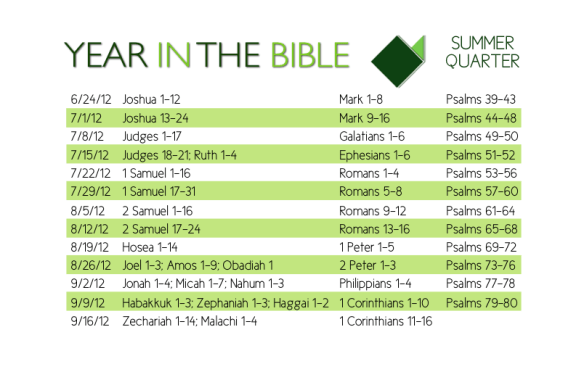
I had forgotten to do this earlier, as I did for our first quarter, but here is something to print out or use in some way as a guide for your readings. I made it about a half page, so you can tuck it right inside most Bibles.
When you’ve got 5 minutes to read, you don’t want to waste 2 of them trying to figure out what we’re supposed to be reading that week. So keep this, or something else like it, handy. I hope it helps.
Joshua brings us back to the edge of the promised land, just like 40 years prior. Having been one of the twelve that spied out the promised land then, he now is the one sending two spies to investigate, especially the city of Jericho. How amazing then is it that they hear these words from Rahab in chapter two:
I know that the Lord has given you the land, and that the fear of you has fallen upon us, and that all the inhabitants of the land melt away before you. For we have heard how the Lord dried up the water of the Red Sea before you when you came out of Egypt, and what you did to the two kings of the Amorites who were beyond the Jordan, to Sihon and Og, whom you devoted to destruction. And as soon as we heard it, our hearts melted, and there was no spirit left in any man because of you, for the Lord your God, he is God in the heavens above and on the earth beneath.
The spies return, only with the help of Rahab who has had also saved them from their enemies, and they bring the message that the people melt away because of Israel. It must have been a bit humbling to hear greater conviction in the ability of God to deliver the land to Israel from the mouth of a prostitute than from the God’s own people a generation ago. At that point, the Israelites were overwhelmed with fear at the size and strength of the people and the spies (not including Joshua and Caleb) convince the people to act on that fear.
As this was happening in the Israelite camp, as they were figuring out a plan B so they wouldn’t have to match up against the supposed giants of Canaan against whom they thought they were no match, the Canaanites were melting away in fear. Israel couldn’t trust that their God, who had already done so much for them, would take them to the land he promised. But Israel’s enemies could. They knew of God’s power and were frightened.
Fear was the appropriate response, but only for one of the groups. For those who should have put their trust in the Lord, there was no need to fear.
Now Israel approach the Jordan and Jericho, the promised land, probably wishing they had heard from Rahab 40 years earlier.
Today we had a lunch after church to celebrate the end of our first quarter of Year in the Bible. Looking back it is a great amount of reading that has been finished and so many of the big stories of the Bible have been covered. You’ve really accomplished a lot in just a few months.
Noah Ark – One of the many well-known stories of quarter one.
We’ve gone from creation to God’s people readying themselves to enter the promised land. In between God has shown himself to be faithful and true, strong and mighty, full of grace and mercy, as well a God of judgment who does not tolerate sin. God has chosen a people for himself, beginning with Abraham, and has provided all that was needed. But God’s provision and sufficiency ironically never seem like enough and Israel always turns away. God meets this faithlessness with his grace. There is judgment, like 40 years of wandering, but God never ceases being a God for us.
God is never revealed more clearly as for us than in Jesus Christ, of whom we read about in the New Testament. We read John and Luke who present to the reader the gospel, and that is the story of Jesus Christ. God is for us and has stopped at nothing to make us his own, and this means that God came to earth in Jesus Christ and took our sin upon himself, dying the death that we deserve, so that we can be reconciled. Now we a sinful people can be with a holy God.
In response to such an amazing, world-changing event, the lives of the disciples of Christ can never be the same. In the book of Acts we see the way in which the church exists in light of the death and resurrection of Christ, as empowered by his Spirit.
Now in quarter two we take up both of these strands and follow the story further along. The promised land, which has been held out before Israel, is finally occupied in the book of Joshua. We’ll then see Israel move from prophets and judges to a nation that wants and gets a king for itself, just like all the other nations. This summer quarter will also give us a chance to read all of the minor prophets who speak against the nation, calling for its people to return to God and to his ways.
The church that finds its footing in the Roman empire is still in need of help and encouragement and we’ll read many letters that were circulated to do just that. These are the letters of Paul and Peter, who sought to build up the people and strengthen the small group of believers who would one day rise up from under the oppression of a hostile culture to be a force for the kingdom of God.
That’s what we’ll have to look forward to this summer quarter of Year in the Bible, starting this week. Hope you can stay with it. I’ll be praying for you and for your time spent with God in his word.
Tune in tomorrow after church to get the full low down on the weekly “story so far.” We’ll look back at the big picture at our Review/Preview lunch. Then we’ll have a more substantial post to intro our Summer Quarter of Year in the BIble.
We’ve come a long way from creation to the doorstep of the promised land in the Old, and hearing about Jesus Christ to seeing his church take shape in the New Testament. I pray it has been a wonderful experience so far.
And it is good when that bread is topped with cheese and marinara sauce.
That’s what we’ll be doing this Sunday after our late service at church to celebrate the end of our first quarter. One of the goals of Year in the Bible, I guess second only to the obvious reading of the Bible, is doing so together. This Sunday will remind us that we do not undertake such a task alone. We learn better together, we grow more together, we’re better challenged together. We should not take for granted the great cloud of witnesses we’ve been blessed with by being a lone ranger. We need each other.
Some of you have been a part of a small group or a Bible study that is reading along with one another, but others do not have that weekly contact. This luncheon can be a place to rub shoulders with brothers and sisters, hear about their experience, and enjoy the company.
We’ll also get a short review of all we’ve done as well as some words of introduction to the summer quarter. So come out if you can, this Sunday, June 24th. We’ll have pizza and salad. Let me know if you will be coming.
For those unable to join in this fun, let me encourage you, if you haven’t already, to find someone to partner with in this study of God’s Word. Share your experiences, your questions, your joys, and frustrations. Reading God’s Word is great, but doing so as the church is even better.
Acts 22 recounts a message delivered by Paul. He had been before the tribune asking for permission, and receiving it proceeds to speak to fellow Jews.
The crowd appears to listen intently, all the more because Paul speaks in Hebrew. He tells of his stirring conversion, meeting with Christ on the road to Damascus. He then was taken in by Ananias, received back his sight, and was given the call to be a witness. Paul repented and was baptized.
Paul is commanded in a vision to flee from Jerusalem, because the people there will not accept his testimony. Paul knows that people remember the role he took in persecuting the church, even standing by approvingly as Stephen was marytred.
St Paul Preaching in Athens, Raphael – Preaching to the Gentiles.
The crowd was listening throughout all of Paul’s message, but in verse 22 it says that at his last line they raised their voice and called for him to be cast out. What could he have said that would cause them, after listening throughout his message so intently, to turn so quickly?
In verse 21 Paul says that God commanded him to, “Go, for I will send you far away to the Gentiles.’”
Paul’s opponents will tolerate his words up to the point that he claims God calls him to go to people unlike themselves. They appreciate that he is like them, that he is from a place like them, and that he speaks a language like them. They do not appreciate that he is ministering to “the other.” Their vision is so clouded and their understanding of God’s intent so narrow that they cannot hear the good news of Paul’s message.
God’s love for the gentiles is described as the core of a great mystery of our faith, revealed to us now. We now know how great is this new word that Paul speaks of in his letter to the church in Ephesus. I, a Gentile, for one am thankful for the ministry of Paul, as called by God, and need to follow suit to seek out not only others who are like me, but to bring the gospel to others.
For this reason I, Paul, a prisoner for Christ Jesus on behalf of you Gentiles— assuming that you have heard of the stewardship of God’s grace that was given to me for you, how the mystery was made known to me by revelation, as I have written briefly. When you read this, you can perceive my insight into the mystery of Christ, which was not made known to the sons of men in other generations as it has now been revealed to his holy apostles and prophets by the Spirit. This mystery is that the Gentiles are fellow heirs, members of the same body, and partakers of the promise in Christ Jesus through the gospel.





 And it is good when that bread is topped with cheese and marinara sauce.
.jpg "St Paul Preaching in Athens, Raphael")
 Year in the Bible