
Quick to Listen, Slow to Speak

I’m not sure how many times I’d repeated in my head (or deserved to have someone say to me), “quick to listen, slow to speak.” This of course is part of James 1:19 and is a simple directive, b it sure is hard. We all want to be heard. We’re tempted to think ourselves much smarter than we truly are and we want to give our two cents. But we don’t stop there, adding additional cents and finding ourselves in debt in the conversation. Having given so much speech, we owe the other person some time of listening.

Tell me if these situations are familiar to you–either as the victim or perpetrator:

  • One person in a conversation does not seem to be really listening, probably because he uses the time when the other person is talking only to think about what he’ll say next.
  • A person uses the story of another merely as a platform to tell another story that she thinks is much greater than the first.
  • Someone cuts you off to either agree, disagree, or correct the opinion that he actually did not hear since he interrupted you in the first place.
  • You have a friend who loves to tell you all about what is going on in her life, but has no time to listen to you.
  • You put your foot in your mouth because you jumped to conclusions without waiting for all the facts or because you didn’t wait for someone to finish.

It is so easy for us to fall into these traps. Embarrassingly, it is easy to complain when someone else does it, but then go off and do those very same things. But we need to evaluate ourselves, be humble in our relationships and conversations, and follow this command. The text goes on to say we should be “slow to anger” and being a person with patience who is slow to speak is key. I find it hard to imagine a hothead–someone quick to anger–as also someone who is a great listener and very humble.

On the flip side, don’t you find yourself drawn to people who listen to you? Who are patient as you speak and ask you questions? This can be a great witness for Christians to their neighbors, especially in a frantic world that is hurried and where we’re having more online relationships or transactional relationships. If you are one who listens, you’ll be taking a step to show the love and care God has for us to someone who may really need it.

This is also a lesson we need to make sure to apply to those God has placed close to us, those about whom we care most. That group is often one that sadly gets our worst, along with our best, since we see them so much. We can be so sure we already know them well enough, so we jump to conclusions, cut them off, or tune out. But we need to slow down.

If you need to be quick, be quick to listen. Give yourself time to really hear people. Take time to think. Then be slow to respond.
A Delight of Reading the Whole Bible in a Year

I have not had as much chance to post this past week as I have been way at a conference. Several of the speakers delivered fantastic sermons, which is always a benefit of these events. But I had a special delight this year as I heard from books like Daniel, Ezra, Ephesians, and Timothy. As the preachers delivered the messages I was so much more familiar with the scriptures that they were using.

But that isn’t to say that I now know enough. In reading though the Bible this past year I am instead primed to learn more and learn better. I loved knowing the context of the stories, remembering conversations had or posts written about those passages, and being challenged in new ways on what I thought I knew.

When they stepped back to give context, I was right there with them. The texts were still fresh in my mind, much closer to the surface, and much more accessible for the Spirit to use in my hearing and responding to the Word. It wasn’t like I was having to watch the same movie over again. It wasn’t at all tired or boring. The Bible is a living Word and I could see that as I had the chance to sit and receive it.

I pray you find that same delight as you grow more familiar with it and continue to read and re-read and read again God’s Word.

A Mix of Boldness and Gentleness

Remind them to be submissive to rulers and authorities, to be obedient, to be ready for every good work, to speak evil of no one, to avoid quarreling, to be gentle, and to show perfect courtesy toward all people. For we ourselves were once foolish, disobedient, led astray, slaves to various passions and pleasures, passing our days in malice and envy, hated by others and hating one another. But when the goodness and loving kindness of God our Savior appeared, he saved us, not because of works done by us in righteousness, butaccording to his own mercy, by the washing of regeneration and renewal of the Holy Spirit,whom he poured out on us richly through Jesus Christ our Savior, so that being justified by his grace we might become heirs according to the hope of eternal life.

Titus 3:1-7

Paul urges gentleness for the believers in these churches. He does not want the Christians to be quarrelsome but rather courteous to others. By the early churches example of such humble love and service, many were impressed with the new movement of Christians.

It didn’t mean they were pushovers. Just before this section Paul exhorts them to be bold in the truth, not letting anyone disregard them. They are to teach and rebuke with authority.

In today’s church, especially as it acts more publicly, do we find such a balance? Is it courteous and nice to the extent that we disregard ourselves and our own teachings, not wanting to offend anyone? Or are we so bold about the truth that we lose all humility and kindness?

Paul wants them to be both, and the humility I think is key. He reminds Titus, “For we ourselves were once foolish, disobedient, led astray, slaves to various passions and pleasures, passing our days in malice and envy, hated by others and hating one another.” How can we treat those who do not know Jesus Christ and his gospel when we are no better ourselves, save for the mercy of God? We should treat others well in hopes of impressing the love of Christ upon them, rather than condemn them as though we were in a position to be the judge ourselves. We all need the mercy of God, and that should be central to the message we carry to others, and to each other in the church.

A look back at Psalm 119

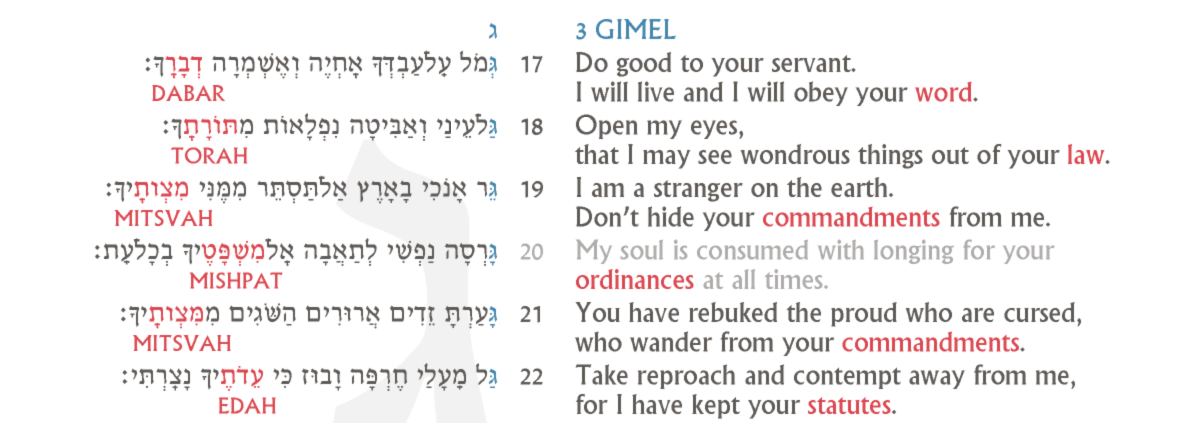
Psalm 119 Screenshot

Better late than never, right? This would’ve made for more sense a couple of weeks ago when we looked at the very long psalm, Psalm 119. If you were at our church, you would’ve heard a sermon that said a great deal about this unique psalm, but I did not include anything on it here on the site. And maybe you’re more of a visual person.

I found this some months back and it emphasizes the acrostic nature of the poem (how each line of the stanza begins with the same letter, with the proceeding stanzas moving along through the Hebrew alphabet). It also points out the place that God’s Word holds throughout the psalm. The way this site puts it is this:

Psalm 119 is telling us that to know the Creator God you must know His law, ordinances, word, commandments, statutes, precepts, decrees, testimonies, ways, and faithfulness.

I’d really encourage you to go take a look at this, and maybe skim down to the end first, as it has a word of explanation that helps make sense of the rest.

Basics of the Bible – Psalm 119 (It is pretty big, so it may take a moment to load).

A supposedly more friendly mobile version is here.

God’s Work, Not Our Work

Therefore do not be ashamed of the testimony about our Lord, nor of me his prisoner, but share in suffering for the gospel by the power of God, who saved us and called us to a holy calling, not because of our works but because of his own purpose and grace, which he gave us in Christ Jesus before the ages began.
2 Timothy 1 :8-9

As much as this is a letter to Timothy and about his ministry, it isn’t really about him. Paul wants to keep the focus on Jesus Christ and what he has done. It is not on the basis of our work that we are called, but because of God’s purpose and grace.

That doesn’t mean we aren’t called to do a work. We are. God has a plan for us and wants us to follow it. But just as it isn’t all about Timothy, it isn’t all about you or me. We are to make our work point to Jesus.

We do have a role to play, but Jesus deserves all the glory. We would have nothing if not for the grace given in him.

It reminds me a bit of this quote from Stacey King, a teammate of Michael Jordan.

I’ll always remember this as the night that Michael Jordan and I combined for 70 points.
(Said after Michael Jordan scored a career high 69 points and Stacey King scored 1 point against the Cavaliers. )*

*But when it comes to the work of our salvation, we don’t even contribute that one point.

Can There Be Perfect Matches Between Imperfect People?

In reading Song of Songs I thought this would be an appropriate time to share an article that is just an except from a larger book, but still one of the better and more insightful pieces on marriage I’ve read recently. It may be odd to read this along with Song of Songs, in which two people gush about one another. But it is good to remember that even the ones we love the most are imperfect, just like us.

Here is the opening paragraph:

In generations past, there was far less talk about “compatibility” and finding the ideal soul-mate. Today we are looking for someone who accepts us as we are and fulfills our desires, and this creates an unrealistic set of expectations that frustrates both the searchers and the searched for.

You Never Marry the Right Person, Tim Keller – Relevant Magazine

What sort of movie rating would you give the Bible?

Given all the sinning that seems to be so popular among the people of the Bible, you’d think it may come sealed in plastic and watched closely by booksellers so small, innocent children wouldn’t accidentally find themselves reading such graphic materials. It is a great story of God’s love, but it doesn’t shy away from the awful depths to which humanity falls.

Song of Songs may cause you to ask yourself how’d you rate the Bible (PG-13?), but not because of sin, but because of the intimate picture of love presented in it. Just read its opening lines:

Let him kiss me with the kisses of his mouth!
For your love is better than wine;
your anointing oils are fragrant;
your name is oil poured out;
therefore virgins love you.
Draw me after you; let us run.
The king has brought me into his chambers.

Song of Songs 1:2-4

This is not what you may expect to read as you open up a book of the Bible. But read through it and ask yourself why it would be included in our Scriptures. What does it say of love? What place does love have in our Christian belief? Does the relationship present here clue us in on God’s intent for our own relationships?

It is a unique book that isn’t often preached or taught, so I hope you take the time in this lighter week to read through it.

Salvation is Only a Work that God Can Do

"The Vision of The Valley of The Dry Bones", Gustave Doré, 1866
“The Vision of The Valley of The Dry Bones”, Gustave Doré, 1866

Our focus passage from this last week was the familiar passage (at least familiar relative to other parts of Ezekiel) of the valley of dry bones. God brings Ezekiel to a place full of death. There are bones that are long dead and have dried up. They appear to be hopeless, for who holds out hope that life can return to a corpse, let alone the bones that remain after years of decay? But God commands Ezekiel to speak this prophecy to the bones:

O dry bones, hear the word of the Lord. Thus says the Lord God to these bones: Behold, I will cause breath to enter you, and you shall live. And I will lay sinews upon you, and will cause flesh to come upon you, and cover you with skin, and put breath in you, and you shall live, and you shall know that I am the Lord.

Ezekiel 37:4b-6

As God had described it so it happened. Ezekiel witnesses dry bones covered with sinews and then flesh. But just to have appearance of the living is not enough. God then breathes life, Spirit, into the bodies. Then they stood as a great army.

These bones represent the whole house of Israel that believed itself beyond hope, but God still had a plan for them. He would revive them and put his Spirit within them. Just as it was with the vision of the bones, the work God would do in Israel would be miraculous and therefore would cause the people to know whose hand was behind this. Then the people would know God is the Lord for only God could save them from death and gift them with life.

This chapter describes the work of God for a nation in exile and suffering from their sins, but the miracle of turning death to life is described as well in the New Testament. I find that Ephesians 2 parallels this in some ways.

And you were dead in the trespasses and sins in which you once walked, following the course of this world, following the prince of the power of the air, the spirit that is now at work in the sons of disobedience— among whom we all once lived in the passions of our flesh, carrying out the desires of the body and the mind, and were by nature children of wrath, like the rest of mankind. But God, being rich in mercy, because of the great love with which he loved us, even when we were dead in our trespasses, made us alive together with Christ—by grace you have been saved— and raised us up with him and seated us with him in the heavenly places in Christ Jesus, so that in the coming ages he might show the immeasurable riches of his grace in kindness toward us in Christ Jesus. For by grace you have been saved through faith. And this is not your own doing; it is the gift of God, not a result of works, so that no one may boast. For we are his workmanship, created in Christ Jesus for good works, which God prepared beforehand, that we should walk in them.

Ephesians 2:1-10

Like the dry bones, we were dead. What could the bones do to restore flesh and life? Nothing. As a people dead in our sins, how could we save ourselves? We lived according to the sinful ways of the world, like the people of God in Ezekiel. They acted just like the nations surrounding them and suffered discipline for their disobedience. Likewise we are described here as children of wrath, just like the rest of mankind. But God rescues us in both situations and it is not because we deserved it. I see two reasons, first that God is merciful and loving to his people.

But God, being rich in mercy, because of the great love with which he loved us, even when we were dead in our trespasses, made us alive together with Christ…

Imagine reading that passage and ending before this verse. It is a dire situation. That is a pretty big “but” that comes to our aid. The situation was dire as well for the people in exile. In both, all hope is lost if not for the intervention of a gracious God. It is and has always been “by grace you have been saved.”

The other reason that God would do such a thing is that it fits in with his perfect plan. In Ephesians we see lines like, “so that in the coming age he might show immeasurable riches of his grace in kindness toward us in Christ Jesus” and “created in Christ Jesus for good works.” Ezekiel is full of the line, “that you may know that I am the Lord your God.” God’s work for the whole house of Israel is a testimony to his character and his grace and he wants the people to know, and he wants the world to know. We are chosen not to merely enjoy a blessing, but to also carry a great responsibility in God’s plan for this world.

God saves us from our sin and he raises us up with Christ. He does so because he has a plan for us. That plan is one of blessing, surely. But it blessing to be shared. His saving us is not a result of good works, but it is part of a plan that God prepared beforehand that leads to good works for his sake.

It is only because of God’s grace could we receive such mercy and love. Like dry bones, we could not bring back life. Even if we could somehow restore flesh and sinews, we still would lack life–the breath of God within us. Fortunately his plan did not call for us to remain dead. His plan was for us to have a life where we walk in his ways. This plan bought us back from death, restored us, and raised us to life with and because of our Lord Jesus Christ.