Can we find questions to the struggles of life?

There are a variety of types of questions in life. Those questions we have answers to, the questions we may one day be able to answer, and there are questions we may not ever be able to answer. Our curiosity may not be able to sit well with the idea that we don’t have every answer and that instead we’ll need to be satisfied with mystery.

You could put these extremes on a spectrum, with a sense of certainty about all things on one side and a belief that we can’t know anything on the other. We, the church, can get into trouble if we fall too far to one side. We can get dogmatic and argumentative about every minute detail, puffed up with a pride that we can know everything, even everything about God. On the other hand, the church may be too reactive to this and shrug its shoulders claiming “who are we to claim to know anything?”

The difficult task is then to discern what in fact God has shown us and what is kept concealed. Where can we have boldness and certainty and when must we patiently wait with our mouths quiet? And how do we learn the answers when we are able to find them?

John Calvin speaks well on this:

“Let us… permit the Christian man to open his mind and ears to every utterance of God directed to him, provided it be with such restraint that when the Lord closes his holy lips, man also shall at once close the way to inquiry.”

We ought to seek wisdom and answers and understanding throughout life. God has gifted us with our minds and blessed us with great understanding by his Spirit. The church should be a place of deep questioning and long meditation. Yet we must remain humble knowing that we have our limits and our place—a place far below the full understanding and wisdom of God. We must remain dependent upon God and his word.

All this to take me to the passage I read this week from Psalm 73. The psalmist is struggling with the way the world seems to operate. The wicked are finding such riches and comfort, and this seems to go against the ways that God has prescribed. He can find no answer for his questions. Does this question have an answer or not?

It turns out that this is the sort of question that finds an answer in only one place: the presence of God.

But when I thought how to understand this,
it seemed to me a wearisome task,
until I went into the sanctuary of God;
then I discerned their end. (Psalm 73:16-17 ESV)

We may not always know where this discernment will lead, but doing so holding the hand of God (v23) will lead us nearer to him. And while our flesh and heart may fail, God says he will forever be our strength (v26).
Steward of the Mystery of God

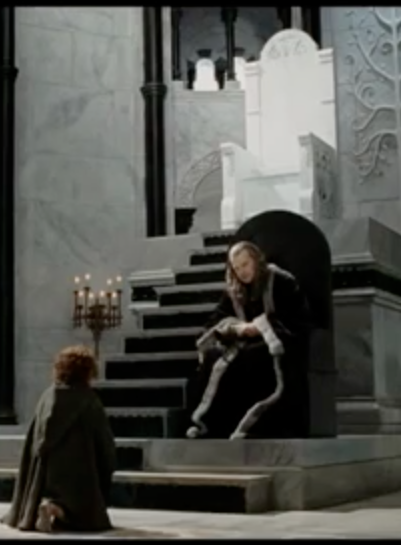
Whenever I think of the word steward I think of the Lord of the Rings. In Lord of the Rings there is a character whose position is the Steward of Gondor. His job is to be the caretaker of his city, Gondor, in the absence of the true king. What I love about the concept of steward is that it is both, at the same time, a position of great authority and great humility. Paul speaks about his role as a steward of God’s mysteries and as such he has authority among the churches. But his authority is completely foreign to him–it is not his own. He is not there to teach of his own wisdom. He preaches the cross. Paul doesn’t go to the churches as he sees fit, rather he goes where God has called him. So as a steward he has power, yet it is humble through and through, for it is the power of God that he is entrusted with.

This is why Paul goes on in this chapter to say that he isn’t accountable to the church. A steward must be found faithful, but it is a faithfulness to the one who has given the power. Paul is a steward of the mysteries of God, and he is then accountable to God. God is the one who judges faithfulness. The churches do not judge him, Paul himself won’t even judge.

He wanted what wasn't his to have -- the big throne.
He wanted what wasn’t his to have — the big throne.

Going back to Lord of the Rings for a moment, the character ends up getting into trouble because he is not respecting the position he has and seeks to claim more power than is due to him. He wants to go beyond the authority he has as steward and rule on his own. He wants to occupy the throne of the king. In doing this he is not found faithful.

This is just what Paul is seeking to avoid. In verse six as he writes, “I have applied all these things to myself and Apollos for your benefit, brothers, that you may learn by us not to go beyond what is written, that none of you may be puffed up in favor of one against another.” A steward that goes beyond what is written is going beyond the role of steward. It is dangerous territory of pride and ego. That is the downfall of the steward in the Lord of the Rings.

Paul’s intent should be ours, as well. We’ve been blessed with God’s word and what he has given us in it is sufficient. We veer toward sin when we step beyond Scripture and begin to speculate, innovate, or even delete. This quote from John Calvin from his commentary on the book of Romans says it well,

Let this then be our sacred rule, to seek to know nothing concerning it, except what Scripture teaches us: when the Lord closes his holy mouth, let us also stop the way, that we may not go farther.

God has entrusted us with much. He has given us his word but has also given each of us the life we live. To be found faithful we must seek to be good stewards, humbling acknowledging that all we have is truly God’s. We must also as stewards humbly accept what God has shown us and how he directs us, and make it our aim to trust his will, not looking to go beyond his perfect wisdom. After all, as we’ve learned in 1 Corinthians, our wisdom cannot compare to his own. God’s wisdom in the cross of Christ may seem foolish, but it is the power of God; it is our righteousness, sanctification, and redemption.