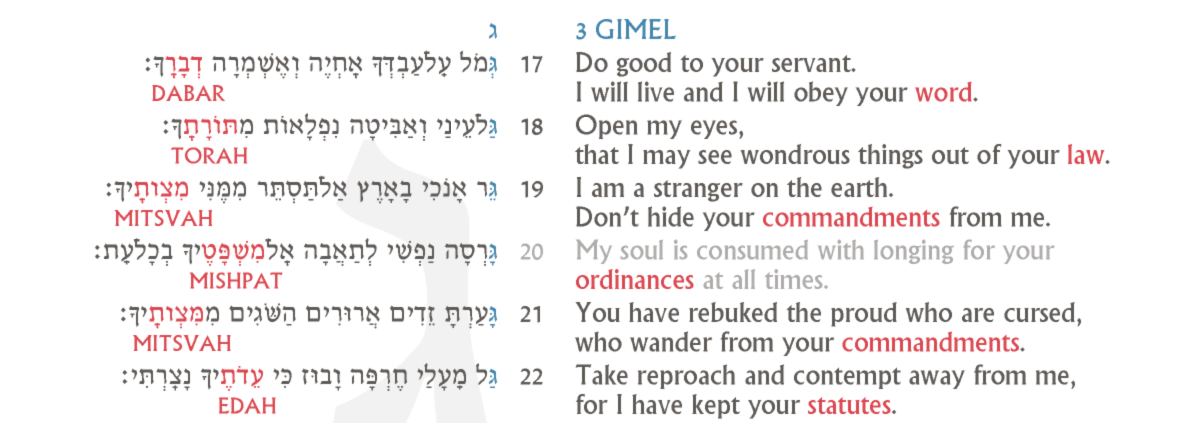
Better late than never, right? This would’ve made for more sense a couple of weeks ago when we looked at the very long psalm, Psalm 119. If you were at our church, you would’ve heard a sermon that said a great deal about this unique psalm, but I did not include anything on it here on the site. And maybe you’re more of a visual person.
I found this some months back and it emphasizes the acrostic nature of the poem (how each line of the stanza begins with the same letter, with the proceeding stanzas moving along through the Hebrew alphabet). It also points out the place that God’s Word holds throughout the psalm. The way this site puts it is this:
Psalm 119 is telling us that to know the Creator God you must know His law, ordinances, word, commandments, statutes, precepts, decrees, testimonies, ways, and faithfulness.
I’d really encourage you to go take a look at this, and maybe skim down to the end first, as it has a word of explanation that helps make sense of the rest.
Therefore do not be ashamed of the testimony about our Lord, nor of me his prisoner, but share in suffering for the gospel by the power of God, who saved us and called us to a holy calling, not because of our works but because of his own purpose and grace, which he gave us in Christ Jesus before the ages began. 2 Timothy 1 :8-9
As much as this is a letter to Timothy and about his ministry, it isn’t really about him. Paul wants to keep the focus on Jesus Christ and what he has done. It is not on the basis of our work that we are called, but because of God’s purpose and grace.
That doesn’t mean we aren’t called to do a work. We are. God has a plan for us and wants us to follow it. But just as it isn’t all about Timothy, it isn’t all about you or me. We are to make our work point to Jesus.
We do have a role to play, but Jesus deserves all the glory. We would have nothing if not for the grace given in him.
It reminds me a bit of this quote from Stacey King, a teammate of Michael Jordan.
I’ll always remember this as the night that Michael Jordan and I combined for 70 points.
(Said after Michael Jordan scored a career high 69 points and Stacey King scored 1 point against the Cavaliers. )*
*But when it comes to the work of our salvation, we don’t even contribute that one point.
In reading Song of Songs I thought this would be an appropriate time to share an article that is just an except from a larger book, but still one of the better and more insightful pieces on marriage I’ve read recently. It may be odd to read this along with Song of Songs, in which two people gush about one another. But it is good to remember that even the ones we love the most are imperfect, just like us.
Here is the opening paragraph:
In generations past, there was far less talk about “compatibility” and finding the ideal soul-mate. Today we are looking for someone who accepts us as we are and fulfills our desires, and this creates an unrealistic set of expectations that frustrates both the searchers and the searched for.
Given all the sinning that seems to be so popular among the people of the Bible, you’d think it may come sealed in plastic and watched closely by booksellers so small, innocent children wouldn’t accidentally find themselves reading such graphic materials. It is a great story of God’s love, but it doesn’t shy away from the awful depths to which humanity falls.
Song of Songs may cause you to ask yourself how’d you rate the Bible (PG-13?), but not because of sin, but because of the intimate picture of love presented in it. Just read its opening lines:
Let him kiss me with the kisses of his mouth!
For your love is better than wine;
your anointing oils are fragrant;
your name is oil poured out;
therefore virgins love you.
Draw me after you; let us run.
The king has brought me into his chambers.
Song of Songs 1:2-4
This is not what you may expect to read as you open up a book of the Bible. But read through it and ask yourself why it would be included in our Scriptures. What does it say of love? What place does love have in our Christian belief? Does the relationship present here clue us in on God’s intent for our own relationships?
It is a unique book that isn’t often preached or taught, so I hope you take the time in this lighter week to read through it.
“The Vision of The Valley of The Dry Bones”, Gustave Doré, 1866
Our focus passage from this last week was the familiar passage (at least familiar relative to other parts of Ezekiel) of the valley of dry bones. God brings Ezekiel to a place full of death. There are bones that are long dead and have dried up. They appear to be hopeless, for who holds out hope that life can return to a corpse, let alone the bones that remain after years of decay? But God commands Ezekiel to speak this prophecy to the bones:
O dry bones, hear the word of the Lord. Thus says the Lord God to these bones: Behold, I will cause breath to enter you, and you shall live. And I will lay sinews upon you, and will cause flesh to come upon you, and cover you with skin, and put breath in you, and you shall live, and you shall know that I am the Lord.
Ezekiel 37:4b-6
As God had described it so it happened. Ezekiel witnesses dry bones covered with sinews and then flesh. But just to have appearance of the living is not enough. God then breathes life, Spirit, into the bodies. Then they stood as a great army.
These bones represent the whole house of Israel that believed itself beyond hope, but God still had a plan for them. He would revive them and put his Spirit within them. Just as it was with the vision of the bones, the work God would do in Israel would be miraculous and therefore would cause the people to know whose hand was behind this. Then the people would know God is the Lord for only God could save them from death and gift them with life.
This chapter describes the work of God for a nation in exile and suffering from their sins, but the miracle of turning death to life is described as well in the New Testament. I find that Ephesians 2 parallels this in some ways.
And you were dead in the trespasses and sins in which you once walked, following the course of this world, following the prince of the power of the air, the spirit that is now at work in the sons of disobedience— among whom we all once lived in the passions of our flesh, carrying out the desires of the body and the mind, and were by nature children of wrath, like the rest of mankind. But God, being rich in mercy, because of the great love with which he loved us, even when we were dead in our trespasses, made us alive together with Christ—by grace you have been saved— and raised us up with him and seated us with him in the heavenly places in Christ Jesus, so that in the coming ages he might show the immeasurable riches of his grace in kindness toward us in Christ Jesus. For by grace you have been saved through faith. And this is not your own doing; it is the gift of God, not a result of works, so that no one may boast. For we are his workmanship, created in Christ Jesus for good works, which God prepared beforehand, that we should walk in them.
Ephesians 2:1-10
Like the dry bones, we were dead. What could the bones do to restore flesh and life? Nothing. As a people dead in our sins, how could we save ourselves? We lived according to the sinful ways of the world, like the people of God in Ezekiel. They acted just like the nations surrounding them and suffered discipline for their disobedience. Likewise we are described here as children of wrath, just like the rest of mankind. But God rescues us in both situations and it is not because we deserved it. I see two reasons, first that God is merciful and loving to his people.
But God, being rich in mercy, because of the great love with which he loved us, even when we were dead in our trespasses, made us alive together with Christ…
Imagine reading that passage and ending before this verse. It is a dire situation. That is a pretty big “but” that comes to our aid. The situation was dire as well for the people in exile. In both, all hope is lost if not for the intervention of a gracious God. It is and has always been “by grace you have been saved.”
The other reason that God would do such a thing is that it fits in with his perfect plan. In Ephesians we see lines like, “so that in the coming age he might show immeasurable riches of his grace in kindness toward us in Christ Jesus” and “created in Christ Jesus for good works.” Ezekiel is full of the line, “that you may know that I am the Lord your God.” God’s work for the whole house of Israel is a testimony to his character and his grace and he wants the people to know, and he wants the world to know. We are chosen not to merely enjoy a blessing, but to also carry a great responsibility in God’s plan for this world.
God saves us from our sin and he raises us up with Christ. He does so because he has a plan for us. That plan is one of blessing, surely. But it blessing to be shared. His saving us is not a result of good works, but it is part of a plan that God prepared beforehand that leads to good works for his sake.
It is only because of God’s grace could we receive such mercy and love. Like dry bones, we could not bring back life. Even if we could somehow restore flesh and sinews, we still would lack life–the breath of God within us. Fortunately his plan did not call for us to remain dead. His plan was for us to have a life where we walk in his ways. This plan bought us back from death, restored us, and raised us to life with and because of our Lord Jesus Christ.
There is a passage in 1 Timothy that draws a fair bit of attention and controversy. As Paul gives instructions to Timothy in how to safeguard the church, he also includes descriptions as to how men and women ought to conduct themselves.
Let a woman learn quietly with all submissiveness. I do not permit a woman to teach or to exercise authority over a man; rather, she is to remain quiet. For Adam was formed first, then Eve; and Adam was not deceived, but the woman was deceived and became a transgressor. Yet she will be saved through childbearing—if they continue in faith and love and holiness, with self-control.
1 Timothy 2:11-15 ESV
Much of the controversy hinges on whether these specific instructions are specific to this church and its contexts, or whether they are universal in scope. Should the women (or woman) in Ephesus set their sights on learning humbly and restrain themselves from inappropriately teaching and seizing authority because they have been deceived, and were especially prone to deception given that women in that culture were not often allowed the same access to education? Or should women not teach nor speak by mere fact that they are women?
I’ve been reading more on this text in the last few days, looking for resources on this issue to help present the arguments eloquently. I’ll include a link to a short essay found on Biblegateway that I think does a good job of presenting the different views, and does so without a quarrelsome, arrogant, or dismissive tone. Many articles on this issue can be aggressive, and especially given the way in which the whole of 1 Timothy speaks to that problem in the church, I wanted to find something respectful.
Personally, as I’ve said before, we need to read Scripture in light of Scripture. There are examples throughout the Bible of women of influence and authority. In the Gospels women play a very prominent role, even more so when taken in light of the prevailing customs of that culture. We see in books like Romans and Acts that women already had prominent positions in the early church. Given that fact, and other theological assertions of Paul himself in letters like Galatians, I believe when we come upon Paul’s writing here, we are warranted to spend more time on the passage that may seem to more easily lean one way, and read it in light of other passages and understand it to mean something else. Again, if we note the culture to which he writes, the mere assertion that the women ought to learn (v11) already pushes the boundaries of the roles of women.
That being said, I’d encourage you to read this article. It is from the IVP New Testament Commentaries, provided “generously by InterVarsity Press.” Isn’t great what you can access for free on the internet?
You may live your whole life and never once hear about the issues of authorship that arise in the discussion of the pastoral letters of Paul. And that life would be just fine. But questions do come up as to whether or not Paul wrote the New Testament book we’re reading this week for Year in the Bible, 1 Timothy.
As I said, you could live a full life without spending great time and energy on this question. But I bring it up because the authors of these books are important and I don’t want to make it seem like this issue is hidden. When churches never touch on controversial issues there can be a feeling that it is because if the controversy is true and some new idea becomes the norm, everything will fall apart. If Paul, by his own hand with his favorite quill, did not write 1 Timothy, do we then throw away the Bible and quit church? I do not think so.
One thing we shouldn’t do is use these questions as an excuse to dismiss parts of Scripture that we find difficult. Just recently at a conference at Princeton Seminary a professor, instead of tackling an issue that is raised in 1 Timothy, just dismissed whichever parts she was unsatisfied with saying something like, “Well, Paul probably didn’t write that book.”
1 Timothy is still part of the Bible. Clear on that? If Moses didn’t write all five books of the Pentateuch, does that mean we can then say, “Well, that’s in Genesis, and Moses probably didn’t write it.” The Bible is God’s book and he has worked upon many people throughout generations so that we may know his story.
That introduction aside, here is a very brief rundown of some thoughts about 1 Timothy. First, the issue of who wrote it is brought up because of different styles in grammar and form between a book like 1 Timothy and Paul’s epistles. I am no great expert, but in hearing these objections while in school I couldn’t help think to my own writing and how different it must have been my first year in college compared to my final year, my first year in seminary to my final year, and compare that to my writing today. Take that into consideration along with different causes for writing and different audiences and I thought that could account for a good deal of change. Perhaps that is far too simple an explanation. But I do know Paul was not perfect, and even though he was a teacher to many, he certainly had lessons to learn as well, and as he matured he may have had a better sense of what to say, how to say it, and to whom to say it.
Without further ado, here are three views quickly summarized with the help of New Testament Theology by I. Howard Marshall (397-398).
Paul is aided by a colleague in ministry who had a certain degree of freedom in composing the message.
The letter was written by someone else who wanted to bolster the authority of the letter by associating Paul’s name with it.
This letter contains Paul’s materials that were appropriate for the needs Ephesus and were formatted into a letter so as to be better received by the church.
The more letters of Paul you read the more you may notice patterns. He, along with other writers, often expresses a great concern for false teachers. There are warnings against their doctrines and the gospel is then described in stark contrast. 1 Timothy begins no differently as part of Timothy’s charge in watching over the church in Ephesus is to pay careful attention to what is being taught. Timothy needs to keep the teaching pure and put in end to false teachings.
I think most of us would rather stand for something rather than against it, but there are times, as we see in the Bible, when it isn’t either/or. There is a time for subtlety. There is also a time to call attention to false teaching and false teachers. And it is not only an issue about what is true and how should we protect that. Here in 1 Timothy we see one concern of Paul’s is that some in Ephesus have devoted themselves to myths and endless genealogies. Are they the most threatening issues affecting the church? Perhaps not. But they result in speculation and vain discussions.
What Paul wants Timothy to promote is proper stewardship from God and to foster love from a pure heart. If we spent all day speculating on unimportant issues we would have spent the whole day on unimportant issues! We certainly may have discussions that border the core elements of our faith, but we ought not devote our whole selves to them. In Ephesus people do devote themselves in this way, desiring to be teachers, to be authorities, yet they have no idea what they’re even talking about (rough translation of 1:7).
If you ever listen to talk radio, be it sports or politics, it is amazing how many hosts can go on and on for hours filling up time without saying much at all. Try taking notes during the program and then at the end look back at just how much was said. I doubt it’ll be very much. That is not the model for Christianity. We aren’t to endlessly babble or speculate, whine or critique. There is a great place for discussion, teaching, and study. But these are to lead us in following Christ and being a people of action, acting out our faith in love.
Proper stewardship isn’t just an issue of money. Vain discussions and speculation are poor stewardship of one of our greatest possessions: time. God has given us each day to live and we need to be wise in how we manage such an wonderful gift.



 Year in the Bible