
A Word About 1 Timothy and Paul

You may live your whole life and never once hear about the issues of authorship that arise in the discussion of the pastoral letters of Paul. And that life would be just fine. But questions do come up as to whether or not Paul wrote the New Testament book we’re reading this week for Year in the Bible, 1 Timothy.

As I said, you could live a full life without spending great time and energy on this question. But I bring it up because the authors of these books are important and I don’t want to make it seem like this issue is hidden. When churches never touch on controversial issues there can be a feeling that it is because if the controversy is true and some new idea becomes the norm, everything will fall apart. If Paul, by his own hand with his favorite quill, did not write 1 Timothy, do we then throw away the Bible and quit church? I do not think so.

One thing we shouldn’t do is use these questions as an excuse to dismiss parts of Scripture that we find difficult. Just recently at a conference at Princeton Seminary a professor, instead of tackling an issue that is raised in 1 Timothy, just dismissed whichever parts she was unsatisfied with saying something like, “Well, Paul probably didn’t write that book.”

1 Timothy is still part of the Bible. Clear on that? If Moses didn’t write all five books of the Pentateuch, does that mean we can then say, “Well, that’s in Genesis, and Moses probably didn’t write it.” The Bible is God’s book and he has worked upon many people throughout generations so that we may know his story.

That introduction aside, here is a very brief rundown of some thoughts about 1 Timothy. First, the issue of who wrote it is brought up because of different styles in grammar and form between a book like 1 Timothy and Paul’s epistles. I am no great expert, but in hearing these objections while in school I couldn’t help think to my own writing and how different it must have been my first year in college compared to my final year, my first year in seminary to my final year, and compare that to my writing today. Take that into consideration along with different causes for writing and different audiences and I thought that could account for a good deal of change. Perhaps that is far too simple an explanation. But I do know Paul was not perfect, and even though he was a teacher to many, he certainly had lessons to learn as well, and as he matured he may have had a better sense of what to say, how to say it, and to whom to say it.

Without further ado, here are three views quickly summarized with the help of New Testament Theology by I. Howard Marshall (397-398).

  • Paul is aided by a colleague in ministry who had a certain degree of freedom in composing the message.
  • The letter was written by someone else who wanted to bolster the authority of the letter by associating Paul’s name with it.
  • This letter contains Paul’s materials that were appropriate for the needs Ephesus and were formatted into a letter so as to be better received by the church.

False teaching and speculation is not only wrong, but a waste of time

The more letters of Paul you read the more you may notice patterns. He, along with other writers, often expresses a great concern for false teachers. There are warnings against their doctrines and the gospel is then described in stark contrast. 1 Timothy begins no differently as part of Timothy’s charge in watching over the church in Ephesus is to pay careful attention to what is being taught. Timothy needs to keep the teaching pure and put in end to false teachings.

I think most of us would rather stand for something rather than against it, but there are times, as we see in the Bible, when it isn’t either/or. There is a time for subtlety. There is also a time to call attention to false teaching and false teachers. And it is not only an issue about what is true and how should we protect that. Here in 1 Timothy we see one concern of Paul’s is that some in Ephesus have devoted themselves to myths and endless genealogies. Are they the most threatening issues affecting the church? Perhaps not. But they result in speculation and vain discussions.

What Paul wants Timothy to promote is proper stewardship from God and to foster love from a pure heart. If we spent all day speculating on unimportant issues we would have spent the whole day on unimportant issues! We certainly may have discussions that border the core elements of our faith, but we ought not devote our whole selves to them. In Ephesus people do devote themselves in this way, desiring to be teachers, to be authorities, yet they have no idea what they’re even talking about (rough translation of 1:7).

If you ever listen to talk radio, be it sports or politics, it is amazing how many hosts can go on and on for hours filling up time without saying much at all. Try taking notes during the program and then at the end look back at just how much was said. I doubt it’ll be very much. That is not the model for Christianity. We aren’t to endlessly babble or speculate, whine or critique. There is a great place for discussion, teaching, and study. But these are to lead us in following Christ and being a people of action, acting out our faith in love.

Proper stewardship isn’t just an issue of money. Vain discussions and speculation are poor stewardship of one of our greatest possessions: time. God has given us each day to live and we need to be wise in how we manage such an wonderful gift.

More on Colossians 1

I put up the picture inspired by Colossians 1 on Monday, but I did so without explanation. So I thought today I’d talk more about what I see going on in the opening of the chapter. Paul writes beginning in verse three:

3 We always thank God, the Father of our Lord Jesus Christ, when we pray for you, 4 since we heard of your faith in Christ Jesus and of the love that you have for all the saints, 5 because of the hope laid up for you in heaven. Of this you have heard before in the word of the truth, the gospel, 6 which has come to you, as indeed in the whole world it is bearing fruit and increasing—as it also does among you, since the day you heard it and understood the grace of God in truth, 7 just as you learned it from Epaphras our beloved fellow servant. He is a faithful minister of Christ on your behalf 8 and has made known to us your love in the Spirit.

You may have noticed by now that Paul likes to use long sentences. This is one good reason to slow down and make sure you’re understanding what he writes. The picture from Monday centers in on ‘hope’ and I did this because although it comes later in the passage, we hear that it is a cause for the faith and love about which Paul has heard. Their hope–their goal, their promise–spurs them on to have greater faith in Christ and to spread his love to others. Christians who journey toward the goal, who are bound to the hope we have in Christ, should exhibit in that journey the characteristics that arise from that hope: love and faith.

Later in verse five Paul tells of where this hope is found, that is in the word of truth, the gospel. These words have power as they have not only taken hold in these Colossian believers, but in the whole world. Where the gospel is sown it bears fruit and this fruit is faith, hope, and love.

The Colossians know what their end will be, they have their hope, and they are exhibiting the marks of followers of Christ, faith and love. But Paul then goes on to pray for them so that they may know best how to live. They are already trusting Christ and loving the saints, but he wants them to excel in it. Paul wants them to know what faith and love will continue to look like, so he writes:

9 And so, from the day we heard, we have not ceased to pray for you, asking that you may be filled with the knowledge of his will in all spiritual wisdom and understanding, 10 so as to walk in a manner worthy of the Lord, fully pleasing to him, bearing fruit in every good work and increasing in the knowledge of God. 11 May you be strengthened with all power, according to his glorious might, for all endurance and patience with joy, 12 giving thanks to the Father, who has qualified you to share in the inheritance of the saints in light.

Christians surely know we should have faith, hope, and love. What can be difficult is having the wisdom to know not only the what but the how. This is Paul’s prayer. He wants them to know God’s will for them and to have the wisdom to discern how to follow his will. This is not an endeavor to begin alone so we need the strength of God’s power to endure this life, and to do so with patience and joy.

Even though Paul gives thanks to God when he thinks of his fellow Christians, for their love and faith, he reminds his reader that this is not something we’ve achieved on our own, rather it is the Father who has qualified us to receive all we have.

Keep reading Colossians and you’ll see a beautiful picture of Christ and what he has done for us, and how what he has done is sufficient for all we’ll ever need.

Increasing faith and increasing influence

In chapter 10 Paul writes “our hope is that as your faith increases, our area of influence among you may be greatly enlarged…” Here I believe he is talking about the spread and increase of the gospel in the area surrounding Corinth, hoping that the church there can help push the gospel further. But these words got my minding going off on a tangent, something that is not uncommon for me.

Perhaps it happened because of what I was reading previously in the chapter. Given that our struggles are not against the flesh, Paul writes that we should take captive every thought so that our mind will be obedient to Christ. We must not let our minds succumb to temptation, instead we need to place our minds, and by extension, our whole selves under Christ’s control.

So with this on the mind when I came to the passage about influence increasing with faith, I jumped to the fact that as our faith increases so does our understanding of the implications of the gospel in our life. The stronger the faith the more we give over to the Lordship of Jesus Christ. If in faith we take captive our thoughts to give over to obedience to Christ, surely his influence will spread throughout us.

What maybe began as a small understanding of Jesus grows and creeps into every single area of life as Christ grows in our eyes. We cannot keep relationships from his authority, we cannot go about with a belief that our job is a separate area apart from his watch, and we must understand that even our bodies are not our own. The influence of the gospel of Jesus Christ grows as our faith grows. Not that Christ is made to be Lord, but our eyes open wider to see the truth that is there, that he is already Lord, and we make our life correspond to the reality that is in him.

So while the passage may not directly be addressing Christ’s control in a person of faith, certainly if the church of Corinth is increasing in faith, so too will Paul’s ability to influence that geographic area grow, as well, for they will be giving themselves over in obedience to the rule of Jesus Christ.

A man fully consecrated to God

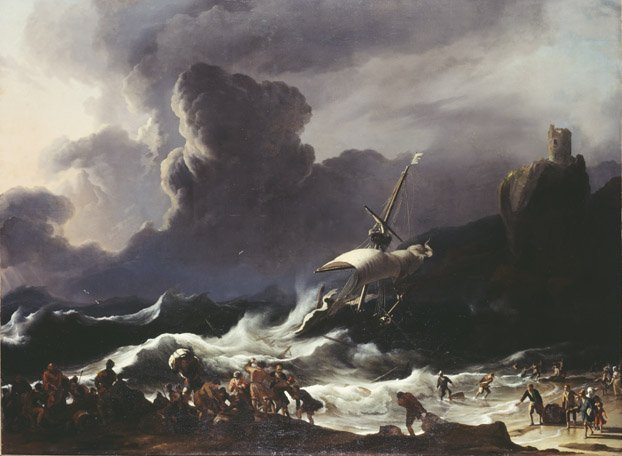
Ludolph Backhuysen – Paul’s Shipwreck

In 2 Corinthians we see a long list of Paul’s sufferings that have come his way during his time as a minister of the gospel. Starting in 2 Corinthians 11:24, Paul writes:

Five times I received at the hands of the Jews the forty lashes less one. Three times I was beaten with rods. Once I was stoned. Three times I was shipwrecked; a night and a day I was adrift at sea; on frequent journeys, in danger from rivers, danger from robbers, danger from my own people, danger from Gentiles, danger in the city, danger in the wilderness, danger at sea, danger from false brothers; in toil and hardship, through many a sleepless night, in hunger and thirst, often without food, in cold and exposure. And, apart from other things, there is the daily pressure on me of my anxiety for all the churches.

Paul was so committed to the call God had placed upon him that he continued the work even as he faced such pains. Knowing the cost did not deter him. Christ was more precious to him than anything else.

This passage about Paul reminds me of the quote that Henry Varley spoke to D.L. Moody, “the world has yet to see what God will do with a man fully consecrated to him.” That certainly was Paul’s desire–to live his life for someone else, no matter the cost. As he pursued this goal, being used by God, Paul helped to change the world. And that is just what will happen when one gives themselves fully to God.

Love and (More than) Marriage


I bet if you’re married, there is a very good chance that a certain passage from this week’s readings were a part of your wedding ceremony. 1 Corinthians 13 is a favorite passage for couples to use at their nuptials.

Of course, I hope love is part of a marriage, so I don’t think it is out of place to use this passage. But given that this passage on love is so linked for many to weddings, we need to make sure we remember this scripture applies for all. Love is patient is not only for couples. You don’t have to be married for your love to rejoice with truth, bear all things, and not seek its own way. This chapter is lifted up as a goal for how we should love, but just don’t think it is the goal only in marriage. All Christians are called to follow the self-giving love of Jesus Christ, who even loved his enemies.

It would be much easier if I only was called to love my spouse. Even still, I’d fail. But it’d be easier. But it is the more challenging way of disciples of Christ to hear this as a call for all of us to love our neighbors in a way that pushes us and requires great reliance on God’s Spirit. For we can do many amazing things, but if we have not love, we are nothing.

To some, being a Christian will be like wearing a dunce cap

20120912-204558.jpg
We talked a great deal tonight in our Reading Group about 1 Corinthians 1. It is our focus passage for the week and in it Paul talks of the foolishness of the cross in the eyes of the world. Conversation went in all directions so we did not make it through all the prepared questions, so I had to ask one question as we parted. (By the way, that’s my favorite way for conversation to go).

The cross is foolishness to others, so how do we prepare ourselves to be seen as fools because of it? I know I try avoid appearing stupid, dumb, foolish (toss in your favorite synonym). But, if I serve a crucified Christ, I won’t be able to avoid being seen that way.

Do I care more about how I’m perceived? Do I want to look smart more than I want to look like a fool for Christ? I think in certain circles we Christians want to appear to have all the answers and be seen as wise. While we shouldn’t seek to be ignorant or unwise, that cannot be our greatest pursuit. The cross of Christ is utter foolishness to the world and no matter how we phrase it, the cross will be a stumbling block and folly to a great many.

We just need to find ourselves more comfortable resting in the wisdom and power of God than vainly struggling to muster strength and smarts of our own. How others see me is nothing compared to knowing and being known by God.

You’ve Got Mail!

So imagine you’re the church in Philippi.

Paul has done work in your area a while back. He came and taught, spending time in the household of a neighbor, Lydia. He got in to some trouble with the local officials, and while in jail he ministered to fellow prisoners and even though an earthquake loosed his chains and could have freed him, he remained. In doing so he kept the prison guard from taking his own life, and later this guard and his whole household believe in Jesus.

You believe what he taught about Jesus and seek to follow his teaching, even in a city that has shown itself to be hostile. There are some things that are familiar to the Jewish faith, and Jesus seems to be a continuation, but there is a radical newness to Christianity, as well. As much as you try to hold on to Paul’s teaching of the gospel, you have still have questions. Other teachers have come around and are spreading a message that doesn’t quite sound the same, and that troubles you. You’re also troubled because you know Paul himself has again found himself imprisoned in Rome.

You worry about him and the work he is to do for the gospel of Christ. Can he still spread the word?

To your delight you hear that your church has received a letter of encouragement, and it is from Paul, and from his fellow servant Timothy! You’ve been given the chance to hear it read for body of believers in Philippi. At the end of the day you all gather together in a home that you’ve frequently used for meetings–for prayer and worship, and you sit down to hear the news. He writes:

Paul and Timothy, servants of Christ Jesus, To all the saints in Christ Jesus who are at Philippi, with the overseers and deacons: Grace to you and peace from God our Father and the Lord Jesus Christ…