Habukkuk 1
2 O LORD, how long shall I cry for help, and you will not hear? Or cry to you “Violence!” and you will not save?
3 Why do you make me see iniquity, and why do you idly look at wrong? Destruction and violence are before me; strife and contention arise.
4 So the law is paralyzed, and justice never goes forth. For the wicked surround the righteous; so justice goes forth perverted.
We are to read Scripture in light of Scripture, getting a fuller understanding the more we take in the breadth of the Bible. It is hard to understand God’s wisdom in just a single verse. With these Minor Prophets I’ve emphasized the whole message we receive by their words. There is word of judgment, but also a promise of hope and restoration. At times it is even more than restoration as God promises to make something new for his people that is greater than what has come before.
I think this is a good practice. But as you read the Psalms or this intro to Habakkuk, it is good to see that at times we’re a people who grieve. We grow frustrated. The truth is still the truth–God is in control and at work. But we don’t always see it clearly.
God can handle this. He doesn’t want us to live in that place. But we can pass through it with all conviction, spilling over our fears, frustrations, and questions to God. He knows our weakness and we see in his Word that he is compassionate and is moved by our prayers. If you are going to be angry, just don’t try to hide it from God. He may have good word to share with you.
5 “Look among the nations, and see; wonder and be astounded. For I am doing a work in your days that you would not believe if told.”
We’re getting so close to the end of this quarter. For me, it’s flown by. In some ways that has been great–but some weeks it just seems like I have less time. But that is to be expected. We never have perfect weeks or completely normal schedules. So we make our choices and work hard to keep our priorities in place.
What helped when we finished the Spring quarter was having an event to close it out, while at the same time previewing what is ahead. We’re going to do that again this month. Summer is almost over and the Fall is around the corner, so let’s get ready.
Mark your calendars: SEPTEMBER 26 – Year in the Bible, Review and Preview, Pt. 2
Last time we gathered after church for some food, fellowship, and some learning. We’ll keep that format, but change the time. Instead of after church, we’ll do it Wednesday evening at 6 pm. This is perfect for both those who want to have a refresher on all we’ve done this last quarter. But if you are new (OR KNOW SOMEONE WHO’D LIKE TO JOIN? hint hint), this is for you. We’ll then have some introductory comments on what is ahead. I think the third quarter is one of the hardest. You don’t have that motivation from being close to the end and our opening excitement may have worn off.
You can do it!
And of course, you can do it this week, too. We have two more weeks of Minor Prophets, and we’re beginning 1 Corinthians. Send your thoughts and insights my way.
PS – RSVP to me for the Review/Preview session. I’m providing dinner, so I need to know how much to make.
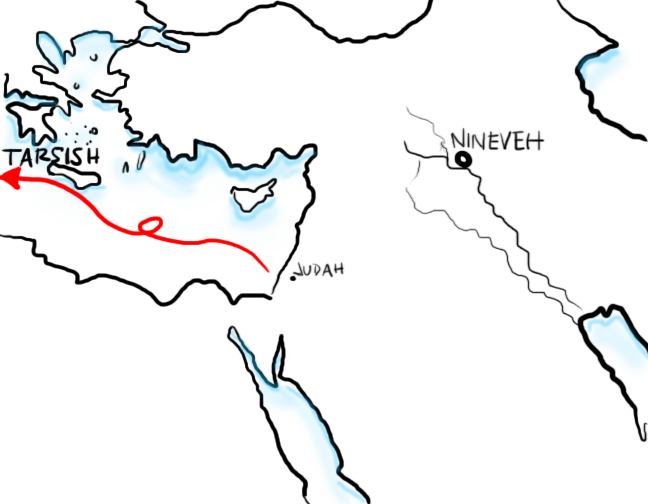
Jonah is a peculiar book among our readings this past week. These prophets we’ve had for a few weeks in Year in the Bible typically are part of the people they minister to. But Jonah is sent away to speak God’s message to another nation in the city of Ninevah. Also, the prophets typically want their recipients to stop their wicked ways and turn to God. As you read the short four chapters of Jonah, you see he’s not that concerned with Ninevah’s fate. He wants God to judge them. And when God relents, Jonah is upset.
1 But it displeased Jonah exceedingly, and he was angry. 2 And he prayed to the Lord and said, “O Lord, is not this what I said when I was yet in my country? That is why I made haste to flee to Tarshish; for I knew that you are a gracious God and merciful, slow to anger and abounding in steadfast love, and relenting from disaster. 3 Therefore now, O Lord, please take my life from me, for it is better for me to die than to live.”
Jonah 4:1-3
Jonah complains saying to God, almost in his defense, “This is why I ran. I ran off to Tarshish because you’re gracious. I know you’d do this!” He is displeased exceedingly because God is gracious. You want to shove the Bible in his face and tell Jonah that God’s grace is exactly why he still has a people of his own. Israel has been a sinner just like the others, but they have been forgiven more times than we can keep count.
But Jonah has a selfish pride and a pompous assumption that Israel has a monopoly on God’s mercy. He doesn’t want a rival nation to be spared because he wants his own nation, and only his nation, to prosper. Jonah would rather see thousands die than witness their repentance because he hates the people of Ninevah.
Jonah tried to go as far away from Ninevah as he could.
Along with Jonah being a story of Assyrian sin and God’s grace and forgiveness, it is a book displaying an ugly nationalism that would prevent Jonah from obedience and love, choosing instead sin. Jonah sins by fleeing, ends up in the belly of a whale, then cries out for God to take his life, all because of his displeasure at seeing God work wonders in another people.
We should never follow Jonah’s lead in this regard. We are called to love our enemies, to pray for them, and to work to spread the gospel to all peoples. We cannot lay claim to God’s grace as though it is ours to possess. We don’t deserve it and we can’t earn it. Thanks be to God that he is in fact slow to anger and merciful.
*Tim Keller has an excellent chapter on Jonah’s idolatry in his book, Counterfeit Gods.
Philippians is a book that shows the great depths of Christ’s humility. Christ is the one who has the most reason to be proud, but instead he humbled himself more than any other. He came down to us from heaven, emptying himself and taking the form of a servant. Not only did he come to serve, but he came to die for the people he came to save.
Paul writes to the church urging us to follow Christ in this regard. He says, “Do nothing from selfish ambition or conceit, but in humility count others more significant than yourselves. Let each of you look not only to his own interests, but also to the interests of others. Have this mind among yourselves, which is yours in Christ Jesus…” Then what follows it he powerful description of Christ’s humility.
But Christ does not end in a lowly position. His end is not the cross. He has been raised up and at the name of Jesus, every knee should bow and every tongue confess that Jesus Christ is Lord. This is quoted from the book of Isaiah, here in reference to Jesus and in Isaiah as a reference to God. Paul is making the case that it is right to worship Christ, to lift up his name. He is the Son of God.
In sight of this, how can we not be humble? God came to us, died for us, saved us, loves us. This is not something God had to do, but something he chose to do in his great mercy. We cannot live in light of this with conceit or pride. We ought to live like Christ, being like servants. If we are to make a name for anyone, it should be the name of Christ. Like John the Baptist our pursuit is to decrease so that Christ may increase (John 3).
We should put great effort and energy into spreading the name of Christ, all for the glory of God. Our work should be to shift focus away from ourselves and onto the one who has saved us.
Many women and men humbly serving one purpose.
I read this quote a while back and I think it is fitting. It is about orchestras and the way in which the best musicians come together not to bring attention to themselves, but to come together and make something greater than themselves. It’s from an article The Believer, which I’ve slightly edited, referring to the New York Philharmonic:
They were the top in their school and then the top at Juilliard and now they’re playing second cello. And the humility is as high as the musicianship. Let’s say you’re playing a Beethoven piece in a room where the same piece was played one hundred years ago. They’re sitting in the same chairs, wearing the same shoes and suits, playing instruments that are one hundred years old, playing the same sounds with the best conductor of their time, who is standing under photos of twenty of the greatest conductors. And when the music started playing, I had this idea that the music was coming through this little channel—for lack of a better word—for years and years. Musicians come and go and they’re stewards of the music for a brief period of time. But once the music plays—it’s really between Beethoven and the listener at that point. The musicians are there to get their … hands off of it. All that training! Thousands of hours! Sight-reading every day! All so they can get … out of the way because nobody gives a crap about them at all. The less you notice them, the better it sounds. I mean, it was the highest level of art in music that I’d ever seen, and it was performed by people who had spent countless hours of work just to be invisible.
We may know the name of an orchestra or even the name of the conductor. But can we name all the musicians whose work comes together to make something beautiful? That is how it should be in the church. We hope the church has made itself known for its great work and witness in this world, and certainly we hope the conductor, Christ, is known the world over. But our aim, as a second cello, should not be to draw attention to ourselves.
We are stewards of the gospel, stewards to the King of Kings and Lord of Lords. He has entrusted us a great work to do for his kingdom. We ought to devote such countless hours to make Christ visible and ourselves invisible–at least compared to Christ. That is humility. May he be seen by what we do. May Christ’s name receive all glory for our labors. May Jesus Christ receive all praise.
Paul has done work in your area a while back. He came and taught, spending time in the household of a neighbor, Lydia. He got in to some trouble with the local officials, and while in jail he ministered to fellow prisoners and even though an earthquake loosed his chains and could have freed him, he remained. In doing so he kept the prison guard from taking his own life, and later this guard and his whole household believe in Jesus.
You believe what he taught about Jesus and seek to follow his teaching, even in a city that has shown itself to be hostile. There are some things that are familiar to the Jewish faith, and Jesus seems to be a continuation, but there is a radical newness to Christianity, as well. As much as you try to hold on to Paul’s teaching of the gospel, you have still have questions. Other teachers have come around and are spreading a message that doesn’t quite sound the same, and that troubles you. You’re also troubled because you know Paul himself has again found himself imprisoned in Rome.
You worry about him and the work he is to do for the gospel of Christ. Can he still spread the word?
To your delight you hear that your church has received a letter of encouragement, and it is from Paul, and from his fellow servant Timothy! You’ve been given the chance to hear it read for body of believers in Philippi. At the end of the day you all gather together in a home that you’ve frequently used for meetings–for prayer and worship, and you sit down to hear the news. He writes:
Paul and Timothy, servants of Christ Jesus, To all the saints in Christ Jesus who are at Philippi, with the overseers and deacons: Grace to you and peace from God our Father and the Lord Jesus Christ…
We have so much that is thrown at us demanding our attention. This issue is constantly on my mind and it came up today in conversation. And then I saw this article, so I thought I’d pass it along.
This article looks back on a time, a more low-tech time, when just taking the phone off the hook was all that was necessarily to shut out the world. Now we silence phones and turn off computers, but even when we do that, there is a big difference when the technology is turned back on. You put your phone back on the hook and you’re reconnected. No messages, no voice mails. End of story. But now when we reconnect, we are met with a deluge of messages, emails, and all sorts of alerts.
It seems that when we try to silence tech, we can only do so much. It may remain quiet for a time, but it is sitting in wait.
But even if it is a small victory, such quiet time is good for the soul. Do not feel greedy in wanting it. Unplug and find your focus.
Jonah and the Whale, Verduner altarpiece in Klosterneuburg, Austria by Nicholas of Verdun.
Welcome to another week. You may find yourself fortunate to have the day off due to the holiday, and if so, perhaps that means you have a few extra moments to begin this week’s reading.
We continue to plow through these shorter books of the Minor Prophets. If I haven’t said so already, don’t let their name mislead you. They are not minor in their importance, but are named as such because of their shorter length. This week we have three more in Jonah, Micah, and Nahum.
Then over in the New Testament we have the letter to the Philippians. We just happened to have finished studying this letter during a Sunday class, and I am excited to go through it again. It’s a wonderful book that draws focus on the great worth of Jesus Christ, the humility that he displayed and which we should display in response, and contentment that flows from such focus.
And of course, we continue with our slow walk through the Psalms.






 Year in the Bible