Famous Amos

Famous Amos

Amos is a prophet against the people of Israel and he begins his prophecy with oracles of judgment. He describes the horrible sins of Israel’s foreign neighbors and slowly brings the target closer to home. He begins far off, moves to nearby neighbors, then to Judah, and finally he pulls all the punches and ends with the eighth oracle: judgment on Israel itself.

Israel has oppressed the poor, given themselves to pagan practices, exploited others financially, and not respected those who have taken special vows for God. Their sins are made worse for unlike the other foreign nations, they should know better since they know God.

As I mentioned earlier there is a last word of hope. Israel has failed but it is not the end for them for in the last days God will restore all things. Amos concludes with this powerful promise:

“I will plant them on their land, and they shall never again be uprooted out of the land that I have given them,” says the LORD your God.
Amos 9:15

Tough to Be a Prophet

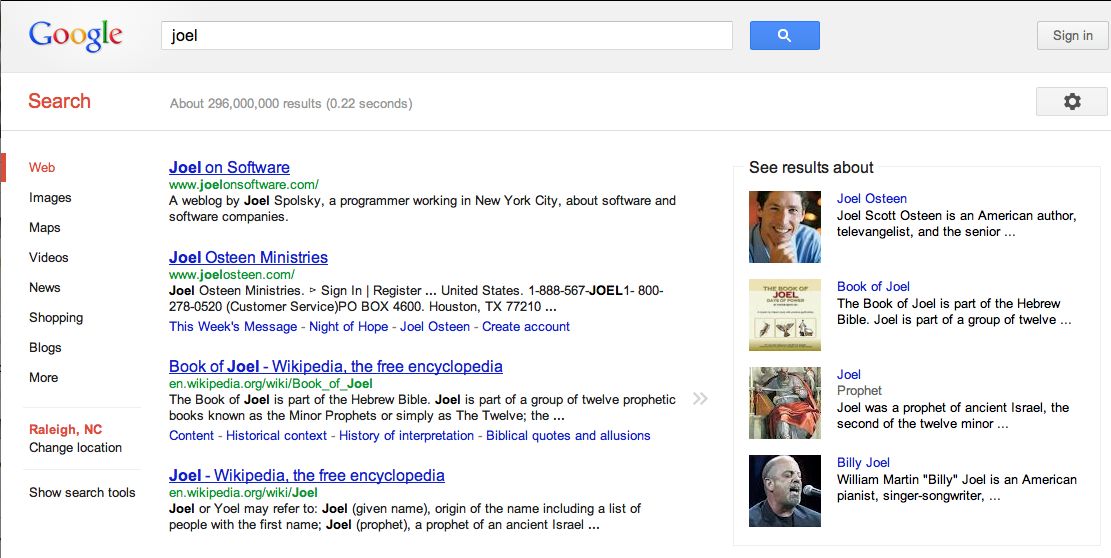
I’m sad Google ranked Joel Osteen higher than the prophet Joel.

Like other Minor Prophets, Joel is a book calling for repentance. Just because he is writing to God’s chosen people does not mean that they will necessariliy be spared from judgment. They have sinned against God and have been unfaithful to him. Joel preaches that their restoration will come once they turn from sin, and turn to God.

It’s not always a great job to be a prophet. Joel (and others) have to deliver messages against their people. They are messengers of bad news. They announce the sin of their peers. This is a quick way to make enemies, then and now.

But their message is not a despairing one. Look for the words of hope that are held out for God’s people. In the end, despite their lack of faith, God will renew them and will make his residence among us once more (Joel 3:17).

Always Have a Reason

“…but in your hearts honor Christ the Lord as holy, always being prepared to make a defense to anyone who asks you for a reason for the hope that is in you; yet do it with gentleness and respect…”
1 Peter 3:15

This is an utterly simple command of Peter, and one I think we take for granted. In many areas of life we assume we know what is needed. We assume we’ve got something under control or that we know “how to take it from here.” But when we finally are out in the position to reveal what we know, to put our learning into practice and take off the training wheels, only then do we realize our deficiencies.

I almost know the lyrics to countless songs. Pop songs and hymns, bubble gum oldies and classic rock, contemporary Christian and country. I know them when I sing along. I do not know the lyrics well enough to sing on my own, which is embarrassingly revealed as I stumble through half-remembered lines when I’m singing around the house. I overestimate my knowledge and it an example of the behavior that leads us to think we know, really know, more than we do.

Getting back to Peter’s call to us, we all can pick answers about our faith if it were a multiple choice quiz. But if we are asked about the hope that we have, can we give a response? Can we clearly communicate the gospel of Jesus Christ? Can we do so on the spot, without help (except by the Spirit)?

I hope reading though God’s Word helps you prepare yourself. Peter tells us in plain language to be prepared, so what is stopping us? This story of Jesus Christ is the good news for the world and our only hope. If we don’t share his story, who will? It is not only beneficial for the hearer, but when we know more about the hope we have, it will only strengthen our own belief, too.

If you’re interested in working on your ability to communicate the gospel, let me know. I’ll always make time for that. I even have some resources from a recent class that has some visuals to help us learn, remember, and communicate Jesus that I’m happy to pass along. I’ll try to remember once I get back in town to post some to our site.


Connecting Hosea to 1 Peter

Our focus passage for the week takes a look at the connection between Hosea and the book of 1 Peter, but if you are not following along with those, here’s a short summary. Peter quotes lines from the prophet when he is addressing the believers–both Jew and Gentile. He makes the bold assertion that they are now part of the people of God, brought in by his mercy to the family of faith, not based on blood, but on their being chosen in Christ. When he writes that those who were once not God’s people and who did not receive mercy are now God’s people and have received mercy, Peter is grafting believer’s into the history of Israel, assigning to them the words that had been first used to speak of God’s people in Hosea.

Especially for those Gentiles who had been kept at a distance before Christ came, this would have been an overwhelming affirmation of their place within the Kingdom of God. They are made to be God’s people and have been chosen to be a royal priesthood so that they may all declare the praises of God, who has saved us from the darkness (v9). To be brought in from the darkness into the light, to be made a people who were once not a people, to be called priests who were once pagans, is a great reversal and a humbling work of God for which he is to receive all praise.

Intro to Hosea and a Plug for Study Bibles

We begin a whole new genre this week with our first Minor Prophet. We read Hosea, which is tied for most chapters along with Zechariah at 14. I find refreshing my memory with some brief introductions is always helpful with these books of the Bible, which brings me to why I like study Bibles.

Being a pastor it is my job to keep Christian publishers in work by buying lots of Bibles. I have a great number in my possession that have either been bought by or for me over the years. I have several translations, sizes, and even languages. When I was a student I really valued portability because I lived out of my bag and always wanted to have a Bible with me without having to carry around so many extra pounds. I mentioned earlier in the year that the Bible I’m mainly using for our Year in the Bible is one that has sizable borders for taking notes. Beyond that I’ve really enjoyed my old, trusty NIV Study Bible. If you don’t have some version of a study Bible, I highly recommend it.

These are the ones that include all sorts of notes on the text with cross references and commentary, they provide cultural and contextual notes, and they even include pictures and diagrams. And as I mentioned earlier, they give introductions to each book of the Bible.

So take this as a plug for getting your own study Bible. Here is an introduction taken from the NIV Study Bible, published on Biblica.com, to give you A) helpful information as we start Hosea and B) a preview of what you get with study Bibles:

biblica.com/niv/study-bible/hosea/

Romans, David, and Love for Enemies

The Death of Absalom, Gustav Dore

This week I read our Old Testament passages first before moving into the New, so by the time I read Romans, parts of 2 Samuel kept coming to mind. One part especially struck me from Romans 12 in the way we are to relate to our enemies.

David was by no means a perfect man, but he did display character unlike those around him. Starting back in 1 Samuel David has had many enemies, such as Saul, Abner, and Absalom. To these so-called enemies, David showed great respect and grace. In chapter 19 he is criticized for showing too much grief at the death of Absalom, who was his son, and his military commander complains and says David loves those who hate him.

But Romans 12 teaches us to bless those who persecute us and not to repay evil with evil. We are to love those who hate us. This certainly must be one of the most difficult commands placed upon us. We wish it could just stop at not repaying evil with evil. Couldn’t we just turn the other cheek and move along? Can’t I just walk away? To most such actions are commendable. But we’re called to do more.

It is too easy to support and encourage a perspective that views others as enemies (and not in a way to help target who we should love). We want a foil, a villain, an antagonist–someone or something to compare ourselves to and come out looking good. We’d rather demonize the enemy than sacrifice for their sake and show them love. This is not the way of the Christian.

Christ shows us a greater way, “Love your enemies and pray for those who persecute you.” When we were enemies, God showed his love for us in sending Jesus Christ.

We won’t be able to match his demonstration of love, but one simple way we could start is to hold our tongues when it comes to labeling others as ‘enemy.’

Whose Orders Do We Follow?

There is a soldier under the command of David who has gone out seeking to fight back against the opposing forces under Absalom. As he leaves he hears David mention that Absalom is to be protected. So when this soldier finds Absalom trapped and vulnerable to attack, he passes over him. When he gets back to his superior, Joab, and has an exchange that goes like this:

2 Samuel 18

And Absalom happened to meet the servants of David. Absalom was riding on his mule, and the mule went under the thick branches of a great oak, and his head caught fast in the oak, and he was suspended between heaven and earth, while the mule that was under him went on. 10 And a certain man saw it and told Joab, “Behold, I saw Absalom hanging in an oak.” 11 Joab said to the man who told him, “What, you saw him! Why then did you not strike him there to the ground? I would have been glad to give you ten pieces of silver and a belt.” 12 But the man said to Joab, “Even if I felt in my hand the weight of a thousand pieces of silver, I would not reach out my hand against the king’s son, for in our hearing the king commanded you and Abishai and Ittai, ‘For my sake protect the young man Absalom.’ 13 On the other hand, if I had dealt treacherously against his life (and there is nothing hidden from the king), then you yourself would have stood aloof.”

This soldier stands between two commands from two commanders. Even though he must have felt pressure to kill the enemy of David, he was more compelled to be obedient to him. He stands up to Joab, disregards his offers of money, and even draws to his attention the fact that David gave his command to protect Absalom in the presence of Joab.

At times we may stand between two opposing commands, but we should follow the lead of this unnamed man. Even in his dangerous position, he heeds the higher calling. We should recognize that the orders of our higher commander, of our Lord, should be what we obey over and sometimes against all other authorities.

Year in the Bible, Quarter 2, Week 8

It seems like so long ago we read about people like Noah and were reading some of the gospels of the New Testament. But then I look at a calendar. It hasn’t been all that long–only a matter of months. We began Year in the Bible back in March, and late March at that. It’s exciting to look back and think about all we’ve been able to read and all that we’ve learned from God through the scripture.

We’ve done so much and we’re not even halfway!

As I write that sentence, I realize some may interpret it negatively, as some sort of depressing statement of fact. We’re only halfway? We still have to so far to go? Sure, you could read it like that. But I read it in light of that first paragraph. I feel like I’ve learned so much and the experience has been great and if God can do so much with just these last several months, what will he do with the whole year?

So I say again, with excitement, we’re not even halfway!

For this week though we’re more than halfway through both 2 Samuel and Romans. It’s a lighter week as we finish off with a shorter section from the Old and we keep our pace with Romans. We’ve had sermons the last few weeks going along with readings from Romans and I hope that has helped those who have had the chance to be there in worship.

Enjoy this last week of familiar readings since next week we shift gears and begin into the Minor Prophets and go from a couple months of reading Paul to to reading the letters of Peter.

One more note, as I mentioned last week the focus passage for week 8 covers readings from week 7. Sorry for my confusing actions. I just wanted to reiterate that point so you don’t pull it up and think you’re going crazy. It’s me.