The Evolution of the Way We Read the Bible

Book Greenbackground

When I was putting together some graphics to go along with this second iteration of Year in the Bible, I came up with a simple image of a book with a bookmark pulled down through the middle. Year in the Bible is a guided reading plan, so I thought a book with a bookmark fit that pretty well. The logo for Year in the Bible looks like a square and a triangle and is supposed to evoke the shape of an open book, too. I also have made bookmarks for this 1 Corinthians plan to tuck in your Bible. This all makes sense because books and reading go and in hand.

Except that is now changing.

When we kicked this off in June, I remember another pastor here mentioning the bookmarks and how you might need to take it and tape it to the back of your phone, if that’s where you read. What was meant as a joke had a lot of truth in it. For more and more people, reading the Bible doesn’t mean opening a book, but instead pulling out a phone.

What does it mean if reading the Bible now looks more like this?

So, I’ve been mulling that over for a while. Are there any implications for the way we engage with God’s word when we do so via a screen instead of a page? Do we lose something? Do we gain something? I certainly don’t have any conclusive remarks on this, especially since we’re just in the middle of what seems to be this great change in the way we read.

One worry for me is that I lose a bit of the uniqueness of the Bible when it is just another item for me to read on my phone. It doesn’t stand apart. I don’t have to make the deliberate choice I once did to carry a Bible with me. There is no sacrifice of space in my bag or the added weight to my shoulders. Also, if I went away to rid myself of distractions and to-do lists and emails and sat with my Bible, nothing else competed for my attention. With a phone or tablet, it is very easy to stop reading to quickly do something else. The temptation to multitask is great. For these reasons, and a few more, I’m not ready yet to part with my dead-tree Bibles.
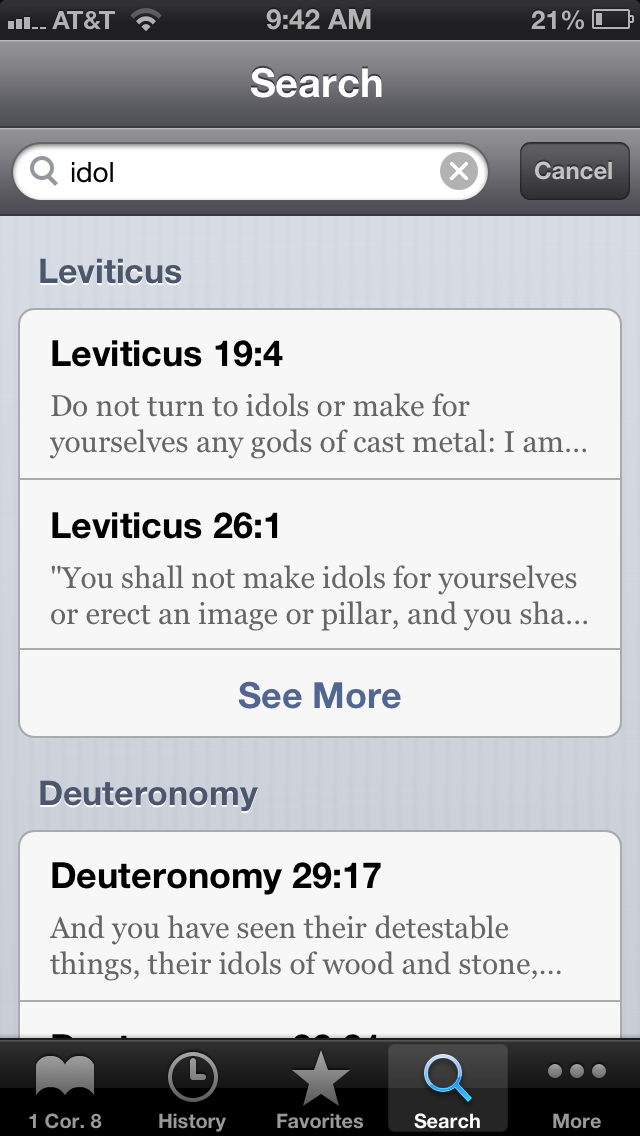
Searching the Bible has never been easier. (Pictured is the ESV Bible App)

But on the other hand, I now always have the Bible with me. And not only one translation, but many. My paper Bibles have nice concordances, but with the technology we have now, I can search through the entire Bible in a moment. I can follow cross-references all around Scripture, and do so with ease. Reading like this on a phone or a website has really encouraged not only the reading, but study. I am no expert scholar in Biblical languages, but I’ve got tools that help me with Greek and Hebrew that fit in my pocket. With that sort of ability it is not an usual feeling for me to think that I am living in the future.
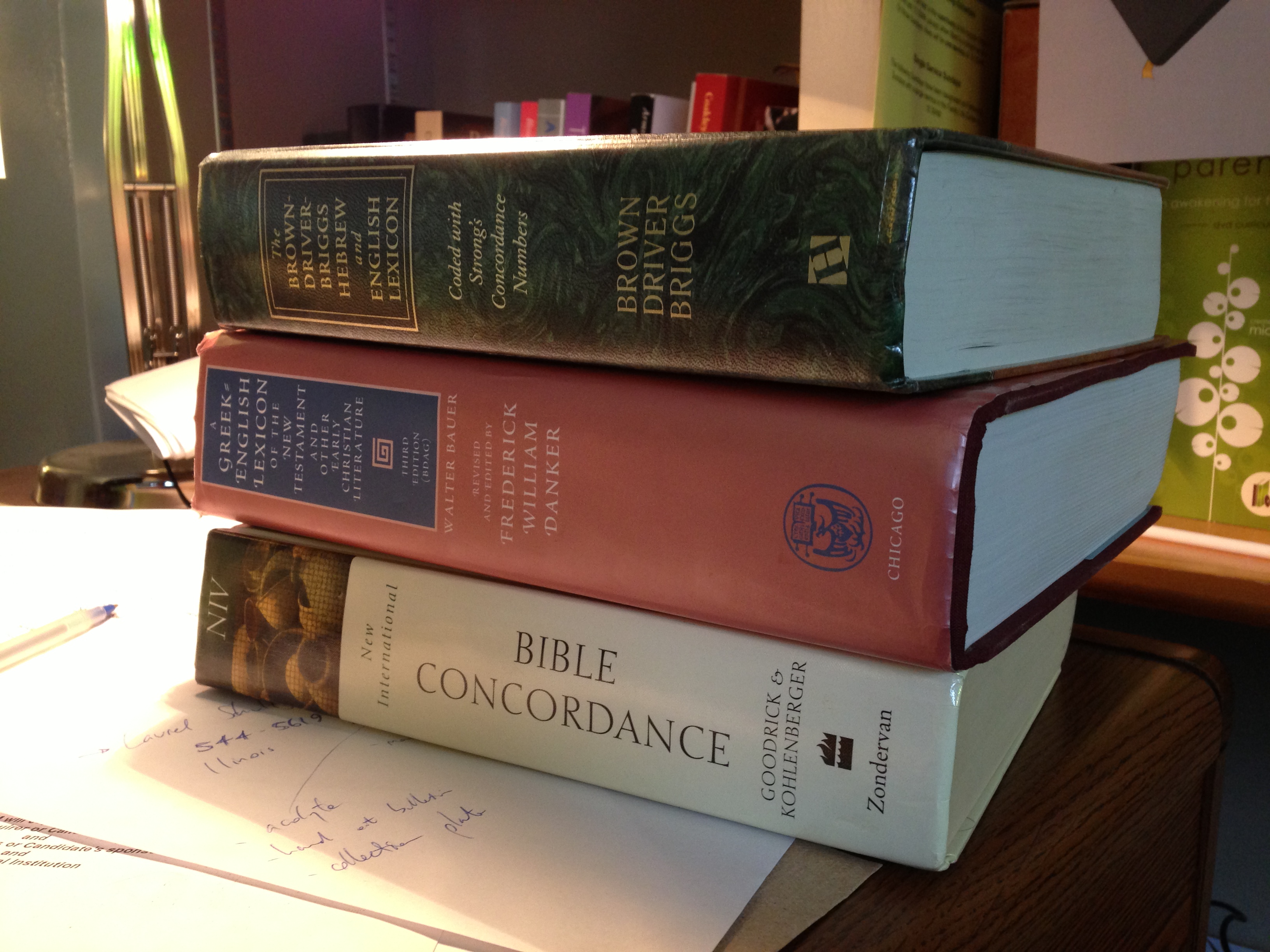
Imagine carrying these books in your bag, let alone your pocket.

There are sites and apps that can bring a communal aspect into your personal readings. You can tap on a verse and find out what comments others had contributed in regards to it. Have questions about what Paul meant in a certain passage? Maybe someone had the same question, too, and maybe someone else has a pretty good answer. There’s another program that provides fantastic illustrations and interactive graphics to help you feel like you’re in ancient Jerusalem, so as you read through the gospels you can see what it was like. As I’ve mentioned before, we can listen to the audio of the Bible and there can be real value in hearing and listening, as well as reading. Who knows what else may be offered in five or ten years?

Community notes in the Youversion Bible app

About five hundred years ago the Bible was a book that resided in the hands of a select few. It wasn’t for the masses. But things change. Perhaps some of the reverence was lost when the Bible slowly became common. Would you feel the same way about the Bible if you only saw it richly ornamented and embellished in a church instead of in every hotel room drawer? Probably not. Yet the gain outweighed what was lost. God’s word is for the people of God, and when the printing press started a revolution and the texts were being translated into the vernacular, it had a great impact.

Illuminated manuscript of the Bible

I don’t know all the implications of the technology many are now using to read the Bible, but we can at least rejoice as more people are given access to God’s word around the world. The tools are being spread and men and women are engaging with the Bible in new ways and the more we can draw attention–not to the technology–but to the content, the better it will be, for our focus can then be drawn to the Word of God, Jesus Christ.

Our Bodies Are Not Our Own, So What Are Our Bodies For?

Paul begins the final section of chapter six with a illustration that parallels food and the body. He says that food is meant for the stomach and the stomach for food. He doesn’t want us to be deceived in thinking that the body is meant for sexual immorality and sexual immorality for the body. No, Paul shows us the correct purpose for the bodies that God has given us. The body is for the Lord and the Lord for the body.

Paul then makes an argument about the negative affect of treating the body as though it were meant for immorality and makes a positive argument for why it is for the Lord and how the body is the Lord’s.

Many in Corinth saw sex as something to be treated casually and even within the church there were those who thought that freedom in Christ meant the freedom to do anything with their bodies, including incest and prostitution. Paul disagrees with this and tries to show why what we do with our bodies has great importance.

Any sexual interaction creates a new unity. Therefore there is no casual sex. This is a myth of our culture that says sex can be “just sex.” It is something more. So to have sex with a prostitute is to join yourself to the prostitute. It is not a casual encounter with no significance and to make it all the worse, Paul reminds us that we are already joined to Christ. We are members of Christ and to engage in this wrong behavior is to take the members of Christ and make them members with a prostitute. We should rather flee this sexual immorality and flee to Christ.

This stems from a low view of the body and of sex. Sex shouldn’t be seen in the same way as food. Ken Bailey’s commentary says this on the topic:

Paul is objecting to the dehumanizing of sex that takes place when it is turned into a form of entertainment and made parallel to food. Paul is rejecting the view that says “I feel hungry–I eat. I feel sexual desire–I engage in sex.”1

No we are made for something more. Our bodies are for the Lord and in Christ we are bound to him, two are made one in spirit. If we throw ourselves into immoral sexual relationships we are pulling ourselves away from unity to Christ and united our bodies, temples of the Spirit, to a prostitute. We are torn apart from the fellowship we find in Jesus.

It is more than a moral argument about what is acceptable in polite society. Paul wants his readers to realize that our bodies are meant for the Lord and they will be raised up with him. Our bodies are meant for the resurrection and what we do to them matters. Christianity is not a religion that pulls away from the body and focuses only on the otherworldly. We believe God created this world and proclaimed it good. Our God even came to us and took on flesh in Jesus Christ. Jesus had a body and our bodies are of great worth and we can’t toss them aside or think what we do with them has no meaning. No, they are meant for the Lord and destined to be raised with him.

Memory Verse 1 Cor 6.19-20

Our bodies are given a great task in that they are temples of the Holy Spirit. Where once there was one place where all people went to seek the presence of God, now the one who is found in Christ is the very dwelling place of his Spirit. As a temple, our bodies then are to be places of worship, sacrifice, dedication, praise, offering, and thanksgiving. As a temple, we represent God’s presence where ever we walk.

Sexual immorality draws us away from Christ, harming the unity we have with him. It also misunderstands the purpose of our bodies, giving us a vision of a purpose that is far too small for the Christian. God has given us our bodies to be temples of the Holy Spirit, to be for the Lord. And we are the Lord’s. We have been purchased at great cost to be Christ’s. The price for you and for me was his death. But that is how much we are loved and prized by God. We are beloved, a cherished possession. So know that we now do in our bodies matters. His sacrifice for us gives our whole selves–bodies and all–great significance. If you and your body are important to God, they should be important to you as well.

The last line says it all so well. Remember, you are not your own, for you were bought with a price. So glorify God in your body.


  1. Ken Bailey, Paul Through Mediterranean Eyes. 185. ↩

Christ’s Sacrifice Frees Us From Sin, Not For Sin

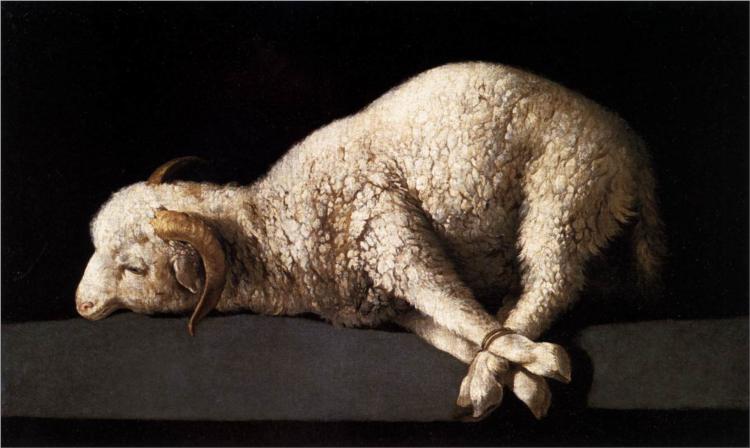
When Paul mentions the Passover he is calling to mind one of the defining events for the Jewish people. The final plague of Exodus was to be the death of the firstborns in Egypt, but God’s people are spared because he has made a provision for them. The blood of the firstborns is replaced by the blood of a lamb. Its blood is smeared on the doors of the homes and death passes over God’s people. Paul now says to the church that Christ is this Passover lamb.

Agnus Dei (Lamb of God) - Francisco de Zurbaran
Agnus Dei (Lamb of God) – Francisco de Zurbaran

But the Passover calls to mind not only the passing over, but also the final deliverance from Egypt. The people were to prepare themselves for on the same night that Israel is passed over and death comes upon many in that land, there were to leave. They need to be ready to go and go quickly. Exodus 12:11 says this:

In this manner you shall eat it: with your belt fastened, your sandals on your feet, and your staff in your hand. And you shall eat it in haste. It is the Lord’s Passover.

Having your belt fastened is what is at times translated, “gird up your loins.” The idea behind it is be ready for travel. Don’t let your robes hang low and trip you up as you make your escape. Don’t just have your shoes by the door, put them on. Fasten your belt, tie your shoes laces–in double knots, have your car keys in hand and not on the table. Be ready to go immediately.

This hurry is why they eat the unleavened bread. Israel would have no time for their dough to rise. They needed to make haste.

Then as God had told them, it all comes to pass. Cries went up in the night “for there was not a house where someone was not dead.” Pharaoh summons Moses and Aaron in the night and commands them to go. He says, ““Up, go out from among my people, both you and the people of Israel; and go, serve the Lord, as you have said. Take your flocks and your herds, as you have said, and be gone, and bless me also!”

There is a great urgency for Egypt to rid itself of such a people that have brought God’s judgment upon them. They fear what may come next. So with such urgency in the land, it was in God’s wisdom that he prepared Israel to make haste. This great exodus was no small undertaking and it would have taken much preparation, and God had guided them through it. Here is what happened, beginning in verse 34 of Exodus 12:

So the people took their dough before it was leavened, their kneading bowls being bound up in their cloaks on their shoulders. The people of Israel had also done as Moses told them, for they had asked the Egyptians for silver and gold jewelry and for clothing. And the Lord had given the people favor in the sight of the Egyptians, so that they let them have what they asked. Thus they plundered the Egyptians.

And the people of Israel journeyed from Rameses to Succoth, about six hundred thousand men on foot, besides women and children. A mixed multitude also went up with them, and very much livestock, both flocks and herds. And they baked unleavened cakes of the dough that they had brought out of Egypt, for it was not leavened, because they were thrust out of Egypt and could not wait, nor had they prepared any provisions for themselves.

The book of Exodus then recounts the length of time that Israel had spent in Egypt, emphasizing the ending of that time and the beginning of a new day for Israel. Now they are freed. Generations of slavery have come to an end. So, when death pases over the people and Pharaoh finally tells Moses and his people, “Go!”, the only proper response is to leave. God did not bring about such a miraculous deliverance for his own people from the great worldly power of Egypt for them to remain in captivity. Israel’s response to God’s work and Pharaoh’s charge cannot be to linger. When Pharaoh says to leave, they shouldn’t say, “Give me a minute.” They can’t stay a moment longer. They can’t remain in slavery. God makes this point when he tells them to prepare themselves and dress appropriately for they won’t even have time for bread to rise. When God makes the way for his people, they must go. He desires to free them from Egypt and deliver them into a land that had been promised to them.

Paul is calling upon this theme of deliverance in 1 Corinthians. When he mentions that Christ is our Passover lamb he wants you to remember the Passover. The Passover is not only the sparing of Israel, it is the catalyst of their freedom. Likewise, Jesus is our sacrifice, sparing us from the consequence of our sin. He has taken the judgment on himself. But this Passover lamb was not sacrificed so that we can now linger in slavery. The church in Corinth is making a mockery of the sacrifice and is misunderstanding freedom in Christ. The arrogant sinning that is going on is nothing but a return to slavery. Paul wants them to understand and then live into a true freedom in Christ. His sacrifice is what brings us freedom to flee from captivity, leaving behind the chains of sin and the dominion of death.

Knowing that Jesus is our Passover, we ought to make haste to flee from sin and rush into his arms. We experience true freedom in him. We know the life we are intended to live when we are in Christ.

Lamb of God Stained Glass

Using our freedom in Christ to return to sin is a return to slavery. Rather, just as Israel prepared itself to march out of Egypt into God’s guidance, we too must prepare ourselves. We are called to rid ourselves of such bondage, casting aside whatever weighs us down and entangles us because we have a race before us that we must run (Hebrews 12:1-2). We must be ready for a march into God’s promised land. We have a kingdom to be stewards of in this fallen world. We have a life of freedom that leads not to death, but to newness of life and life everlasting. So in our continuing work to leave the captivity of sin and live the life of a freed people, captive only to the righteousness of God, let us prepare ourselves as we are instructed in Ephesians 6, keeping in mind the way the Israelites were to prepare themselves on the night of their deliverance:

Therefore take up the whole armor of God, that you may be able to withstand in the evil day, and having done all, to stand firm. Stand therefore, having fastened on the belt of truth, and having put on the breastplate of righteousness, and, as shoes for your feet, having put on the readiness given by the gospel of peace. In all circumstances take up the shield of faith, with which you can extinguish all the flaming darts of the evil one; and take the helmet of salvation, and the sword of the Spirit, which is the word of God, praying at all times in the Spirit, with all prayer and supplication. To that end keep alert with all perseverance, making supplication for all the saints, and also for me, that words may be given to me in opening my mouth boldly to proclaim the mystery of the gospel, for which I am an ambassador in chains, that I may declare it boldly, as I ought to speak.

Steward of the Mystery of God

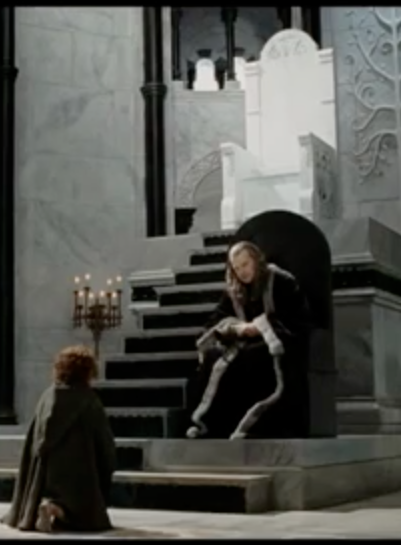
Whenever I think of the word steward I think of the Lord of the Rings. In Lord of the Rings there is a character whose position is the Steward of Gondor. His job is to be the caretaker of his city, Gondor, in the absence of the true king. What I love about the concept of steward is that it is both, at the same time, a position of great authority and great humility. Paul speaks about his role as a steward of God’s mysteries and as such he has authority among the churches. But his authority is completely foreign to him–it is not his own. He is not there to teach of his own wisdom. He preaches the cross. Paul doesn’t go to the churches as he sees fit, rather he goes where God has called him. So as a steward he has power, yet it is humble through and through, for it is the power of God that he is entrusted with.

This is why Paul goes on in this chapter to say that he isn’t accountable to the church. A steward must be found faithful, but it is a faithfulness to the one who has given the power. Paul is a steward of the mysteries of God, and he is then accountable to God. God is the one who judges faithfulness. The churches do not judge him, Paul himself won’t even judge.

He wanted what wasn't his to have -- the big throne.
He wanted what wasn’t his to have — the big throne.

Going back to Lord of the Rings for a moment, the character ends up getting into trouble because he is not respecting the position he has and seeks to claim more power than is due to him. He wants to go beyond the authority he has as steward and rule on his own. He wants to occupy the throne of the king. In doing this he is not found faithful.

This is just what Paul is seeking to avoid. In verse six as he writes, “I have applied all these things to myself and Apollos for your benefit, brothers, that you may learn by us not to go beyond what is written, that none of you may be puffed up in favor of one against another.” A steward that goes beyond what is written is going beyond the role of steward. It is dangerous territory of pride and ego. That is the downfall of the steward in the Lord of the Rings.

Paul’s intent should be ours, as well. We’ve been blessed with God’s word and what he has given us in it is sufficient. We veer toward sin when we step beyond Scripture and begin to speculate, innovate, or even delete. This quote from John Calvin from his commentary on the book of Romans says it well,

Let this then be our sacred rule, to seek to know nothing concerning it, except what Scripture teaches us: when the Lord closes his holy mouth, let us also stop the way, that we may not go farther.

God has entrusted us with much. He has given us his word but has also given each of us the life we live. To be found faithful we must seek to be good stewards, humbling acknowledging that all we have is truly God’s. We must also as stewards humbly accept what God has shown us and how he directs us, and make it our aim to trust his will, not looking to go beyond his perfect wisdom. After all, as we’ve learned in 1 Corinthians, our wisdom cannot compare to his own. God’s wisdom in the cross of Christ may seem foolish, but it is the power of God; it is our righteousness, sanctification, and redemption.

I Will Not Boast in Anything–No Gifts, No Powers, No Wisdom

I always enjoy posting music that fits our readings so enjoy this wonderful song describing our God’s great love for us. The following lines especially fit with our repeated theme of boasting, and not doing so about ourselves, but only in Jesus Christ.

From How Deep the Father’s Love for Us:

I will not boast in anything
No gifts, no power, no wisdom.
But I will boast in Jesus Christ,
His death and resurrection.

Echoes of 1 Corinthians

I’ve been spending this weekend away on a retreat and have been blessed by some great teaching. But I am further blessed to know that the Holy Spirit is my teacher and I have been able to see the ways in which scripture has been called to mind. The teachers here have made several direct or indirect references to 1 Corinthians or topics contained in these last few weeks of reading and I love that given our study of that book, the references just pop out. When someone referred to 1 Corinthians 2 the one verse quoted had greater impact for I knew the whole chapter so much better now than I did months ago.

The retreat is almost done but I’ve already heard echoes of the following themes of 1 Corinthians (and I’m sure I’ve missed one, too):

  • Boasting
  • Eloquent speech
  • Wisdom
  • Receiving by the Spirit
  • Mind of Christ
  • Not about me, but pointing to Christ
  • Mysteries of God

Thanks to the Spirit for calling God’s Word to mind. How I look forward to having read all of this letter and having more for God to teach me!

Come, Lord Jesus!

On this our final day of reading, Jesus says to us from the last chapter of Revelation:

Behold, I am coming soon, bringing my recompense with me, to repay each one for what he has done. I am the Alpha and the Omega, the first and the last, the beginning and …

…The End.

Well done, every one. Well done.

Why Do We Read the Bible? Or Now At The End, Why Have We Read?

We spent more time looking at the question of why we read the Bible as we began our readings almost one year ago. But now at the end, can you answer that question again? Why have you been reading? What has been a result of being in God’s word?

What has been a takeaway for you in doing this? Has there been a certain story that struck you and has changed how you see the world? Have you seen themes through and through?

I’m not trying to ask rhetorical questions. We should take time to reflect on what we’ve done. (Although maybe you want to take time next week, once we’ve finished.)

Think of it this way. You have a neighbor that knows hardly anything about the Bible and she comes up to you and finds out what you’ve been doing for the last year. If she were to ask, “Why do you read the Bible? What does it matter? What does it mean?”, how would you answer?

Or imagine that a family member who doesn’t go to church were to ask “What have you learned? Are you different now than a year ago”, how would you answer him?

Doing something as big as reading the Bible in the year can stand out to others and be a cause for questions and something that sparks discussion. If that happens, I’d urge you to be ready to witness to others about the importance of God’s word and seeking him in it. As it says in 1 Peter 3:15, “Always be prepared to give an answer to everyone who asks you to give the reason for the hope that you have.”

Here are some more questions that push us as we look back on what we have done and why we have done it:

  • What has been your favorite part?
  • What has been the most difficult?
  • Would you do it again?
  • What did you learn about God?
  • Do you think you’re closer to God when you are in his word?
  • Does what the Bible say affect how you live now?

  • And again the simple question: Why?