
What Kind of Love the Father has Lavished Upon Us

1 John is a book that hits on a number of topics, but love sure is one of them. It could be tempting by the time you reach chapter three to just gloss over all this love talk. But if you do you’d miss a beautiful line of Scripture. I actually like the sound of the NIV so I’ll quote from there:

See what great love the Father has lavished on us, that we should be called children of God! And that is what we are!

Our understanding of love is defined in many ways through passages in this book as we’re told what love has done, who has loved first, what love should look like now, and so on. But this line has such simplicity and profundity. God’s love for us is visible in the fact that he would call us his very own children. The Christian understanding of how we relate to God is amazing in that fact. There is not some distant God who cares little for the affairs of this tiny world. We do not have a God who tolerates us because of what we do for it. Our God loved us before we ever could and calls us his children. We are no long slaves to sin and bound to death, rather we are rescued from that peril and are God’s sons and daughters.

We are not merely saved from sin then left in a position always needing to please a capricious God who could easily reverse his judgment. No we are saved from sin and saved for God himself. He is faithful to his promises and has adopted us as his children, an action that cannot then be undone. What love God has truly lavished upon us that we are his own, and how overwhelming it is when we fix our mind upon the fact that we are his beloved.

For what and to whom we are Thankful


As tradition would have it, today we spend time thinking about what we’re thankful for. We probably could use a bit more thinking about to whom we are thankful. But to get back to first question, I have an answer inspired our readings.

Both Kings and Chronicles include a story when the people find the law of God that had been lost. Can you imagine what we would do today if our Bible either didn’t exist or had been lost generations ago? We have such a source for thanksgiving bound in this book that we take for granted. We have good news to share. We have reason for hope. We read of our past and our future.

We may not read it as we should, but even for those who never read it, there are few who have not experienced the effects of the Bible in their own lives. God could have left us with a lot of questions, but he has blessed us with knowledge of himself, especially revealed in the witness of Jesus Christ. For this I am thankful.

Looking ahead to our goal, especially in tough times

How is it finishing our History Blitz? So far it is hard.

I have driven halfway down the east coast which hasn’t afforded me much reading time, and when I have had the chance, other things have come up. I’ve seen grandparents and visited quite a bit with them and of course I wouldn’t want to limit that time that is increasingly rare to go off and read. My kids have been sick, which is just another drain on time and energy.

I have excuses. But, I have had chances before bed and didn’t have my priorities then. When my wife took some turns to drive, I could’ve then, too. I have excuses, but they are not quite good enough. Perhaps I don’t have the same time I do other weeks, but there is still time, nonetheless. This is no easy task, but few things of great worth often are.

It is hard, but I am excited to keep working hard reading and spending time with God in his word. I am looking ahead toward the goal of having all of the Bible read by the end of the year. It is especially especially in challenging times that I need to be reminded of the “why” and keep focused on our purpose. We know God will bless us through the reading of his word and we will be all the more equipped to follow him and serve his will in the world.

A man fully consecrated to God

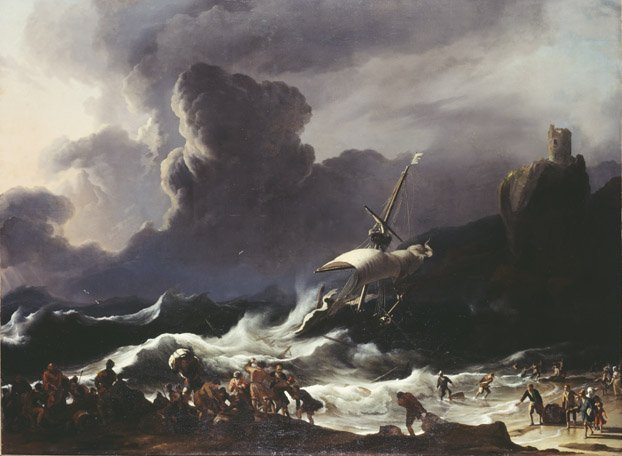
Ludolph Backhuysen – Paul’s Shipwreck

In 2 Corinthians we see a long list of Paul’s sufferings that have come his way during his time as a minister of the gospel. Starting in 2 Corinthians 11:24, Paul writes:

Five times I received at the hands of the Jews the forty lashes less one. Three times I was beaten with rods. Once I was stoned. Three times I was shipwrecked; a night and a day I was adrift at sea; on frequent journeys, in danger from rivers, danger from robbers, danger from my own people, danger from Gentiles, danger in the city, danger in the wilderness, danger at sea, danger from false brothers; in toil and hardship, through many a sleepless night, in hunger and thirst, often without food, in cold and exposure. And, apart from other things, there is the daily pressure on me of my anxiety for all the churches.

Paul was so committed to the call God had placed upon him that he continued the work even as he faced such pains. Knowing the cost did not deter him. Christ was more precious to him than anything else.

This passage about Paul reminds me of the quote that Henry Varley spoke to D.L. Moody, “the world has yet to see what God will do with a man fully consecrated to him.” That certainly was Paul’s desire–to live his life for someone else, no matter the cost. As he pursued this goal, being used by God, Paul helped to change the world. And that is just what will happen when one gives themselves fully to God.

Knowing Our Own Faith

I’m reading a book in preparation for a book club at my church and it is a more narrative take on comparative religion. One thing that has struck me so far are the comments from the three lay people who represent different religions in regards to what they know and do not know about their own faith.

One has been through a religious school, another went to worship services frequently, and they have members of their family who could pass doctrine, practice, and tradition along. Yet these adults have a pretty basic understanding.

I’m not that far along in the book, so there is plenty of time for growth in these characters, but I just wonder what accounts for the limited understanding of one’s own faith, even when there have been years of being among the faith communities?

What we are undertaking with Year in the Bible is by no means a certain way to achieve perfect knowledge of Christianity, but it will certainly continue to be used by God to show us more about him. If we devote ourselves to God’s word, we won’t remain in the dark, rather he’ll shine his light upon us. When we prayerfully approach Scripture, we’re opening ourselves up to the teaching of the Holy Spirit and (I pray) we are learning much. We ought to be able to articulate what we believe and what we believe is there in the text, so let’s continue on in our reading. God wants us to know him, to know Jesus Christ, to understand what we are called to be and do, and to receive maturity in our faith.

Exploring the Possibilities

Image of Folio 27v, with the four evangelist symbols from the Book of Kells, a 1200 year old book.

I was in a group tonight that was reading the beginning of Mark. Probably for all of us there it was re-reading this gospel. But even though it is familiar to us, God always can speak. His word is fresh and needs to be approached with the expectation he’ll still meet us there. We’ll never quite have all the answers, rather we are constantly in a place of need. We should be humble and open to the leading of the Spirit.

If that is what God can do in a familiar passage, what do you think can happen with books of the Bible we know very little about? If there can be newness to familiar passages, what is there to learn from the more unfamiliar passages?

We can easily pick up Jeremiah and think, “I don’t know anything about this!” This can lead to our being discouraged. But how much better to respond with an attitude of excitement. If we don’t know much, how much is there to explore? What will God speak to us? How can it be stale if we’ve never passed through these texts before?

We may like familiar. We like what is known. Many really like routine and habit. But we need to have that adventurous spirit that gets excited when we encounter the unknown. Sure, we may feel out of our element with some of these books of the Bible, but that’s how we learn. Look at your Bible’s study notes (if you have them), search the internet for answers, call a friend and discuss, and even–if you’re desperate and grasping for straws–email me.

When you get into these books, like Jeremiah, be excited for a new word from God, be expectant that he will speak, and embrace the perspective of “what can I learn?”.

The Gospel in Zechariah’s Vision of a High Priest

Satan, the accuser (Gustave Doré, Illustration from Dante’s Inferno)

Zechariah 3 includes a vision of the priest Joshua that in one short paragraph paints a picture of the gospel.

Then he showed me Joshua the high priest standing before the angel of the Lord, and Satan standing at his right hand to accuse him. And the Lord said to Satan, “The Lord rebuke you, O Satan! The Lord who has chosen Jerusalem rebuke you! Is not this a brand plucked from the fire?” Now Joshua was standing before the angel, clothed with filthy garments. And the angel said to those who were standing before him, “Remove the filthy garments from him.” And to him he said, “Behold, I have taken your iniquity away from you, and I will clothe you with pure vestments.”

Joshua is standing before the Lord with Satan beside him, accusing him. I imagine Satan describing Joshua’s inadequacy and sin. How could God accept one like him? What use does God have with Joshua? Look at his filthy garments!

But Satan’s accusations are of no use. The Lord rebukes Satan, removes the filthy garments, and bestows upon Joshua pure vestments. God overcomes Joshua’s iniquity and provides for him.

This could easily be the scene for any of us, sinful as we are, standing before God in judgment. Satan would not be lacking in his accusations. Who of us does not have a long list from which Satan could pick and choose? But the good news is that our sin, our filthy garments, that should disqualify us from standing before God are removed because of the work of Jesus Christ. God does not base his love for us in our deeds. Our deeds amount to nothing. Our right standing is based on what God has supplied for us. He removed our sin and gives to us his own righteousness.

Satan has no right to accuse us any longer. The only one who can condemn us, who can judge us in such a way is Christ, but he is the one who stands at the righthand of God interceding for us (Romans 8:34). The one who could accuse instead stepped in for us and died in our place so that his own righteousness could be placed upon us like pure vestments. It is a righteousness not our own, but of Christ (Phil 3:9).

Our sinfulness clothes us in filth, but by God’s grace we are cleansed, and instead clothed in Christ himself.

To some, being a Christian will be like wearing a dunce cap

20120912-204558.jpg
We talked a great deal tonight in our Reading Group about 1 Corinthians 1. It is our focus passage for the week and in it Paul talks of the foolishness of the cross in the eyes of the world. Conversation went in all directions so we did not make it through all the prepared questions, so I had to ask one question as we parted. (By the way, that’s my favorite way for conversation to go).

The cross is foolishness to others, so how do we prepare ourselves to be seen as fools because of it? I know I try avoid appearing stupid, dumb, foolish (toss in your favorite synonym). But, if I serve a crucified Christ, I won’t be able to avoid being seen that way.

Do I care more about how I’m perceived? Do I want to look smart more than I want to look like a fool for Christ? I think in certain circles we Christians want to appear to have all the answers and be seen as wise. While we shouldn’t seek to be ignorant or unwise, that cannot be our greatest pursuit. The cross of Christ is utter foolishness to the world and no matter how we phrase it, the cross will be a stumbling block and folly to a great many.

We just need to find ourselves more comfortable resting in the wisdom and power of God than vainly struggling to muster strength and smarts of our own. How others see me is nothing compared to knowing and being known by God.