The Value of Memorization

Have you ever quoted your mother in giving advice? Has a famous line of some presidential speech made its way into your conversation? How did you do it? Do you carry around a quote book, organized by topic, to pull out and read from at just the right time?

Of course not. These nuggets are stored deep down in your brain. They live alongside movie lines you could recite in your sleep, sports statistics such as a starting lineup of a decades old baseball team, and your childhood street address. We commit all sorts of things to memory. Some clearly of more value than others. But value is what gets it there.

What we value we focus on, we repeat, we talk about, and eventually we memorize–often without even knowing it.

As Year in the Bible slows down to focus on 1 Corinthians, I want memorization to take a central role. God’s Word has tremendous value, therefore we should take the time and energy to store it in our hearts. Since we are reading fewer verses each week we have more time to dig deep, we’ll have the time to meditate on these verses, reading them over and over. As we do so, God’s Spirit will strengthen the roots that Scripture has within us.

Each week we’ll have a couple of verses to memorize. Think of it almost like a parallel to last year’s focus passages. I’m working on ways to encourage and make it easier, but it will still take dedication. We’ll have verses printed on paper the size of business cards to tuck away in your pocket. I’m often thinking of visual aids, and have already worked on one for our first memory verses: 1 Corinthians 1:1-3 (Paul’s Opening Lines).

My hope is that by the end of these several months, we’ll have a great storehouse of Scripture in our minds, ready to be used by God in us, for us, and through us.
A Humble Suggestion on What to Read Next

We have finished a very long reading plan and currently I’m working on what may come next. But in the meantime, let me humbly offer a suggestion.

We’re right in the middle of Holy Week. We look back on Jesus’ death and then to his resurrection on Sunday. Why not then go back and read Luke, focusing on what he came to live for, as well as why he had to die. Then continue with Luke’s writing into Acts, to see the how the world is changing as a result of Jesus. He is raised and ascends to the throne of God. In Acts, see what happens once he pours out his Holy Spirit and his kingdom grows as his followers seek to live as disciples of Christ–as Christians.

Heads Up About Revelation

Tomorrow I’ll be preaching on Revelation 5. And I’m trying to keep it to just that. Although I’d like to go on about more of the book, the sermon would be so long.

I’m mostly done at this point, but are there things about Revelation you have questions about? What have you learned previously? Before you started reading, did you have any preconceived notions about what Revelation was about? Enjoying it? Perplexed?

If your question or comment is suitably earth-shaking, maybe I’ll have to rewrite my entire sermon. If not, I’ll try to tackle your questions in the weeks to come as we slowly make our way through this mysterious book.

Leave a reply in the comments, or email me.

Drawing Nearer and Nearer to the End

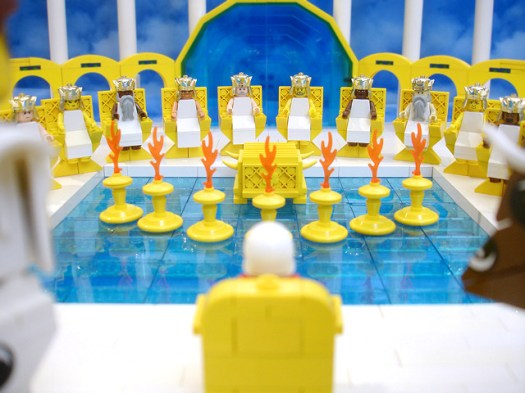
Revelation 4:4 from the Brick Testament. Click for original.

This week is a big step toward the end of Year in the Bible’s reading plan. We begin Ecclesiastes, which excluding Proverbs and Psalms, is our last Old Testament book. We also begin our final New Testament book, Revelation.

If you look ahead in our plan you’ll see that Ecclesiastes finishes next week, and we don’t then pick up additional chapters from other books. That means we end with weeks with only 20 and 17 chapters total. This is a bit on the light side and I wanted that to be the case so you can really slow down near the end. We can reflect on the whole year as we slow to a stop.

But again I emphasize that we aren’t to stop reading. We are just stopping this reading plan. I hope it is a spring board to continue on.

Another approach to these final weeks, if you’re not as into slow reflection, is to try as hard as you can with the extra time to cram in all those chapters you may have had to skip! There is still time. (But don’t go so fast that you have no idea what you’re reading.)

As we go through Revelation, a very intriguing book, please feel free to send in questions that I’ll do my best to answer. Even though we’re only doing six chapters, there is plenty to go through and we won’t be able to do it all. So if you have a part you want to focus on, let me know.

A look back at Psalm 119

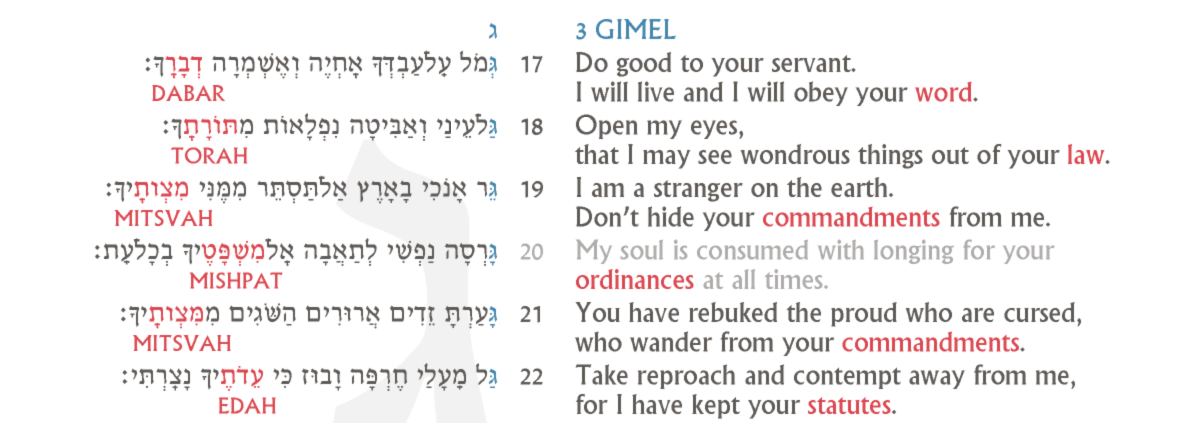
Psalm 119 Screenshot

Better late than never, right? This would’ve made for more sense a couple of weeks ago when we looked at the very long psalm, Psalm 119. If you were at our church, you would’ve heard a sermon that said a great deal about this unique psalm, but I did not include anything on it here on the site. And maybe you’re more of a visual person.

I found this some months back and it emphasizes the acrostic nature of the poem (how each line of the stanza begins with the same letter, with the proceeding stanzas moving along through the Hebrew alphabet). It also points out the place that God’s Word holds throughout the psalm. The way this site puts it is this:

Psalm 119 is telling us that to know the Creator God you must know His law, ordinances, word, commandments, statutes, precepts, decrees, testimonies, ways, and faithfulness.

I’d really encourage you to go take a look at this, and maybe skim down to the end first, as it has a word of explanation that helps make sense of the rest.

Basics of the Bible – Psalm 119 (It is pretty big, so it may take a moment to load).

A supposedly more friendly mobile version is here.

A Word About 1 Timothy and Paul

You may live your whole life and never once hear about the issues of authorship that arise in the discussion of the pastoral letters of Paul. And that life would be just fine. But questions do come up as to whether or not Paul wrote the New Testament book we’re reading this week for Year in the Bible, 1 Timothy.

As I said, you could live a full life without spending great time and energy on this question. But I bring it up because the authors of these books are important and I don’t want to make it seem like this issue is hidden. When churches never touch on controversial issues there can be a feeling that it is because if the controversy is true and some new idea becomes the norm, everything will fall apart. If Paul, by his own hand with his favorite quill, did not write 1 Timothy, do we then throw away the Bible and quit church? I do not think so.

One thing we shouldn’t do is use these questions as an excuse to dismiss parts of Scripture that we find difficult. Just recently at a conference at Princeton Seminary a professor, instead of tackling an issue that is raised in 1 Timothy, just dismissed whichever parts she was unsatisfied with saying something like, “Well, Paul probably didn’t write that book.”

1 Timothy is still part of the Bible. Clear on that? If Moses didn’t write all five books of the Pentateuch, does that mean we can then say, “Well, that’s in Genesis, and Moses probably didn’t write it.” The Bible is God’s book and he has worked upon many people throughout generations so that we may know his story.

That introduction aside, here is a very brief rundown of some thoughts about 1 Timothy. First, the issue of who wrote it is brought up because of different styles in grammar and form between a book like 1 Timothy and Paul’s epistles. I am no great expert, but in hearing these objections while in school I couldn’t help think to my own writing and how different it must have been my first year in college compared to my final year, my first year in seminary to my final year, and compare that to my writing today. Take that into consideration along with different causes for writing and different audiences and I thought that could account for a good deal of change. Perhaps that is far too simple an explanation. But I do know Paul was not perfect, and even though he was a teacher to many, he certainly had lessons to learn as well, and as he matured he may have had a better sense of what to say, how to say it, and to whom to say it.

Without further ado, here are three views quickly summarized with the help of New Testament Theology by I. Howard Marshall (397-398).

  • Paul is aided by a colleague in ministry who had a certain degree of freedom in composing the message.
  • The letter was written by someone else who wanted to bolster the authority of the letter by associating Paul’s name with it.
  • This letter contains Paul’s materials that were appropriate for the needs Ephesus and were formatted into a letter so as to be better received by the church.

Visualizing Our Progress through the Bible

If you need a bit of motivation, I’ve shown this visual to a few folks in recent weeks. We’ve completed three of four quarters of our reading plan. You might think that means we’ve ready 75% of the Bible, but wait–because the fall quarter was longer, you’ve actually read more than three quarters of Scripture.

So what does that look like? My Bible is just about 1600 pages, so I took a quick picture of our progress. It isn’t exact, but it gives a good estimate and sure is exciting for me to know how far along we’ve come!

Three quarters bible

In need of a resolution?

times square ballDo you have a friend who is in need of a last minute resolution? Well, they can start with not putting things off to the last minute. But if they want another idea, invite them along to finish out Year in the Bible with you. Let them know what it is about, introduce them to the reading plan and website, and you can even meet with from time to time to talk about the readings. I know it can be odd to join in so late in the game, but we’re not reading start to finish like a novel, so it isn’t so bad. They can augment the readings, too, if they’d like.

Or maybe your resolution is to catch up with the readings? Regardless of our readings, the aim of going through God’s Word in a year is to know him better. Resolve to seek God out in the Bible. Resolve to prayerfully approach it. Resolve to give God enough time in devotional reading. Resolve to be humble enough to learn from it and change your life accordingly.

It is good to remember that we are not reading the entirety of the Bible to impress friends or check something off a list. We do it because the Bible is such a gift, one not to be taken for granted. And God has shown us himself in it. Let’s meet him there.