A tip for reading Job

Job mocked by his wife, Georges de la Tour, 1625-1650

One thing I have found difficulty in reading Job is just keeping track of where I am. This is a pretty unique book and coming from the prophets in which we have fewer voices to keep track of, Job is complicated in comparison. Once we get past the prologue we find Job surrounded by three people, Eliphaz, Bildad, and Zophar.

As the speeches start, make sure to keep track in your mind who is talking. Sometimes they’ll go on for pages, so you won’t have those handy little section headings that modern Bibles have. Each one will speak and then Job will reply to them. It is good to note here that just because the words of these companions are included in the Bible does not mean that they each have thoroughly ‘biblical’ perspectives. Try to imagine what you’d say to someone in Job’s position to get a sense of the difficulty these three have in finding any words to share. But also think of Job’s perspective and ask how he would respond to their words. They go back and forth several times, taking us through the first 26 chapters.

Later on another man named Elihu is added to this discussion, but in the end it is not the words of any of these men, but God who has the final say.

Welcome to Week 4 of this Fall Quarter

William Blake’s illustration of Job

If you’ve made it this far here’s what I have to say–Well done, everyone. Jeremiah was a long, full book and you’ve finished it. But if you were hoping for a short and light read to follow it, you’ve come to the wrong place. We get the ancient book of Job with all the challenging questions about suffering and God’s sovereignty. We’ll also begin Hebrews, which I’ve really enjoyed in the last few years. It teaches us, among other things, just how perfectly Jesus fulfills the Old Testament.

Don’t forget that this week we’re back into the Psalms, so get back out your third bookmark for this week.

Send your questions my way and enjoy the week.

Knowing Our Own Faith

I’m reading a book in preparation for a book club at my church and it is a more narrative take on comparative religion. One thing that has struck me so far are the comments from the three lay people who represent different religions in regards to what they know and do not know about their own faith.

One has been through a religious school, another went to worship services frequently, and they have members of their family who could pass doctrine, practice, and tradition along. Yet these adults have a pretty basic understanding.

I’m not that far along in the book, so there is plenty of time for growth in these characters, but I just wonder what accounts for the limited understanding of one’s own faith, even when there have been years of being among the faith communities?

What we are undertaking with Year in the Bible is by no means a certain way to achieve perfect knowledge of Christianity, but it will certainly continue to be used by God to show us more about him. If we devote ourselves to God’s word, we won’t remain in the dark, rather he’ll shine his light upon us. When we prayerfully approach Scripture, we’re opening ourselves up to the teaching of the Holy Spirit and (I pray) we are learning much. We ought to be able to articulate what we believe and what we believe is there in the text, so let’s continue on in our reading. God wants us to know him, to know Jesus Christ, to understand what we are called to be and do, and to receive maturity in our faith.

Something New for Year in the Bible

So I was talking with someone this morning in my small group about scripture memorization. It seems like that is something many do when we’re young, but as we get older it we stop. I wonder if subconsciously we think memorization like that is childish.

If I remember getting prizes for knowing my memory verse along with stars for attendance, and then have few instances where I memorize later in life, it’d be easy to think it is something for children. But that would be a failure on our part. We are to store up God’s Word in us. We should meditate on the Bible. It’s as though we should marinate our minds with it, taking on its flavor. (How’s that for a fun mental image?)

When we do so, and the words dig their roots deep into us, God will use it to continue to shape us after the likeness of Jesus Christ. When such life-giving words saturate our minds our entire personalities will come under their influence.

So in light of this, and in light of the conversation I had this morning in which I said I wanted to do something about it, I’m going to put up some verses on the right hand side of the site as memory verses. Every week we read many chapters, then we focus in on one passage during our focus passage, and now (if you’re so inclined) we can try to commit one even smaller selection to memory.

This is new, ie. easy for me to forget, so if it doesn’t get updated regularly–OR if you have suggestions for the verses for the week, let me know. For this week I thought we’d use:

Therefore, we are ambassadors for Christ, God making his appeal through us. We implore you on behalf of Christ, be reconciled to God. For our sake he made him to be sin who knew no sin, so that in him we might become the righteousness of God.

2 Corinthians 5:20-21

Books of the Bible in One Sentence

Having just come home from our Review/Preview session for Quarter 2, I wanted to share a little. Unfortunately for you all, I cannot share the food we had. We enjoyed some fine BBQ from our neighborhood Q-Shack. I’d put money down that most everyone is still stuffed, especially because we had some delicious desserts brought in, as well.

But enough gloating. We had a great time sharing our experiencing from the summer quarter, almost marveling at all we’ve read thus far. We’ve got a great quarter ahead this fall and to intro it, I’ve got a document to share. Someone else had this brilliant idea, so here are one sentence summaries of the many books we’ll be reading in the next few months. And skip to the end for a downloadable, one-page PDF.

Jeremiah
He was given the tough task of announcing the destruction of Judah, pointing out their sin, preaching for the repentance of the people, and holding out the promise that God’s faithfulness would remain.

Job
Job is described as a good man who lost everything, bringing up the question of how God can be just in light of human suffering.

1 & 2 Kings
Follows the line of David and the Kings of Israel and Judah from times of power and prosperity to their Babylonian exile, including the ministries of prophets like Elijah and Elisha.

1 & 2 Chronicles
Another look at the history of God’s people, going back further than Kings, focusing on David and Solomon, perhaps with a particular concern for their restored community.

Daniel
A book by the exiled prophet Daniel in Babylonia that through his visions holds up a picture of a God who, even though Babylon has overthrown Jerusalem, is still sovereign over all kingdoms and powers.

Nehemiah
Thought to be written by same person (Ezra) that wrote Chronicles and Ezra, and details post-exilic life, with special attention to the rebuilding of the walls of Jerusalem.

Ezra
The return from exile and rebuilding of holy structures and restoring holy worship.

2 Corinthians
Paul’s letter to Corinth and surrounding areas defending his own ministry and calling.

Colossians
Paul’s Letter to Colosse refuting heresy that had come into the church, comparing its insufficient philosophy to the complete supremacy and sufficiency of Jesus Christ.

Hebrews
Letter addressed primarily to Jewish believers that teaches that Christ is the full and final revelation of God who surpasses the revelation seen in the Old Testament and fulfills the promises of the Old Testament in his new covenant.

1 John
John, the apostle and author of John and Revelation, writes to battle false teachers and the Gnostic heresies, defending Christ’s bodily resurrection, and calling for love to be characteristic of the believers’ life.

2 & 3 John
John gives further warnings about false teachers, encourages discernment in giving support, and commends Gaius for his hospitality.

Jude
Another book with warnings for the church in regards to false teachers who have made their way among them.

Matthew
A gospel of Jesus Christ, perhaps mostly written to Jews, as Matthew’s gospel purposes to convince the reader of Jesus’ fulfillment of Old Testament scriptures and points to him as the Messiah.

Here is a nicely formatted PDF if you’d like to print it out and stick in your Bible:

Books of the Bible in One Sentence

Welcome to the third quarter of Year in the Bible

We are halfway there!

Maybe not in terms of page count, but chronologically we have made it the halfway mark. Gone are Spring and Summer quarters. Two down, two to go.

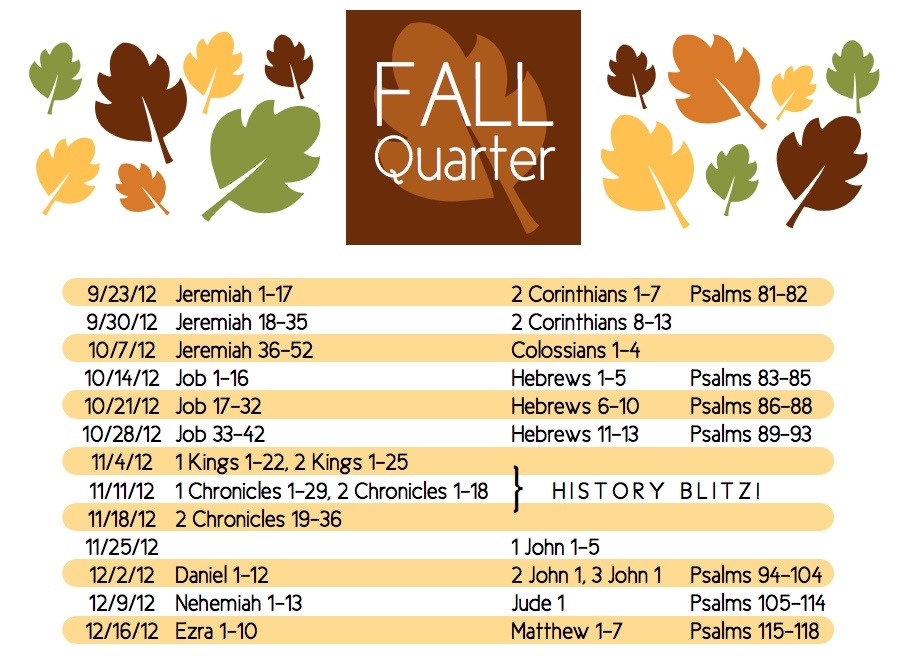
This fall we’ll move from minor prophets to major prophets, continue with some history books, and tackle more letters from the New Testament. It is a great time to jump in. This reading plan isn’t the only one and I don’t claim it is even the best one. But reading with a plan is a good way to make sure you stick to it. Along with a plan I’ll recommend again finding someone or several someones to read with. It is better when we do it together.

Here is this fall quarter’s plan if you want to print it out. Happy reading!

20120923-133731.jpg

In the News: Did Jesus have a Wife?

Papyrus fragment: front. Karen L. King 2012

This is a site about reading the Bible and given that the news has been talking about ancient texts concerning Jesus, I thought I’d offer a few resources on this talk of Jesus having a wife based on an old coptic manuscript:

A bit of overview from Christianity Today

An academic response to it from Near Emmaus

Harvard’s own site on the finding

One quick point I’ll make. Don’t let talk of authenticity fool you. Authenticity in this sense means that this fragment is believed to be an ancient text. It’s not a hoax written in contemporary times. This does not mean that the content is necessarily true.

I could grab a piece of paper and write on it that I have a unicorn. In a thousand years, if that paper were to survive and someone found it, it would be an authentic ancient writing. They could say that it was truly written in the early 21st century. But does that mean that I have a unicorn? Of course not.

There were many different schools of thought and religions that wanted to associate Jesus or a follower of Jesus with their beliefs. But just because scholars call something a gospel does not mean it truly is.

Clarifications and Intro for Malachi

The Prophet Malachi, Duccio di Buoninsegna 1310

If you use this site to guide your readings, rather than a printout of the reading plan, then you may have had some confusion this week. I posted Micah 1-4, realized Micah has 7 chapters, changed the corresponding texts, then realized Malachi was the assigned reading, saw that Malachi has 4 chapters, then changed everything back. What made it more difficult was all this was using a finicky internet provided by my brother’s cell phone.

Hopefully you have not tried to read seven chapters of Malachi, come up short, and conclude your Bible was a misprint.

Malachi is the final book in the Old Testament, but don’t be deceived into thinking we’ve now finished that part of the Bible. We’ve still got plenty to go. But it is the last of the Minor Prophets as they are ordered in our Bibles.

You’ve got to love it when you find a good one sentence summary of a book, so I thought I’d share this one I came across:

The theological message of the book can be summed up in one sentence: The Great King (1:14) will come not only to judge his people (3:1–5; 4:1) but also to bless and restore them (3:6–12; 4:2).

That’s what you’ll come across as you read. I hope I caught you before you began to follow my poor guidance. If so, you might want to read further introductory comments from the article the above quote is taken from.

Malachi – Biblica.com