Steward of the Mystery of God

Whenever I think of the word steward I think of the Lord of the Rings. In Lord of the Rings there is a character whose position is the Steward of Gondor. His job is to be the caretaker of his city, Gondor, in the absence of the true king. What I love about the concept of steward is that it is both, at the same time, a position of great authority and great humility. Paul speaks about his role as a steward of God’s mysteries and as such he has authority among the churches. But his authority is completely foreign to him–it is not his own. He is not there to teach of his own wisdom. He preaches the cross. Paul doesn’t go to the churches as he sees fit, rather he goes where God has called him. So as a steward he has power, yet it is humble through and through, for it is the power of God that he is entrusted with.

This is why Paul goes on in this chapter to say that he isn’t accountable to the church. A steward must be found faithful, but it is a faithfulness to the one who has given the power. Paul is a steward of the mysteries of God, and he is then accountable to God. God is the one who judges faithfulness. The churches do not judge him, Paul himself won’t even judge.

He wanted what wasn't his to have -- the big throne.
He wanted what wasn’t his to have — the big throne.

Going back to Lord of the Rings for a moment, the character ends up getting into trouble because he is not respecting the position he has and seeks to claim more power than is due to him. He wants to go beyond the authority he has as steward and rule on his own. He wants to occupy the throne of the king. In doing this he is not found faithful.

This is just what Paul is seeking to avoid. In verse six as he writes, “I have applied all these things to myself and Apollos for your benefit, brothers, that you may learn by us not to go beyond what is written, that none of you may be puffed up in favor of one against another.” A steward that goes beyond what is written is going beyond the role of steward. It is dangerous territory of pride and ego. That is the downfall of the steward in the Lord of the Rings.

Paul’s intent should be ours, as well. We’ve been blessed with God’s word and what he has given us in it is sufficient. We veer toward sin when we step beyond Scripture and begin to speculate, innovate, or even delete. This quote from John Calvin from his commentary on the book of Romans says it well,

Let this then be our sacred rule, to seek to know nothing concerning it, except what Scripture teaches us: when the Lord closes his holy mouth, let us also stop the way, that we may not go farther.

God has entrusted us with much. He has given us his word but has also given each of us the life we live. To be found faithful we must seek to be good stewards, humbling acknowledging that all we have is truly God’s. We must also as stewards humbly accept what God has shown us and how he directs us, and make it our aim to trust his will, not looking to go beyond his perfect wisdom. After all, as we’ve learned in 1 Corinthians, our wisdom cannot compare to his own. God’s wisdom in the cross of Christ may seem foolish, but it is the power of God; it is our righteousness, sanctification, and redemption.

I Will Not Boast in Anything–No Gifts, No Powers, No Wisdom

I always enjoy posting music that fits our readings so enjoy this wonderful song describing our God’s great love for us. The following lines especially fit with our repeated theme of boasting, and not doing so about ourselves, but only in Jesus Christ.

From How Deep the Father’s Love for Us:

I will not boast in anything
No gifts, no power, no wisdom.
But I will boast in Jesus Christ,
His death and resurrection.

All We Have is Given by God

Bible Visualization for 1 Corinthians 4:7b

Before we get into more of the reflection of this great chapter in 1 Corinthians, I wanted to give you all the memory verse visualization. It’s already Wednesday so you may be getting a late start trying to study this one small part of the chapter. For future reference, if you are reading this on the website rather than getting these posts via email, the site has a handy sidebar that says: read, study, memorize. Under the study part you can click and get the Bible study and under the memorize heading is this visualization.

This week is a simple statement that fits well with what Paul has been arguing throughout. He stands firmly against boasting in ourselves, and makes his point in yet another way here in 1 Corinthians 4:7b.

Memory Verse for 1 Corinthians 4:7b for iPhone

Echoes of 1 Corinthians

I’ve been spending this weekend away on a retreat and have been blessed by some great teaching. But I am further blessed to know that the Holy Spirit is my teacher and I have been able to see the ways in which scripture has been called to mind. The teachers here have made several direct or indirect references to 1 Corinthians or topics contained in these last few weeks of reading and I love that given our study of that book, the references just pop out. When someone referred to 1 Corinthians 2 the one verse quoted had greater impact for I knew the whole chapter so much better now than I did months ago.

The retreat is almost done but I’ve already heard echoes of the following themes of 1 Corinthians (and I’m sure I’ve missed one, too):

  • Boasting
  • Eloquent speech
  • Wisdom
  • Receiving by the Spirit
  • Mind of Christ
  • Not about me, but pointing to Christ
  • Mysteries of God

Thanks to the Spirit for calling God’s Word to mind. How I look forward to having read all of this letter and having more for God to teach me!

Simple Questions to Guide Your Meditation

As you read this week, try asking yourself a few simple questions. These may help encourage some deeper reflections.

  • what is something new I learned?
  • which part stood out among the rest?
  • what good news is in this text?
  • what didn’t I understand completely?
  • how can I understand it?
  • how can I apply this to my life?

Merely Human Or?

Paul uses this great phrase in 1 Corinthians 3, saying at the end of verse 4, “are you not being merely human?” We’ve been shown a variety of comparisons in this letter as Paul is always urging us to be more as we follow the ways of God. Do we settle for milk or move on to solid food? Do we settle for being merely human, or do we look for even more? The choice should be obvious, but it is not always easy. But we do not act alone, for we have God with us, helping us to choose the greater–to choose himself.

Here is how he frames the choices in this life:

  • Merely human with the wisdom of the world?
    or recipients of the wisdom of God in the cross, by his Spirit?

  • Merely human trying to do things in our own strength?
    or empowered by the Spirit, serving God in the work to which he has called us?

  • Merely human built upon what will burn up and be lost?
    or God’s building, the temple of his Spirit, built to late upon Christ?

  • Merely human tied to the fleeting things of this life?
    or Christ’s cherished possession, recipient of all things, for all things are his?

If we are being built by God, what’s God’s building plan?

Paul writes how God is the one who truly gives the growth and we just take a part in being used by God, whether to “plant” or “water.” But what are we growing into? What is the building plan? It’s a humbling beginning to this chapter as we recognize our place before God. We can claim no credit for God’s work. We take a part, but God is the true actor. But as humbling as that is, we are then shown an extraordinarily privileged and high calling that God has for each of us. God is growing us and building upon us because, as it says in verse 16, we are God’s temple, the dwelling place of the Spirit of God. Paul writes, “For God’s temple is holy, and you are that temple.”

plant and water

This is an amazing truth for God’s people. The temple had been the dwelling place for God. It had been a place among the people, but distinct from them. Only a select few could enter and even fewer still could enter the Holy of Holies. In all of creation this was the place of his presence. Now Paul writes that we are his temple. We are that holy place of his presence. The Spirit of the Most Holy God resides in us, in we who are in the foundation of Christ.

This past Sunday I preached on this text as well as a text from Daniel 7. Along with the strange visions of that chapter, we get a parallel picture of God’s craftsmanship, compared to what will ultimately be burned up, fade away, and be destroyed. We learn in both texts that what God builds, and builds upon Jesus Christ, is the only thing that will last. I wrote for the sermon:

“In Daniel, these great beasts look so powerful, but they will come to an end.
Only the kingdom of God will last.
The Son of Man will have all dominion, glory, and a kingdom that will last forever.

Likewise, the powers in our time will fall. They will not last. A life built upon them will not last.
But a life built by God, upon Jesus Christ will last.
Therefore your life will last, your life will be eternal.

Only that which is of God is forever, and your life can be in God’s hands. Your life can be forever, if it is built upon the one foundation: Jesus Christ. We are God’s building, his temple, and his craftsmanship is flawless. We live forever when we live a life in Christ.”

Paul, Apollos, and a long line of servants of Christ have served his Church. There have surely been many who have blessed you by similar service. But we know that through it all, by the Spirit, God has been working upon you and in to give you the growth. We are being built into his temple, a place of God’s very presence, and if that were not already amazing enough, we have a sure hope that God’s building, his people, are built to last forever.

What then is Apollos? What is Paul? – The role we play in ministering to others on God’s behalf

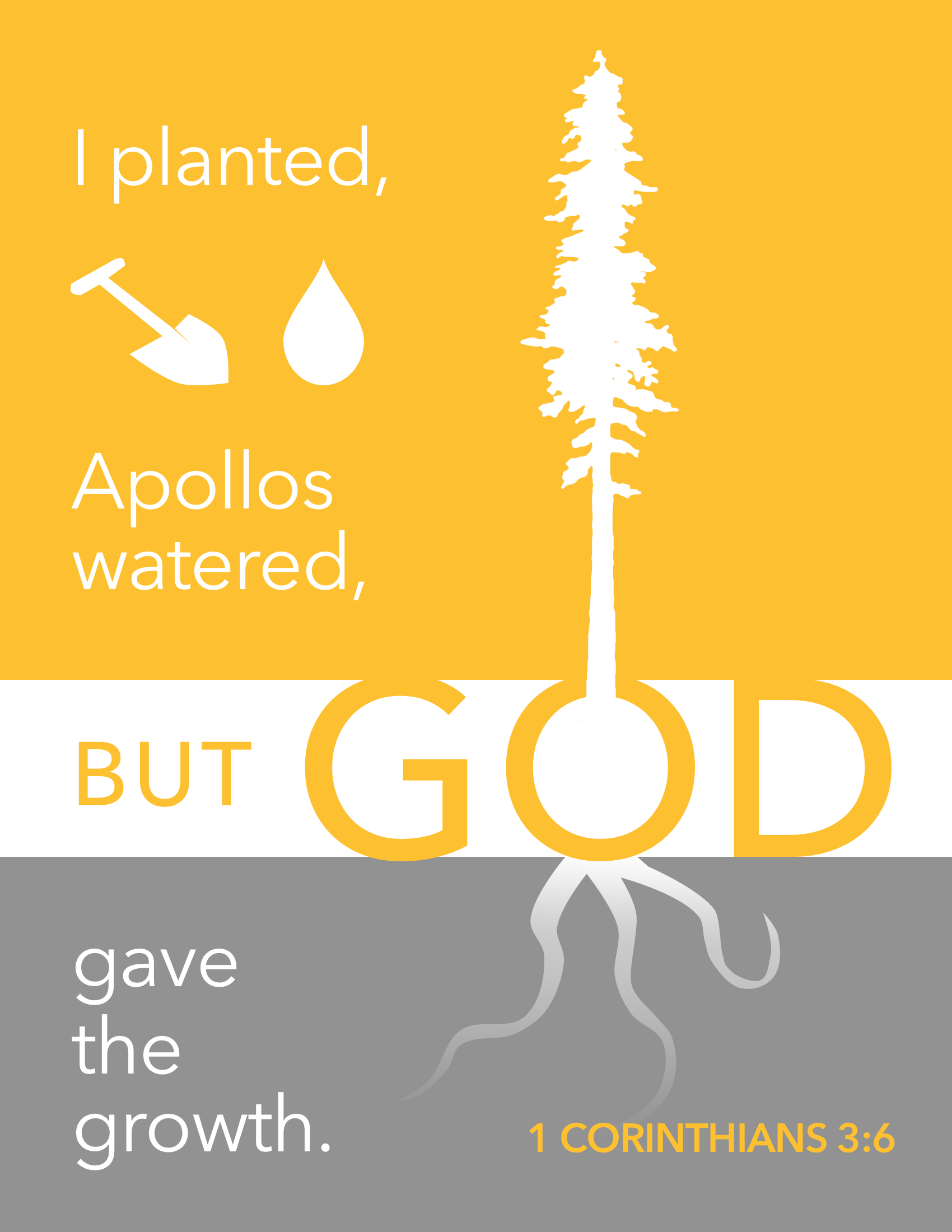
Memory Verse 1 Cor 3.6

Yesterday we focused on what was hindering the Corinthians’ understanding (their jealousy and strife) and what it led to was not only the divisions in their church, but a misunderstanding of who people like Paul and Apollos were. Paul describes their problem and then turns attention to himself, and Apollos, briefly.

What then is Apollos? What is Paul? Servants through whom you believed, as the Lord assigned to each. I planted, Apollos watered, but God gave the growth. So neither he who plants nor he who waters is anything, but only God who gives the growth. He who plants and he who waters are one, and each will receive his wages according to his labor. For we are God’s fellow workers. You are God’s field, God’s building.

1 Corinthians 3:5-9

What do we learn about these two in this passage? Who are they? What is their job? How should the church view them?

First, we see that they are servants. Being a servant, obviously, means that they are not masters. The Corinthians had elevated them and thought Paul and Apollos were to be played off each other as though they were rivals, but they are both servants who in fact are co-laborers, working together.

Are you a gardener? I’m sure you then know that there aren’t good ways to compete over one plant. If one plants and one waters, you can’t do so with different aims. You have the same goal. Paul is not at odds with Apollos. They both want to see growth. They are both called by God to their task. They both serve for God’s glory.

We also learn that as much as Paul or anyone labors, they do not claim credit for the work that God accomplishes. He may have planted, but just as importantly, Apollos watered, but neither compare to the growth that God achieves.

If not for God, what would happen to the seed? If not for God, would the water do any good? It is as it says in Psalm 127:

Unless the Lord builds the house,
those who build it labor in vain.

Paul is not anything but a servant of God. He is a tool God has used. All glory should pass right through him and be directed at the only one worthy. He has had the privilege of being called to this people to minister to them, as has Apollos. But Paul is telling them that God was at work then, God is at work now, and God is the one who will continuously give the growth.

Memory Verse for 1 Corinthians 3:6 for iPhone