Maybe not in terms of page count, but chronologically we have made it the halfway mark. Gone are Spring and Summer quarters. Two down, two to go.
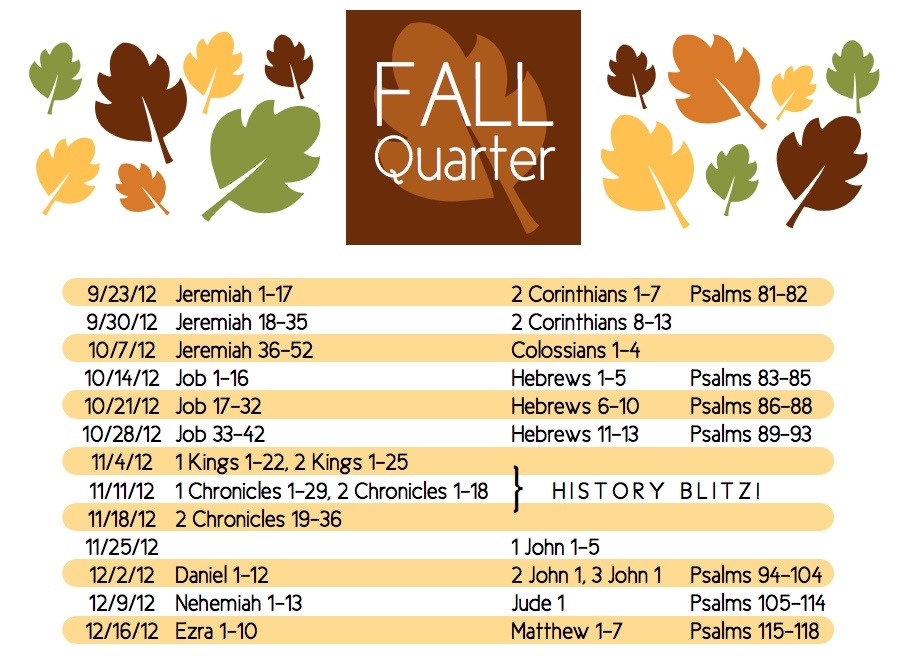
This fall we’ll move from minor prophets to major prophets, continue with some history books, and tackle more letters from the New Testament. It is a great time to jump in. This reading plan isn’t the only one and I don’t claim it is even the best one. But reading with a plan is a good way to make sure you stick to it. Along with a plan I’ll recommend again finding someone or several someones to read with. It is better when we do it together.
Here is this fall quarter’s plan if you want to print it out. Happy reading!
I bet if you’re married, there is a very good chance that a certain passage from this week’s readings were a part of your wedding ceremony. 1 Corinthians 13 is a favorite passage for couples to use at their nuptials.
Of course, I hope love is part of a marriage, so I don’t think it is out of place to use this passage. But given that this passage on love is so linked for many to weddings, we need to make sure we remember this scripture applies for all. Love is patient is not only for couples. You don’t have to be married for your love to rejoice with truth, bear all things, and not seek its own way. This chapter is lifted up as a goal for how we should love, but just don’t think it is the goal only in marriage. All Christians are called to follow the self-giving love of Jesus Christ, who even loved his enemies.
It would be much easier if I only was called to love my spouse. Even still, I’d fail. But it’d be easier. But it is the more challenging way of disciples of Christ to hear this as a call for all of us to love our neighbors in a way that pushes us and requires great reliance on God’s Spirit. For we can do many amazing things, but if we have not love, we are nothing.
This is a site about reading the Bible and given that the news has been talking about ancient texts concerning Jesus, I thought I’d offer a few resources on this talk of Jesus having a wife based on an old coptic manuscript:
One quick point I’ll make. Don’t let talk of authenticity fool you. Authenticity in this sense means that this fragment is believed to be an ancient text. It’s not a hoax written in contemporary times. This does not mean that the content is necessarily true.
I could grab a piece of paper and write on it that I have a unicorn. In a thousand years, if that paper were to survive and someone found it, it would be an authentic ancient writing. They could say that it was truly written in the early 21st century. But does that mean that I have a unicorn? Of course not.
There were many different schools of thought and religions that wanted to associate Jesus or a follower of Jesus with their beliefs. But just because scholars call something a gospel does not mean it truly is.
Satan, the accuser (Gustave Doré, Illustration from Dante’s Inferno)
Zechariah 3 includes a vision of the priest Joshua that in one short paragraph paints a picture of the gospel.
1 Then he showed me Joshua the high priest standing before the angel of the Lord, and Satan standing at his right hand to accuse him. 2 And the Lord said to Satan, “The Lord rebuke you, O Satan! The Lord who has chosen Jerusalem rebuke you! Is not this a brand plucked from the fire?” 3 Now Joshua was standing before the angel, clothed with filthy garments. 4 And the angel said to those who were standing before him, “Remove the filthy garments from him.” And to him he said, “Behold, I have taken your iniquity away from you, and I will clothe you with pure vestments.”
Joshua is standing before the Lord with Satan beside him, accusing him. I imagine Satan describing Joshua’s inadequacy and sin. How could God accept one like him? What use does God have with Joshua? Look at his filthy garments!
But Satan’s accusations are of no use. The Lord rebukes Satan, removes the filthy garments, and bestows upon Joshua pure vestments. God overcomes Joshua’s iniquity and provides for him.
This could easily be the scene for any of us, sinful as we are, standing before God in judgment. Satan would not be lacking in his accusations. Who of us does not have a long list from which Satan could pick and choose? But the good news is that our sin, our filthy garments, that should disqualify us from standing before God are removed because of the work of Jesus Christ. God does not base his love for us in our deeds. Our deeds amount to nothing. Our right standing is based on what God has supplied for us. He removed our sin and gives to us his own righteousness.
Satan has no right to accuse us any longer. The only one who can condemn us, who can judge us in such a way is Christ, but he is the one who stands at the righthand of God interceding for us (Romans 8:34). The one who could accuse instead stepped in for us and died in our place so that his own righteousness could be placed upon us like pure vestments. It is a righteousness not our own, but of Christ (Phil 3:9).
Our sinfulness clothes us in filth, but by God’s grace we are cleansed, and instead clothed in Christ himself.
If you use this site to guide your readings, rather than a printout of the reading plan, then you may have had some confusion this week. I posted Micah 1-4, realized Micah has 7 chapters, changed the corresponding texts, then realized Malachi was the assigned reading, saw that Malachi has 4 chapters, then changed everything back. What made it more difficult was all this was using a finicky internet provided by my brother’s cell phone.
Hopefully you have not tried to read seven chapters of Malachi, come up short, and conclude your Bible was a misprint.
Malachi is the final book in the Old Testament, but don’t be deceived into thinking we’ve now finished that part of the Bible. We’ve still got plenty to go. But it is the last of the Minor Prophets as they are ordered in our Bibles.
You’ve got to love it when you find a good one sentence summary of a book, so I thought I’d share this one I came across:
The theological message of the book can be summed up in one sentence: The Great King (1:14) will come not only to judge his people (3:1–5; 4:1) but also to bless and restore them (3:6–12; 4:2).
That’s what you’ll come across as you read. I hope I caught you before you began to follow my poor guidance. If so, you might want to read further introductory comments from the article the above quote is taken from.
Today I had the privilege to worship with a another congregation in Charleston, SC and for the second time in a row, I found another church doing some sort of Bible reading in a year plan. I was at another church in Georgia doing a year in the New Testament and this one was just beginning today a year in the Bible, based off a book called The Story. There must be something in the water that we southeastern pastors are drinking. But whatever the reason, it excites me to be around others who are diving into God’s Word because they see they exceeding value of meeting him there.
This week we will finish 1 Corinthians and the Minor Prophets. It is the last week of the summer quarter so keep with it and finish strong. I would also recommend flipping back through all you’ve read these last months. I think it will encouraging to see all that God has shown you in these books.
We will have our own review, as well, coming up Wednesday, September 26, at 6 pm. Love to have you come out for a free meal. Invite a friend even. I welcome the planning headache you’ll cause if lots people come (and RSVP!).
I want to continue with the passage from 1 Corinthians–the one about the foolishness of the cross. I’ve been trying to get a grasp on just how difficult this would be to accept for Paul’s hearers. Having read three gospels already in our Year in the Bible plan, you see how much the Jews wanted a political messiah. How could they overthrow Rome with a crucified Christ? Jesus had shown great power. How could he waste it all by submitting to the cross?
But imagine you’re a Greek or Gentile. You have many gods and perhaps you are hearing about a new one from Paul. But you hear that this God is glorified in weakness. How does that make sense to you? Does Zeus deserve recognition because he is thought to be strong or weak? Who among the gods is praised for dying, humility, service, or crucifixion? Especially being crucified would make it hard, for Christ died the death of a criminal. What is deserving of worship in an executed criminal?
But so it is. Christ crucified. Failure to Jewish political pursuits. Ridiculous to Greek notions of the divine. Our God is not like the rest for he came to serve us, love us, die for us, and in his death he is glorified.




 Year in the Bible