Jesus’ perfection covers our deepest flaws

Sermon on the mount

Last night I was talking with my wife about this week’s readings from Matthew. There are some truly challenging teachings that Jesus has in Matthew 5 and in the following chapters. One line is particularly difficult, “Be perfect, as your heavenly Father is perfect.”

I’ll speak for myself here and say that I don’t measure up.

So what do we make of such a a line? In the conversation I had, my wife looked at it a bit differently and was thinking about how else Jesus could’ve said that. What else was Jesus going to say? What else would Jesus desire for us?

That absolutely should be our aim. Thankfully, when we don’t measure up we have one who does. Jesus Christ fulfilled all the laws demands perfectly for us. His righteousness is all that we could ever need. Whenever we miss the mark we can find comfort knowing that when the Father looks at us we are found in his Son, Jesus Christ.

Even before the cross, pay attention to the suffering of Jesus

Jesus tempted in the desert.

This last Sunday I preached on the topic of suffering, seeking to bring our attention to this simple point: We have a God who truly knows suffering himself.

This week we read the first half of Matthew and I’d ask that you pay close attention to the experiences of Jesus. What does he go through? What troubles does he face? What luxuries does he have? How is he tempted? What is he going through in order to accomplish his great work?

Jesus is the one who walked in our footsteps. Truly he walked the path that we should have walked–the path we deserved, the path up to the cross. Jesus came to earth and experienced all that we do and he did so in order to take our place. We now can know that our God is compassionate and he is not unaffected by suffering. God knows suffering in ways we can never understand and he did it all so we would not be left alone. Into this dark world Jesus brought us light and gives us hope.

We Are Too Quick to Judge by External Appearance and Thankfully God is Not

After King Saul rejects God’s ways Samuel is sent to anoint the one who would be the next king of Israel. Saul, the first king, was a man of great strength and stature. But God makes sure to instruct Samuel to look beyond those things. When Samuel goes to Jesse and searches among his sons and comes upon Eliab, God has specific instructions.

But the Lord said to Samuel, “Do not look on his appearance or on the height of his stature, because I have rejected him. For the LORD sees not as mans sees: man looks on the outward appearance, but the LORD looks on the heart

We know we’re not supposed to judge by appearances. But we do, for as God says, “man looks on the outward appearance.” Too often appearances have significant influence in all sorts of areas–on who gets certain positions or how someone is treated in their role. Think about presidents, pastors, waiters or waitresses, spouses, friends, employees or employers. Can’t image dictate far too much?

We are too quick to judge books by their covers. And it’s hard to resist such a temptation. We (sinfully and lazily) prefer to make the easy judgments based on the externals: beauty, color, strength–even other external data like degrees, diction, or dress.

But what do we miss when we lean toward the external? Who have we overlooked? Do you feel that at times you’ve been overlooked? God sees beyond the superficial and sees the heart. And the good news is that even when God looks in our hearts and sees our sin, he still doesn’t treat us as we’d deserve. God is not swayed in judgment the way we are. He sees us for who we are and has a greater vision for our lives. God treats us differently from the ways of the world and differently from what we deserve and for that we can be thankful.

Knowing that is how he sees us, our prayer should be to have eyes like his. Our aim should be to see people as he does; to look more than skin deep and treat everyone with the dignity they deserve.


Like Sheep Without a Shepherd

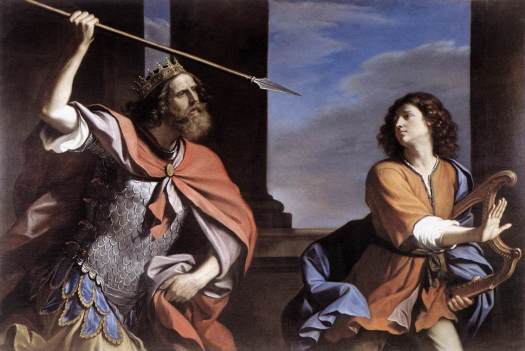
5-saul-attacking-david-guercino

We are now in week six and that means we’ve just crossed the halfway point in our reading plan.

We’ve read about the promises God has made to Abraham and how he has remained faithful to a people who are often faithless. God brought them out of slavery to a land that he had prepared for them. But they turn from him again and again. He still blesses them and while Israel has no problem enjoying the promised land, they fail to be a blessing to others.

We’ve also seen how God has has been their king leading through the judges that he has brought up in Israel in times of need, but Israel rejects God and wants an earthly king. They want to be like the other nations. But no leader can compare with God. In fact, the leaders that rise up often do more harm than good. Those who are entrusted to watch over Israel have oppressed the people.

This week we will look closely at those failure of leadership in Israel and see what God plans to do to about it.

Failure to Be a Blessing

jonah in the whale Verduner altarpiece
This week we are reading passages that are written in a time when Israel has now come to possess the land that God has promised to them. God was faithful to Joshua and led the people to the land that was flowing with milk and honey. He was fulfilling the promise he had made to Abraham. But the people fail to be a blessing to others and fail to live in the way they were called to. In Amos we read how Israel is oppressing the poor and weak, treating them much like they were treated when they were slaves in Egypt. In Jonah we see the lengths Jonah would go in order not to go to his enemy, instead preferring Nineveh’s destruction.

Then when we look in the New Testament in Matthew 23, Jesus is criticizing the leaders of the Jews who similarly are not living as a blessing to those around.

This last Sunday I preached on Jonah, looking closely at his reluctance to even be a possible blessing to his enemy. The good news is that we have one who willingly came to his own enemies and sacrificed himself for us.

If you’re interested in reading the sermon, you can find it here.

The Difficulty of Moses Handing Leadership Over to Joshua

In this read through of Deuteronomy one thing that is standing out to me is Moses’ role in handing things over to Joshua. Here is a man who desperately wants to enter the promised land, but cannot. God tells him in Dt 3:28, “charge Joshua, and encourage and strengthen him, for he shall go over at the head of this people, and he shall put them in possession of the land that you shall see.”

History is full of bloody transitions of power. Successions do not always go over well. Turn to 1 Samuel and see the way that Saul takes the news that there will be another king. As remarkably peaceful as the transitions of power in the United States have been for over 200 years, there are still accounts of outgoing presidents (and staff) being less than gracious in the way they leave the White House for the next administration.

So this must be tough for Moses. He not only cannot go to the promised land, his job until then is to train the one who will go. But how important a job is that? It is hard to look beyond our own experiences and lifetime and look ahead to future generations. What are we doing to prepare the way for those who will come next? What world are we leaving to them? What ministries are we passing along? We like to be involved and be active, but there are times when we need to shift our focus on the future, rather than our our immediate circumstances.


If you are looking for a bit more introduction and recap as you read Deuteronomy, you may enjoy going back to this article from June 2012.

So much has already happened in the first few books of the Bible and it is very easy to get lost or confused with all the people, travel, city names, the people groups that end with -ites. Due to that, don’t hesitate to flip back through your Bible or use online tools to be reminded of who’s who.

Between a Rock and a Hard Place

We have skipped over some books and about forty years and find ourselves reading the first chapters of Deuteronomy. But don’t think you’ll be in the dark. Moses here does a great job of recapping where they have been and what God has been up to. They left the mountain and wandered for forty years because of their lack of trust in God and now as they have endured God’s discipline, they stand at the threshold of the promised land. Israel is again given the opportunity to walk in faith into the land that God has prepared for them.

But not before a real hard look at themselves in the mirror, courtesy of Moses.