
Learning the Story So Well

We’ve been teaching a class at church about learning and telling the story of Jesus in a variety of ways, connecting his life with other stories in Scripture. The goal is to better know Jesus’ story for yourself and to know it better so that you are then prepared to share it. If your child asks you about Jesus or a co-worker says, “What’s the big deal about Jesus?”, I want you to be able to answer. Learning the whole story of God’s love for us is a goal of Year in the Bible. We are seeing the big picture of history and how God remains faithful throughout and how his love is most clearly seen in Jesus Christ. Jesus Christ is the pinnacle of such love.

How better to know this story than to read the book?

From Karalee Reinke, 2012. Click image to go to source.

I found this image and its geared toward children, but I think with a bit of imagination, adults can understand the point, too. This site created the graphic based off a quote from the book, Give Them Grace: Dazzling Your Kids With The Love Of Jesus, by Elyse Fitzpatrick and Jessica Thompson.

We want to know the one good story so well that we can be reminded of it in our daily experiences, but also so that we can discern truth and lies by it. We want to know Jesus so well that we can be easily prompted to share his goodness in conversation. We want to know that story of good news so well that we won’t be so easily satisfied by what the world offers us that appears good.

If you’ve ever felt like you couldn’t quite articulate your faith or express what you believe, let’s read this Good Book together. God will reveal himself to you.
Story So Far, Week 7

We’ve made it to the last day of week seven, so give yourself the customary pat on the back for getting this far. We’re now half way through Leviticus with only one week remaining and we’re getting toward the end of Luke.

I posted earlier this week an image about the most read books in the world, and the Bible tops that list. The question I asked was how many people have read the Bible–the whole Bible? It may be the most circulated book by a mile, but that isn’t the only thing that matters. I want the Bible in the hands of the people, but I want its bindings creased. I want you to open it and read it and love it. Having read half of Leviticus you’re probably in a small percentage of readers. Maybe in these last seven weeks you’ve read more pages of the Bible than you have in your life. Fantastic.

This isn’t to say that you’ve now earned some badge of honor. But God’s Word is a beautiful thing and it is of great value to have spent this time with it. Even if you’re not seeing God work through you in his Word yet, he will do so. He who has planted these seeds will continue to tend them.

So keep out carving time out for the Lord. Spend time with him in study and prayer. Learn at his feet and follow him. We’ve had many challenging words from Jesus to that point. I like his imagery about salt, and how it loses its value when it loses its saltiness. Let the Bible flavor you each day. Be salty.

If you want one piece of homework, one little activity, try going without salt for a few days. I’m not saying put your salt shaker away. Do that, but more than that I mean don’t any eat food that has salt as an ingredient. I suspect it wouldn’t take long to develop a better appreciation for salt and a better understanding of Jesus’ words. Salt preserves, but it also flavors. As disciples of Christ we are the salt of the earth, and what we are endeavoring to do in reading all of Scripture is great preparation for that seasoning process.

Humility and the Wedding Feast

Luke 14 includes a parable about a wedding feast where Jesus teaches us to not seek out a place of honor for ourself, instead seek a humble position. The judgment on the proud is that they will be brought down, and the humble will be raised up. Jesus says, “For everyone who exalts himself will be humbled, and he who humbles himself will be exalted.”

Christians are called to be humble, just like Christ who humbled himself. We hear that lesson often, but how do we do it? Have you faced a time at work when you felt like you had to exalt yourself to gain the attention of superiors? Do you worry that if you don’t seek credit and put yourself out there to be noticed someone else will? How do we manage that cultural influence along with Jesus’ words?

Do we have the radical trust in God that he will lift us up and that his exaltation is far more important than any promotion? Is our goal in life to climb the ladder or to be a witness for Jesus and to serve others humbly at the station we are at currently?

Humility is not self-deprecation, but it is certainly not boasting. But it does have to do with moving the self out of the center and making that a place for Christ, and boasting in him. When we do so humility doesn’t become timidity, rather it gives great confidence because we find ourselves firmly fixed on Christ, caring more for his name receiving glory than our own.

Most Read Books

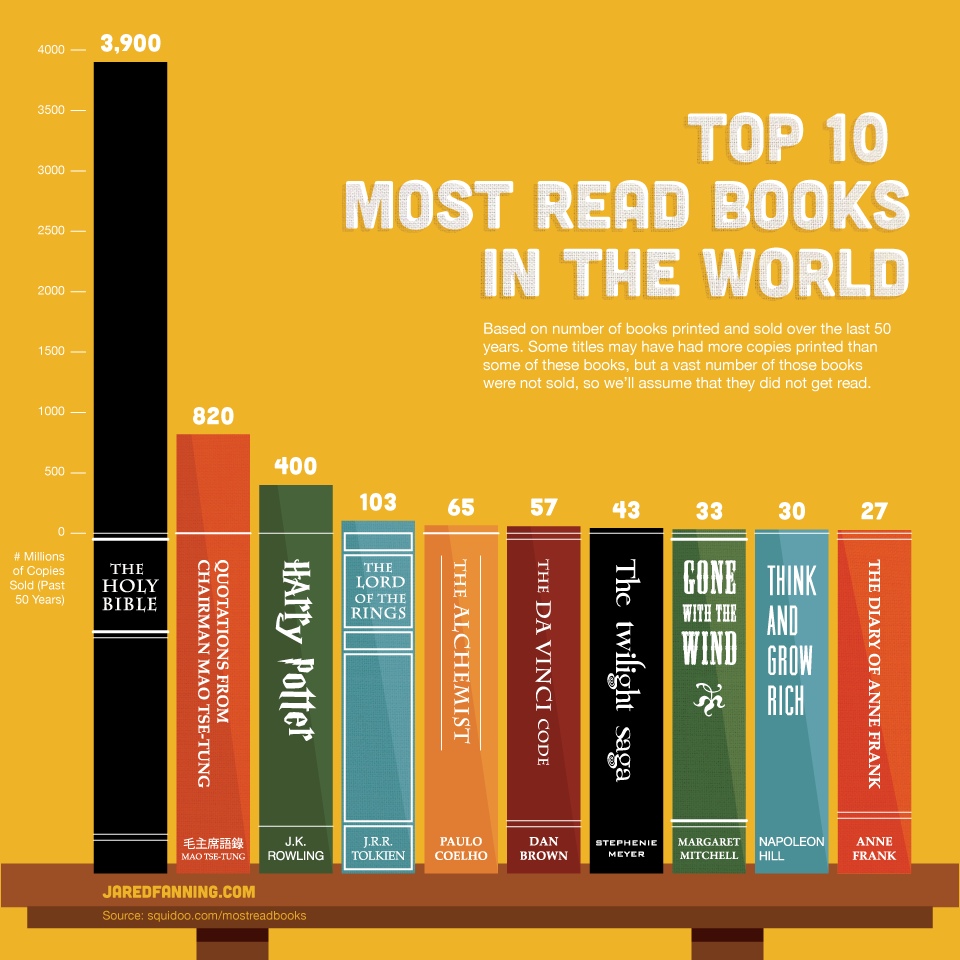
20120507-133053.jpg

Thought this was a little interesting. It shows the projected most read books of the last 50 years. You’ll see that we are in good company in reading the Bible. But the challenging question is have more people finished books from this list like Harry Potter or Lord of the Rings than have read the whole Bible?

The graphic is misleading since the books are not to scale (do you see the millions more f Harry Potter than Anne frank?). But even with the staggering lead that the Bible has, how many have read Leviticus? Let that be a challenge to press on.

Welcome to Week 7 and Leviticus

Well done for making it so far. Or if you’re just joining Year in the Bible, welcome along. In the New Testament we continue in Luke and we’ll keep reading psalms most weeks. But things are shifting in the Old Testament. We’ve finished Genesis and Exodus and that brings us to Leviticus.

Maybe you’ve planned your vacation to coincide with this week because the thought of reading through Leviticus is too much to bear. But I want to slow you down at jumping to such conclusions. (And worst case scenario, if it is that tough, it’ll be done in two weeks!)

I found an article at bible.org that I think is helpful and it addresses directly some of our objections to reading Leviticus. Ever thought that Leviticus is too hard to understand, that it is too dull, or that is has nothing to do with the world after Christ? If so, then read the article.

He makes some challenging points, such as in response to feelings that Leviticus is too boring, he says “our culture has concluded that anything which is not entertaining is not worth listening to.” Leviticus may not jump off the page like some of the passages from Genesis and Exodus, which are full of action, but that does not mean it is irrelevant for us now or that we shouldn’t study it. Speaking of relevance he makes a good point that we’re too interested in what is pragmatic for us in the immediate, lacking the patience to read in obedience to God’s invitation and trust that God has value in every word–even if it is not practical in the here and now.

Read this week with patience and perseverance, and I hope you can approach with renewed interest a book that is too often overlooked.

Story So Far, Week 6

I’ve read Luke 9:62 many times before. There Jesus says, “No one who puts his hand to the plow and looks back is fit for the kingdom of God.” I had often thought of Lot’s wife who turns back to her home and is turned into a pillar of salt. She was being delivered from judgment and all she could do was look back to her home.

But as we’ve finished the book of Exodus this week, I couldn’t help but read this verse in Luke and think of the Israelites as a whole. They were delivered from slavery and almost immediately they turn their hearts back to Egypt and to other gods. God is angered by these actions. We read this week in Exodus 34 that our God is a jealous God. He wants us for himself alone. God wants us to only worship him. Yet we look back again and again. We look back to false gods and idols. We look back imagining that an old life was better than it truly was. We rewrite history like the Israelites who wished they could return to Egypt where they felt life was better.

In Luke, Jesus pushes his disciples to not turn back from following him. There is a radical break in the way the disciples and Jesus relate to possessions and treasure–don’t look back to those. Do not return to seeing the world the way the culture does and they way you used to. To follow Jesus in many ways is to leave behind the things of the world.

As always, Jesus never pushes us and challenges us to do what he will not do himself. Earlier in chapter nine it says of Jesus, “When the days drew near for him to be taken up, he set his face to go to Jerusalem.” Jesus knew what waited for him there. Jesus set his face to the city where he would be crucified, and he didn’t look back. Repeatedly Jesus says to his disciples that he came for that very purpose. Jesus did not look back even though his purpose was to die for those who hated him.
This Jesus is the one who tells us, “If anyone would come after me, let him deny himself and take up his cross daily and follow me. For whoever would save his life will lose it, but whoever loses his life for my sake will save it.” He calls us to come and follow him. We are to firmly fix our eyes on Jesus, and let the things of earth fade away, never looking back.

This is a hard task, greater than our efforts could accomplish, but thanks be to God that he gives us the strength and works in us, both to will and to work for his good pleasure (Phil 2:13).

Give TV the Night Off

Last night my wife and I didn’t turn the TV on. It wasn’t some deliberate act on our part, it just happened that way. But it doesn’t happen all that often. We enjoy sitting together on the couch relaxing in the evening watching shows that we both like. The problem with TV, though, is that it is habit forming and it is sneaky in how it causes time to fly by.

More days go by when the tv goes on than when it doesn’t–and we don’t even have cable. It came on all the more when we did, especially since you may feel like you need to watch more in order to justify the high price of cable.

I don’t mention this primarily as some inquisition of television, but to compare its place in our lives compared to reading. Do days go by that you don’t pick up a book? When they do, does it stand out the same way the absence of TV does? Why isn’t reading the go-to activity for more people? For me?

This week, if you don’t already, spend a night away from the TV. Make more room for family, for quiet, for games, for crafts, and for reading. If you’re having a hard time keeping up with the readings, maybe television can be dialed down a bit. It should give us pause If we have a hard time keeping up with the readings but we are able to keep up with all our favorite shows.

I like TV. But I don’t like how much time of my life it takes. At least one night a week, take your time back.