Heads Up About Revelation

Tomorrow I’ll be preaching on Revelation 5. And I’m trying to keep it to just that. Although I’d like to go on about more of the book, the sermon would be so long.

I’m mostly done at this point, but are there things about Revelation you have questions about? What have you learned previously? Before you started reading, did you have any preconceived notions about what Revelation was about? Enjoying it? Perplexed?

If your question or comment is suitably earth-shaking, maybe I’ll have to rewrite my entire sermon. If not, I’ll try to tackle your questions in the weeks to come as we slowly make our way through this mysterious book.

Leave a reply in the comments, or email me.
Vanity of Vanities! All is vanity!

Oddly, Ecclesiastes packs a punch even though it is talking about the listlessness of life. Life is vanity, we are a vapor, there is no point. If this were entirely true, then it is surprising that the author intends for you to keep reading more than one chapter.

There is meaning in life, and it comes through in Ecclesiastes, but much of the book is devoted to talk about what has no real worth.

I think this resonates with many in today’s world who have had the realization that they live a life with no purpose. Some leave jobs and lives behind to forge a new path searching for meaning. Others reject the values of wealth and power that society seeks to lift up hoping to live life according to a better principle or philosophy.

This creates a great opportunity to shine a light on what Christ offers. To those without, he gives direction. In Christ we all have a calling. We have a purpose as we seek to be his disciples, loving God and loving others. Participating in his kingdom work is of great worth and eternal value. The world offers goals like get a bigger house, have more cable channels on your bigger TV, and gain fame. But these are vanity and are nothing in comparison to the revolutionary purpose of living for Jesus.

Proverbs; Short and Sweet

We often equate the length of writing with its quality. If someone writes a thirty page paper it must be more scholarly than a fifteen page paper. Right?

Well, not always. Length shouldn’t account for everything. Especially when we consider that some authors have been paid by the word.

Even if we know that is true, we can still be influenced by the notion that longer is better. This really gets in the way of appreciating a book like Proverbs. It is too easy to breeze through the quick sayings of Proverbs, missing the depth of the words.

Take this from Proverbs 3 as an example:

Trust in the Lord with all your heart,
and do not lean on your own understanding.
In all your ways acknowledge him,
and he will make straight your paths.
Be not wise in your own eyes;
fear the Lord, and turn away from evil.
It will be healing to your flesh
and refreshment to your bones.

How long does it take to read that? How long ought it to take to take this in and reflect upon it?

So instead of missing out because we move too fast, take the time to reflect on these sayings. Sometimes lengthy writing just masks an inability to communicate clearly. Let’s then be thankful for the concise and powerful words of Proverbs.

Music from the Psalms – Psalm 130

Several months ago I bought an album by Indelible Grace that leads off with the song “From the Depths of Woe.” It is a long song that builds from its mournful opening to a confident and hopeful end. I had heard it played a little differently before, but this is a powerful version that I was eager to share with you. But since it is a song based off of Psalm 130, I had to wait until this week when it falls within our readings.

Quick bit of history: It was written by Martin Luther way back in the 16th century. Not the psalm, of course, someone else wrote that. But he paraphrased it into German. If you didn’t know it yet, Luther was not only an accomplished nuisance to the church and great reformer, but he was a man of many talents, such as writing hymns.

If you enjoy playing the music, as well as listening to it, here is the music for it. (The links are on the right).

Drawing Nearer and Nearer to the End

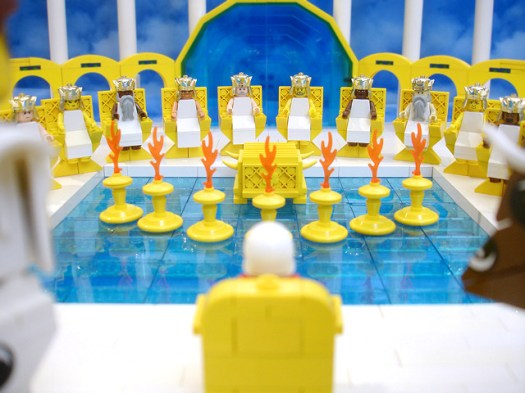
Revelation 4:4 from the Brick Testament. Click for original.

This week is a big step toward the end of Year in the Bible’s reading plan. We begin Ecclesiastes, which excluding Proverbs and Psalms, is our last Old Testament book. We also begin our final New Testament book, Revelation.

If you look ahead in our plan you’ll see that Ecclesiastes finishes next week, and we don’t then pick up additional chapters from other books. That means we end with weeks with only 20 and 17 chapters total. This is a bit on the light side and I wanted that to be the case so you can really slow down near the end. We can reflect on the whole year as we slow to a stop.

But again I emphasize that we aren’t to stop reading. We are just stopping this reading plan. I hope it is a spring board to continue on.

Another approach to these final weeks, if you’re not as into slow reflection, is to try as hard as you can with the extra time to cram in all those chapters you may have had to skip! There is still time. (But don’t go so fast that you have no idea what you’re reading.)

As we go through Revelation, a very intriguing book, please feel free to send in questions that I’ll do my best to answer. Even though we’re only doing six chapters, there is plenty to go through and we won’t be able to do it all. So if you have a part you want to focus on, let me know.

Trying to Empathize with Lamentations

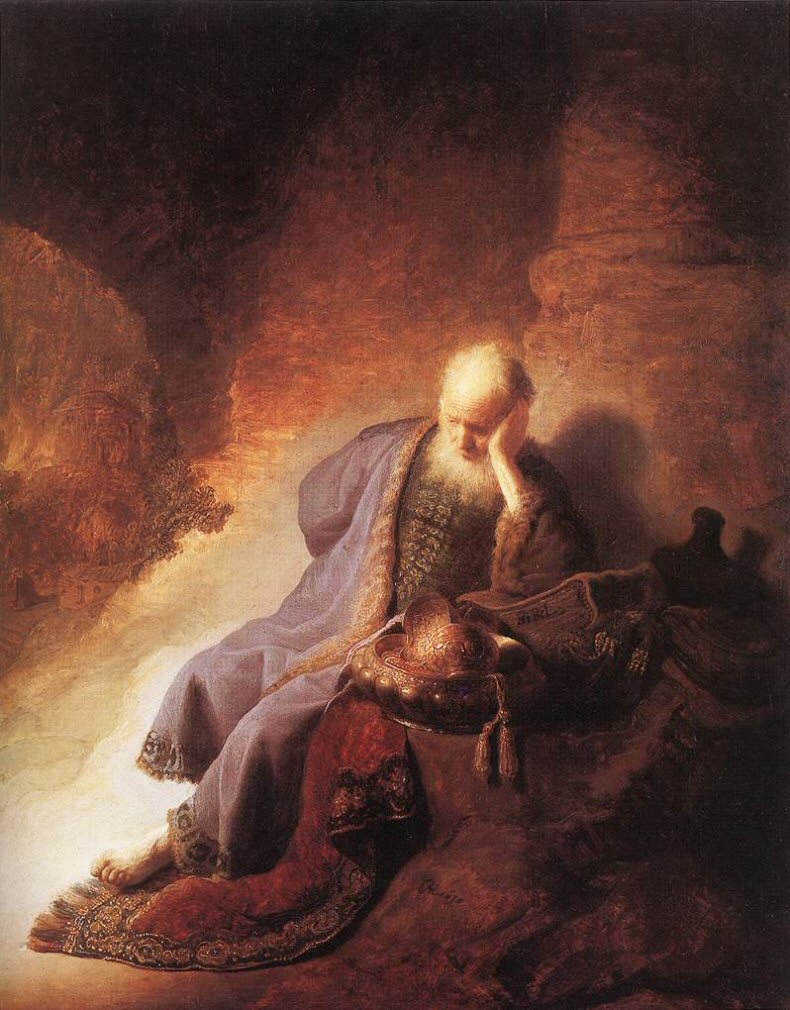
Jeremiah lamenting the destruction of Jerusalem, Rembrandt, 1630

In reading Lamentations I wondered how much we could empathize with the weeping over a destroyed Jerusalem. We are so less rooted to our geography in this culture and see it as a point of pride to be well-traveled. For some the goal of growing up is to get out of the small town you grew up in. Even the US taken as a whole isn’t all that old of a country and our history is hardly anything compared to the longstanding nations elsewhere in the world.

So if we were to imagine a hometown or an iconic city like Washington, D.C. or New York City destroyed, how would we react? Could our sorrow even begin to match that of what is read in Lamentations? Jerusalem was not only a civic center or place of worship, it was both those things and more. It was where that generation’s ancestors had worshiped the living God who made his dwelling place there, among all the places on earth.

Surely that destruction would cause questions and doubts. Where is God if his habitation is destroyed? Where is he if he would allow his people to be exiled? Who are we if we do not have our home or a place to gather and worship?

As we read Lamentations, take the time to imagine the devastation the author must have felt. Only once you have tried that then move toward the jubilation you can imagine when God’s people are returned home and this city is rebuilt. You can’t grasp the hope that comes in places like the end of Isaiah, dealing with Israel’s restoration, without first understanding the depth of despair that met the people as Jerusalem burned.

How is your time in the Word?

As close as we are to finishing our Year in the Bible, that doesn’t mean we are close to putting our Bibles down and moving on. We are developing habits of reading to continue for years to come. Since that is one of our aims, then now is as good a time as any to evaluate how our reading is going–and not just by the numbers. Is our time spent before God and in his word as it should be?

This article from The Gospel Coalition asks some good questions to get you thinking about the way you approach reading scripture.

Why We Work

There are several remarks about work and against idleness in 1 & 2 Thessalonians. But we mustn’t get the wrong idea as to what this focus on work is for. Paul’s concern with work is work that is an outpouring of our faith, and these works express a faith that is in Christ. Our good works aren’t about making ourselves good, rather they are to point to Jesus, fulfill our purpose, and glorify God. Paul’s says in 2 Thessalonians:

To this end we always pray for you, that our God may make you worthy of his calling and may fulfill every resolve for good and every work of faith by his power, so that the name of our Lord Jesus may be glorified in you, and you in him, according to the grace of our God and the Lord Jesus Christ.
2 Thessalonians 1:11-12