
An Assault on a Promise to Abraham

For the sons of Judah have done evil in my sight, declares the Lord. They have set their detestable things in the house that is called by my name, to defile it. And they have built the high places of Topheth, which is in the Valley of the Son of Hinnom, to burn their sons and their daughters in the fire, which I did not command, nor did it come into my mind. (Jeremiah 7:30-31)

Reading through the prophets you come across a long list of the sins of God’s people, a people who are called to be set apart from their neighbors, who are supposed to be a holy nation. To me, this one stands out among the rest. They have not only been guilty of evil, but they have done their evil in the house of God. They have built up Topheth for a horrifying practice, sacrificing their sons and daughters. These “sons of Judah” have sacrificed their own flesh in pagan practices by throwing their children into the flames.
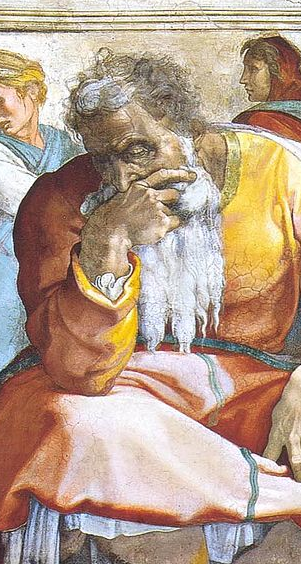
Michelangelo’s depiction of Jeremiah from the Sistine Chapel.

How much sorrow must this cause our God? He has many times seen his people turn away from him, which causes him grief. But here the sin of the parents is to destroy their own children. Judah is taking the lives of God’s people and in so doing, upending the promises of God. They are no longer cherishing the promise of God to Abraham and his descendants. Instead they cast the promised children into this Valley of Slaughter.

God promised Abraham offspring so numerous they’d be impossible to count and Abraham longed for a child. Children were an honor and a blessing. But here in Jeremiah as descendants of Abraham receive this promise, they mock God and his promises. It is evil in God’s sight as they slaughter their own kin–something so far from God’s mind.

This is a clear reason why Jeremiah comes to preach judgment, and good reason that he is known as the weeping prophet (Jer 9).

Books of the Bible in One Sentence

Having just come home from our Review/Preview session for Quarter 2, I wanted to share a little. Unfortunately for you all, I cannot share the food we had. We enjoyed some fine BBQ from our neighborhood Q-Shack. I’d put money down that most everyone is still stuffed, especially because we had some delicious desserts brought in, as well.

But enough gloating. We had a great time sharing our experiencing from the summer quarter, almost marveling at all we’ve read thus far. We’ve got a great quarter ahead this fall and to intro it, I’ve got a document to share. Someone else had this brilliant idea, so here are one sentence summaries of the many books we’ll be reading in the next few months. And skip to the end for a downloadable, one-page PDF.

Jeremiah
He was given the tough task of announcing the destruction of Judah, pointing out their sin, preaching for the repentance of the people, and holding out the promise that God’s faithfulness would remain.

Job
Job is described as a good man who lost everything, bringing up the question of how God can be just in light of human suffering.

1 & 2 Kings
Follows the line of David and the Kings of Israel and Judah from times of power and prosperity to their Babylonian exile, including the ministries of prophets like Elijah and Elisha.

1 & 2 Chronicles
Another look at the history of God’s people, going back further than Kings, focusing on David and Solomon, perhaps with a particular concern for their restored community.

Daniel
A book by the exiled prophet Daniel in Babylonia that through his visions holds up a picture of a God who, even though Babylon has overthrown Jerusalem, is still sovereign over all kingdoms and powers.

Nehemiah
Thought to be written by same person (Ezra) that wrote Chronicles and Ezra, and details post-exilic life, with special attention to the rebuilding of the walls of Jerusalem.

Ezra
The return from exile and rebuilding of holy structures and restoring holy worship.

2 Corinthians
Paul’s letter to Corinth and surrounding areas defending his own ministry and calling.

Colossians
Paul’s Letter to Colosse refuting heresy that had come into the church, comparing its insufficient philosophy to the complete supremacy and sufficiency of Jesus Christ.

Hebrews
Letter addressed primarily to Jewish believers that teaches that Christ is the full and final revelation of God who surpasses the revelation seen in the Old Testament and fulfills the promises of the Old Testament in his new covenant.

1 John
John, the apostle and author of John and Revelation, writes to battle false teachers and the Gnostic heresies, defending Christ’s bodily resurrection, and calling for love to be characteristic of the believers’ life.

2 & 3 John
John gives further warnings about false teachers, encourages discernment in giving support, and commends Gaius for his hospitality.

Jude
Another book with warnings for the church in regards to false teachers who have made their way among them.

Matthew
A gospel of Jesus Christ, perhaps mostly written to Jews, as Matthew’s gospel purposes to convince the reader of Jesus’ fulfillment of Old Testament scriptures and points to him as the Messiah.

Here is a nicely formatted PDF if you’d like to print it out and stick in your Bible:

Books of the Bible in One Sentence

Before Jeremiah was a twinkle in his father’s eye

20120924-161021.jpg

We immediately get into a passage in Jeremiah 1 that is well known, at least relative to other texts from Jeremiah. In verse five we read:

Before I formed you in the womb I knew you…

In it we see God’s sovereignty over creation and time. We find comfort being known by God, and that he knows us before we ever have a chance to seek him. Before we even have the ability to turn to him, he knows us.

But it is great to look beyond this one line to see how this truth plays out. God wants his prophet Jeremiah to rely on God to fulfill his call. Jeremiah worries that he is only a youth, so how is he to be a prophet to the nations? But doesn’t he realize that God already knew that when he called him–he knew all things about Jeremiah before Jeremiah was even born. God says do not worry that you are young, for I will give you the words. Just follow my command. I will be with you. Verse nine even says that God will put the words in Jeremiah’s mouth. What then will he lack?

If he is worried that he’ll have to go it alone, all Jeremiah should do is look back–God knew him before he was formed. And he can look ahead–God will continue to be with him. God has not left his side and will remain with him making him capable of the great work that is prepared for him. There is no time Jeremiah can think of or imagine in which God is absent from the picture.

In a similar way that Jesus talks of Abraham in John 8, God could say here that before Jeremiah was, I am. God was by his side before he even had a side, before he had a body. Therefore Jeremiah can rely on this God who holds these plans securely in his own hands. He need not worry about what he may lack and instead focus on all that is perfectly provided by God.

Welcome to the third quarter of Year in the Bible

We are halfway there!

Maybe not in terms of page count, but chronologically we have made it the halfway mark. Gone are Spring and Summer quarters. Two down, two to go.

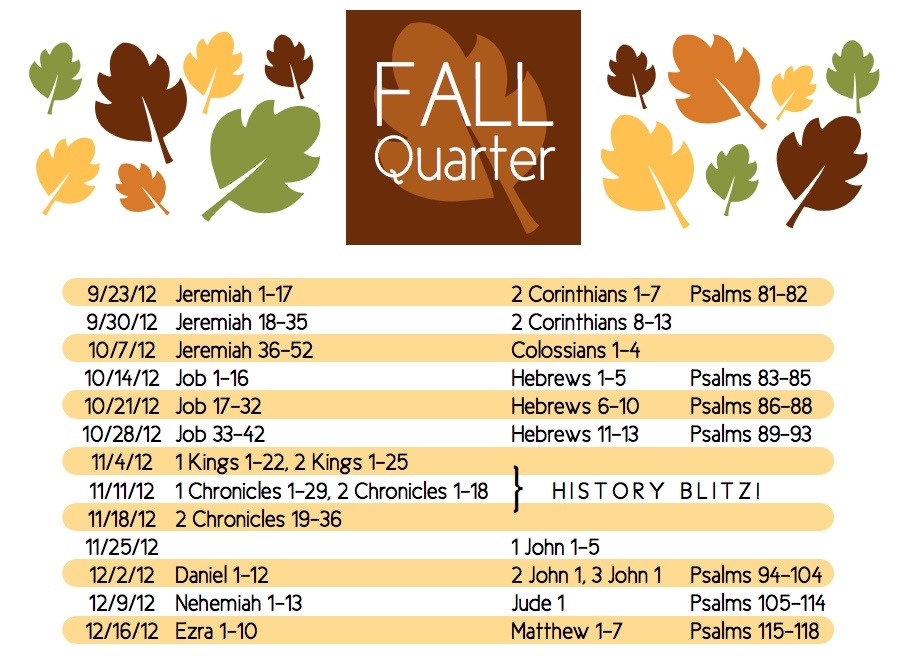
This fall we’ll move from minor prophets to major prophets, continue with some history books, and tackle more letters from the New Testament. It is a great time to jump in. This reading plan isn’t the only one and I don’t claim it is even the best one. But reading with a plan is a good way to make sure you stick to it. Along with a plan I’ll recommend again finding someone or several someones to read with. It is better when we do it together.

Here is this fall quarter’s plan if you want to print it out. Happy reading!

20120923-133731.jpg

Love and (More than) Marriage


I bet if you’re married, there is a very good chance that a certain passage from this week’s readings were a part of your wedding ceremony. 1 Corinthians 13 is a favorite passage for couples to use at their nuptials.

Of course, I hope love is part of a marriage, so I don’t think it is out of place to use this passage. But given that this passage on love is so linked for many to weddings, we need to make sure we remember this scripture applies for all. Love is patient is not only for couples. You don’t have to be married for your love to rejoice with truth, bear all things, and not seek its own way. This chapter is lifted up as a goal for how we should love, but just don’t think it is the goal only in marriage. All Christians are called to follow the self-giving love of Jesus Christ, who even loved his enemies.

It would be much easier if I only was called to love my spouse. Even still, I’d fail. But it’d be easier. But it is the more challenging way of disciples of Christ to hear this as a call for all of us to love our neighbors in a way that pushes us and requires great reliance on God’s Spirit. For we can do many amazing things, but if we have not love, we are nothing.

In the News: Did Jesus have a Wife?

Papyrus fragment: front. Karen L. King 2012

This is a site about reading the Bible and given that the news has been talking about ancient texts concerning Jesus, I thought I’d offer a few resources on this talk of Jesus having a wife based on an old coptic manuscript:

A bit of overview from Christianity Today

An academic response to it from Near Emmaus

Harvard’s own site on the finding

One quick point I’ll make. Don’t let talk of authenticity fool you. Authenticity in this sense means that this fragment is believed to be an ancient text. It’s not a hoax written in contemporary times. This does not mean that the content is necessarily true.

I could grab a piece of paper and write on it that I have a unicorn. In a thousand years, if that paper were to survive and someone found it, it would be an authentic ancient writing. They could say that it was truly written in the early 21st century. But does that mean that I have a unicorn? Of course not.

There were many different schools of thought and religions that wanted to associate Jesus or a follower of Jesus with their beliefs. But just because scholars call something a gospel does not mean it truly is.

The Gospel in Zechariah’s Vision of a High Priest

Satan, the accuser (Gustave Doré, Illustration from Dante’s Inferno)

Zechariah 3 includes a vision of the priest Joshua that in one short paragraph paints a picture of the gospel.

Then he showed me Joshua the high priest standing before the angel of the Lord, and Satan standing at his right hand to accuse him. And the Lord said to Satan, “The Lord rebuke you, O Satan! The Lord who has chosen Jerusalem rebuke you! Is not this a brand plucked from the fire?” Now Joshua was standing before the angel, clothed with filthy garments. And the angel said to those who were standing before him, “Remove the filthy garments from him.” And to him he said, “Behold, I have taken your iniquity away from you, and I will clothe you with pure vestments.”

Joshua is standing before the Lord with Satan beside him, accusing him. I imagine Satan describing Joshua’s inadequacy and sin. How could God accept one like him? What use does God have with Joshua? Look at his filthy garments!

But Satan’s accusations are of no use. The Lord rebukes Satan, removes the filthy garments, and bestows upon Joshua pure vestments. God overcomes Joshua’s iniquity and provides for him.

This could easily be the scene for any of us, sinful as we are, standing before God in judgment. Satan would not be lacking in his accusations. Who of us does not have a long list from which Satan could pick and choose? But the good news is that our sin, our filthy garments, that should disqualify us from standing before God are removed because of the work of Jesus Christ. God does not base his love for us in our deeds. Our deeds amount to nothing. Our right standing is based on what God has supplied for us. He removed our sin and gives to us his own righteousness.

Satan has no right to accuse us any longer. The only one who can condemn us, who can judge us in such a way is Christ, but he is the one who stands at the righthand of God interceding for us (Romans 8:34). The one who could accuse instead stepped in for us and died in our place so that his own righteousness could be placed upon us like pure vestments. It is a righteousness not our own, but of Christ (Phil 3:9).

Our sinfulness clothes us in filth, but by God’s grace we are cleansed, and instead clothed in Christ himself.

Clarifications and Intro for Malachi

The Prophet Malachi, Duccio di Buoninsegna 1310

If you use this site to guide your readings, rather than a printout of the reading plan, then you may have had some confusion this week. I posted Micah 1-4, realized Micah has 7 chapters, changed the corresponding texts, then realized Malachi was the assigned reading, saw that Malachi has 4 chapters, then changed everything back. What made it more difficult was all this was using a finicky internet provided by my brother’s cell phone.

Hopefully you have not tried to read seven chapters of Malachi, come up short, and conclude your Bible was a misprint.

Malachi is the final book in the Old Testament, but don’t be deceived into thinking we’ve now finished that part of the Bible. We’ve still got plenty to go. But it is the last of the Minor Prophets as they are ordered in our Bibles.

You’ve got to love it when you find a good one sentence summary of a book, so I thought I’d share this one I came across:

The theological message of the book can be summed up in one sentence: The Great King (1:14) will come not only to judge his people (3:1–5; 4:1) but also to bless and restore them (3:6–12; 4:2).

That’s what you’ll come across as you read. I hope I caught you before you began to follow my poor guidance. If so, you might want to read further introductory comments from the article the above quote is taken from.

Malachi – Biblica.com