Our reading this week had a great reminder for us all, and for me in particular given what I’ve busied myself with this last several days.
And we impart this in words not taught by human wisdom but taught by the Spirit, interpreting spiritual truths to those who are spiritual.
1 Cor 2:13
The whole chapter emphasizes what we receive by the Spirit. What we know is not something we can boast in, nor is what we teach and pass on something that is of ourselves. It all is of the Spirit. I mentioned it is a nice reminder for me since I’m currently preparing both a sermon for tomorrow morning and a talk on prayer for tomorrow night.
It is easy to try rely on yourself and to worry if what we have to say is enough. We focus on our education, our smarts, our delivery, etc. But that is missing the point. I can rely on the Spirit, and I ought to make sure what I speak is of God. It’d be foolish to try to do what God calls us to in our own strength. All I have the privilege of doing is to take what the Spirit has shown us and pass it on. From start to finish, we are a work of God. Which is why it’s not about us and why we should say, soli deo gloria–glory to God alone.
And I was with you in weakness and in fear and much trembling, and my speech and my message were not in plausible words of wisdom, but in demonstration of the Spirit and of power, so that your faith might not rest in the wisdom of men but in the power of God.
1 Corinthians 2:3-5
There are some great books that defend the Christian faith that I’ve personally enjoyed in the past. They could be grouped broadly into the category of “apologetics.” This name isn’t based on our saying “sorry” for our faith, but the word relates to giving a defense. While I certainly believe that there are reasons to believe in Jesus Christ and that our Bible is a trustworthy book, it is important to remember that we cannot argue someone into faith. We shouldn’t present some sort of bullet point list to someone, then demand that she believe.
While Paul does use argumentation and is thoughtful with his words and his audience, he is primarily a witness pointing to Jesus. Paul can’t make someone believe. In fact, he doesn’t want to. His desire is that a person’s faith “might not rest in the wisdom of men.”
This chapter goes on about how what we now know–the wisdom of God that we see in the cross of Jesus Christ–is not based in our own intellectual achievements. It is not because I’m smart enough that I’m a Christian. Likewise it is not because someone is dumb that they may not believe. The eternal purposes of God are known to us because they have been revealed to us by the Spirit of God.
But, as it is written,
“What no eye has seen, nor ear heard,
nor the heart of man imagined,
what God has prepared for those who love him”—
these things God has revealed to us through the Spirit. For the Spirit searches everything, even the depths of God.”
1 Corinthians 2:9–10
We can’t even boast in our knowing because it is a gift of God’s grace. Our coming to believe and understand is a work of God’s through and through.
We ought to love God with our minds, seek to know him better, to discern the mind of Christ, and speak ably about Jesus to those around us, always giving a reason for the hope we have (1 Peter 3:15). But we do not do this as though everything hinges on my skillful argumentation. Christianity is not an anti-intellectual faith, but it is not a faith dependent on advanced understanding and academic achievement. Our faith is dependent on the working of the power of God.
Make this your “lock screen” on your phone and you’ll be memorizing in no time!
I heard on the radio yesterday that the average person looks at their phone 150 times a day. I heard it on the radio, and then I also was able to find it on the internet–so it must be true! Even if your own results may vary, I’m sure you are checking it many times every day. You check it for the time, for emails, for news, and of course, to make phone calls.
In hearing this little statistic I was given more reason to do something useful with my screen. I have already made Bible visualizations for your smartphone, but now I’m really thinking this can be a great way to memorize. Even if it is just a glance, 150 times a day is a lot. Do it for seven days a week, for each of our verses. That’ll add up quick.
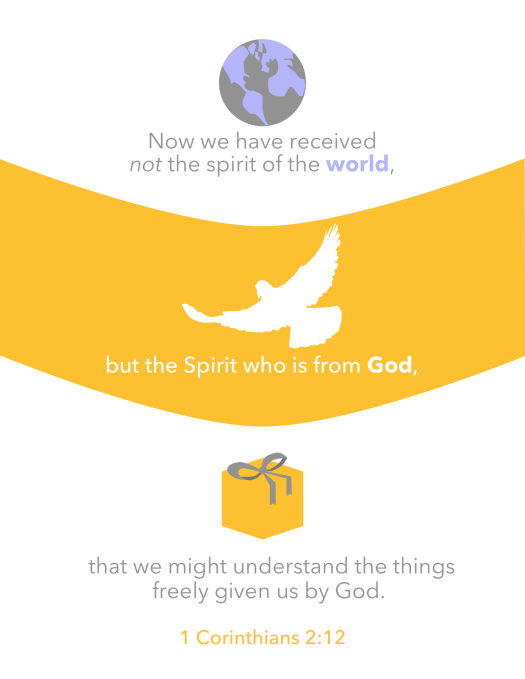
These visualizations have more than words, so maybe when you quickly glance at this week’s image when you want to see if you’re running late, you may not read all the words. But you will see, again and again and again, a picture of the earth, a dove, and a gift. That alone helps us to remember the three points in this verse: that we don’t receive the spirit of the world, we receive the Holy Spirit, who helps us receive what is given by God. Imagine seeing that picture 150 times a day, over a thousand times a week. You’ll remember something of it for a long time.
So I’ve already covered the basics of Year in the Bible in an earlier post, but I wanted to give you a few more tips.
Following
You should see something like this on the right of the site, or at the very bottom.
We already covered three elements: Read, Study, Memorize. That’s straightforward. But how can you more easily do this? I hope, since you are reading these words, that you’ve taken advantage of what is being published to the website. But did you know you could have this come to your email inbox? You can “follow” Year in the Bible and whenever a new post is published, it’ll come to you. If you’re not seeing where to do so, talk to me and I’ll help you out. (Or you can send me your email–I think I can manually add you in).
You could also do something similar by either ‘liking’ Year in the Bible on facebook at facebook.com/yearinthebible or if you use Twitter, follow Year in the Bible there at @YearintheBible. Both of those are updated with all the new posts.
Commenting
You can also comment on any of these posts. I can then follow up if something wasn’t clear or you have a further question. Someone else can follow up, too. The Spirit speaks through more than just one person and we can interact in the expected places like a Bible study at a church, but we can also do so on a website or through facebook comments.
If posting a comment publicly isn’t something you’d like to do, please email me. Many posts in the past have been in response to people emailing me questions or pointing out something that has been helpful to them.
Quick recap: follow the Year in the Bible program either by email, facebook, or twitter and comment on the articles. I think these will help us engage with one another and that will be an encouragement for us all.
Bonus
Here’s a quick list of some other things to do:
Make the memory verse your lock screen on your smart phone. This has helped me quite a bit.
Put the memory verse on your dash board. Again, that’s helped me out.
Read the Bible passage in different versions. When you see differences between translations that can be a great place to dig in and find out why (or ask me why) the versions went in different directions.
If you’re doing it alone, invite a friend to do it with you. This is not an intimidating reading plan so it could work great for someone’s first real Bible study. Find someone in your neighborhood. And it is certainly not too late to start. We’ve read a chapter so far!
Do you have any of your own tips? If so, share. We’d all love to hear.
As we close the first chapter and begin the second, it is important to take account of what we’ve read. A goal of reading the way we are is to really get a sense of the whole of the letter. What is Paul saying start to finish?
You could go back and review any highlights or underlines. As you read you can jot down short summaries in the margins. At least, if your Bible has them, review the section headings–I hope those will remind you of what is in them.
I thought I’d provide a few short questions to review. See if what you are reading is being retained and understood. If so, fantastic! If not, maybe slow down or read it a few more times this week.
Who is it from?
And the answer is more than Paul.
Who is it to?
And the answer is more than the Corinthians.
What was going well in the church?
And who is really responsible for that?
What was going wrong in the church?
And who really deserves the church’s loyalty?
What does Paul preach?
And how might the world react to it?
Now in chapter two, read it with an eye toward retention. Read it knowing that we’re not just checking off a "to-do" list, but we are approaching God in his word to us. By the Spirit we are blessed with understanding. Read it knowing that God has something to say and it is worth remembering.
And if you want to remember just one thing, our memory verse this week is 1 Corinthians 2:12:
Now we have received not the spirit of the world
but the Spirit who is from God,
that we might understand the things freely given by God.
Again, I know memorization is hard and if you are like me, you are out of practice, so here again is a visualization to help you remember it:
And don’t forget the Bible study, which we cover on Wednesday night at 6pm at the church, or look at it with a friend or on your own. You can find it here.
When Jesus was crucified, as Paul says in 1 Corinthians, it certainly appeared foolish. Here Jesus is seen as a common criminal, a failure, and powerless. In Mark we read these words of how he is mocked at the crucifixion:
And the soldiers led him away inside the palace (that is, the governor’s headquarters), and they called together the whole battalion. And they clothed him in a purple cloak, and twisting together a crown of thorns, they put it on him. And they began to salute him, “Hail, King of the Jews!” And they were striking his head with a reed and spitting on him and kneeling down in homage to him. And when they had mocked him, they stripped him of the purple cloak and put his own clothes on him. And they led him out to crucify him.
Mark 15:16-20
That is our savior. Paul won’t waiver from this painful sight–the Messiah dying on the cross. It seems foolish. But it is our savior. It is love in action.
I thought I’d share a hymn that puts these two concepts together. Each stanza begins with what appears foolish: birth in a manger, a wandering existence with no home, his beating, and finally his crucifixion. But coupled with these scenes is the fact that such humble events do not diminish our Lord. Each stanza asks, “Who is this?” And the answer is always, regardless of circumstance, “our God.” We still praise him. Jesus Christ is the Son of God in these times and judging by the world’s standards, or by the world’s wisdom, does not fully comprehend his real power and glory.
Who Is This, So Weak and Helpless?
Who is this, so weak and helpless,
Child of lowly Hebrew maid,
Rudely in a stable sheltered,
Coldly in a manger laid?
’Tis the Lord of all creation,
Who this wondrous path has trod;
He is Lord from everlasting,
And to everlasting God.
Who is this, a Man of Sorrows,
Walking sadly life’s hard way,
Homeless, weary, sighing, weeping
Over sin and Satan’s sway?
’Tis our God, our glorious Savior,
Who above the starry sky
Is for us a place preparing,
Where no tear can dim the eye.
Who is this? Behold him shedding
Drops of blood upon the ground!
Who is this, despised, rejected,
Mocked, insulted, beaten, bound?
’Tis our God, Who gifts and graces
On His church is pouring down;
Who shall smite in holy vengeance
All His foes beneath His throne.
Who is this that hangs there dying
While the rude world scoffs and scorns,
Numbered with the malefactors,
Torn with nails, and crowned with thorns?
’Tis our God Who lives forever
’Mid the shining ones on high,
In the glorious golden city,
Reigning everlastingly.
You can also listen to the song here, in a rendition from Indelible Grace, sung by Sandra McCracken (although the video was not made by them):
When we move from one culture to another, we often change our illustrations to best fit our audience. For example, if you use a baseball metaphor in the United States, it may not work so well if you are in England. (I guess you need to hope you can easily translate it into a cricket metaphor.)
We have no issue changing these illustrations because it isn’t changing the true content of the message, just its packaging. We even are happy to change if it helps us avoid miscommunication, or worse, offending someone.
But this does not apply to the cross of Jesus Christ. Paul knows this will offend and trouble some of his audience, but he will not change his message. He may change his metaphors and other examples, but the crucifixion isn’t a metaphor. The cross is not merely an illustration of God’s love. It is not just a story, a parable or fable where what is important is only the lesson we can learn. The cross is a true event in our history that changed everything.
When Paul is addressing Jews and Greeks there is no substitute for the cross of Christ. Even though it is a stumbling block, he can’t avoid this central event. He won’t avoid the cross, because “to those who are called, both Jews and Greeks,” Christ, and him crucified, is the wisdom of God. He’s our righteousness, our sanctification, and our redemption.
“The Christian good news is all about God dying on a rubbish-heap at the wrong end of the Empire. It’s all about God babbling nonsense to a room full of philosophers. It’s all about the true God confronting the world of posturing, power and prestige, and overthrowing it in order to set up his own kingdom, a kingdom in which the weak and the foolish find themselves just as welcome as the strong and the wise, if not more so”.





 Year in the Bible