What are the Nephilim and how much does it matter?

In many ways, Genesis is a book that is easy to read because itโ€™s a narrative. It tells about people and places, and though those names and locations may be a bit foreign to us, we have heard many of the stories throughout at various times in our lives. Thereโ€™s a certain familiarity about it. However, Genesis is also a tough read because we may not know what exactly we are supposed to get out of it. Reading through Genesis can make us uncomfortable as we come across sections like chapter 6, where the โ€œNephilimโ€ are introduced and thereโ€™s something about the โ€œsons of Godโ€ and the โ€œdaughters of man.โ€ These terms are  confusing, and perhaps weโ€™ve not encountered this part of the narrative very often in a sermon or Sunday school lesson. 

A question came in this week about what we make of this section of chapter 6 (v. 1-4). Who are the โ€œsons of Godโ€? Are they angels? Are they people? Who are the โ€œdaughters of menโ€? Why werenโ€™t these two groups supposed to intermarry? 

First, let it be said that these questions have baffled readers and scholars (both Jewish and Christian) for centuries. So, if youโ€™ve asked these questions, youโ€™re in excellent company! It helps to know that these are tough questions that many others have sought to answer, but donโ€™t let the fact that itโ€™s difficult stop us from seeking to at least understand it better (even if we canโ€™t understand completely). 

Scholars, as you may imagine, are not all in agreement as to the meaning of the term โ€œsons of God.โ€ The fact is, those who wrote it and were the original readers almost certainly understood what it meant, but the full meaning has been lost to us. So, the most honest answer is that we donโ€™t know. 

What Iโ€™ll do is offer a few suggestions offered by people who know much more than I do! 

One view is that โ€œsons of Godโ€ refers to angels that were having relationships with human women. While the term โ€œson of Godโ€ is used in other books (Job, for example) to refer to an angelic being, itโ€™s not the only way to understand the term. Furthermore, the Genesis narrative at this point is focused on the continuing rebellion of humans and their advancement in sin. This being the case, it is much more likely that โ€œsons of Godโ€ refer to some human creatures, and this is an example of humanityโ€™s continuing spiral downward in sin. 

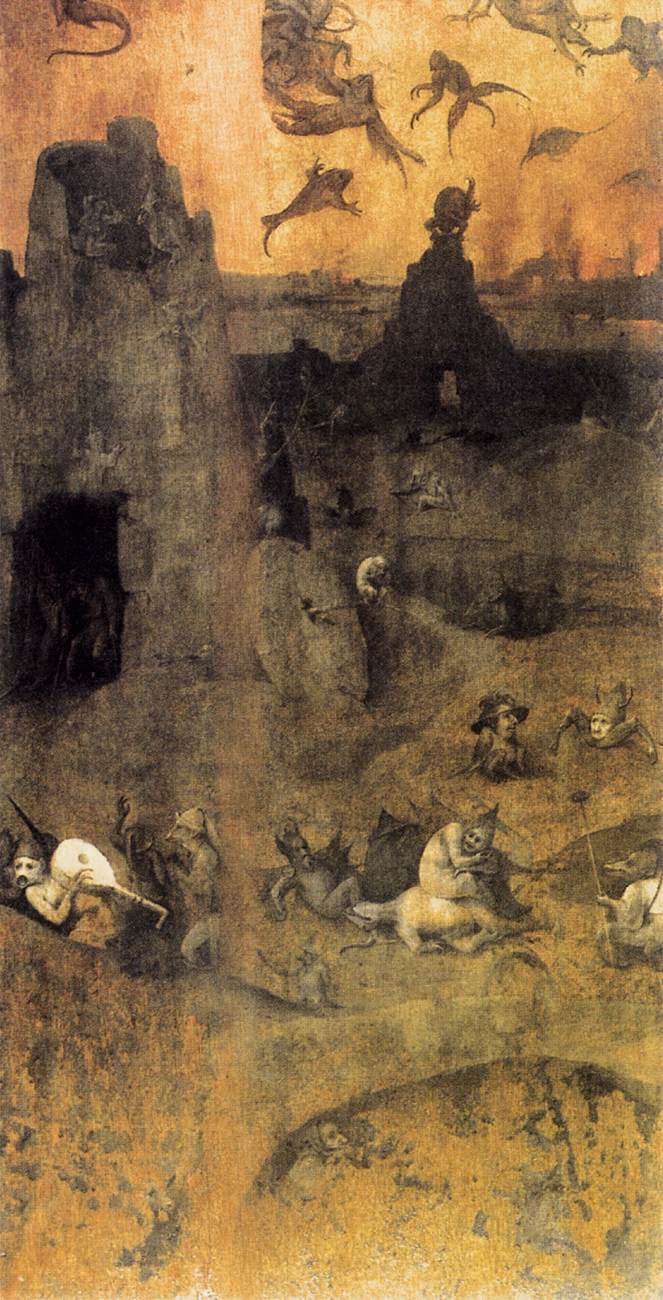
Hieronymus Bosch - The Fall of the Rebel Angels, c. 1510
Hieronymus Bosch – The Fall of the Rebel Angels, c. 1510

So, what are some other possibilities? John Walton, an Old Testament professor at Wheaton College, suggests that the term (โ€œsons of Godโ€) refers to the kings of the Ancient Near East. These rulers, often regarded as sons of God by the people they rule, may have been not just intermarrying, but involved in some sort of sexual perversion with the โ€œdaughters of men.โ€ In this interpretation, the daughters of men would have been Godโ€™s people. Interestingly, these Ancient Near East rulers were very concerned with immortality and long life, so the limiting of their days to 120 years would be an appropriate consequence.  

A third possibility is that the lines of Seth and Cain are represented by โ€œsons of Godโ€ and โ€œdaughters of men.โ€ Remember, Cain was the firstborn son of Adam and Eve- the one who murdered his brother, Abel. Later on, Eve has another son whom she called Seth. Because of what he had done, Cain was driven away from the Lordโ€™s presence. Seth was considered the โ€œchild of promise,โ€ and it was his family line that โ€œbegan to call upon the name of the Lordโ€ (Genesis 4:26). So, in this interpretation, the sons of God are the line of Seth (the line of promise) and the daughters of men are the descendants of Cain. The children of the promise were intermixing with those who had been cursed. Those who worshipped God were not to live like the rest of humankind, marrying whomever they wanted; rather they were to live as a distinct people. 

Given that this section of Genesis is fixed on the theme of humanityโ€™s plunge into disorder, it seems much more likely that the term โ€œsons of Godโ€ refers to a group of human beings. Saint Augustine and John Calvin are two examples from history who believed the โ€œsons of Godโ€ to be human creatures. 

Both the second and third possibilities have their interesting points of support, and of course there are other variations out there. Even without knowing with certainty the identity of the groups of people in this text, we can understand the point of the text is to show us that human beings were choosing their own way. What had begun in the garden, when Adam and Eve ate of the Tree of the Knowledge of Good and Evil is continuing to have its impact. Human beings want to be the determiners of good and evil, and are trying to usurp God from his rightful place. And itโ€™s not going well. 

Hope this helps, and please bring us more of your questions, because itโ€™s very likely that others are asking the same ones!


Also: Hereโ€™s a short video on the identity of the โ€œnephilimโ€ and how much weight we should give any particular interpretation of that term. 

Failure to Be a Blessing

jonah in the whale Verduner altarpiece
This week we are reading passages that are written in a time when Israel has now come to possess the land that God has promised to them. God was faithful to Joshua and led the people to the land that was flowing with milk and honey. He was fulfilling the promise he had made to Abraham. But the people fail to be a blessing to others and fail to live in the way they were called to. In Amos we read how Israel is oppressing the poor and weak, treating them much like they were treated when they were slaves in Egypt. In Jonah we see the lengths Jonah would go in order not to go to his enemy, instead preferring Ninevehโ€™s destruction.

Then when we look in the New Testament in Matthew 23, Jesus is criticizing the leaders of the Jews who similarly are not living as a blessing to those around.

This last Sunday I preached on Jonah, looking closely at his reluctance to even be a possible blessing to his enemy. The good news is that we have one who willingly came to his own enemies and sacrificed himself for us.

If youโ€™re interested in reading the sermon, you can find it here.

Ways to Learn, Relearn, and Review 1 Corinthians

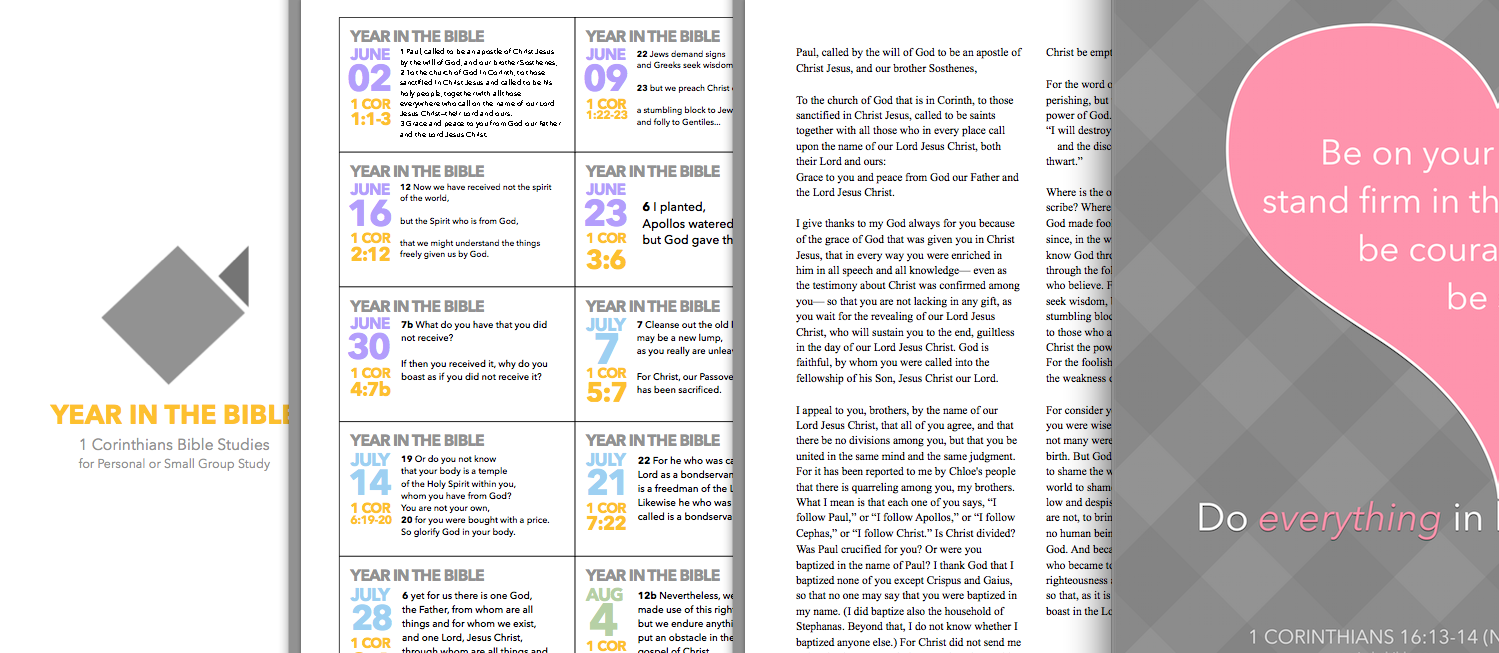
Review of 1 Corinthians Image

Since we finished reading 1 Corinthians just last week, what do we do now? The reading plan was pretty clear that we finished, but so you know, you are allowed to return to 1 Corinthians. You can reread it to your heartโ€™s content.

If you want some methods of review, here are a few.

  • You could read it. Slowly. Again. Not a complicated method. Maybe you could try a different version this time around.
  • You could use the Bible studies to go in-depth. Besides that link to the website, you can also download them all as one PDF here.
  • Using the Bible visualizations you can review the memory verses. We did this in our final meetings of the Bible study and tried to remember what the context of those verses were. Itโ€™s great to know these verses, but it is even better to remember why Paul was talking about Christ as our Passover lamb or why he talks about eating to the glory of God. Again, if you want to download them, here is a big (20 mb) PDF you can use.
  • Something else we did to review at our study was like a puzzle. I stripped 1 Corinthians of all its verses and chapter headings and then mixed up all the chapters. The goal was to be able to put the letter back in order. You can use this to try it out for yourself. Iโ€™d recommend stapling the few chapters that are two pages together so that you have sixteen units to put in order.
  • If visuals arenโ€™t your style for memorization or you want something more portable, print out these memory verse cards, cut them out, and flip through them.

Have another idea? Iโ€™d love to hear it.

Questioning the Resurrection of the Dead

Continuing the topic of resurrection in chapter 15, Paul voices some of the questions or objections that he has heard to this fantastic notion of the dead being raised. Some have asked how this happens? If in fact it does happen, what sort of body will they have?

Paul uses several mini-parables to answer this, looking at seeds, animals, and celestial bodies. Even with his concise illustrations this can still be a difficult passage. Or maybe I should say, of course it is a difficult passage. Resurrection is not an easy thing to believe in. In a very literal sense, it’s not natural for us. Nature allows for birth and death, but no more. The resurrection is supernatural.

For such an amazing concept, maybe watching a short video will help. Here’s NT Wright on resurrection and its understanding in the first century. It’s not very long (6 min), but it is part of a much longer video, if you’re feeling adventurous.

Love Never Ends

Lover Never Ends

Love never ends.

1 Corinthians 13:8a

These three words have great force especially when we remember that this is love that has its roots in God. It is God’s love that never fails. Reading these words this week brought this song to mind: One Thing Remains.

Enjoy.

The Downside to Memorization and Its Defense

I read an article today that peaked my interest since I have been thinking about memorization a lot more recently. As I have emphasized much of the good associated with memorization (of which I think there is plenty), there can also be a downside. At times the focus is placed too heavily on recitation without any concern for understanding.

At The Atlantic, Ben Orlin writes an article titled When Memorization Gets in the Way of Learning that comes down pretty heavy-handed against memorization. But he does then seek to build it back up to be more useful. Some of what he says I might disagree with, partly because of the limited definition he places upon memorization, “learning an isolated fact through deliberate effort.” But I’d share his biggest concern, which is that memorization detaches what is memorized from a web of meaning and connections and context. Orlin writes:

Some things are worth memorizing–addresses, PINs, your parents’ birthdays. The sine of ฯ€/2 is not among them. It’s a fact that matters only insofar as it connects to other ideas. To learn it in isolation is like learning the sentence “Hamlet kills Claudius” without the faintest idea of who either gentleman is–or, for what matter, of what “kill” means. Memorization is a frontage road: It runs parallel to the best parts of learning, never intersecting. It’s a detour around all the action, a way of knowing without learning, of answering without understanding.

This relates directly to this week’s memory verse. The words we may know by heart that precede our taking of communion may already be memorized. But if we know the words without knowing the meaning and significance, what have we gained? It is the same concern with memorizing the creeds or a catechism. Or why would we memorize the Lord’s Prayer if you only do so that you can recite it with your brain turned off?

This isn’t to say memorization is bad. We just need to remember its place. I want memorization of Scripture to be a result of long meditation and thoughtful reflection. It should be a desire of ours to know these great passages of God’s Word so well that we can recall them even if our Bible isn’t around. The end goal really isn’t memorization. Memorization can be and should be a tool to help us learn and retain. As we do so we’ll only then gain a greater sense of awe and wonder at the goodness of our God.

Why Does Paul Want Women Covering their Heads in 1 Corinthians 11?

Now I commend you because you remember me in everything and maintain the traditions even as I delivered them to you. But I want you to understand that the head of every man is Christ, the head of a wife is her husband, and the head of Christ is God.ย Every man who prays or prophesies with his head covered dishonors his head, but every wife who prays or prophesies with her head uncovered dishonors her head, since it is the same as if her head were shaven. For if a wife will not cover her head, then she should cut her hair short. But since it is disgraceful for a wife to cut off her hair or shave her head, let her cover her head. For a man ought not to cover his head, since he is the image and glory of God, but woman is the glory of man. For man was not made from woman, but woman from man.ย Neither was man created for woman, but woman for man.ย That is why a wife ought to have a symbol of authority on her head, because of the angels. Nevertheless, in the Lord woman is not independent of man nor man of woman; for as woman was made from man, so man is now born of woman. And all things are from God.ย Judge for yourselves: is it proper for a wife to pray to God with her head uncovered?ย Does not nature itself teach you that if a man wears long hair it is a disgrace for him, but if a woman has long hair, it is her glory? For her hair is given to her for a covering. If anyone is inclined to be contentious, we have no such practice, nor do the churches of God.

1 Corinthians 11:2-16

Misunderstanding the Traditions

Paul has passed on traditions, or teachings, to the Corinthians, but as is his pattern, he then moves on to other churches. Paul is a missionary and he is persistent in traveling the Mediterranean world, spreading the gospel, and helping to plant churches. He does his best to remain faithful to this calling, but the difficulty is that he always is leaving behind brothers and sisters that he cares for and about whom he is concerned. While he does identify leadership for the new congregations, others travel from city to city and at times teach other gospels and challenge what he has received and taught himself. This is why the tone of his letters is often pushing back against new teachings or misunderstandings of what he left for them.

Already in this letter he has dealt with an issue around a teaching that โ€œall things are lawful for me.โ€ The church had taken this to mean that freedom in Christ could encourage any and all actions. Paul wants to affirm the freedom Christ has purchased for us, but he wants to correct their misunderstandings that led to lawlessness and sin. Yes, we have freedom, but it is freedom to live for God, not return to slavery and bondage to sin.

No male and female?

It is possible that another tradition that he passed on was something like what we find in Galatians 3:25-29:

But now that faith has come, we are no longer under a guardian,ย for in Christ Jesus you are all sons of God, through faith.ย For as many of you as were baptized into Christ have put on Christ. There is neither Jew nor Greek, there is neither slave nor free, there is no male and female, for you are all one in Christ Jesus. And if you are Christโ€™s, then you are Abrahamโ€™s offspring, heirs according to promise.

If the church misunderstood a teaching like this, it may have led to the problem we see in 1 Corinthians 11. Perhaps the women there, affirming the freedom we have in Christ and the new way Christโ€™s church is structured, no longer favoring the males, took the notion of โ€œthere is no male and femaleโ€ a step further. What is meant as a leveling of the sexes, as well as ethnic and social status, in regards to our standing in Jesus Christ, could have been taken to obscure gender and sex altogether.

Looking back to creation where humans are created male and female, Paul doesnโ€™t want the church to eliminate the distinction between the sexes. They are seen as equals, but we are not to undo the order of creation and elimiminate the sexes, altogether.

That could have been the background to this section and the reason for the women to be uncovering their heads. The practice of their day was for women, in public settings, to cover their hair. If some saw such a practice as unnecessary now that there is โ€œno male and femaleโ€ they would have done away with it, uncovering their hair or cutting it in a fashion similar to men of that dayโ€“short. But as I said, Paul doesnโ€™t want them to think that creation is undone. Godโ€™s creation is good, including Godโ€™s making us male and female, and in Christ that is not discarded but maintained. Male and female are both valued in the church, and the one does not have to become like the other nor do they both need to be subsumed into a genderless condition. So when Paul instructs the church in reference to its dress, using the cultural norms of that day, he is trying to preserve a distinction. It is not a distinction in roles in worship, for as I said yesterday, women in this chapter are clearly praying and prophesying, but rather a distinction in appearance between men and women.

Cultural Associations and Sensitivities

To make the matter more complex, it is likely that the segment of the female population that did uncover their hair publicly were prostitutes. This, as well, is not something that Paul would then want in the worship of the church. He wouldnโ€™t want women, in seeking to enact their freedom, to be a stumbling block to their own church or be a poor witness to the world (1 Corinthians 10:32). Do they have the freedom to uncover their hair? This is not a question unlike previous chapters asking about eating food that has been offered to idols. But similarly, the question should instead be, โ€œWhat action is going to build up?โ€ Is the way that the women of the church, in their specific culture, present themselves building up and loving the congregation? This would especially be an important question for the female prophets as they lead in worship.

Whenever we have a chance to stand before a people, speaking for God and about God, the goal should not be to draw attention to ourselves. We donโ€™t want to cause confusion, temptations, or detract in any way from the message. The attention and focus should be on the one who has called us. The way this applies to dress and other aspects of public leading will change depending on the culture and audience. But the goal is to lift up Jesus Christ and his good news, with as little hindrance as possible.

Further Reading

As I said yesterday, there is a great deal written on this chapter, and this only has begun to scratch the surface. I hope that it has furthered your study in some small way. That being said, there are parts I havenโ€™t dealt with today and Iโ€™d encourage you to continue to study this passage. There are a multitude of opinions and it is difficult to separate what our current cultural climate may want this passage to say from what God is teaching us through Paulโ€™s words to this church in Corinth.

Iโ€™m linking to one article to read if you want a place to start. It is by NT Wright, whose commentary Iโ€™ve used for studying 1 Corinthians, and in his paper he includes some of his research from that commentary. But reading it at the link provided gives you a taste of the commentary without having to buy anything. While at first glance it may seem long, compared to what is out there, it isnโ€™t so bad. For an admittedly difficult passage like 1 Corinthians 11, you donโ€™t want people to move too quickly and skim over the tricky parts. It assumes some level of familiarity with the passage and it is written to a British audience, but if you take your time, I think there is much to benefit from it.