Today I had the privilege to worship with a another congregation in Charleston, SC and for the second time in a row, I found another church doing some sort of Bible reading in a year plan. I was at another church in Georgia doing a year in the New Testament and this one was just beginning today a year in the Bible, based off a book called The Story. There must be something in the water that we southeastern pastors are drinking. But whatever the reason, it excites me to be around others who are diving into God’s Word because they see they exceeding value of meeting him there.
This week we will finish 1 Corinthians and the Minor Prophets. It is the last week of the summer quarter so keep with it and finish strong. I would also recommend flipping back through all you’ve read these last months. I think it will encouraging to see all that God has shown you in these books.
We will have our own review, as well, coming up Wednesday, September 26, at 6 pm. Love to have you come out for a free meal. Invite a friend even. I welcome the planning headache you’ll cause if lots people come (and RSVP!).
I want to continue with the passage from 1 Corinthians–the one about the foolishness of the cross. I’ve been trying to get a grasp on just how difficult this would be to accept for Paul’s hearers. Having read three gospels already in our Year in the Bible plan, you see how much the Jews wanted a political messiah. How could they overthrow Rome with a crucified Christ? Jesus had shown great power. How could he waste it all by submitting to the cross?
But imagine you’re a Greek or Gentile. You have many gods and perhaps you are hearing about a new one from Paul. But you hear that this God is glorified in weakness. How does that make sense to you? Does Zeus deserve recognition because he is thought to be strong or weak? Who among the gods is praised for dying, humility, service, or crucifixion? Especially being crucified would make it hard, for Christ died the death of a criminal. What is deserving of worship in an executed criminal?
But so it is. Christ crucified. Failure to Jewish political pursuits. Ridiculous to Greek notions of the divine. Our God is not like the rest for he came to serve us, love us, die for us, and in his death he is glorified.
We talked a great deal tonight in our Reading Group about 1 Corinthians 1. It is our focus passage for the week and in it Paul talks of the foolishness of the cross in the eyes of the world. Conversation went in all directions so we did not make it through all the prepared questions, so I had to ask one question as we parted. (By the way, that’s my favorite way for conversation to go).
The cross is foolishness to others, so how do we prepare ourselves to be seen as fools because of it? I know I try avoid appearing stupid, dumb, foolish (toss in your favorite synonym). But, if I serve a crucified Christ, I won’t be able to avoid being seen that way.
Do I care more about how I’m perceived? Do I want to look smart more than I want to look like a fool for Christ? I think in certain circles we Christians want to appear to have all the answers and be seen as wise. While we shouldn’t seek to be ignorant or unwise, that cannot be our greatest pursuit. The cross of Christ is utter foolishness to the world and no matter how we phrase it, the cross will be a stumbling block and folly to a great many.
We just need to find ourselves more comfortable resting in the wisdom and power of God than vainly struggling to muster strength and smarts of our own. How others see me is nothing compared to knowing and being known by God.
We’re getting so close to the end of this quarter. For me, it’s flown by. In some ways that has been great–but some weeks it just seems like I have less time. But that is to be expected. We never have perfect weeks or completely normal schedules. So we make our choices and work hard to keep our priorities in place.
What helped when we finished the Spring quarter was having an event to close it out, while at the same time previewing what is ahead. We’re going to do that again this month. Summer is almost over and the Fall is around the corner, so let’s get ready.
Mark your calendars: SEPTEMBER 26 – Year in the Bible, Review and Preview, Pt. 2
Last time we gathered after church for some food, fellowship, and some learning. We’ll keep that format, but change the time. Instead of after church, we’ll do it Wednesday evening at 6 pm. This is perfect for both those who want to have a refresher on all we’ve done this last quarter. But if you are new (OR KNOW SOMEONE WHO’D LIKE TO JOIN? hint hint), this is for you. We’ll then have some introductory comments on what is ahead. I think the third quarter is one of the hardest. You don’t have that motivation from being close to the end and our opening excitement may have worn off.
You can do it!
And of course, you can do it this week, too. We have two more weeks of Minor Prophets, and we’re beginning 1 Corinthians. Send your thoughts and insights my way.
PS – RSVP to me for the Review/Preview session. I’m providing dinner, so I need to know how much to make.
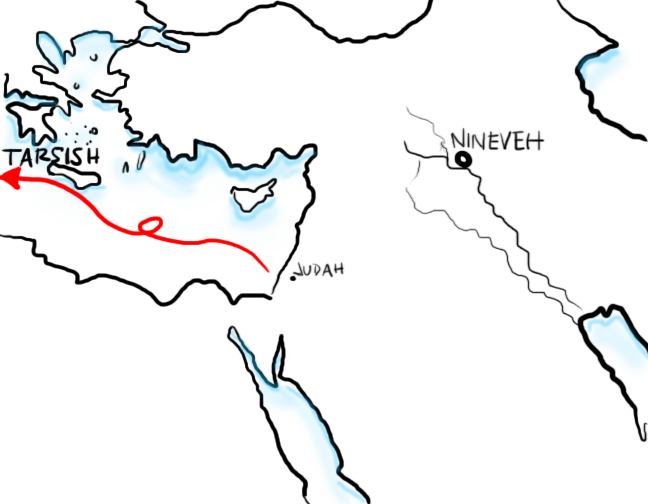
Jonah is a peculiar book among our readings this past week. These prophets we’ve had for a few weeks in Year in the Bible typically are part of the people they minister to. But Jonah is sent away to speak God’s message to another nation in the city of Ninevah. Also, the prophets typically want their recipients to stop their wicked ways and turn to God. As you read the short four chapters of Jonah, you see he’s not that concerned with Ninevah’s fate. He wants God to judge them. And when God relents, Jonah is upset.
1 But it displeased Jonah exceedingly, and he was angry. 2 And he prayed to the Lord and said, “O Lord, is not this what I said when I was yet in my country? That is why I made haste to flee to Tarshish; for I knew that you are a gracious God and merciful, slow to anger and abounding in steadfast love, and relenting from disaster. 3 Therefore now, O Lord, please take my life from me, for it is better for me to die than to live.”
Jonah 4:1-3
Jonah complains saying to God, almost in his defense, “This is why I ran. I ran off to Tarshish because you’re gracious. I know you’d do this!” He is displeased exceedingly because God is gracious. You want to shove the Bible in his face and tell Jonah that God’s grace is exactly why he still has a people of his own. Israel has been a sinner just like the others, but they have been forgiven more times than we can keep count.
But Jonah has a selfish pride and a pompous assumption that Israel has a monopoly on God’s mercy. He doesn’t want a rival nation to be spared because he wants his own nation, and only his nation, to prosper. Jonah would rather see thousands die than witness their repentance because he hates the people of Ninevah.
Jonah tried to go as far away from Ninevah as he could.
Along with Jonah being a story of Assyrian sin and God’s grace and forgiveness, it is a book displaying an ugly nationalism that would prevent Jonah from obedience and love, choosing instead sin. Jonah sins by fleeing, ends up in the belly of a whale, then cries out for God to take his life, all because of his displeasure at seeing God work wonders in another people.
We should never follow Jonah’s lead in this regard. We are called to love our enemies, to pray for them, and to work to spread the gospel to all peoples. We cannot lay claim to God’s grace as though it is ours to possess. We don’t deserve it and we can’t earn it. Thanks be to God that he is in fact slow to anger and merciful.
*Tim Keller has an excellent chapter on Jonah’s idolatry in his book, Counterfeit Gods.
Philippians is a book that shows the great depths of Christ’s humility. Christ is the one who has the most reason to be proud, but instead he humbled himself more than any other. He came down to us from heaven, emptying himself and taking the form of a servant. Not only did he come to serve, but he came to die for the people he came to save.
Paul writes to the church urging us to follow Christ in this regard. He says, “Do nothing from selfish ambition or conceit, but in humility count others more significant than yourselves. Let each of you look not only to his own interests, but also to the interests of others. Have this mind among yourselves, which is yours in Christ Jesus…” Then what follows it he powerful description of Christ’s humility.
But Christ does not end in a lowly position. His end is not the cross. He has been raised up and at the name of Jesus, every knee should bow and every tongue confess that Jesus Christ is Lord. This is quoted from the book of Isaiah, here in reference to Jesus and in Isaiah as a reference to God. Paul is making the case that it is right to worship Christ, to lift up his name. He is the Son of God.
In sight of this, how can we not be humble? God came to us, died for us, saved us, loves us. This is not something God had to do, but something he chose to do in his great mercy. We cannot live in light of this with conceit or pride. We ought to live like Christ, being like servants. If we are to make a name for anyone, it should be the name of Christ. Like John the Baptist our pursuit is to decrease so that Christ may increase (John 3).
We should put great effort and energy into spreading the name of Christ, all for the glory of God. Our work should be to shift focus away from ourselves and onto the one who has saved us.
Many women and men humbly serving one purpose.
I read this quote a while back and I think it is fitting. It is about orchestras and the way in which the best musicians come together not to bring attention to themselves, but to come together and make something greater than themselves. It’s from an article The Believer, which I’ve slightly edited, referring to the New York Philharmonic:
They were the top in their school and then the top at Juilliard and now they’re playing second cello. And the humility is as high as the musicianship. Let’s say you’re playing a Beethoven piece in a room where the same piece was played one hundred years ago. They’re sitting in the same chairs, wearing the same shoes and suits, playing instruments that are one hundred years old, playing the same sounds with the best conductor of their time, who is standing under photos of twenty of the greatest conductors. And when the music started playing, I had this idea that the music was coming through this little channel—for lack of a better word—for years and years. Musicians come and go and they’re stewards of the music for a brief period of time. But once the music plays—it’s really between Beethoven and the listener at that point. The musicians are there to get their … hands off of it. All that training! Thousands of hours! Sight-reading every day! All so they can get … out of the way because nobody gives a crap about them at all. The less you notice them, the better it sounds. I mean, it was the highest level of art in music that I’d ever seen, and it was performed by people who had spent countless hours of work just to be invisible.
We may know the name of an orchestra or even the name of the conductor. But can we name all the musicians whose work comes together to make something beautiful? That is how it should be in the church. We hope the church has made itself known for its great work and witness in this world, and certainly we hope the conductor, Christ, is known the world over. But our aim, as a second cello, should not be to draw attention to ourselves.
We are stewards of the gospel, stewards to the King of Kings and Lord of Lords. He has entrusted us a great work to do for his kingdom. We ought to devote such countless hours to make Christ visible and ourselves invisible–at least compared to Christ. That is humility. May he be seen by what we do. May Christ’s name receive all glory for our labors. May Jesus Christ receive all praise.







 Year in the Bible