
Getting the Most Out of Your Year in the Bible Experience, Part 2

So I’ve already covered the basics of Year in the Bible in an earlier post, but I wanted to give you a few more tips.

Following
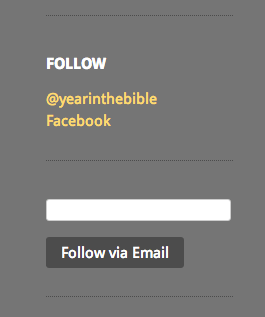
You should see something like this on the right of the site, or at the very bottom.

We already covered three elements: Read, Study, Memorize. That’s straightforward. But how can you more easily do this? I hope, since you are reading these words, that you’ve taken advantage of what is being published to the website. But did you know you could have this come to your email inbox? You can “follow” Year in the Bible and whenever a new post is published, it’ll come to you. If you’re not seeing where to do so, talk to me and I’ll help you out. (Or you can send me your email–I think I can manually add you in).

You could also do something similar by either ‘liking’ Year in the Bible on facebook at facebook.com/yearinthebible or if you use Twitter, follow Year in the Bible there at @YearintheBible. Both of those are updated with all the new posts.

Commenting

You can also comment on any of these posts. I can then follow up if something wasn’t clear or you have a further question. Someone else can follow up, too. The Spirit speaks through more than just one person and we can interact in the expected places like a Bible study at a church, but we can also do so on a website or through facebook comments.

If posting a comment publicly isn’t something you’d like to do, please email me. Many posts in the past have been in response to people emailing me questions or pointing out something that has been helpful to them.

Quick recap: follow the Year in the Bible program either by email, facebook, or twitter and comment on the articles. I think these will help us engage with one another and that will be an encouragement for us all.

Bonus

Here’s a quick list of some other things to do:

  • Make the memory verse your lock screen on your smart phone. This has helped me quite a bit.
  • Put the memory verse on your dash board. Again, that’s helped me out.
  • Read the Bible passage in different versions. When you see differences between translations that can be a great place to dig in and find out why (or ask me why) the versions went in different directions.
  • If you’re doing it alone, invite a friend to do it with you. This is not an intimidating reading plan so it could work great for someone’s first real Bible study. Find someone in your neighborhood. And it is certainly not too late to start. We’ve read a chapter so far!

Do you have any of your own tips? If so, share. We’d all love to hear.
Year in the Bible Begins Today (and I’m already finished?)

Welcome to day one of the new Year in the Bible!

I hope you are even half as excited as I am to begin a new reading plan together and to uncover what God has in store for us as we read and study 1 Corinthians. I’ve tried to answer the questions you may have as we prepared for today, but I’ve got one more that may come now that you’ve had time to read.

I can imagine a few people picking up their Bible, looking up what the reading assignment is for this week, sitting down and then in a few minutes asking, “What now?” What do you do for the rest of your week when you finish the text so quickly?

Here are some simple suggestions:

  • Read it again. That’s a simple one, right?
  • Write down your reflections and/or questions.
  • Find someone to share those reflections with.
  • Rewrite the text in your own words or summarize the text.
  • If you have some sort of study Bible, take a look in the margins for cross references and do some Biblical exploration for other passages that may expand on ideas from this text.
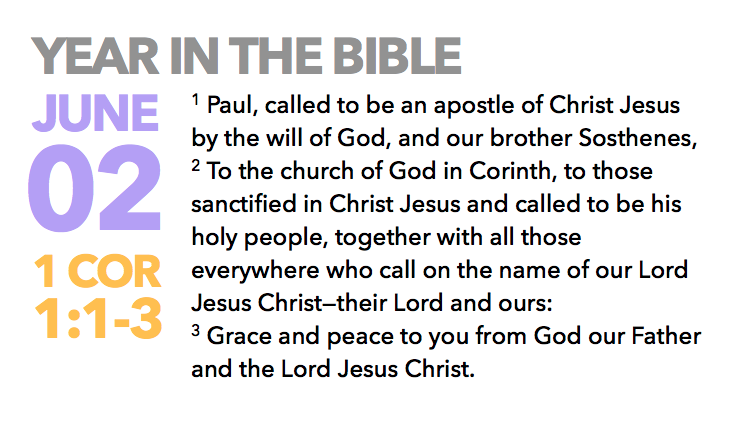
  • Memorization – this week I’m encouraging you to memorize 1 Corinthians 1:1-3, Paul’s intro. (They won’t all be this long.)

It is far too easy to read something and let it quickly pass through you. What we want to do is read in such a way that God’s word permeates our minds and rests in our hearts. That’s why we’re going slow. So when you finish early, know that it is an intentional choice to give you more time to devote yourself to learning 1 Corinthians.

Week 1 Memory Verse 1 Cor 1.1-3

Habits of Highly Ineffectual Bible Study

It’s been a little while since I’ve posted some Bible study tips for you, so I thought I’d share this article I came across from The Gospel Coalition by Jen Wilkin. It warns against some of the misguided ways in which we approach God’s Word, such as the “Magic 8 Ball Approach”:

You remember the Magic 8 Ball—it answered your most difficult questions as a child. But you’re an adult now and wondering if you should marry Bob, get a new job, or change your hair color. You give your Bible a vigorous shake and open it to a random page. Placing your finger blindly on a verse, you then read it to see if “signs point to yes.

I’d recommend giving it all a read. She has some great points, and the only caveat I’d add is that I wouldn’t phrase the ending the same way. It is easy to break issues into false dichotomies or react against one problem by pushing too far in the other direction. She defines a disciple as “primarily” a learner, which I think is jut as problematic as “primarily” a doer. We are followers of Jesus, and that consists of learning at his feet AND doing as he commanded.

Week four begins today

We are now finished with two longer books of the bible, Genesis and John. So this week begins two new books, Exodus, featuring Moses, and Luke, which like John features Jesus primarily. But new to the mix is a third reading, and that is taken from the poetry of the Psalms.

I hope you enjoy these books and are open to what God will speak to you through his words.

Click on This Week for more information and to find the focus passage for this week.