The Forest from the Trees

We have had some great Bible study during our most recent church-wide study, most of which focused on short passages or individual verses. When you do so you can take great time to linger in that passage and pour over every detail. But that shouldn’t be the only method of study.

When we take the Bible a tiny chunk here or a verse there, we can at times miss the greater context of the passage. We need to be able to see the forest from the trees. We will better understand the flood by reading about creation. We better understand the building drama and tension of John when we read it start to finish.

Friend of our church, Dusty Ellington, posted some tips about reading the Bible that I would encourage you to take a look at, and his first step is this:

Read through the book in its entirety, seeking to understand it as a whole and trying to follow the line of thought. As you read the whole book, be aware if you see things you haven’t noticed before or if you recognize parts that may not have been emphasized in your prior exposure to the book. Also, does reading the whole give you have a sense of the basic structure of the book?

It is a good reminder to couple slow, meditative reading of small selections with the sort of reading that helps us to build up the big picture of each book and the big picture of God’s love for us.

Going Back Again

Sometimes when I would go hiking in college with friends, we’d figure out a new trail to try out. I lived in the Shenandoah Valley and regardless of which direction we set out, there were beautiful mountains and forests to welcome us and always new paths we could find. But often we would go back to the same spots and same trails. We’d been there before and knew it was a great climb or a great view. Having gone through it once never meant we were finished with it. Having the familiarity actually helped in some ways since we were less concerned about losing the trail and making the correct turns and instead focused on conversation or the beauty of creation. We knew the stunning vistas that awaited and that built up the anticipation.

When we’d return to well-worn paths the trails were not always the same as we remembered. If the path took us up to see a cascade in the fall, as the colors were changing and the air smelled like dying leaves, when we came back in winter it was new. It was the same trail, but the water had halted its violent path down the mountain, and it was frozen and smooth. The leaves were gone so the sky opened up above us. It was the same trail but it offered something entirely new for those who would journey back again. You can’t use a mountain stream as a slip n’ slide in the fall.

Even if I went with different friends the experiences would change dramatically. The perspectives were different, the conversation changed, the pace may be slower.
If we slow down our pace in all things, I think we will be open to see the subtle differences in life that bring freshness to our experience. I chose Genesis and John to begin our reading because for many these are familiar passages. They are paths which have already been walked. But let that be a joy, not a chore. We are not the same people as we were when we first read. Our circumstances are not the same. Our companions through this journey may be entirely different. What new thing is God showing you as you read? How are you experiencing the Bible as a living Word, not stale and old, but dynamic and fresh?

Feel free to share below in the comments.

About Focus Passages and Small Groups

To go along with the readings, each week there is a focus passage that will be highlighted in the This Week section of the site. We’ll have time during the Reading Groups to talk about whatever has been assigned for the week, but we will make sure to spend time on the Focus Passage as well.

Small groups are able to use these as handouts for their groups, if you would like. You may prefer something more like a workbook for your meetings, but if your group or some of your group are reading along, this may work well.

I’ve put up the first three weeks if you want to see what the future holds. Here they are:

Week 1 Focus Passage John 3

Week 2 Focus Passage Genesis 22

Week 3 Focus Passage John 20.

One more note about how to best coordinate your reading with a small group. Take my group as an example. We decided we want to do this Year in the Bible together and use the Focus Passage handouts. But our group meets at 7am on Tuesday morning, which doesn’t afford us much time to have read the rest of the Scripture for that week. So what we have decided is that when we meet, we’ll go over the readings that go along with the previous week. If your group meets later in the week, you may find it works to keep in sync with the current week’s assignment.

As always, if you have questions about this or any other detail, let me know. It may be a great question that others have as well, and I’ll then post the answer here to share with everyone.

In the beginning

“In the beginning…”

This is how both of our readings for this week begin. Genesis is the account of creation, John is the account of Jesus. But these accounts are not too different. In the beginning God created heaven and earth, and Jesus Christ, the Word of God, was there for that beginning. Christ is before all beginnings, he was with God, and he is God.

John is a book that presents the case that Jesus is truly divine. That he is one with the Father. John makes his reader decide on this fact. It is unavoidable in his gospel. Do I believe Jesus? Who he says he is, where he has come from? Or don’t I? To John, this is the question the must be answered.

If we believe John’s account, that Jesus was there in the beginning and that all things have been created through him, how can we read Genesis the same way? Or for that matter, how can we interpret the Old Testament in any way that ignores Jesus? Jesus Christ is the Son of God who is eternal. There was never a time he was not.

So in the beginning of Genesis, there is God creating all things. But it is God the Father, the Son, and the Holy Spirit. Let that truth help inform your reading and understanding of all of God’s Word. In the beginning, as God created this world, he already had in mind that he would come and live among us. God knew, before creation, that he would come and die for us. Knowing that, knowing the pain and sacrifice that was certain, God created the heavens and the earth–and everything in it. God did so because he loves us, and he loves us at all costs.

Read John to discover that cost, the cross. Read Genesis to see the way God governs all things, even so long ago, to lead to the cross and bring humanity back to himself through that sacrifice.

And so it begins… tomorrow

Tomorrow is March 25th, and what does that mean? It means it is the first day of the “Year in the Bible” year. Some folks may say resolutions are to be made January 1. But let’s ignore those people, people like Dick Clark and Ryan Seacrest. January 1 is in the midst of holidays and travel, and how often to we have the time to make such serious commitments and decisions then?

The beginning of Spring seems like a perfect time to make a resolution.

So for your consideration, make this year, from March 25th, 2012 to March 24th, 2013, a year to be in God’s Word. To abide in it, to listen to God, to seek out Jesus Christ. Be resolved to do something important–read the Bible, the whole Bible.

Through Spring, Summer, Fall, and Winter, join with us as we break down the Scripture into quarters. Find someone to read with, get involved with a small group or a reading group, and let God reveal himself to you in his Word.

(And just so you know, if you don’t jump in right away, anytime is a good time to pick up your Bible and join in right where we are in the process!)

Having a Bible in your Pocket (or Purse)

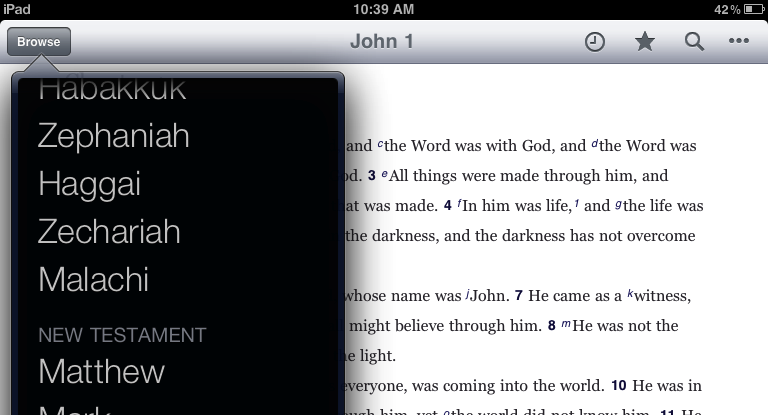
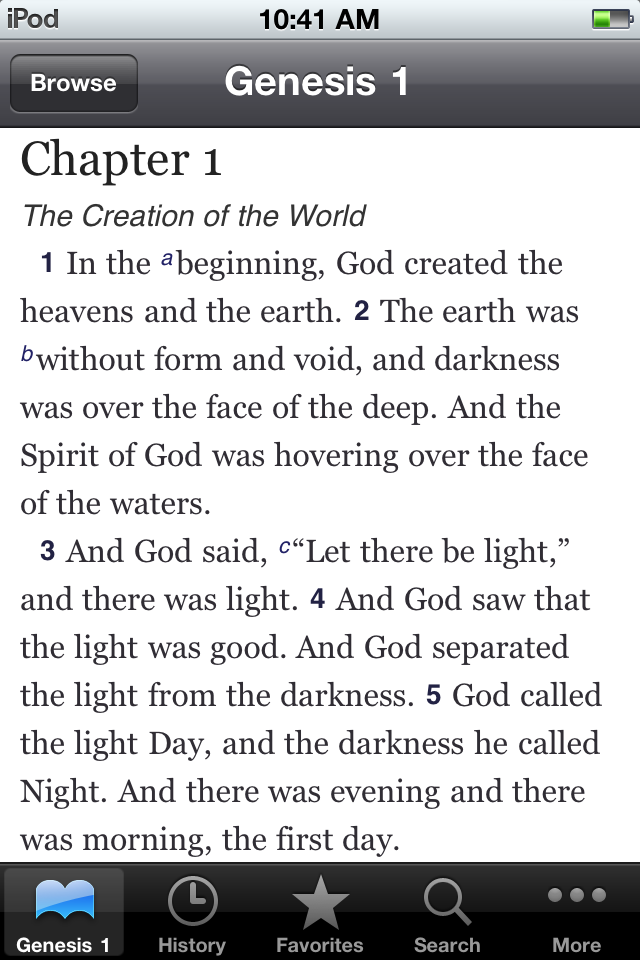
I heard some questions about using apps on smarthphones and iPads. I think they are great since you’ve already got them with you, so you’re never without the Bible. And a big plus is that they are searchable. I have some Scripture committed to memory and a bit more that isn’t quite memorized, but I know where to find it. But there are plenty of times when I have an idea of what I’m looking for and just can’t remember where to look, and that’s when searching comes into play.

Bible apps, like Bible websites, allow you to find that passage you’re looking for or to do a word search and see all the places in the Bible where a word shows up. Want to know every time Abraham is mentioned? Search. Reading a passage and can’t remember who Eli is, search for the first time he comes up in Samuel.

So, if you haven’t taken advantage of these apps, here are a few (free) suggestions:

For iPhone, iPod Touch, iPad:

As mentioned, the version I like, and this has a great interface that makes it especially easy to browse between books of the Bible. It’ll show you the cross-references and notes, as well.

You can download several different translations from this app for offline use.

For Android:

No personal experience with this, so I’d appreciate any feedback about this app or other suggestions.

Which translation is for me?

It is amazing to live at a time when we actually have choices as to which translation of the Bible we should read. For so long the person in the pew couldn’t have their own copy, and even if they did it would have been in a foreign language.

Now we have so many versions at our finger tips it can be hard to make a choice. Zondervan, who publishes lots of Bibles, put together a helpful chart to describe the differences and philosophies behind the more common translations. Zondervan publishes the NIV, so it gets top billing. I typically read from the English Standard Version (ESV), which is a bit more literal. I lean this direction because these sorts of translations try to stick closer to the original and refrain from making a decision on a translation that would shut out other interpretations. On the other end of the spectrum, the thought-for-thought style Bibles, those translations help communicate the text by paraphrasing the original for you. This can be helpful to present a very readable style that can even refresh some of the more familiar texts, but they may obscure or lose certain meanings in the text.

With so many tools online to read and compare versions, you don’t need to make some lifetime decision to stick with just one. Reading multiple translations can be a great way to better understand God’s Word. I bring this up in preparation for the Year in the Bible because I wanted to have a physical edition that I use for my daily readings. This Bible will serve almost like a journal to record the process–notes in the margins, underlines, and other squiggles. I look forward to the day, a year or so from now, when I can compare the way my Bible will look compared to its current “mint” condition.

Translation Chart (pdf)