A Fill in the Blank Review of 1 Corinthians

A good way to look back and review our readings is with our memory verses. I’d encourage you to reread the previous sections as much as you can as we work our way through 1 Corinthians, but these short verses can be a fine short cut.

If you haven’t memorized it, but have glanced as the visualizations and read through a few times, you may know more than you realize.

I’m going to put the verses below, but missing about half of the words. See how you do and if you’re able to fill in the blanks. I’ll leave it up to you to find your Bible and check your answers!

Week 1: 1 Corinthians 1:1-3

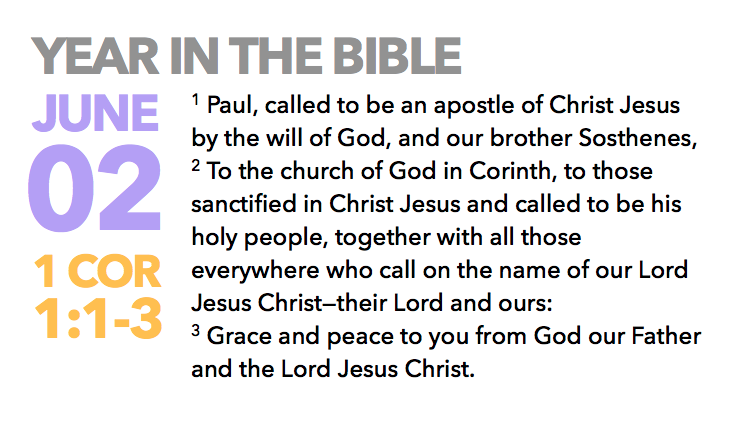
1 ________, called by the ________ ________ ________ to be an ________ of Christ Jesus, and our brother ________,
2 To the ________ of ________ that is in ________, to those ________ in Christ ________, called to be ________ together with ________ ________ who in every ________ ________ upon the name of ________ ________ ________ ________, both ________ ________ and ours:
3 ________ to you and ________ from ________ ________ ________ and the ________ ________ ________.

Week 2: 1 Corinthians 1:22-23

22 _______ demand ________ and ________ seek ________,
23 But we ________ ________ ________,
A ________ ________ to the ________ and ________ to the ________.

Week 3: 1 Corinthians 2:12

Now we have ________ not the ________ of the ________,
but ________ ________ who is from ________,
that we might ________ the ________ freely ________ us by ________.

Week 4: 1 Corinthians 3:6
I ________, Apollos ________, but God ________ ________ ________.


How’d you do?

If You Look at Your Phone 150 Times a Day, You Might as Well Make Good Use of It

Make this your "lock screen" on your phone and you'll be memorizing in no time!
Make this your “lock screen” on your phone and you’ll be memorizing in no time!

I heard on the radio yesterday that the average person looks at their phone 150 times a day. I heard it on the radio, and then I also was able to find it on the internet–so it must be true! Even if your own results may vary, I’m sure you are checking it many times every day. You check it for the time, for emails, for news, and of course, to make phone calls.

In hearing this little statistic I was given more reason to do something useful with my screen. I have already made Bible visualizations for your smartphone, but now I’m really thinking this can be a great way to memorize. Even if it is just a glance, 150 times a day is a lot. Do it for seven days a week, for each of our verses. That’ll add up quick.

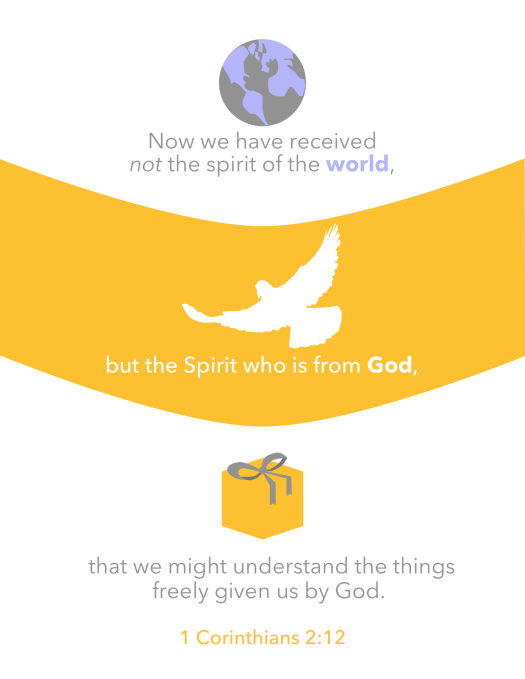
These visualizations have more than words, so maybe when you quickly glance at this week’s image when you want to see if you’re running late, you may not read all the words. But you will see, again and again and again, a picture of the earth, a dove, and a gift. That alone helps us to remember the three points in this verse: that we don’t receive the spirit of the world, we receive the Holy Spirit, who helps us receive what is given by God. Imagine seeing that picture 150 times a day, over a thousand times a week. You’ll remember something of it for a long time.

Getting the Most Out of Your Year in the Bible Experience, Part 2

So I’ve already covered the basics of Year in the Bible in an earlier post, but I wanted to give you a few more tips.

Following

You should see something like this on the right of the site, or at the very bottom.

We already covered three elements: Read, Study, Memorize. That’s straightforward. But how can you more easily do this? I hope, since you are reading these words, that you’ve taken advantage of what is being published to the website. But did you know you could have this come to your email inbox? You can “follow” Year in the Bible and whenever a new post is published, it’ll come to you. If you’re not seeing where to do so, talk to me and I’ll help you out. (Or you can send me your email–I think I can manually add you in).

You could also do something similar by either ‘liking’ Year in the Bible on facebook at facebook.com/yearinthebible or if you use Twitter, follow Year in the Bible there at @YearintheBible. Both of those are updated with all the new posts.

Commenting

You can also comment on any of these posts. I can then follow up if something wasn’t clear or you have a further question. Someone else can follow up, too. The Spirit speaks through more than just one person and we can interact in the expected places like a Bible study at a church, but we can also do so on a website or through facebook comments.

If posting a comment publicly isn’t something you’d like to do, please email me. Many posts in the past have been in response to people emailing me questions or pointing out something that has been helpful to them.

Quick recap: follow the Year in the Bible program either by email, facebook, or twitter and comment on the articles. I think these will help us engage with one another and that will be an encouragement for us all.

Bonus

Here’s a quick list of some other things to do:

  • Make the memory verse your lock screen on your smart phone. This has helped me quite a bit.
  • Put the memory verse on your dash board. Again, that’s helped me out.
  • Read the Bible passage in different versions. When you see differences between translations that can be a great place to dig in and find out why (or ask me why) the versions went in different directions.
  • If you’re doing it alone, invite a friend to do it with you. This is not an intimidating reading plan so it could work great for someone’s first real Bible study. Find someone in your neighborhood. And it is certainly not too late to start. We’ve read a chapter so far!

Do you have any of your own tips? If so, share. We’d all love to hear.

Looking Back on Chapter 1 and Preparing for Chapter 2 of 1 Corinthians

As we close the first chapter and begin the second, it is important to take account of what we’ve read. A goal of reading the way we are is to really get a sense of the whole of the letter. What is Paul saying start to finish?

You could go back and review any highlights or underlines. As you read you can jot down short summaries in the margins. At least, if your Bible has them, review the section headings–I hope those will remind you of what is in them.

I thought I’d provide a few short questions to review. See if what you are reading is being retained and understood. If so, fantastic! If not, maybe slow down or read it a few more times this week.

Who is it from?
And the answer is more than Paul.

Who is it to?
And the answer is more than the Corinthians.

What was going well in the church?
And who is really responsible for that?

What was going wrong in the church?
And who really deserves the church’s loyalty?

What does Paul preach?
And how might the world react to it?

Now in chapter two, read it with an eye toward retention. Read it knowing that we’re not just checking off a "to-do" list, but we are approaching God in his word to us. By the Spirit we are blessed with understanding. Read it knowing that God has something to say and it is worth remembering.

And if you want to remember just one thing, our memory verse this week is 1 Corinthians 2:12:

Now we have received not the spirit of the world
but the Spirit who is from God,
that we might understand the things freely given by God.

Again, I know memorization is hard and if you are like me, you are out of practice, so here again is a visualization to help you remember it:

1 Corinthians 2:12

Here is a size for your iPhone, to make it your background.

And don’t forget the Bible study, which we cover on Wednesday night at 6pm at the church, or look at it with a friend or on your own. You can find it here.

Getting the Most Out of Your Year in the Bible Experience

I wanted to put together something to help you get the most out of your experience with Year in the Bible, and as I was working on it, I concluded it was best to split it into multiple parts. So today: the basics.

As you know this is a guided reading plan that will slowly take us through 1 Corinthians. That being the case there are three things to do each week: read, study, memorize.

Read

  • I expect you to read the weekly scripture. If you take part in a reading plan, of course you read, right?

Study

  • I encourage you to study. This text is so short and it is designed so that you have the time to read, and re-read, studying the Bible, asking questions and seeking answers. To study is to approach it in prayer, not just approach it as something to quickly finish and check off as done.

Memorize

  • I recommend you memorize the weekly verses. This is not a requirement. But it is going to make this experience all the more impactful as you store God’s word in your heart.

Again, at minimum, read. But the further steps you take the more God will work in you. If you’re on the fence about memorizing, read this article that lifts it up as a great spiritual discipline, including this quote:

Bible memorization is absolutely fundamental to spiritual formation. If I had to choose between all the disciplines of the spiritual life, I would choose Bible memorization, because it is a fundamental way of filling our minds with what it needs.
Dallas Willard

Desiring God: Memorizing Scripture – Why and How

Year in the Bible Begins Today (and I’m already finished?)

Welcome to day one of the new Year in the Bible!

I hope you are even half as excited as I am to begin a new reading plan together and to uncover what God has in store for us as we read and study 1 Corinthians. I’ve tried to answer the questions you may have as we prepared for today, but I’ve got one more that may come now that you’ve had time to read.

I can imagine a few people picking up their Bible, looking up what the reading assignment is for this week, sitting down and then in a few minutes asking, “What now?” What do you do for the rest of your week when you finish the text so quickly?

Here are some simple suggestions:

  • Read it again. That’s a simple one, right?
  • Write down your reflections and/or questions.
  • Find someone to share those reflections with.
  • Rewrite the text in your own words or summarize the text.
  • If you have some sort of study Bible, take a look in the margins for cross references and do some Biblical exploration for other passages that may expand on ideas from this text.
  • Memorization – this week I’m encouraging you to memorize 1 Corinthians 1:1-3, Paul’s intro. (They won’t all be this long.)

It is far too easy to read something and let it quickly pass through you. What we want to do is read in such a way that God’s word permeates our minds and rests in our hearts. That’s why we’re going slow. So when you finish early, know that it is an intentional choice to give you more time to devote yourself to learning 1 Corinthians.

Week 1 Memory Verse 1 Cor 1.1-3

About the Bible Studies

Even though we are already slowing down as compared to our last reading plan, it is no reason to get rid of the Bible studies we had in what were called “focus passages.” When we read 25 chapters I didn’t want us to miss out on the slow, meditative sort of reading that allows us to prayerfully go through Scripture. When we do so we allow God to confront us with challenges and questions, we can better see and gain comfort in his Word, and we can take the time to ask our own questions. Even better we can do so with others.

On Wednesdays we’ll have a Bible study at 6pm at our church. Anyone is welcome. We’ll take time to talk about anything of interest that came up and we’ll also use the Bible study handouts to guide our discussion. Small groups also have used these handouts to study the Bible. Whether at the Wednesday group or a small group, I believe studying with others is the best way. I’d encourage you to at least find a friend (or make a new friend!) to read with you. Ask your spouse, invite your neighbor, get a co-worker to meet with you at lunch. Find a way to let the Spirit speak through others. I know for me, I never leave a time spent gathered around the Bible with another without having benefited.

Anyone can read through 1 Corinthians in five months. Most could find time to do it today. But we don’t want to read it just to do it. We want to read it to understand what God wants us to know and to be shaped by the Spirit as we study his Word. Bible study is key to this.

Here is the first week’s study to take a look at. Again, we’ll study this together this Wednesday at 6pm. But I am just as happy if you find a friend or get a small group together to study Scripture.

Week 1 – 1 Corinthians 1:1-17

Our 1 Corinthians Bible Reading Plan in a convenient bookmark

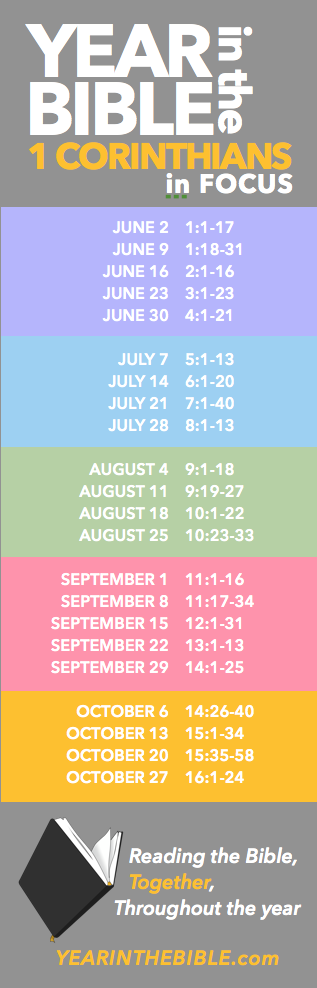
Even though we won’t be flipping all over the Bible, it is still nice to keep a bookmark so you won’t lose your place in 1 Corinthians. But I also don’t want you to lose your place in the ongoing reading plan, so I’ve made a bookmark for you to slide in your Bible and keep track of what we’re doing each week.

I’ve included a letter-sized .pdf to print out if you’d like–that way you get the sizing right. Although if you’re coming to church this Sunday you will find one slipped into the bulletin. I hope this helps you spend more time reading and in prayer, and less time flipping through papers or checking the website to find that week’s assignment.

Bookmark Letter Sized for Printing

1 Corinthians Reading Plan Bookmark for Web